
Uncovering perfume prices: What makes fragrance cost vary?
TL;DR:
- Perfume prices vary due to concentration, production scale, and ingredient sourcing. Higher concentrations like Parfum cost more because of expensive raw materials and longer-lasting formulas. Sampling through decants and discovery sets offers a cost-effective way to explore luxury scents before purchasing full bottles.
Perfume pricing confuses even experienced fragrance buyers. You see two bottles on a counter, both elegant, both from respected houses, and one costs three times more than the other. The assumption is usually branding. But brand name is rarely the whole story. Fragrance concentration, production scale, ingredient sourcing, and retail markups all play significant roles in what you pay. Understanding these factors helps you make smarter buying decisions, whether you are eyeing a designer classic or a rare niche creation. This article breaks down exactly where your money goes and how to access luxury scents without overspending.
Table of Contents
- Understanding fragrance concentration and its impact on pricing
- Production scale: Niche vs designer perfume pricing
- Ingredients, craftsmanship and marketing: Where your money goes
- Retail markups and affordable options for enthusiasts
- The surprising truth about price versus performance
- Explore luxury and niche scents affordably with decants
- Frequently asked questions
Key Takeaways
| Point | Details |
|---|---|
| Fragrance concentration matters most | The percentage of aromatic compounds in a perfume has the greatest effect on cost and longevity. |
| Production scale alters price | Niche perfumes cost more due to small batches, higher ingredient and craftsmanship expenses, while designer scents benefit from economy of scale. |
| Marketing and retail inflate costs | Designer brands spend heavily on marketing, and department stores add high markups, making retail prices greater than actual ingredient value. |
| Sampling is affordable and smart | Discovery sets and decants allow buyers to test luxury scents without full commitment, often at cost price to brands. |
| Quality doesn’t always equal price | Expensive perfumes aren’t always better—testing on skin is key to finding your ideal scent. |
Understanding fragrance concentration and its impact on pricing
The first thing to understand is what is actually inside the bottle. Every perfume is a mixture of aromatic compounds dissolved in alcohol and water. The percentage of those aromatic compounds determines the fragrance category, and that category directly influences both the price and how long the scent lasts on your skin.
Here is a quick breakdown of the main concentration types:
| Concentration type | Aromatic compound % | Typical longevity | Relative price |
|---|---|---|---|
| Parfum (Extrait) | 20–40% | 8–12 hours | Highest |
| Eau de Parfum (EDP) | 15–20% | 6–8 hours | High |
| Eau de Toilette (EDT) | 5–15% | 3–5 hours | Mid-range |
| Eau de Cologne (EDC) | 2–5% | 2–3 hours | Lower |
| Eau Fraîche | 1–3% | 1–2 hours | Lowest |
Perfume prices vary primarily due to differences in fragrance concentration, with Parfum containing 20–40% aromatic compounds costing significantly more than Eau de Toilette at 5–15%, because higher aromatic content directly increases production costs and longevity. This is not just a marketing tier. It is a real cost difference based on raw material usage.
When you buy an Extrait de Parfum, you are paying for a much higher volume of often expensive raw materials. Naturals like Bulgarian rose, oud, and ambergris cost thousands per kilogram. The more concentrated the fragrance, the more of these costly materials go into each bottle. That is why a 50ml Parfum can cost twice as much as a 50ml Eau de Toilette from the same fragrance house, even though the bottle looks identical.
For buyers, this matters practically. An EDT may seem like the affordable choice, but if you need to reapply it three times a day, the cost per wear can exceed that of a longer-lasting EDP or Parfum. Understanding choosing scent strength before purchasing can save money over time.
Key considerations for buyers choosing by concentration:
- Parfum suits those who want all-day wear from one application, justifying the higher upfront cost
- Eau de Parfum is the most versatile option, balancing longevity and price for most buyers
- Eau de Toilette works well for lighter, seasonal wear and is easier to layer
- Eau de Cologne is best for quick refresh rather than a full fragrance experience
Understanding perfume performance factors goes beyond concentration alone. Skin type, humidity, and even diet affect how a fragrance performs, which means the same product can behave very differently from one person to the next.
Pro Tip: Before investing in a full bottle at any concentration level, test a sample or decant of the exact version you intend to buy. A 2ml or 5ml decant lets you assess real-world longevity on your own skin without committing to a £150 or £300 bottle.
With concentration in mind, let us move to production scale and how niche versus designer houses approach cost differently.
Production scale: Niche vs designer perfume pricing
Production scale is one of the most significant but least discussed reasons why perfume prices differ so dramatically between categories. Designer houses like Chanel, Dior, and Giorgio Armani produce fragrances in enormous volumes, sometimes millions of bottles annually. Niche houses, by contrast, may produce only a few thousand bottles of a particular scent per year.
Mass-produced designer perfumes benefit from economies of scale, while small-batch niche perfumes carry higher per-unit costs simply due to the smaller volume of production. When you manufacture at scale, every element of the process becomes cheaper per unit. Ingredients are bought in bulk at lower prices. Machinery runs continuously, reducing per-bottle labour costs. Packaging, whether glass or printed materials, is negotiated at volume discounts.
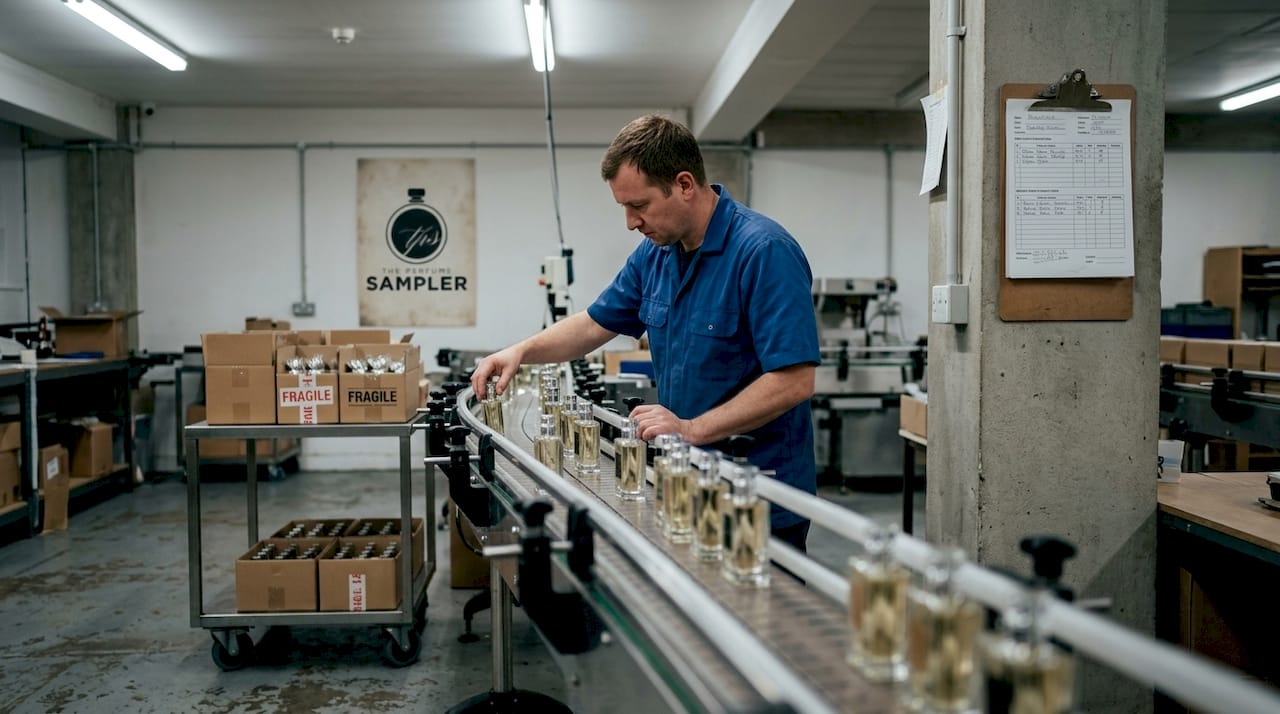
Niche perfumers do not have that luxury. A small French atelier producing 2,000 bottles of a single scent cannot negotiate the same raw material pricing as a conglomerate purchasing ingredients for 2 million bottles. Every cost is proportionally higher.
Here is a simplified comparison of how production scale affects retail pricing:
| Factor | Designer perfume | Niche perfume |
|---|---|---|
| Annual production volume | Hundreds of thousands to millions | Hundreds to thousands |
| Ingredient sourcing cost | Lower (bulk purchasing) | Higher (small quantities) |
| Packaging complexity | Standardised, efficient | Often bespoke, artisanal |
| Typical retail price range | £30–£200 | £100–£800+ |
| Concentration range | EDT to EDP (primarily) | EDP to Parfum (primarily) |
The production process for niche fragrances typically involves these stages, each adding proportional cost at lower volume:
- Concept and development: Niche perfumers often spend months or years developing a single formula, with no guarantee of mass-market success to amortise that cost
- Ingredient sourcing: Rare naturals, often single-origin, are sourced in small quantities at premium prices
- Blending and testing: Small-batch blending requires skilled labour and quality checks at every stage
- Bottling: Lower volume runs on bottling lines increase per-unit mechanical costs
- Packaging and presentation: Bespoke bottles and artisan packaging are produced in limited quantities, making each unit more expensive
“When you pay for a niche perfume, you are not just paying for what is inside the bottle. You are funding the labour of a skilled perfumer, the sourcing of often irreplaceable ingredients, and the cost of producing a very small number of units to a very high standard.”
Understanding luxury perfume pricing factors gives buyers a realistic picture of where that cost originates. It also explains why niche perfume discovery is so valuable. Sampling before buying at full niche prices is not just sensible. It is practically essential.
Once production is considered, the next key layer is how ingredients, craftsmanship, and marketing influence the final retail cost.
Ingredients, craftsmanship and marketing: Where your money goes
Knowing the production volume helps, but understanding how the final retail price is actually allocated is even more illuminating. For fragrance enthusiasts deciding between niche and designer, the internal cost breakdown tells a different story from what most assume.
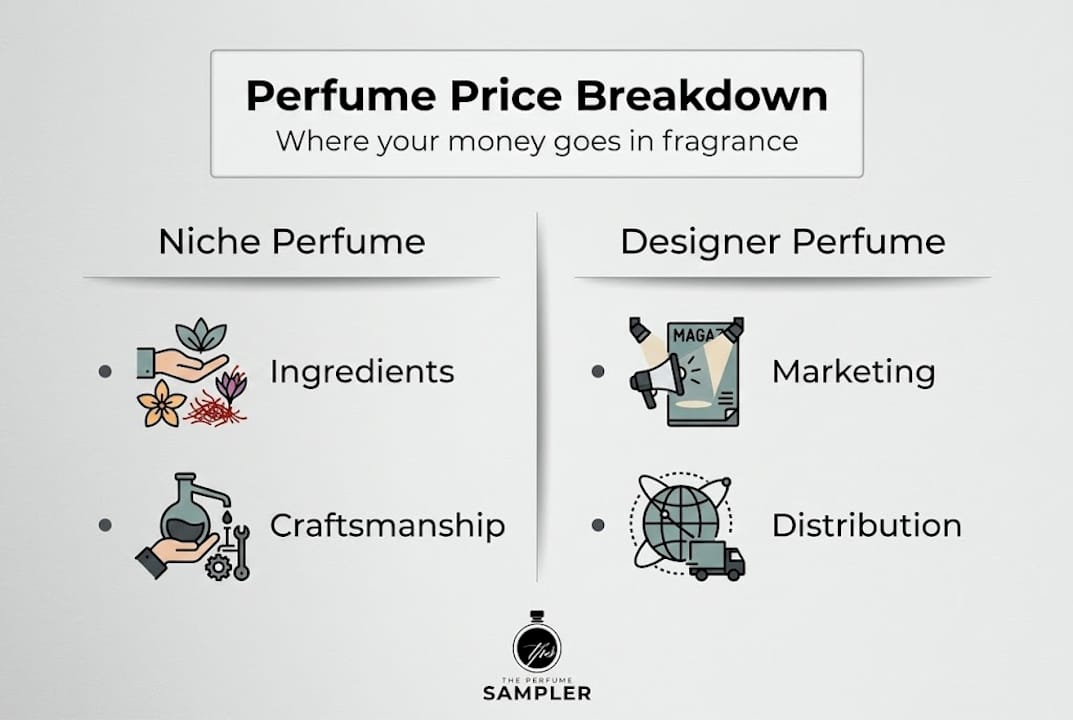
Niche perfumes allocate 35–45% of their price to ingredients and craftsmanship, with only 10–20% spent on marketing. Designer perfumes, by contrast, spend 40–50% of their retail price on marketing alone, often including celebrity endorsements, global advertising campaigns, and prime retail positioning. Niche houses frequently price their bottles at €200–800 or more, driven by rare ingredient usage and higher concentrations of 15–30%.
| Cost element | Niche perfume (% of retail price) | Designer perfume (% of retail price) |
|---|---|---|
| Raw ingredients | 35–45% | 15–25% |
| Craftsmanship and labour | 10–15% | 5–10% |
| Packaging | 8–12% | 10–15% |
| Marketing and advertising | 10–20% | 40–50% |
| Retail margin and distribution | 15–25% | 15–25% |
This allocation reveals something important. A £150 designer perfume may contain a smaller proportion of high-cost ingredients than a £250 niche fragrance, yet still carry a premium retail price because of the marketing investment behind the brand. You are partly paying for the campaign, the celebrity face, and the glossy magazine placement.
Niche fragrances, conversely, invest more in the liquid itself. Ingredients like aged oud, Taif rose, and natural ambergris are extraordinarily expensive. Some raw materials used in niche perfumery cost more per kilogram than gold. When a niche bottle retails at £300, a significant portion of that reflects genuine material cost rather than advertising spend.
What buyers are actually paying for in each category:
- Designer fragrances: Brand heritage, marketing exposure, accessible retail presence, familiar scent profiles designed for broad appeal
- Niche fragrances: Rare ingredients, artisan expertise, unique scent architecture, limited availability, and identity-driven positioning
Exploring unique fragrance profiles in the niche space often reveals scents that simply cannot be found in designer catalogues, precisely because the economics of mass production prohibit the use of certain ingredients at scale.
After understanding costs inside the bottle, it is crucial to consider what happens at retail and distribution.
Retail markups and affordable options for enthusiasts
Even after accounting for production and ingredient costs, the retail price you see on a shelf reflects yet another significant layer of cost. Retail and distribution markups add 40–60% or more to the manufacturer’s price, with department stores applying margins of 45–60%, while direct-to-consumer channels reduce this markup but can introduce shipping costs, particularly for perfume, which is classified as a hazmat liquid.
This is not unique to perfume. Every luxury product sold through traditional retail carries these layers. But it does mean that a fragrance with a £30 manufacturing cost can legitimately retail for £80–£120 once distribution, retailer margin, and overheads are added. For niche fragrances with already higher manufacturing costs, these markups push prices even further.
Practical strategies for fragrance enthusiasts who want access to luxury scents without paying inflated retail prices include:
- Decants and samples: Purchase 2ml, 5ml, or 10ml portions of expensive fragrances at a fraction of the full bottle price
- Discovery sets: Curated collections allow you to try multiple fragrances from one house or theme affordably
- Direct-to-consumer channels: Buying directly from trusted decant providers avoids department store margins
- Fragrance communities: Online forums and communities often facilitate sample swaps and recommendations
- Off-season purchasing: Some designer fragrances see price reductions outside their launch windows
Understanding the types of fragrance samples available helps you choose the right format for your needs. A 2ml vial suits initial testing. A 10ml decant works for an extended wear trial before committing to a full bottle.
Pro Tip: Discovery sets and decants often operate at break-even or slight loss for brands and retailers, because the real goal is to convert you into a full-bottle buyer. That means the sampling tier is genuinely the best value in the entire pricing structure. Use it deliberately.
Thinking carefully about building a fragrance collection through considered sampling rather than impulse full-bottle purchases consistently saves money over time. And if you are new to evaluating fragrances critically, learning about reviewing luxury fragrances helps you assess what you are actually experiencing during a sample trial.
The surprising truth about price versus performance
Most articles on perfume pricing end with the conclusion that expensive means better. Our view is more nuanced. The reality, having considered the full picture, is that price and performance do not have a simple relationship.
Synthetics enable affordable complexity that can mimic naturals convincingly, while naturals offer superior evolution and depth over hours of wear. But higher price does not guarantee superior performance; well-formulated affordable perfumes can outperform expensive ones on skin, simply because formulation skill matters as much as ingredient cost.
There is something the industry rarely says directly. Skin chemistry determines a significant portion of how any fragrance performs. A £500 niche Parfum can smell ordinary on one person and extraordinary on another. A well-formulated £60 Eau de Toilette can perform beautifully on specific skin types. This makes sampling not just financially sensible but genuinely important from a performance standpoint.
The uncomfortable truth about investing in high-end scents is that the investment is only worthwhile if the fragrance works on you. A high price buys access to rare ingredients and skilled formulation, but it cannot guarantee your skin will carry the scent the way you experienced it in a bottle review online or on someone else’s wrist.
Experienced fragrance buyers know this. They prioritise testing. They use decants systematically. They pay attention to how a fragrance develops over four to six hours of wear on their own skin, not just the initial spray. They also know that making fragrances last longer has as much to do with application technique and skin preparation as it does with the fragrance concentration level.
The most confident fragrance buyers are not the ones who spend the most. They are the ones who sample broadly and buy deliberately.
Explore luxury and niche scents affordably with decants
Understanding why perfume prices vary is useful. Acting on that knowledge is better. The most practical approach for any fragrance enthusiast is to sample before spending significant sums on full bottles.
At The Perfume Sampler, we offer 100% authentic fragrance decants in 2ml, 3ml, 5ml, and 10ml sizes, covering both luxury niche and designer fragrances. You access the same scents found in high-end department stores, at a fraction of the cost. No commitments. No guesswork. Just genuine fragrance, in a size that suits your needs. Explore the benefits of decants and discover how sampling changes the way you build your fragrance wardrobe. We also stock full bottles for when you find the scent you want to commit to.
Frequently asked questions
Is price a reliable indicator of perfume quality?
No, price alone does not guarantee quality. Well-formulated affordable perfumes can outperform expensive ones, particularly when synthetic ingredients are used with skill. Always test on your own skin before deciding.
Why are niche perfumes more expensive than designer perfumes?
Niche perfumes allocate 35–45% of their price to ingredients and craftsmanship, using rare materials at higher concentrations of 15–30%, with far less marketing spend than designer brands, resulting in typical bottle prices of €200–800 or more.
What factors most increase perfume price at retail?
Retail and distribution markups of 40–60% or more are the largest single inflating factor at the point of purchase, with department stores applying margins of 45–60% on top of manufacturer pricing.
How can fragrance enthusiasts sample luxury perfumes without buying full bottles?
Discovery sets and decants are the most cost-effective approach, and 70% of niche buyers sample before committing to a full bottle. These formats often operate at break-even pricing, making them the best-value entry point into luxury fragrance.
Recommended
- Luxury perfume prices: cost factors and affordable sampling – ThePerfumeSampler
- Types of perfume notes: Unlock fragrance layers and lasting power – ThePerfumeSampler
- Defining luxury fragrances: what truly sets them apart? – ThePerfumeSampler
- How fragrances evolve: master scent profiles before you buy – ThePerfumeSampler