
Luxury perfume prices: cost factors and affordable sampling
TL;DR:
- Luxury perfumes often contain rare natural ingredients like oud and Bulgarian rose oil that significantly increase cost.
- Production methods, concentration, and small-batch artisanal processes also contribute to higher luxury fragrance prices.
- Brand storytelling, marketing, and exclusivity drive perceived value, not necessarily ingredient quality.
A bottle of luxury perfume can cost ten times more than a mainstream scent, yet the difference in what you smell is not always obvious. Many fragrance fans assume a higher price tag guarantees a superior experience. That assumption is worth questioning. The true cost of a luxury perfume is shaped by a combination of rare ingredients, artisanal production, and powerful branding. Understanding these factors helps you make smarter choices. It also opens the door to practical ways of enjoying high-end scents without spending hundreds of pounds on a single bottle.
Table of Contents
- Unravelling the ingredients: Rare materials and their impact
- Crafting the fragrance: Production and concentration costs
- The brand effect: Marketing, exclusivity, and price psychology
- Sampling luxury: Affordable trial options for enthusiasts
- Why luxury perfume prices rarely tell the whole story
- Experience luxury scents for less with ThePerfumeSampler
- Frequently asked questions
Key Takeaways
| Point | Details |
|---|---|
| Rare ingredients drive prices | Luxury perfumes use materials like oud and jasmine absolute, costing thousands per kilogram. |
| Production methods matter | Small batch, artisanal techniques and high concentrations elevate costs and exclusivity. |
| Branding boosts value | Marketing, status, and price psychology push luxury scents much higher than mainstream alternatives. |
| Sampling before buying | Discovery sets and decants let you enjoy luxury fragrance experiences at lower risk and cost. |
| Price isn’t always quality | Designer perfumes sometimes outperform niche scents; trial and reviews are crucial for finding your ideal fragrance. |
Unravelling the ingredients: Rare materials and their impact
The ingredients inside a luxury perfume are often the single biggest driver of its retail price. Unlike mainstream fragrances, which rely heavily on synthetic compounds, many high-end scents incorporate natural extracts that are extraordinarily difficult and costly to produce.
Consider some of the most prized materials in perfumery. Luxury perfumes use rare, high-cost natural ingredients like oud, jasmine absolute, Bulgarian rose oil, and orris butter. Oud, derived from infected agarwood trees, can cost over £30,000 per kilogram. Bulgarian rose oil requires roughly 3,500 kilograms of petals to produce just one kilogram of oil. Orris butter, extracted from iris roots that must be dried for up to five years, commands similarly extreme prices.
These are not minor line items. When a perfumer incorporates even a small percentage of these materials into a formula, the cost per bottle climbs rapidly. The sourcing process itself adds further expense. Ingredients are often harvested in specific regions under particular conditions, requiring specialist suppliers and careful quality control.
Here is a quick comparison of common luxury fragrance ingredients and their approximate cost per kilogram:
| Ingredient | Approximate cost per kg | Source region |
|---|---|---|
| Oud (agarwood oil) | £30,000+ | Southeast Asia, Middle East |
| Bulgarian rose oil | £4,000 to £8,000 | Bulgaria |
| Jasmine absolute | £2,500 to £5,000 | India, Egypt |
| Orris butter | £3,000 to £6,000 | Italy, Morocco |
| Synthetic musks | £10 to £50 | Laboratory produced |
Key ingredients that push luxury prices higher:
- Oud: Extremely scarce; only a small fraction of agarwood trees produce resin
- Jasmine absolute: Hand-picked at dawn to preserve scent integrity
- Bulgarian rose oil: Seasonal harvest, highly labour-intensive
- Orris butter: Multi-year drying process before extraction
- Ambergris: Rare whale-derived material, now largely replaced by synthetics
Pro Tip: Not every expensive perfume contains costly natural ingredients. Some luxury houses use advanced synthetics that mimic rare materials convincingly. A high price does not automatically confirm the presence of genuine oud or rose oil.
Crafting the fragrance: Production and concentration costs
Rarity is not the only factor. How a perfume is made matters just as much as what goes into it.
One of the most significant differences between luxury and mainstream perfumes is concentration. Eau de parfum (EdP) typically contains 15 to 20 per cent fragrance oil, while parfum or extrait can reach 25 to 30 per cent. Mainstream eau de toilette (EdT) formulations often sit between 5 and 15 per cent. A higher concentration means more costly raw materials per bottle and a longer-lasting scent on skin.
Production costs for a 50ml niche or luxury perfume bottle range from $18 to $55, with higher concentrations and artisanal methods pushing costs toward the upper end. Luxury perfumes feature small-batch production, artisanal methods, and ageing time, all of which increase the cost per unit significantly compared to mass-market alternatives.
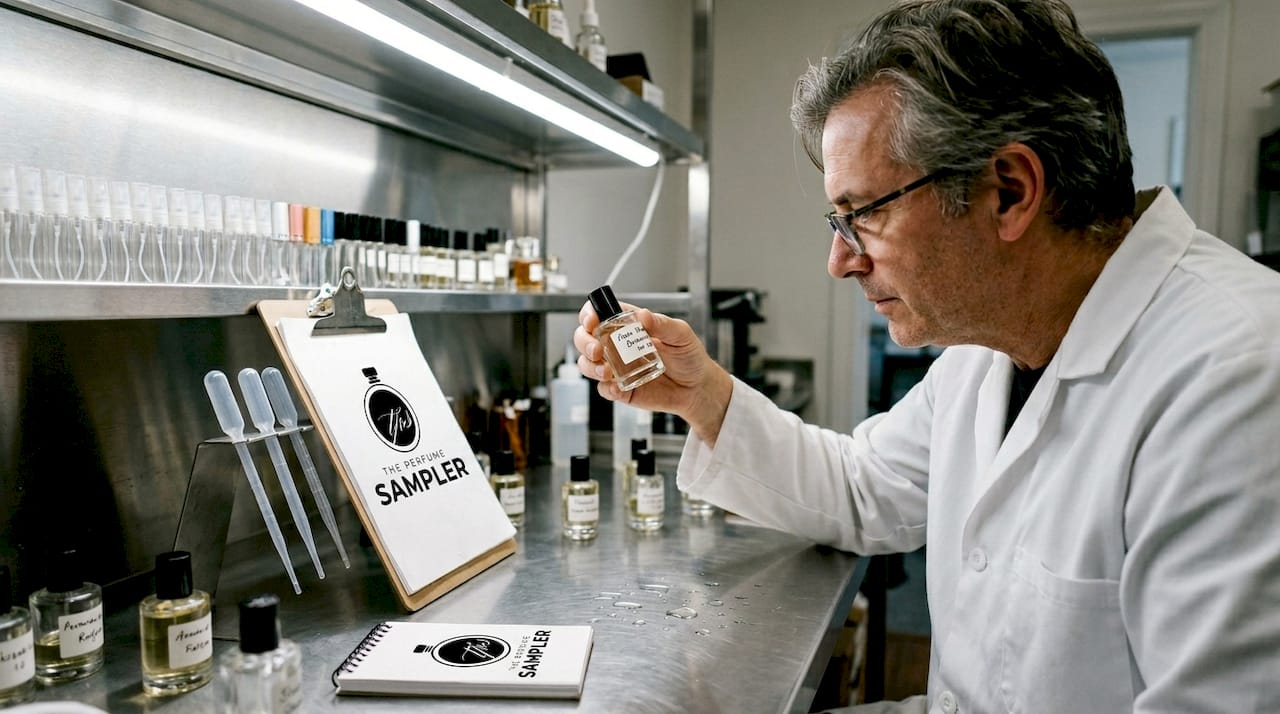
Here is how budget, luxury, and ultra-niche perfumes compare across key cost factors:
| Cost factor | Budget | Luxury | Ultra-niche |
|---|---|---|---|
| Fragrance concentration | 5 to 10% | 15 to 25% | 20 to 35% |
| Batch size | 50,000+ units | 1,000 to 5,000 units | Under 500 units |
| Production method | Automated | Semi-artisanal | Fully artisanal |
| Ageing period | None | 3 to 6 months | 6 to 24 months |
| Packaging cost per unit | £1 to £3 | £10 to £30 | £30 to £80+ |
Steps in the luxury production process and how each affects price:
- Ingredient sourcing: Specialist suppliers, often single-origin, add cost and lead time
- Formula development: Master perfumers command high fees; development can take years
- Blending: Precise, often manual blending ensures consistency
- Maceration and ageing: Allows the formula to mature, deepening complexity
- Quality control: Small batches allow rigorous testing at every stage
- Packaging: Bespoke glass, heavy caps, and luxury boxes add significant unit cost
Small batch production is a particularly important cost driver. When a brand produces only 2,000 bottles of a fragrance, fixed costs such as formula development and quality testing are spread across far fewer units. This is one reason artisan perfume methods result in higher retail prices, even when the raw ingredients are not the rarest on the market.
The brand effect: Marketing, exclusivity, and price psychology
Beyond production, the world of luxury perfume pivots on perception and exclusivity.
A significant portion of what you pay for a luxury perfume is not in the bottle at all. Branding, exclusivity, status signalling, and marketing justify premiums that go well beyond what ingredients or manufacturing alone would support. Celebrity advertising campaigns, limited edition releases, and collaborations with renowned artists all add to a fragrance’s perceived desirability.
Price psychology reinforces perceived value in the luxury sector. When a perfume is priced at £350, many consumers interpret that price as evidence of quality, even before smelling it. Scarcity amplifies this effect. Limited runs of 500 bottles or exclusive distribution through select boutiques create urgency and desire.
“The price of a luxury perfume is as much about the story it tells as the scent it delivers. Exclusivity is a feature, not a by-product.”
Factors that drive brand-related price premiums:
- Heritage and legacy: Houses like Chanel, Guerlain, and Creed trade on decades or centuries of history
- Celebrity endorsements: High-profile campaigns add millions to marketing budgets, reflected in retail prices
- Limited editions: Artificial scarcity increases perceived value and justifies higher price points
- Exclusive distribution: Selling only through select retailers or direct channels maintains prestige
- Bespoke packaging: Collector-worthy bottles and boxes reinforce the luxury narrative
Understanding luxury brand positioning helps you assess whether a fragrance’s price reflects genuine craftsmanship or primarily reflects marketing spend. Some perfumes represent excellent perfume investment value, particularly limited releases that appreciate over time. Others are priced high simply because the market allows it.
Pro Tip: Before paying a premium for a luxury name, research the house’s approach to ingredients and production. True value lies in both craftsmanship and brand story. Price alone is not a reliable guide to quality.
You can also explore exclusivity in fragrance through limited edition sampling, which lets you assess whether the scent justifies its premium before committing.
Sampling luxury: Affordable trial options for enthusiasts
For those not ready to commit to a full bottle, sampling offers a practical solution.
The risk of buying a full bottle of luxury perfume without testing it first is real. Scent is deeply personal. A fragrance that smells extraordinary on one person may not work on another due to skin chemistry, lifestyle, and personal preference. Sampling removes that risk entirely.
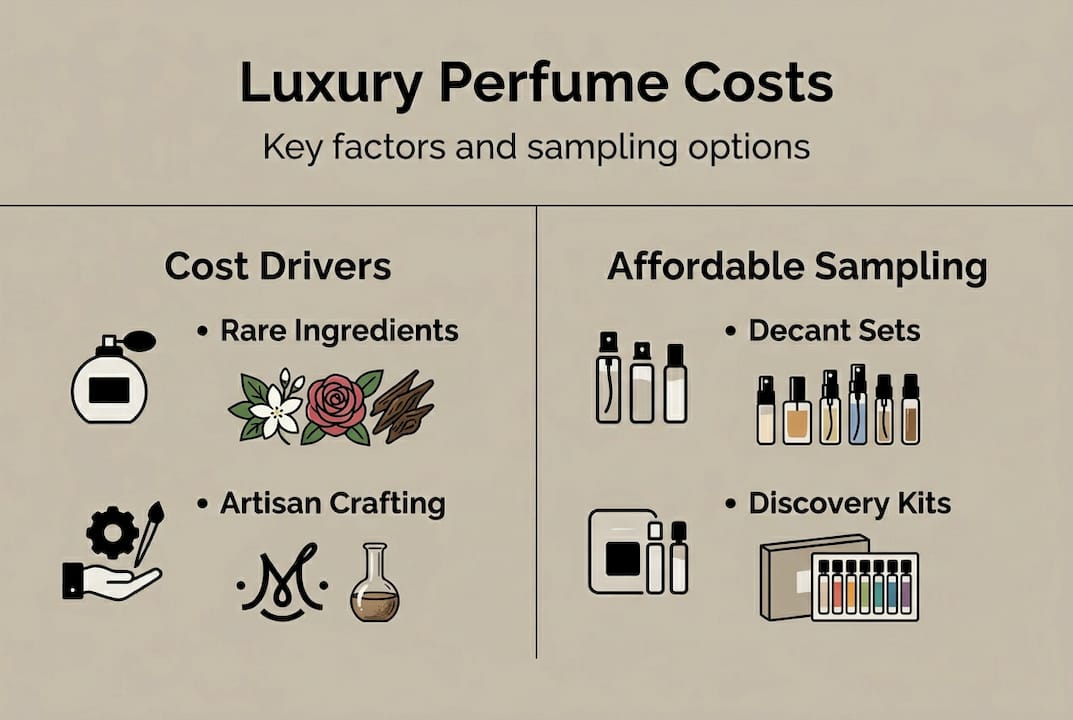
Discovery sets priced between $30 and $50 for 5 to 12 samples, decants, and brand sample programmes make it possible to explore luxury fragrances at a fraction of the full bottle cost. Some houses, such as Nicolaï, even refund the cost of a discovery set against a subsequent full bottle purchase.
Types of fragrance sample options and their typical price ranges:
- Brand discovery sets: Curated by the house; typically 1.5ml to 2ml vials; £25 to £50 for 5 to 12 scents
- Third-party decants: Poured from full bottles by specialist retailers; available in 2ml, 3ml, 5ml, and 10ml sizes; very cost-effective per ml
- Retailer sample programmes: Some department stores offer complimentary samples on request
- Subscription sampling services: Monthly curated boxes; good for broad exploration
- Single decants: Ideal for testing one specific fragrance before buying a full bottle
Exploring niche scent sampling is particularly valuable for niche houses, where the investment in a full bottle is often substantial. Sampling lets you wear a fragrance across different occasions and seasons before deciding whether it is worth the full price.
If you are new to high-end fragrances, designer scent samples from well-known houses are an excellent starting point. They offer recognisable quality benchmarks at manageable cost. Understanding what are decants and how they work gives you confidence when ordering from specialist sampling retailers.
Pro Tip: Some luxury brands refund the cost of their sampling set when you purchase a full bottle. Always check the brand’s policy before buying a discovery kit.
Why luxury perfume prices rarely tell the whole story
Understanding cost is important, but true value goes well beyond price tags.
After years of working with fragrance enthusiasts, one pattern becomes clear. Price and performance are not the same thing. Some designer fragrances outperform niche in performance despite lower cost, due to superior R&D investment and manufacturing consistency. Niche perfumes, by contrast, carry the risk of batch variation, meaning two bottles from the same house can smell noticeably different.
Mainstream brands invest heavily in stability testing, longevity research, and projection performance. The result is a consistent product that performs reliably across different skin types and climates. A £400 niche fragrance may be extraordinary, or it may simply be rare and expensive. The only way to know is to wear it.
Our honest view is this: a high price does not guarantee superior juice. Some of the most wearable, long-lasting, and genuinely impressive fragrances on the market retail for under £80. Conversely, some ultra-expensive releases disappoint in performance and longevity. The fragrance community knows this, even if the marketing rarely admits it.
Sampling is not just a budget strategy. It is the most rational approach to building your fragrance collection with confidence. Try before you invest. That principle holds regardless of your budget.
Experience luxury scents for less with ThePerfumeSampler
Ready to explore high-end fragrances without the full price commitment? ThePerfumeSampler makes it straightforward.
We offer a wide range of fragrance decants in 2ml, 3ml, 5ml, and 10ml sizes, all 100% authentic. You can read more about the decant benefits and why sampling before buying is always the smarter choice. If you are looking for a specific scent, try something like the Boss Bottled Absolu decant as a starting point. Once you find a fragrance you love, full bottles are available too. Visit our luxury sampling shop to browse the full range and start exploring today.
Frequently asked questions
Do expensive perfumes always have rarer ingredients?
Not all high prices mean superior ingredients; some designer fragrances achieve strong performance using advanced synthetics and significant R&D investment rather than rare naturals.
What is the most expensive perfume ingredient?
Oud is considered among the most costly, with prices exceeding £30,000 per kilogram due to its scarcity and complex extraction process. Luxury perfumes use rare ingredients including oud, jasmine absolute, Bulgarian rose oil, and orris butter.
How can I try luxury perfumes without buying a full bottle?
Discovery sets, decants, and sample programmes offer affordable ways to experience high-end scents, with some brands refunding the set cost against a full bottle purchase.
Why are luxury perfumes priced so much higher than mainstream scents?
Their price reflects a combination of rare ingredients, artisanal manufacturing, small-batch production, and significant branding and marketing investment that mainstream brands do not carry.
Does a higher price guarantee a better perfume experience?
Not necessarily. Some designer perfumes outperform niche in longevity and consistency, and mainstream brands benefit from greater R&D resources and quality control.
Recommended
- Defining luxury fragrances: what truly sets them apart? – ThePerfumeSampler
- Why invest in high-end perfumes: scent, luxury & value – ThePerfumeSampler
- How to review luxury fragrances: step-by-step guide – ThePerfumeSampler
- Discover types of fragrance samples for affordable trials – ThePerfumeSampler