
How to review luxury fragrances: step-by-step guide
TL;DR:
- True luxury fragrances feature rare ingredients, craftsmanship, and exclusivity, not just high price.
- Using authentic samples from reputable sources ensures unbiased evaluation and avoids costly mistakes.
- A structured review process, including testing over time and recording metrics, leads to better fragrance choices.
Blind-buying a luxury fragrance is one of the most common and costly mistakes in the fragrance world. You invest in a full bottle based on a description or a friend’s recommendation, and the scent simply does not work on your skin. Thousands of enthusiasts repeat this mistake every year. The good news is that a structured review approach, built around affordable samples, removes the guesswork entirely. This guide walks you through everything: what defines a luxury fragrance, how to source genuine samples affordably, and how to evaluate performance with confidence so every purchase you make is the right one.
Table of Contents
- What defines a luxury fragrance?
- Gathering your luxury fragrance samples: affordable and smart sourcing
- Step-by-step: how to review a luxury fragrance
- Key fragrance metrics: longevity, sillage and character
- A luxury fragrance reviewer’s philosophy: what most people miss
- Explore affordable luxury fragrance trials and reviews
- Frequently asked questions
Key Takeaways
| Point | Details |
|---|---|
| Understand luxury scent standards | Quality, heritage, and composition define luxury fragrances and guide what to notice in reviews. |
| Sample before buying | Trying affordable, authentic samples minimises risk and enhances confidence in your choices. |
| Follow a structured review process | Consistent steps—sampling, note-taking, and performance checks—yield meaningful reviews. |
| Measure performance objectively | Assess longevity, sillage, and projection as core metrics for luxury fragrance evaluation. |
| Context affects scent impression | Skin chemistry, weather, and time reveal a fragrance’s true nature, so review thoughtfully. |
What defines a luxury fragrance?
Not every expensive perfume qualifies as a luxury fragrance. True luxury sits at the intersection of ingredient quality, craftsmanship, heritage, and exclusivity. Understanding these standards is the foundation of any credible review. Without knowing what you are evaluating, your impressions remain vague and difficult to communicate to others.
Ingredient quality is the most immediate differentiator. Luxury fragrances rely on rare raw materials: natural oud, Bulgarian rose absolute, Haitian vetiver, and Grasse jasmine. These materials are costly to source and process. Mainstream perfumes substitute synthetics wherever possible to reduce cost. Luxury houses use synthetics too, but selectively and with intention, often to enhance or stabilise precious naturals rather than replace them.
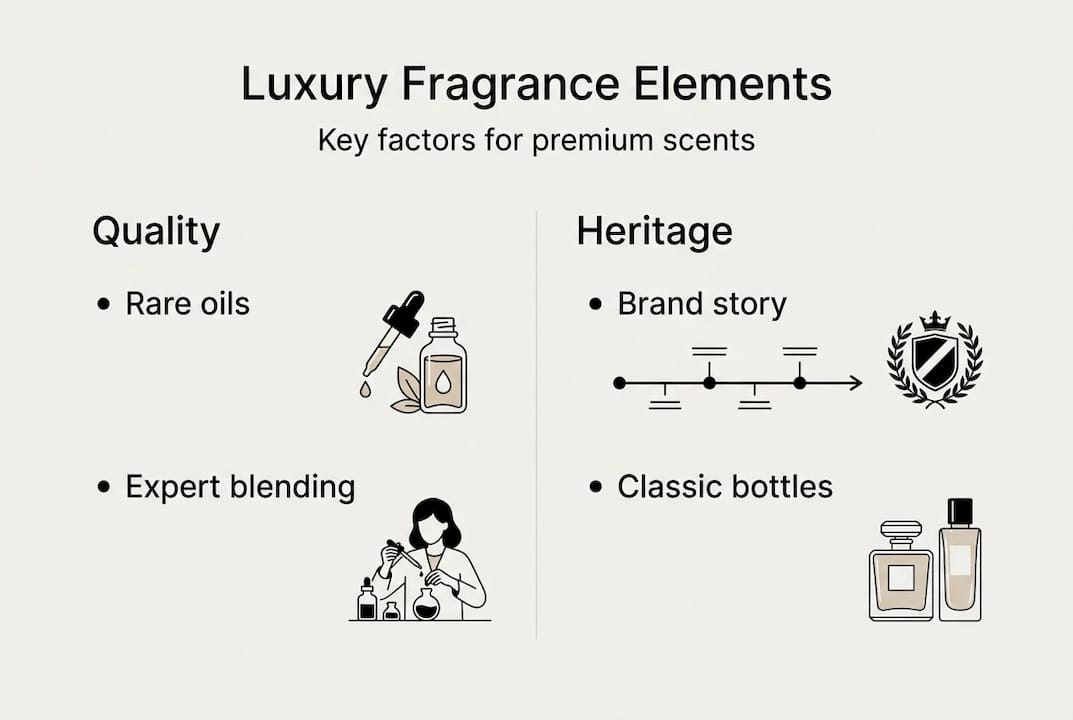
Brand heritage and exclusivity also play a defining role. Houses such as Creed, Amouage, and Roja Parfums carry decades or centuries of perfumery tradition. Limited editions, bespoke services, and restricted distribution all contribute to the perception and reality of luxury. The luxury fragrance standards that separate these scents from the high street are well documented and worth studying before you begin reviewing.
Typical traits of a luxury fragrance include:
- High concentration of fragrance oil (Extrait de Parfum or Eau de Parfum)
- Use of rare or natural raw materials
- Complex, evolving scent structure across top, heart, and base notes
- Distinctive bottle and packaging design
- Limited production runs or exclusive distribution
- Strong brand provenance and perfumer credentials
Understanding fragrance families such as oriental, woody, floral, and chypre also sharpens your ability to contextualise what you are smelling. A reviewer who cannot place a scent within its family will struggle to describe it meaningfully.
“Luxury in fragrance is not simply about price. It is about the deliberate choice of exceptional materials, the skill of the perfumer, and the coherence of the final composition.”
This perspective is central to reviewing well. Approach each fragrance as a deliberate creative work, not just a product.
Gathering your luxury fragrance samples: affordable and smart sourcing
Once you know what to look for in luxury scents, it is crucial to begin with quality samples for unbiased reviews. Reviewing from a full bottle is not practical or affordable for most enthusiasts. Samples and decants solve this problem directly.
The scent sample types available today range from brand-issued vials to independently decanted portions. Each has its advantages depending on your reviewing goals.
| Source | Type | Benefit | Approximate cost |
|---|---|---|---|
| Official brand counter | 1ml to 2ml vial | 100% authentic, free or low cost | Free to £5 |
| Reputable decant seller | 2ml to 10ml decant | Wide selection, affordable | £4 to £20 |
| Discovery sets | 5 to 10 samples | Curated, themed collections | £20 to £60 |
| Fragrance community swaps | Variable | Peer-sourced, diverse | Variable |
Decants from reputable sellers offer the best balance of authenticity, variety, and cost. You can access niche and designer scents that are otherwise unavailable locally. Discovery sets are ideal for exploring a house’s range in one purchase. Store vials are useful but limited to what retailers stock.
For niche and affordable sampling, the key is sourcing from sellers who are transparent about their decanting process and who work only with sealed, original bottles.
Pro Tip: Check seller reviews carefully before purchasing decants. Reputable decanters will confirm the original bottle batch, provide clear photographs, and have verifiable customer feedback. Avoid sellers who cannot confirm the source bottle or who offer unusually low prices on rare niche scents.
Inauthentic samples are a real risk. They can contain diluted or substitute formulations that give a false impression of the fragrance. Always prioritise verified sources over bargain options.
Step-by-step: how to review a luxury fragrance
Having sourced your samples, it is time to follow a repeatable process for in-depth fragrance evaluation. A consistent method ensures your reviews are reliable, comparable, and genuinely useful. The fragrance review steps recommended by experienced reviewers follow a clear sequence.
- Prepare your skin. Shower with unscented soap and avoid applying other fragrances, scented moisturisers, or strongly scented products for at least two hours before testing.
- Apply to pulse points. Spray or dab a small amount to the inner wrist or inner elbow. Do not rub. Allow the fragrance to settle naturally.
- Record the opening impression. Within the first five minutes, note the top notes. What is the immediate character? Sharp, soft, sweet, green, resinous?
- Track the dry-down. At the 20 to 30 minute mark, the heart notes emerge. This is often where the true personality of a luxury fragrance reveals itself. Note any shifts in character.
- Assess the base. After two to four hours, the base notes dominate. Record warmth, depth, and any lingering qualities.
- Measure longevity and projection. Note when the scent becomes imperceptible and how far it projects from the skin throughout the wear.
- Record your overall impression. Occasion suitability, emotional response, and whether you would purchase a full bottle.
Understanding the perfume reviewer role helps you appreciate that objectivity and personal response are both valid parts of a review. Neither should be excluded.
| Approach | Method | Best for |
|---|---|---|
| Side-by-side comparison | Test two scents on different arms simultaneously | Comparing similar fragrances or flankers |
| Wearing over time | Single fragrance tested across a full day | Deep evaluation of longevity and evolution |
Pro Tip: Keep a dedicated scent journal. Record the date, weather conditions, skin preparation, and your impressions at each stage. Over time, patterns emerge that reveal your genuine preferences and help you make better purchasing decisions. Digital spreadsheets work equally well if you prefer a structured format.
Pay attention to how evolving scent profiles change across different skin types and temperatures. The same fragrance can behave very differently on different people.
Key fragrance metrics: longevity, sillage and character
To craft a valuable review, you need to evaluate and communicate how a fragrance actually performs on skin and over time. Vague impressions are not enough. Specific metrics make your reviews credible and useful to others considering the same purchase.
Core performance terms every reviewer should know:
- Longevity: How long the fragrance remains detectable on skin from first application to fade
- Sillage: The trail a fragrance leaves in the air as you move, sometimes called the scent cloud
- Projection: How far from the body the scent radiates, distinct from sillage in that it measures distance rather than trail
- Top notes: The opening impression, typically lasting 15 to 30 minutes
- Heart notes: The core character, emerging after the top notes fade, lasting one to three hours
- Base notes: The foundation, providing depth and longevity, often lasting four hours or more
The fragrance performance metrics that matter most to buyers are longevity and sillage. Niche fragrances, particularly those with high concentrations of natural materials, often perform differently to designer releases. Niche Extrait de Parfum formulations can last eight to twelve hours on well-moisturised skin, while many designer Eau de Toilette releases average three to five hours.
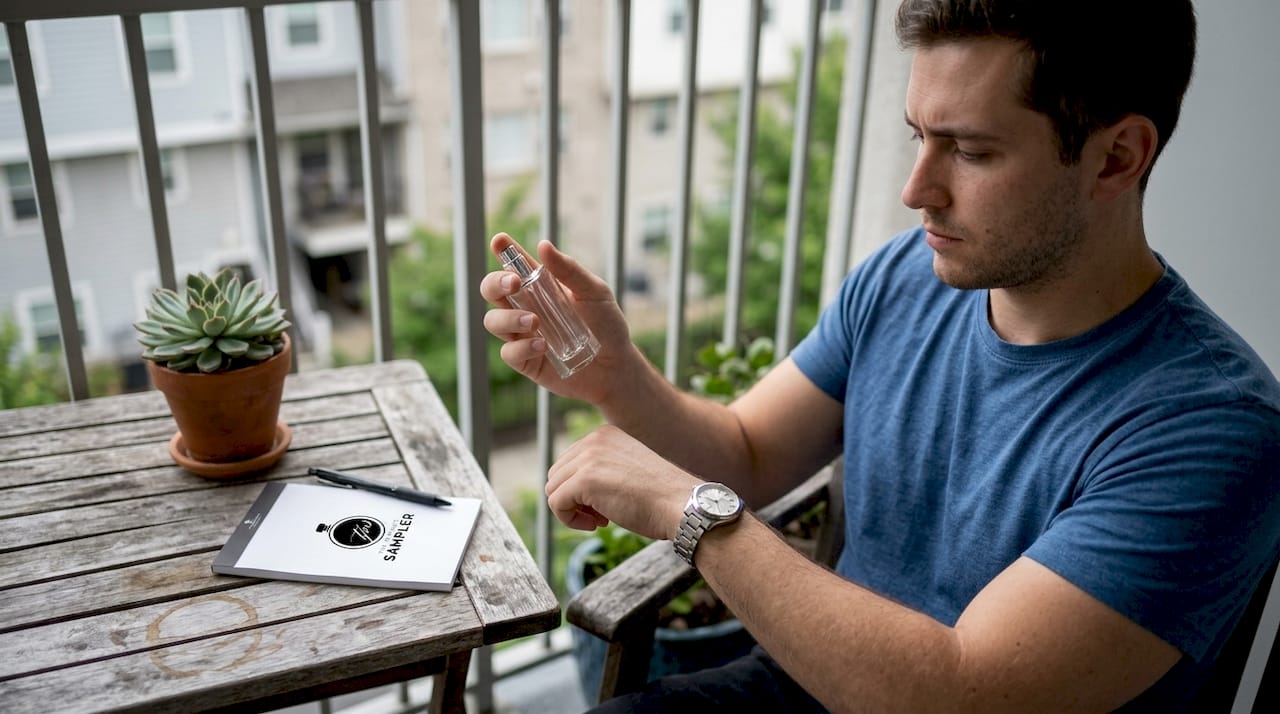
If performance is disappointing, troubleshoot before concluding the fragrance is weak. Dry skin absorbs fragrance faster and reduces longevity significantly. Applying an unscented moisturiser before spraying, as outlined in fragrance longevity tips, can extend wear by two hours or more.
Understanding scent projection also helps you contextualise performance. A fragrance with low projection but excellent longevity is a skin scent, intimate and personal. This is not a flaw. It is a characteristic that suits certain occasions and preferences. Record it accurately rather than treating it as a negative.
A luxury fragrance reviewer’s philosophy: what most people miss
Most fragrance reviews focus on the first impression. This is the least reliable data point in the entire evaluation. The opening minutes of any fragrance are dominated by top notes, which are volatile and fleeting by design. Judging a luxury scent on its opening alone is like judging a film by its first scene.
Context matters enormously and is consistently underreported. Temperature, humidity, skin chemistry, and even your mood at the time of testing all influence what you smell and how you respond to it. A heavy oriental that feels oppressive in summer may be exactly right in winter. Testing understanding scent families across seasons gives a far more accurate picture of a fragrance’s true character.
The conventional wisdom that certain fragrances are universal crowd-pleasers is also worth questioning. A fragrance that receives universal praise online may simply be inoffensive rather than exceptional. The most interesting luxury scents often divide opinion. Do not let consensus override your own carefully recorded experience.
Long-term journalling changes how you review. Revisiting a fragrance after a month often produces a completely different response. Patience is not optional in luxury fragrance reviewing. It is the method itself.
Explore affordable luxury fragrance trials and reviews
Now that you know how to get the most from luxury fragrance reviews, the next step is accessing quality samples to put this process into practice.
At The Perfume Sampler, we offer affordable luxury fragrance samples in 2ml, 3ml, 5ml, and 10ml sizes, covering both niche and designer houses. Every decant is sourced from 100% authentic bottles. If you are ready to review before you invest, explore the benefits of decants and build a structured testing wardrobe without the full-bottle commitment. For seasonal inspiration, browse our seasonal luxury fragrance picks and discover which scents perform best in cooler months. Sampling first is always the smarter choice.
Frequently asked questions
What should I look for in a luxury fragrance review?
Look for details about scent composition, performance metrics, occasion suitability, and how the reviewer sourced their sample. Reviews that address luxury fragrance standards such as ingredient quality and brand heritage are the most reliable.
How can I tell if a fragrance sample is genuine?
Source samples from reputable decanters who confirm the original bottle and have verifiable customer feedback. Transparent sellers who follow proper sample sourcing practices will always be able to confirm authenticity.
How do I objectively compare niche and designer luxury scents?
Test both on clean, unscented skin and record impressions at regular intervals over several hours. Consistent fragrance review steps applied to both ensure a fair and comparable evaluation.
What makes a fragrance perform better on some skin?
Skin type, hydration levels, and even diet influence how a fragrance develops. The factors affecting performance include pH balance and skin oiliness, both of which vary significantly between individuals.
Is it better to blind-buy or sample first?
Sampling first is always recommended for luxury fragrances. The cost of a fragrance sample trial is a fraction of a full bottle, and it removes the risk of a costly and regrettable purchase entirely.
Recommended
- Mastering the fragrance review process: steps and trends – ThePerfumeSampler
- Defining luxury fragrances: what truly sets them apart? – ThePerfumeSampler
- What is a perfume reviewer? Insider role explained – ThePerfumeSampler
- How to layer fragrances for a unique signature scent – ThePerfumeSampler
- Luxe Makeup: Everything You Need to Know – Luméra Cosmetica