
Fragrance concentration explained: Choose the right scent strength
TL;DR:
- Fragrance concentration indicates oil percentage but does not determine quality or craftsmanship.
- Different categories like Eau de Toilette or Parfum have typical oil ranges affecting longevity and projection.
- Sampling and testing on skin is essential to find the best concentration for personal preference and occasion.
Many fragrance enthusiasts assume that higher concentration automatically means a better product. It does not. Concentration shapes how a scent behaves on your skin, how long it lasts, and how far it projects. It does not determine quality. Understanding this distinction is one of the most practical things you can do before spending money on a full bottle of a niche or designer fragrance. This guide breaks down what fragrance concentration really means, how the industry categorises it, and how you can use that knowledge to make smarter, more satisfying choices.
Table of Contents
- What is fragrance concentration?
- Fragrance strength categories: The industry benchmarks
- How concentration affects scent experience
- Beyond strength: Safety standards, myths, and smart strategies
- Our perspective: Why one size never fits all in fragrance
- Explore before you buy: Find your perfect concentration
- Frequently asked questions
Key Takeaways
| Point | Details |
|---|---|
| Concentration defines strength | Fragrance concentration reveals how much perfume oil is in your scent, impacting richness and duration. |
| Category matters for wear | Understanding standard types helps you match scents to different occasions and personal preferences. |
| Longevity isn’t just the label | Performance depends on concentration, notes, and factors like weather and your skin. |
| Sampling saves regrets | Trying samples or decants lets you experience how different concentrations suit you before investing in a full bottle. |
What is fragrance concentration?
At its most basic, fragrance concentration refers to the percentage of aromatic perfume oils dissolved in a carrier, typically alcohol or a blend of alcohol and water. That percentage determines how strong, how lasting, and how projecting a scent will be. A higher proportion of oil generally means a richer, longer-lasting result. But richer is not always right for every situation.
The carrier itself plays an important role. Alcohol helps disperse the fragrance into the air around you. It is what creates that initial burst you notice when someone walks past. Water softens that effect. The ratio of oil to carrier is the core of what concentration means in perfumery.
Why should a fragrance enthusiast care about this? Because it directly affects how a scent fits your life. A heavy, high-concentration Parfum might be perfect for an evening event but overwhelming in a small office. A lighter Eau de Cologne might suit a summer morning far better than an intense resinous Extrait would. Understanding factors affecting perfume performance helps you match a fragrance to the right context.
One of the most common misconceptions is that concentration equals quality or that it justifies a higher price. This is not accurate. A well-crafted Eau de Toilette from a respected house can outperform a poorly formulated Parfum in both character and wearability. Concentration is a technical specification, not a quality grade.
“Fragrance concentration is a formulation choice, not a measure of craftsmanship. The artistry lies in how the perfumer uses those ingredients, regardless of the percentage.”
Brands must also follow IFRA standards when formulating any concentration category, ensuring that the ingredients used are safe for skin contact. These standards apply across all concentration types, which we will cover in more detail later.
- Strength: Higher oil percentage means a stronger initial impression
- Longevity: More oil generally extends wear time on skin
- Projection: Higher concentrations tend to have stronger sillage
- Cost: Higher concentration products often cost more, but not always proportionally
- Occasion fit: Lower concentrations can be more versatile for everyday wear
Fragrance strength categories: The industry benchmarks
Understanding what fragrance concentration is, it is crucial to recognise how the industry categorises these strengths for consumer comparison. The names you see on packaging are not arbitrary, but they are not strictly standardised either.
Standard concentration categories and ranges are not strictly regulated across brands. One house’s Eau de Parfum may behave more like another’s Parfum. This is why knowing the general ranges gives you a useful guide, not an absolute rule.
| Category | Typical oil concentration | Expected longevity |
|---|---|---|
| Eau Fraîche | 1-3% | 1-2 hours |
| Eau de Cologne | 2-4% | 2-3 hours |
| Eau de Toilette | 5-15% | 3-6 hours |
| Eau de Parfum | 15-20% | 6-10 hours |
| Parfum / Extrait | 20-40% | 8-24 hours |
These ranges overlap intentionally. Industry benchmarks by IFRA provide a framework, but individual brands interpret these categories with some freedom. That is why a sample or decant is so valuable before committing.
Here is how to read a label practically when you are shopping:
- Find the category name on the box or bottle. It will say Eau de Toilette, Eau de Parfum, or similar.
- Use the table above as a rough guide to set your expectations for longevity and strength.
- Note the brand and fragrance family. A woody or oriental Eau de Toilette may outperform a citrus Eau de Parfum in longevity, simply because of the note structure.
- Consider your tolerance for projection. If you prefer subtle wear, a lower concentration might serve you better even in evening contexts.
- Try before you buy. No label tells the full story. When choosing an Eau de Toilette, sampling in real conditions matters far more than the stated category.
The category name is a starting point. It is not a guarantee of how a fragrance will perform on your skin.
How concentration affects scent experience
Now we know how to read concentration categories. Let us see how these levels actually change your day-to-day fragrance experience.
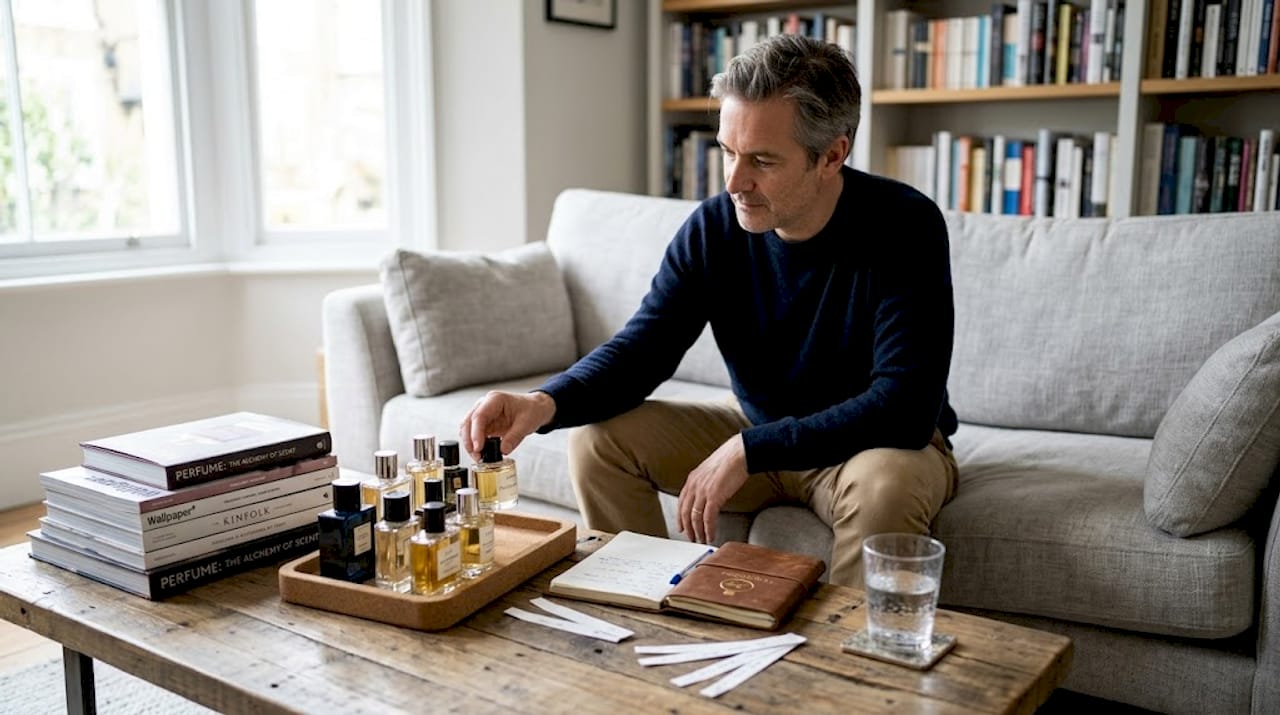
Higher concentrations generally last longer but not always in a linear way. Performance varies by notes, skin type, and environment. Two Parfums from different houses can have dramatically different longevity on the same person.
| Concentration | Longevity | Projection |
|---|---|---|
| Eau Fraîche | 1-2 hours | Very close to skin |
| Eau de Cologne | 2-3 hours | Soft, personal |
| Eau de Toilette | 3-6 hours | Moderate |
| Eau de Parfum | 6-10 hours | Noticeable, medium-strong |
| Parfum / Extrait | 8-24 hours | Strong, lingering |
Note structure is one of the biggest variables. Understanding perfume notes helps explain why a light citrus Eau de Parfum may not outlast a rich amber Eau de Toilette. Base notes like musks, woods, and resins anchor a fragrance to the skin far longer than top notes like lemon or bergamot, regardless of concentration.
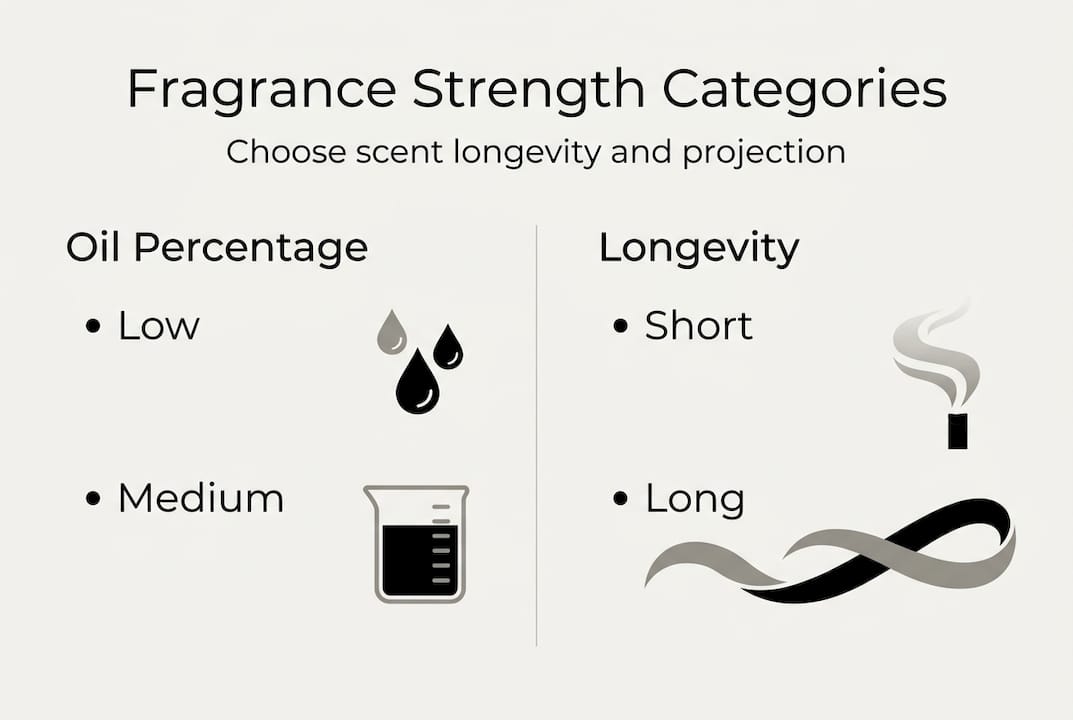
What projection means in practical terms is the distance at which others can detect your fragrance. A high-concentration Parfum may have softer projection than you expect if it contains dense, skin-close base notes. Projection is about note composition as much as oil percentage.
Considerations that affect your real-world experience:
- Skin type: Dry skin absorbs fragrance faster and may reduce longevity at any concentration
- Climate: Heat amplifies projection; cold weather subdues it
- Occasion: A busy commute or shared workspace calls for restraint
- Application: Pulse points on warm areas of the body extend wear time
- Layering: Fragrance-matching body products can extend factors influencing scent longevity
Pro Tip: With very high-concentration fragrances, apply less than you think you need. One or two touches of a Parfum can last the full day, making the cost-per-wear far lower than it first appears. Restraint with a powerful concentration often produces a more elegant result than a generous application.
Beyond strength: Safety standards, myths, and smart strategies
With a foundation in how concentration impacts experience, it is vital to demystify industry safety, popular myths, and effective buying strategies.
IFRA regulates the maximum levels of individual fragrance ingredients, not the overall concentration category. So a brand cannot use a banned ingredient simply by labelling a product as an Eau de Toilette instead of a Parfum. The regulation is ingredient-specific and applies regardless of how a product is classified.
What regulation actually covers:
- Maximum limits for specific allergens and sensitisers in leave-on skin products
- Ingredient bans or restrictions on certain materials based on safety evidence
- Reformulations when new safety data changes the permitted level of an ingredient
- Product type categories that affect limits, such as rinse-off versus leave-on formulations
For detailed guidance on how these rules work in practice, the IFRA guidelines provide a clear explanation of what brands are required to do.
Now for the myths. The most persistent one is that higher concentration is inherently safer, or alternatively that it is riskier. Neither is true. Safety is determined by ingredient choice, not oil percentage. A Parfum formulated to IFRA standards is no more dangerous than a compliant Eau de Fraîche.
“More is not always more. A fragrance that works for your skin and your setting will always outperform one that is simply stronger.”
Another common myth is that Parfum concentration guarantees a better-smelling fragrance. It guarantees intensity. Whether that intensity translates to a pleasing experience depends on the composition and how it interacts with your skin chemistry.
Pro Tip: Before buying any full bottle, test the fragrance in real conditions. A decant or sample lets you wear it through a full workday, in your climate, with your skin chemistry. That information is worth far more than any label. When choosing scents for different occasions, sampling across concentration levels helps you find what genuinely works. For tips on getting the most from each application, guidance on making your scent last is worth reading alongside this guide.
Our perspective: Why one size never fits all in fragrance
There is a tendency in fragrance communities to treat Parfum as the gold standard. The higher the concentration, the more serious the enthusiast. We think this misses the point entirely.
The most satisfying fragrance experience comes from matching the right concentration to the right moment. A confident, well-applied Eau de Toilette in a summer work environment will always outperform an overpowering Extrait in the same setting. The person who smells appropriate and considered makes a stronger impression than the person who simply smells loud.
Skin chemistry matters enormously here. Some people’s skin amplifies fragrance naturally. On them, a Parfum can become antisocial in close quarters. For others, even an Eau de Parfum fades quickly, and a higher concentration is a practical necessity rather than a luxury choice.
Sampling across concentrations is the single most practical thing an enthusiast can do. Understanding the nuances of Extrait de Parfum versus an Eau de Parfum version of the same fragrance, for example, often reveals surprising differences in character, not just intensity. The wiser approach is always to try before you invest.
Explore before you buy: Find your perfect concentration
Ready to put this knowledge into practice? The Perfume Sampler makes it straightforward to explore fragrance concentrations without committing to a full bottle.
We offer decants in 2ml, 3ml, 5ml, and 10ml sizes across a wide range of niche and designer fragrances. You can test an Eau de Parfum and a Parfum version of the same fragrance side by side, in real conditions, on your own skin. Understanding why sampling with decants matters is the first step to building a fragrance wardrobe you will genuinely use. If you are ready to invest in a full-size purchase, browse our full bottle options for 100% authentic products at competitive prices.
Frequently asked questions
What is the difference between Eau de Toilette and Eau de Parfum?
Eau de Toilette typically contains 5-15% perfume oil and lasts around 3-6 hours. Eau de Parfum contains 15-20% and generally lasts 6-10 hours, with stronger projection throughout the day.
Does higher fragrance concentration mean better quality?
No. Higher concentration does not guarantee better quality. Suitability for your skin, climate, and occasion often matters more than the percentage of oil in the formula.
Are fragrance concentrations regulated for safety?
IFRA regulates ingredient safety by setting maximum levels for individual materials. The overall concentration category, such as Eau de Toilette or Parfum, is not itself regulated for safety purposes.
How can I choose the right concentration for me?
The most reliable method is to try samples and decants across different concentration levels. Wear each one in real conditions and assess how they perform on your skin, in your climate, and for your typical occasions.
Recommended
- How to make fragrances last longer: expert steps – ThePerfumeSampler
- Top fragrances for professionals: elevate your scent – ThePerfumeSampler
- Extrait de parfum explained: Discover luxury scent nuances – ThePerfumeSampler
- How fragrances evolve: master scent profiles before you buy – ThePerfumeSampler
- Role of Scent in Skincare – Impact on Well-Being – Moose’s Tallow
- What makes roses special: elegance, fragrance & luxury | OnlyRoses - UK