
How fragrances evolve: master scent profiles before you buy
TL;DR:
- Fragrance evolves through distinct stages: top, heart, and base notes, changing over time.
- Personal factors like skin type influence fragrance longevity, projection, and scent development.
- Sampling on skin and tracking each phase ensures better fragrance choices and satisfaction.
Most people spray a fragrance and judge it within seconds. That first impression shapes the decision to buy, or not. But here is the problem: what you smell in those first moments is not what you will wear all day. A fragrance changes continuously from the moment it touches your skin, moving through distinct phases that can smell entirely different from one another. Understanding this process, known as fragrance evolution, changes how you shop, how you sample, and how satisfied you are with every bottle you own. This guide walks you through the full picture.
Table of Contents
- What does fragrance evolution mean?
- Breaking down the scent pyramid: Top, heart, and base notes
- The role of performance: Longevity, projection, and sillage
- Sampling fragrance evolution: Making informed choices with decants
- Why fragrance evolution matters more than you think
- Try before you buy: Discover your next signature scent
- Frequently asked questions
Key Takeaways
| Point | Details |
|---|---|
| Scents evolve over time | Fragrance changes from application to dry-down, revealing different notes in each phase. |
| Traditional pyramid is a guide | Top, heart, and base notes often blend together more than many expect. |
| Performance is personal | Not everyone wants a loud scent—some value intimate skin-scents over projection. |
| Sampling avoids regret | Testing a fragrance through its full evolution is the best way to ensure you’ll enjoy it before buying a bottle. |
What does fragrance evolution mean?
Fragrance evolution describes how a scent changes over time after application. It is not a flaw. It is by design. Perfumers layer ingredients with different molecular weights and evaporation rates to create a journey, not just a single smell.
At the heart of this concept is the scent pyramid, a model that organises fragrance ingredients into three layers:
- Top notes: The first impression. These are the lightest molecules, and they evaporate fastest.
- Heart notes: The core of the fragrance. They emerge once the top notes fade and form the main character of the scent.
- Base notes: The foundation. These are the heaviest molecules, and they linger longest on skin.
This pyramid model is useful for understanding structure, but it is worth noting that evaporation is not perfectly sequential. Multiple notes are present simultaneously from the start. What changes is the ratio and dominance of each layer as time passes.
“The scent pyramid is a helpful framework, but in reality, all notes begin evaporating at once. The pyramid simply reflects which notes dominate at each stage.”
Understanding this matters for practical reasons. If you test a fragrance on a card in a shop and walk away within a minute, you are only experiencing the top notes. You are missing the heart and base entirely. That is where the true character of a fragrance lives.
Several factors affecting perfume performance influence how quickly this evolution happens, including skin type, temperature, and fragrance concentration. Oily skin tends to hold base notes longer. Dry skin can cause top notes to burn off faster. These variables mean that fragrance evolution is not just about the formula. It is personal.
Knowing this also affects fragrance projection and radiance. A fragrance that projects boldly in the opening may become a quiet skin scent by the afternoon. That shift is part of its character, and it is worth knowing before you commit to a full bottle.
Breaking down the scent pyramid: Top, heart, and base notes
With a concept of scent evolution established, it is time to explore how fragrances are structured using the iconic scent pyramid.
The three stages each have a distinct role and a typical set of ingredients:
| Stage | Typical notes | Duration on skin |
|---|---|---|
| Top notes | Citrus, light herbs, green accords | 15 to 30 minutes |
| Heart notes | Florals, spices, woods | 2 to 4 hours |
| Base notes | Musks, ambers, resins, sandalwood | 4 to 8 hours or more |
In practice, the boundaries between these stages blur. You rarely experience a clean handover from one phase to the next. Instead, the transition is gradual. A citrus top note may still be faintly detectable as the floral heart begins to bloom.
Here is how to experience each stage deliberately:
- Apply the fragrance to your wrist or inner elbow.
- Wait 5 minutes and smell. This is the top note phase.
- Wait 30 minutes and smell again. The heart notes are now dominant.
- Wait 2 to 3 hours. This is the base note phase, and the truest indicator of how the fragrance will wear on you.
The reason some notes disappear quickly and others linger comes down to molecular volatility. Lighter molecules evaporate faster. Heavier molecules, such as musks and resins, are less volatile and cling to skin and fabric for hours. This is why how concentration affects scent evolution matters: an Eau de Parfum will sustain its heart and base notes longer than an Eau de Toilette of the same formula.
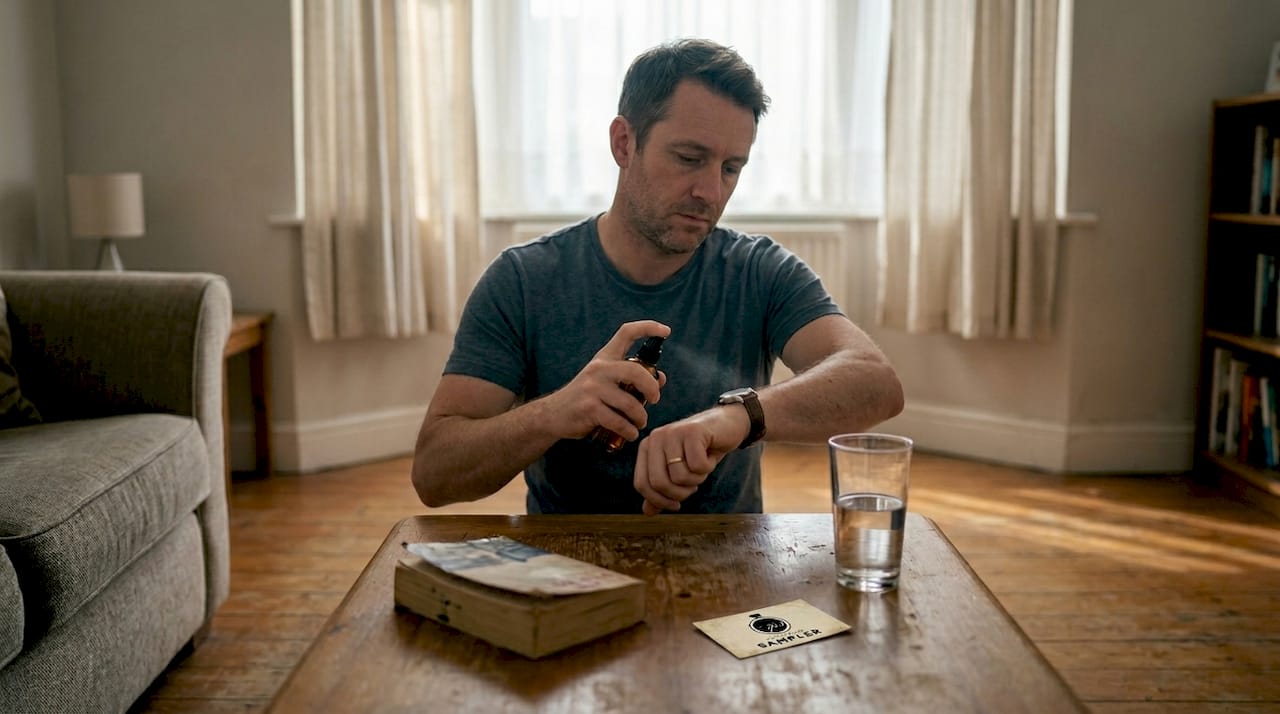
The layering of fragrances can also impact how the pyramid unfolds. Applying a base-heavy fragrance beneath a lighter one can extend the overall evolution and add depth.
Pro Tip: Identify which phase of a fragrance you love most. If you adore the opening but find the dry-down flat, that fragrance may not suit daily wear. If the base note is outstanding, it is likely a strong long-term choice.
The role of performance: Longevity, projection, and sillage
Knowing the stages of scent development, let us address how well a perfume performs during each and the importance this holds.
Three terms define fragrance performance:
- Longevity: How long the fragrance remains detectable on skin.
- Projection: How far the scent radiates from your body into the surrounding space.
- Sillage (pronounced see-yazh): The trail a fragrance leaves as you move through a room.
These are distinct qualities. A fragrance can have excellent longevity but low projection, meaning you can smell it on your wrist hours later, but others around you cannot. This is often called a skin scent. Conversely, a fragrance with strong projection and sillage fills a room but may fade faster.
| Fragrance type | Typical longevity | Typical projection |
|---|---|---|
| Eau de Cologne | 1 to 2 hours | Moderate |
| Eau de Toilette | 3 to 4 hours | Moderate to strong |
| Eau de Parfum | 5 to 8 hours | Moderate |
| Parfum / Extrait | 8 hours or more | Close to skin |
It is a common assumption that stronger projection equals a better fragrance. That is not accurate. Performance preferences are deeply personal. Some people prefer a fragrance that stays close to the skin for intimate wear. Others want a scent that announces their presence. Neither is wrong.
This is why performance preferences should guide your sampling strategy. If you wear fragrance in a professional setting, a skin scent may be more appropriate than a high-projection option. If you wear fragrance for evenings out, you may want something with a noticeable sillage.
Understanding projection and sillage before purchasing means fewer regrets. A fragrance that performs beautifully in one context may feel overwhelming in another. Sampling across real-world situations, not just in a shop, gives you the full picture. Fragrance is also a form of personal style expression, and matching performance to occasion is part of that.
Sampling fragrance evolution: Making informed choices with decants
With an understanding of performance factors, let us put knowledge into action by exploring how to use samples to discover scent evolution.
Sampling is essential to experience a fragrance’s full development timeline before buying. A 2ml or 3ml decant gives you enough product to test a fragrance across multiple wearings, in different environments, and at different times of day.
Here is a reliable step-by-step approach to sampling fragrance evolution properly:
- Apply the sample to clean, moisturised skin on your wrist or neck.
- Do not rub the fragrance in. Let it settle naturally.
- Note your first impression after 5 minutes. Write it down.
- Revisit at 30 minutes and again at 2 hours. Record what has changed.
- At the end of the day, note the dry-down. Is it still pleasant? Does it suit you?
Common fragrance sample types include:
- 2ml decants: Ideal for a single full-day test.
- 3ml and 5ml decants: Allow for multiple wearings and seasonal testing.
- 10ml decants: Best for fragrances you are seriously considering, offering extended trial time.
Pro Tip: Keep a simple fragrance journal. Note the name, date, weather, and your impressions at each phase. Over time, patterns emerge. You may find you consistently love woody base notes or that heavy florals do not suit your skin chemistry. This knowledge makes every future purchase more confident.
The process of reviewing fragrances systematically also helps you communicate your preferences to others, making recommendations and gift-giving far more accurate.
Why fragrance evolution matters more than you think
Here is an honest observation: the majority of fragrance regrets come from buying on the opening. Someone smells a bright, energetic citrus burst in a shop, loves it immediately, and buys the full bottle. Two weeks later, they notice they never reach for it. The dry-down is flat, or too sweet, or simply not them.
The opening of a fragrance is designed to attract attention. It is the most dramatic, the most immediate. But it is also the least representative of what you will actually wear. The base notes are what stay on your skin for hours. They are what others smell when they stand close to you.
Scent evolution is also deeply personal. The same fragrance can smell entirely different on two people, depending on skin chemistry, diet, and even stress levels. What works perfectly for a friend may not suit you at all. This is why relying on reviews or recommendations alone is not enough.
Sampling with patience, using a perfume performance guide to understand what you are experiencing, is the only reliable path to building a scent wardrobe you genuinely love. Rushing the process costs money and leads to a collection of bottles you rarely use.
Try before you buy: Discover your next signature scent
Ready to put your newfound fragrance knowledge to the test?
At The Perfume Sampler, we offer high-end niche and designer fragrance decants in sizes of 2ml, 3ml, 5ml, and 10ml. Each one is 100% authentic, allowing you to experience the full evolution of a scent before committing to a full bottle. The benefits of decants are clear: no risk, no regret, and no wasted money on a fragrance that does not suit you. Browse our full range of perfume samplers and start building your scent wardrobe the smart way. Try first. Buy with confidence.
Frequently asked questions
How long does each fragrance note last?
Top notes usually last 15 to 30 minutes, heart notes 2 to 4 hours, and base notes can linger for several hours or even all day, though evaporation timing varies depending on skin type and concentration.
Why does my fragrance smell different throughout the day?
Fragrance molecules evaporate at different rates, so as lighter top note molecules disappear, heavier heart and base note molecules become more prominent, creating a shifting scent experience across the day.
Is it better to try a perfume on paper or skin?
Sampling on skin is always preferable, as your personal chemistry directly affects how a fragrance develops. A skin trial reveals the true evolution in a way that a paper strip simply cannot.
What should I look for when sampling a new scent?
Pay attention to all three stages: the opening impression, the heart note character after 30 minutes, and the base note dry-down after several hours. A thorough sampling process ensures you love the fragrance at every phase, not just the first spray.
Recommended
- Explore unique fragrance profiles: niche and affordable sampling – ThePerfumeSampler
- Explore fragrance families: find your signature scent affordably – ThePerfumeSampler
- Mastering the fragrance review process: steps and trends – ThePerfumeSampler
- How to layer fragrances for a unique signature scent – ThePerfumeSampler
- Parfums vergelijken workflow: zo vind je jouw ideale geur – Pure Parfum