
How to make fragrances last longer: expert steps
TL;DR:
- Fragrance longevity depends on concentration, notes, skin chemistry, and environmental factors.
- Proper skin preparation, such as moisturizing and correct spraying technique, enhances scent duration.
- Storage in cool, dark places preserves fragrance quality and prolongs wear time.
You spray your favourite luxury perfume, step out the door, and two hours later it has all but vanished. For anyone investing in high-end niche fragrances, that is a genuinely frustrating experience. The good news is that longevity is not purely down to luck or the bottle’s price tag. Concentration, skin preparation, application technique, and storage all play measurable roles. This guide covers each of those variables in practical detail, so you can get the most from every spritz, whether you are wearing a classic designer scent or exploring a rare niche sample for the first time.
Table of Contents
- Understanding what affects fragrance longevity
- Preparation: setting the perfect canvas for your scent
- Application: how to spray fragrances for lasting effect
- Maintaining and verifying fragrance longevity
- A perfumer’s perspective: what truly makes scent last?
- Discover niche samples and lasting scent experiences
- Frequently asked questions
Key Takeaways
| Point | Details |
|---|---|
| Concentration impacts longevity | Perfumes with higher oil content last significantly longer on your skin. |
| Preparation is essential | Moisturising pulse points creates a base and extends the life of your favourite scents. |
| Technique matters | How and where you apply fragrance determines performance far more than quantity alone. |
| Base notes endure | Choosing scents with musk, amber, oud, or vanilla helps ensure longer-lasting aroma. |
| Storage influences freshness | Keeping fragrances in cool, dark places preserves their quality and potency. |
Understanding what affects fragrance longevity
Before you change anything about how you apply perfume, it helps to understand why some scents last and others do not. The single biggest variable is concentration. Parfum, with 20–40% oil concentration, typically lasts 10–14 hours or more. Eau de Parfum (EDP) sits at 15–20% and lasts 6–10 hours. Eau de Toilette (EDT) contains 5–15% and fades within 3–5 hours. Knowing this before you buy is essential, particularly when sampling niche fragrances in smaller decant sizes.
The factors impacting perfume duration go beyond concentration alone. Every fragrance is built on a volatility curve: top notes evaporate first (within 15–30 minutes), heart notes follow over the next few hours, and base notes are what you smell hours later. Citrus and herbal top notes disappear fastest. Musks, ambers, woods, and vanilla in the base linger longest.
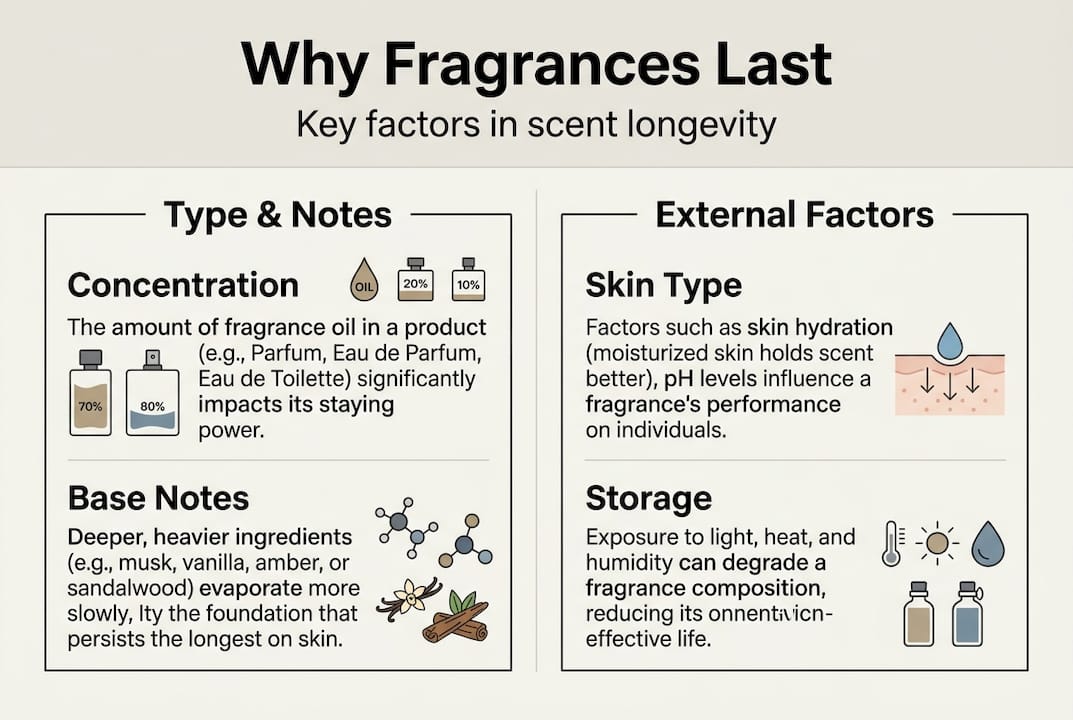
Skin chemistry is equally important. Oily skin holds scent longer than dry skin because the lipid-rich surface traps fragrance molecules more effectively. Warm, humid climates accelerate evaporation, while cooler, drier environments slow it down. This is why the same perfume can smell completely different on two people, or even on the same person in different seasons.
Quick reference: concentration, notes, and expected duration
| Type | Oil concentration | Expected duration |
|---|---|---|
| Parfum | 20–40% | 10–14+ hours |
| Eau de Parfum | 15–20% | 6–10 hours |
| Eau de Toilette | 5–15% | 3–5 hours |
| Eau de Cologne | 2–4% | 2–3 hours |
For a broader look at how fragrance projection and radiance interact with longevity, it is worth understanding sillage, which refers to the trail a scent leaves behind. High sillage does not always mean long duration, and vice versa. Some of the best long-lasting perfumes are surprisingly quiet in projection but stay close to the skin for many hours.
Key factors to keep in mind:
- Dry skin requires more preparation to hold scent effectively
- High humidity speeds up evaporation of top and heart notes
- Base-heavy compositions naturally outlast citrus-forward blends
- Niche fragrances often use higher-quality raw materials, which can improve longevity
Preparation: setting the perfect canvas for your scent
With a clear grasp of why certain scents last, let us prepare your skin to get the most from every drop. The skin is not a neutral surface. Its moisture level, temperature, and pH all influence how a fragrance develops and how long it stays detectable.
The most reliable preparation step is moisturising before you apply fragrance. Applying unscented moisturiser or body oil to pulse points before spraying can extend longevity by 2–3 hours. The lipid layer created by the moisturiser gives fragrance molecules something to bind to rather than evaporating off bare skin. Use an unscented product to avoid clashing with your chosen scent.
Recommended preparation steps:
- Shower beforehand; clean, slightly warm skin absorbs fragrance better
- Pat skin dry rather than rubbing, to keep pores open
- Apply a thin layer of unscented body lotion or a non-occlusive oil such as jojoba
- Allow the moisturiser to absorb for 2–3 minutes before spraying
- Focus on pulse points: wrists, neck, inner elbows, and behind the knees
For high-end niche scents, a dedicated body oil in a complementary scent family can act as a base enhancer. Musk-based body oils work particularly well under oriental and woody fragrances, reinforcing the base notes before you even apply the perfume.
There is ongoing debate in fragrance communities about whether moisturising genuinely extends longevity for all skin types. Some users on forums report no measurable difference. Results vary by skin chemistry, so treat this as a starting point rather than a guaranteed fix.
Exploring layering fragrance techniques in more depth can also help you build a more robust scent profile from the ground up, particularly when working with niche samples.
Pro Tip: When trying a new moisturiser or body oil alongside a new fragrance sample, patch test on your inner arm first. Some combinations can cause unexpected skin reactions or alter the scent profile significantly.
Application: how to spray fragrances for lasting effect
Once your skin is perfectly primed, the way you apply fragrance makes all the difference. Many people unknowingly shorten their scent’s life through a few simple habits.
The most common mistake is rubbing the wrists together after spraying. Spraying on pulse points without rubbing is essential because body heat naturally diffuses the scent upward, while rubbing crushes the delicate top note molecules and accelerates evaporation. Let the fragrance settle on its own.
Step-by-step application:
- Hold the bottle 10–15 cm from the skin
- Spray once or twice on each chosen pulse point
- Do not rub or dab the skin after spraying
- Allow the fragrance to dry naturally for 30–60 seconds
- Apply to inner elbows and behind the knees for longer-lasting diffusion throughout the day
For those exploring long-lasting perfume recommendations, choosing a scent with a strong base note profile and applying it correctly will always outperform a heavy-handed application of a lighter concentration.
Layering with matching or complementary products, such as a scented shower gel or body lotion from the same fragrance line, builds a base note foundation that significantly extends overall longevity. This is a particularly useful approach when working with smaller decant sizes, where you want every spray to count.
Mistakes to avoid:
- Rubbing wrists together after application
- Spraying directly onto clothing as a substitute for skin application
- Over-applying in an attempt to compensate for a light concentration
- Spraying into the air and walking through the mist, which wastes most of the fragrance
Pro Tip: A small travel atomiser filled from your decant or full bottle allows for precise, controlled reapplication during the day without carrying the full bottle. One or two targeted sprays on a pulse point mid-afternoon can revive a fading scent effectively.
For those interested in fragrance layering steps in more detail, building a multi-product routine around a single scent family is one of the most effective ways to extend wear time.
Maintaining and verifying fragrance longevity
Ideal application is only one part. The secrets to true longevity come from ongoing care and knowing what to expect from your specific fragrance.
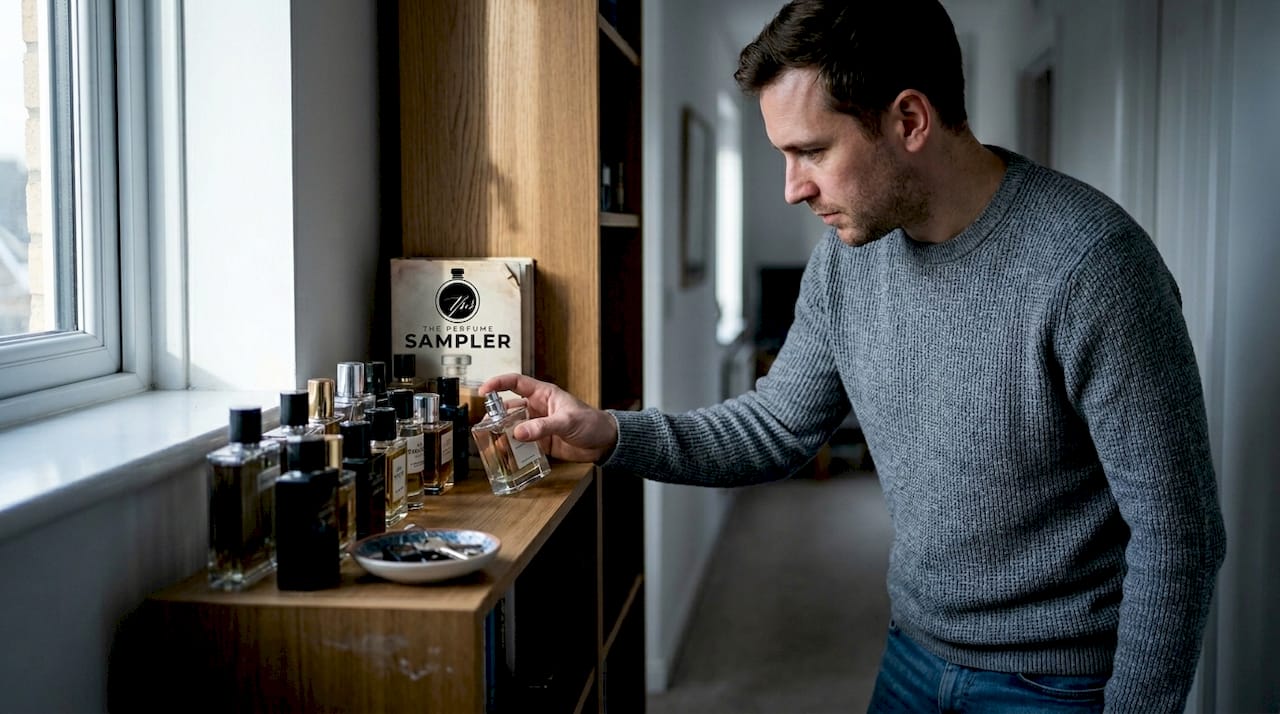
Storage is frequently overlooked. Store fragrances in a cool, dark, dry place away from light and humidity to prevent oxidation. The bathroom cabinet, despite being a popular choice, is one of the worst places to keep perfume. Heat and steam from showers degrade fragrance molecules over time, reducing both quality and longevity.
Base notes such as musk, amber, oud, woods, and vanilla provide the longest wear. Citrus and green notes fade fastest. Understanding the note structure of your fragrance helps set realistic expectations.
Expected vs. real longevity by note type
| Note type | Expected duration | Real-world duration |
|---|---|---|
| Citrus / green | 1–2 hours | 30–90 minutes |
| Floral / spice | 3–5 hours | 2–4 hours |
| Woody / resinous | 6–10 hours | 5–8 hours |
| Musk / amber / oud | 10–14+ hours | 8–12 hours |
To track actual longevity, spray the fragrance on your wrist at a set time and note when you can no longer detect it. Do this across three separate days to account for variation in skin condition and environment. This gives you a reliable personal baseline for each scent you own or sample.
Storage best practices:
- Keep bottles in their original boxes when not in use
- Avoid windowsills, direct sunlight, and radiators
- Store decants upright to minimise air exposure
- Do not shake the bottle, as this introduces air and accelerates oxidation
For guidance on which best lasting fragrance notes suit different occasions, it is worth cross-referencing your note preferences with practical longevity data. For a technical breakdown of projection, longevity, and sillage, the chemistry behind how molecules behave on skin is genuinely illuminating.
A perfumer’s perspective: what truly makes scent last?
Let us take a step beyond the popular tips for an honest perspective on what actually drives longevity. Most advice focuses on technique, and technique does matter. But the honest truth is that the majority of a fragrance’s longevity is determined at the formulation stage, not the application stage.
A perfumer choosing high-quality fixatives, natural resins, and well-anchored base materials will produce a scent that lasts regardless of whether you moisturised beforehand. Conversely, a fragrance built primarily on volatile top notes will fade quickly no matter how carefully you apply it.
This is worth remembering when you encounter niche samples that seem to disappear quickly. Sometimes, that brevity is intentional. Certain compositions are designed to be intimate, skin-close, and fleeting. Chasing longevity in those cases misses the point of the fragrance entirely.
The deeper understanding of fragrance performance is this: layering and base-building help, but they cannot fundamentally alter a fragrance’s character. Work with the composition, not against it. Accept the natural arc of a scent, and you will enjoy it far more than if you spend the day checking whether it has faded.
Discover niche samples and lasting scent experiences
Armed with longevity know-how, you are ready to discover and sample niche scents that make the most of every spritz.
At ThePerfumeSampler, we offer 100% authentic fragrance decants in 2ml, 3ml, 5ml, and 10ml sizes, giving you the chance to test high-concentration parfums and niche compositions before committing to a full bottle. Sampling is the most practical way to verify real-world longevity on your own skin. If you want to understand why decants make sense for any serious fragrance enthusiast, the answer is simple: you get to experience the full scent journey without the full price. For a strong example of a base-rich, long-lasting composition, try Boss Bottled Absolu Intense in a sample size first.
Frequently asked questions
What type of fragrance lasts the longest?
Parfum, with 20–40% oil concentration, typically lasts 10–14 hours or more, making it the longest-lasting fragrance type available.
Does skin type affect how long a perfume lasts?
Yes. Oily skin holds scent longer due to higher lipid content, while dry skin allows fragrance molecules to evaporate more quickly.
Can I make my fragrance last longer by putting it on my clothes?
Scent does last longer on fabric, but skin application on pulse points without rubbing offers richer development and avoids the risk of staining delicate materials.
Should I moisturise before applying perfume every time?
Generally yes, as it creates a lipid base that helps anchor fragrance molecules, though some debate exists around whether the benefit is consistent across all skin types.
How should I store my fragrances to keep them fresh?
Store in a cool, dark, dry place away from sunlight and humidity, as heat and light oxidise fragrance molecules and reduce longevity over time.
Recommended
- How to layer fragrances for a unique signature scent – ThePerfumeSampler
- What affects perfume performance: fragrance guide – ThePerfumeSampler
- Top fragrances for professionals: elevate your scent – ThePerfumeSampler
- Discover types of fragrance samples for affordable trials – ThePerfumeSampler
- Perfume application tips to enhance scent lasting power