

Guide to fragrance scent mapping for enthusiasts
TL;DR:
- Fragrance scent mapping involves tracking how a perfume’s notes evolve on your skin over time to understand its true character and longevity. Using tools like the fragrance pyramid and Michael Edwards’ scent wheel helps categorize scents and avoid purchasing based solely on initial impressions. Proper testing strategies, including multiple checks, controlled application, and awareness of skin chemistry, are essential for confident fragrance selection.
Buying a perfume in a shop and then finding it smells completely different on your skin at home is one of the most common and costly frustrations in fragrance. A guide to fragrance scent mapping gives you a structured way to avoid exactly that. Rather than guessing, you track how a fragrance evolves on your skin across top, heart, and base notes before spending on a full bottle. This guide walks you through the practical techniques, tools, and habits that experienced enthusiasts use to make confident, informed fragrance choices every time.
Table of Contents
- Understanding the fragrance pyramid: the scent evolution on your skin
- Using the Michael Edwards fragrance wheel to navigate scent families
- Preparing for scent mapping: selecting and testing samples strategically
- Mapping fragrance performance: observing note evolution and longevity
- Common pitfalls and expert tips for successful scent mapping
- Rethinking fragrance scent mapping: beyond the basics for enthusiasts
- Discover your perfect scent with ThePerfumeSampler
- Frequently asked questions
Key Takeaways
| Point | Details |
|---|---|
| Understand fragrance structure | Fragrances evolve through top, heart, and base notes that reveal their character over time. |
| Use the fragrance wheel | Classifying scents into families helps you choose and compare perfumes before sampling. |
| Test samples properly | Apply 1-2 sprays on clean skin, limit testing sessions to two scents, and avoid rubbing. |
| Map scent evolution | Observe perfume changes over several hours to assess longevity and personal fit accurately. |
| Avoid common mistakes | Don’t overload your nose, patch test oils, and reset your sense of smell with fresh air. |
Understanding the fragrance pyramid: the scent evolution on your skin
Fragrance pyramids structure every perfume into three distinct layers, each with a different character and lifespan. Knowing how these layers behave is the starting point for any scent mapping guide worth following.
The three layers work in sequence:
- Top notes are the first impression. They are typically bright, light molecules such as citrus, green herbs, or light florals. They last around 5 to 30 minutes before fading.
- Heart notes form the true character of the fragrance. Florals, spices, and soft fruits are common here. They emerge as top notes fade and can last from 30 minutes up to four hours.
- Base notes are the foundation. Ingredients like sandalwood, vetiver, musk, and amber give a fragrance its depth and staying power. They can linger for four to twelve hours or beyond.
| Note layer | Typical ingredients | Duration on skin |
|---|---|---|
| Top notes | Citrus, bergamot, herbs | 5 to 30 minutes |
| Heart notes | Rose, jasmine, spice | 30 min to 4 hours |
| Base notes | Sandalwood, musk, amber | 4 to 12+ hours |
Understanding this timeline is essential for step by step fragrance note mapping. The scent you smell in the first five minutes on a shop tester is not the scent you will wear all day. Many buyers make purchasing decisions based only on the opening. This is the single most common reason people end up disappointed with a full bottle purchase.
Pro Tip: Apply a sample to your wrist and check it again at 30 minutes, one hour, and four hours. Each check reveals a different layer of the fragrance and gives you far more information than a single sniff ever could.
Using the Michael Edwards fragrance wheel to navigate scent families
With fragrance structures clear, the next step in your scent mapping guide is learning how to categorise and compare fragrances before you even apply them. The Michael Edwards fragrance wheel classifies scents into four main families and 14 sub-families, making it a practical tool for anyone building a fragrance wardrobe or trying to identify patterns in what they enjoy.
The four main families are:
- Floral (from delicate single florals to rich bouquets)
- Amber/Oriental (warm, spiced, and resinous)
- Woody (earthy, dry, and forest-like)
- Fresh (aquatic, green, and citrus-forward)
| Family | Typical notes | Mood or occasion |
|---|---|---|
| Floral | Rose, peony, lily | Feminine, romantic, daytime |
| Amber/Oriental | Vanilla, oud, incense | Warm, evening, statement |
| Woody | Cedarwood, vetiver, patchouli | Neutral, sophisticated |
| Fresh | Bergamot, sea notes, green tea | Casual, warm weather, office |
Adjacent families on the wheel share characteristics and blend well together. Floral sits next to Fresh, so if you enjoy light, clean scents, you are likely comfortable in both families. Opposite families create contrast. A Woody Oriental sits on the opposite side from a Fresh Floral, which is useful when you want to layer scents or explore something outside your usual range.
Using this fragrance families guide before sampling helps you narrow your choices intelligently. Rather than selecting samples at random, you can identify which families appeal to you and use the wheel to discover niche fragrances within those categories methodically.
Pro Tip: Write down three fragrances you already know you love. Identify their families on the wheel. This immediately tells you your comfort zone and helps you decide whether your next sample should sit within it or push beyond it.
Preparing for scent mapping: selecting and testing samples strategically
Now that you know which scents to explore, preparation matters. Testing conditions directly affect the accuracy of your fragrance note identification. Rushing this step produces misleading results.
Follow these steps before testing any sample:
- Cleanse skin with an unscented soap and allow it to air dry fully.
- Apply a light, unscented moisturiser to pulse points. Dry skin absorbs fragrance faster and can make base notes appear sooner than they naturally would.
- Choose no more than two fragrances per session. Limit to two per session to prevent olfactory fatigue, which makes scents blur together and distorts your judgement.
- Apply one or two sprays per fragrance to separate pulse points: one wrist for the first scent, inner elbow for the second.
- Do not rub your wrists together. This breaks down fragrance molecules and alters how the notes evaporate.
- Wait a minimum of four to six hours before drawing any conclusions about the drydown.
- Record your impressions at each phase in a notebook or phone app.
Key testing principles to keep in mind:
- Pulse points such as the wrist, inner elbow, and neck generate warmth that activates fragrance development.
- Avoid eating strong food or using heavily scented products during testing, as these alter olfactory perception.
- Reset nose fatigue by stepping outside for fresh air, not by sniffing coffee beans. Coffee beans are a myth and can actually add to sensory overload.
Understanding why perfume smells different on skin is part of the preparation process. Skin pH, hydration, and even diet play a role in how your body interacts with fragrance ingredients.
Pro Tip: Test samples at the same time of day across multiple sessions. Body temperature and skin condition vary with time and environment, and keeping conditions consistent makes comparisons much more reliable.
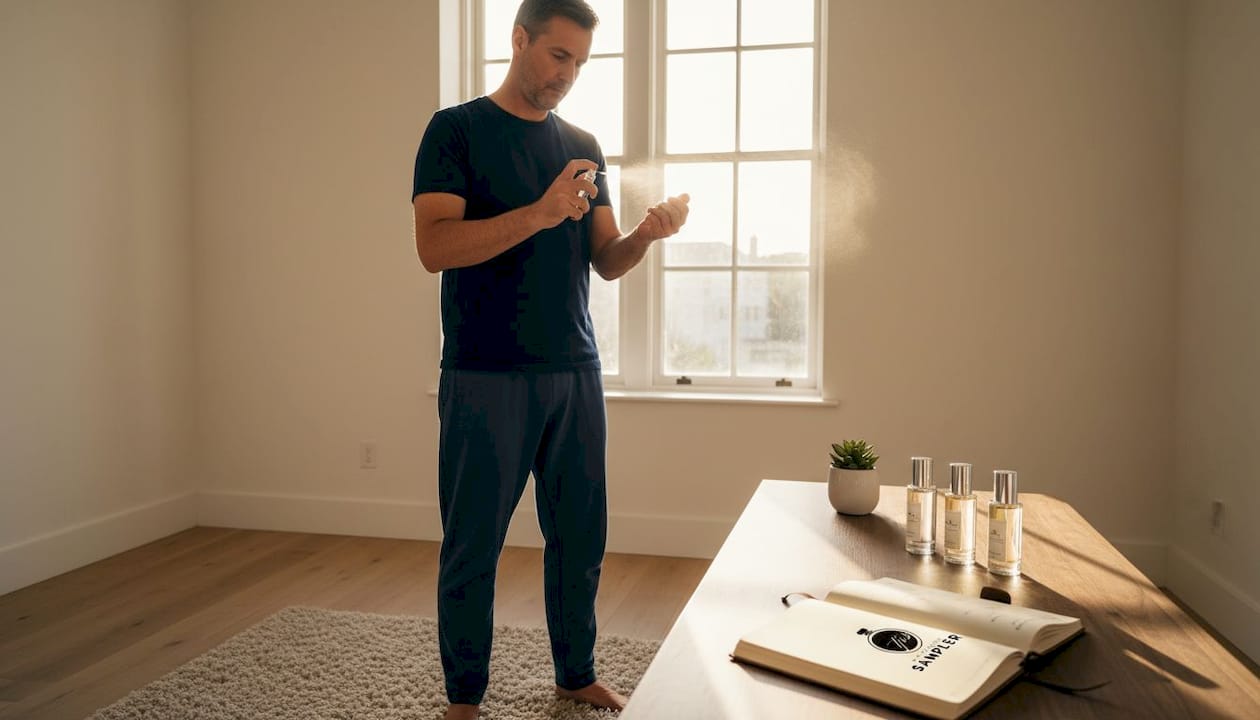
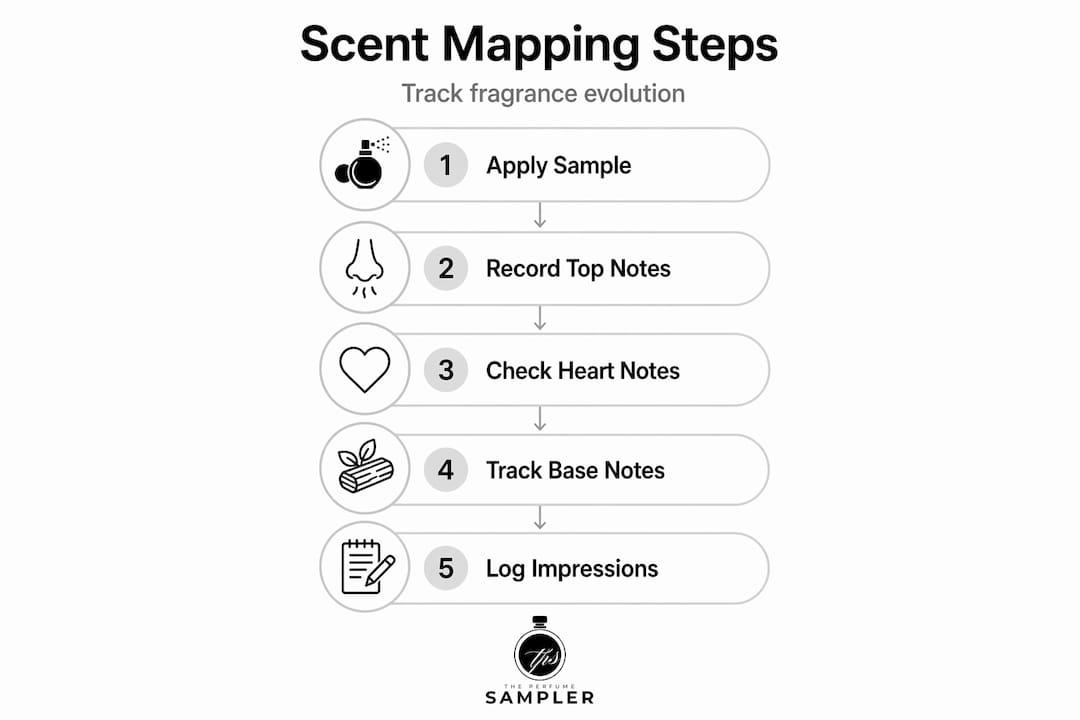
Mapping fragrance performance: observing note evolution and longevity
Having prepared to test samples, the next step is tracking the full scent journey using a systematic approach. This is where a fragrance scent chart or journal becomes genuinely useful.
Check and record impressions at these intervals:
- Immediately after application — what do you smell first? This is the top note.
- At 20 minutes — have the opening notes started to soften? What is beginning to emerge underneath?
- At one hour — you should now be in the heart. Identify the dominant character at this stage.
- At four hours or more — what remains? This is the base note phase and shows you what will define the long-term wear.
What to observe and note at each interval:
- Projection: does the scent radiate outward or stay close to the skin?
- Longevity: is the fragrance still clearly present or has it faded significantly?
- Character shift: did the scent move in a direction you found pleasant or unexpected?
- Skin chemistry interaction: does the fragrance smell as described, or did your skin pull it in a different direction?
Base notes with fixatives such as sandalwood, amber, or musk are strong predictors of longevity over eight hours. When you identify these in a fragrance’s listed ingredients, you can reasonably expect strong staying power. Fragrances led by musks and resins in the base tend to perform better in cooler conditions. Light citrus-forward scents tend to fade faster but project strongly at first.
You can also review detailed guides on how fragrances evolve and practical steps on making fragrances last longer to strengthen your testing framework.
Pro Tip: Create a simple table in your journal with columns for time, scent impression, and intensity score from one to ten. After testing several samples, patterns quickly emerge that reveal your actual preferences.
Common pitfalls and expert tips for successful scent mapping
With mapping tactics clear, it is equally important to know what to avoid. Even experienced enthusiasts make these errors, and they can skew your results significantly.
Common mistakes and how to correct them:
- Testing too many scents at once. Testing more than two simultaneously leads to nose fatigue and makes differentiation nearly impossible. Stick to two per session without exception.
- Rubbing wrists together. This is perhaps the most widespread mistake. Friction generates heat and breaks down the fragrance’s molecular structure, collapsing top and heart notes prematurely.
- Judging on the opening alone. First impressions are the least reliable data point in scent mapping. A fragrance that opens harshly can become genuinely beautiful in the heart and base.
- Skipping patch tests for niche oils. Always apply concentrated niche oils to the inner elbow at least 24 hours before full testing to check for skin sensitivity.
- Testing only once in one environment. Heat, humidity, and indoor versus outdoor conditions all alter how a fragrance performs. A single test is not enough.
- Ignoring skin chemistry. Your skin is a variable, not a constant. Hydration levels, medications, and even stress can alter a fragrance’s expression from one day to the next.
“The most reliable insight comes from wearing a fragrance across two or three different days and environments before making any purchase decision.”
Keeping a scent diary across multiple sessions is the single most reliable tool for building genuine fragrance knowledge. It transforms subjective impressions into a personal reference system that improves with every test.
Pro Tip: Keep your fragrance profiles guide notes alongside your sample decants. When you revisit a scent days later, your earlier notes give you a baseline to compare against and reveal how your perception has shifted.
Rethinking fragrance scent mapping: beyond the basics for enthusiasts
Most guides to understanding scent profiles focus on note breakdowns and timing charts. These are useful. But they often miss something important: real-life conditions are not controlled environments, and treating fragrance testing as a laboratory exercise misses the point.
Temperature and humidity alter perfume projection more than most people account for. A heavy Amber fragrance that performs beautifully in a cool, dry indoor setting can become overpowering in summer heat. Equally, a light Fresh fragrance dismissed in winter as too subtle may reveal a completely different character in warmer months. This is not a flaw in the fragrance. It is simply how the chemistry works, and it means one test in one environment is genuinely insufficient data.
Skin chemistry also shifts across a single day. Morning skin is different from evening skin. A fragrance tested immediately after a workout interacts with skin chemistry in ways that differ entirely from post-shower skin. Many enthusiasts find that base fixatives they read about on paper produce surprising results in actual daily wear conditions, particularly when tested across varied settings.
The most useful shift in mindset is accepting that fragrance mapping is not a single session exercise. It is a process of accumulating impressions across multiple days, conditions, and contexts. Journalling scent evolution in real-life settings, not just structured tests, produces far richer insight. An office environment, an outdoor walk, and an evening out each reveal different dimensions of the same fragrance.
Experienced enthusiasts treat impermanence in fragrance experience not as a problem to solve but as information to collect. A scent that lasts four hours on you but eight on someone else is not inferior. It is simply telling you something specific about your skin, and that knowledge is exactly what helps you choose better.
Discover your perfect scent with ThePerfumeSampler
Ready to put scent mapping into practice? The most effective way to apply every technique in this guide is to start with sample sizes before committing to full bottles.
ThePerfumeSampler offers a wide range of niche and designer fragrance decants in 2ml, 3ml, 5ml, and 10ml sizes. These are ideal for multi-day testing across different conditions. You can read about the practical advantages of why decants work so well for this purpose. Once you have tested and confirmed a fragrance suits your skin, chemistry, and lifestyle, the full bottles collection lets you invest with complete confidence. All products are 100% authentic. Testing before buying is simply the smarter approach.
Frequently asked questions
What is fragrance scent mapping?
Fragrance scent mapping is the method of tracking how a perfume’s top, heart, and base notes evolve on your skin over time, allowing you to understand its true character and longevity before purchasing.
How many perfumes should I test at once on my skin?
You should test only one or two fragrances per session on separate pulse points to avoid olfactory overload and to clearly distinguish each scent’s individual evolution.
Why does my skin change how a perfume smells?
Skin chemistry factors such as pH, temperature, and hydration affect note development and cause fragrances to smell differently on different people or under different conditions.
How long should I wear a perfume when testing it?
Observe a fragrance from application through at least four to six hours to experience the full drydown and base note performance before deciding whether to purchase.
Can I rely on paper strips for perfume testing?
Paper strips give an initial sense of a fragrance’s character but do not reflect true skin development. Skin testing is essential because body heat and chemistry alter how notes unfold in ways a blotter cannot replicate.
Recommended
- Discover wearable fragrances: a luxury guide to sampling scents – ThePerfumeSampler
- How to find your signature scent: a complete guide – ThePerfumeSampler
- Work professional fragrance guide: select, sample and impress – ThePerfumeSampler
- What makes a fragrance truly unique: your scent guide – ThePerfumeSampler