
Discover wearable fragrances: a luxury guide to sampling scents
TL;DR:
- Choosing a luxury fragrance requires understanding wearability, which depends on your skin chemistry, lifestyle, and environment. Thorough on-skin testing across different phases, environments, and days provides reliable insights, whereas paper strips only offer initial impressions. A disciplined, focused sampling process—limiting tests to a few fragrances at a time—ensures better decision-making and a scent that truly fits your identity.
Choosing a luxury fragrance is genuinely difficult. You are drawn to a scent in a boutique, it smells extraordinary on the blotter, and then three hours into wearing it, something shifts. That happens to even the most experienced fragrance enthusiasts. The real challenge is finding a scent that is not just beautiful in isolation, but truly wearable across your daily life. This guide covers how to assess wearability, which sampling strategies actually work, how to test and rank your shortlist, and how to avoid the common mistakes that cost time and money.
Table of Contents
- Understanding wearability and your scent profile
- Sampling strategies: discovery sets, subscription boxes and luxury consultations
- How to test and rank fragrances for real-world wear
- Troubleshooting common mistakes and maximising your results
- Why the luxury fragrance sampling journey is about discipline, not abundance
- Continue your fragrance journey with curated samples
- Frequently asked questions
Key Takeaways
| Point | Details |
|---|---|
| Test on your skin | Always use your skin for fragrance sampling to accurately judge wearability. |
| Limit your shortlist | Sample only a few fragrances at a time for sharper comparison and better results. |
| Use discovery sets | Official discovery sets and curated boxes help you sample luxury scents affordably. |
| Track scent evolution | Take notes at different times and environments to understand how the fragrance performs. |
Understanding wearability and your scent profile
Wearability is not a marketing term. It describes how a fragrance evolves throughout the day and how well it fits your lifestyle, skin chemistry, and environment. A scent might be stunning in cool, dry conditions and overpowering in summer heat. It might suit a formal evening perfectly but feel wrong in a casual office setting.
Understanding your own scent profile is the starting point. Your skin type, diet, and even stress levels affect how a fragrance performs. Oilier skin tends to hold scent longer, while drier skin can cause a fragrance to fade within hours. These are not minor variables. They are the difference between a fragrance you wear with confidence and one that sits on your shelf.
Key factors that define wearability:
- Personal chemistry: How your body’s natural oils, pH levels, and warmth interact with fragrance ingredients
- Projection: The radius at which others can detect your scent, which varies significantly by skin type
- Longevity: How many hours a fragrance maintains its character before fading or turning flat
- Evolving character: Whether the scent changes pleasantly from top notes to dry-down, or becomes unpleasant over time
- Lifestyle fit: Whether the fragrance is appropriate for your daily settings, seasons, and social contexts
There is a critical step many enthusiasts skip: understanding perfume performance factors before testing begins. Knowing what drives longevity and projection helps you interpret your results accurately.
Paper test strips, known as blotters, are useful for initial screening. They let you assess a fragrance’s opening character quickly. But they tell you almost nothing about wearability. As one testing guide states, you should test on your own skin, not just on paper, and take notes with time markers across multiple hours or days because performance and projection can differ by environment and personal chemistry.
“The skin is your most important testing tool. Paper strips are useful for eliminating obvious mismatches, but they will never tell you how a fragrance will behave on your body across an entire day.”
Build your shortlist on paper first, then confirm every candidate on skin before making a purchasing decision.
Sampling strategies: discovery sets, subscription boxes and luxury consultations
With a clearer sense of what wearability means and what your scent profile looks like, the next step is deciding how to access fragrances for testing. There are several practical routes, each with distinct advantages depending on your budget, goals, and access to luxury retailers.
1. Official discovery sets from luxury houses
Many high-end fragrance brands offer official discovery sets. These typically include several miniatures, often between 1.5ml and 5ml, at a combined price that is significantly lower than buying individual bottles. Some houses credit the cost of the set against a full bottle purchase. The Nicolaï sample set is a strong example of this approach, offering twelve miniatures in a structured format ideal for systematic testing.
2. Subscription boxes for ongoing variety
If you are building your fragrance knowledge from a broader base, subscription services deliver regular samples to your door. Perfume subscription boxes can reduce decision paralysis by exposing you to new scents regularly and helping you identify your preferences faster. The key is selecting a service that curates for quality and variety rather than just volume.
3. In-person boutique consultations
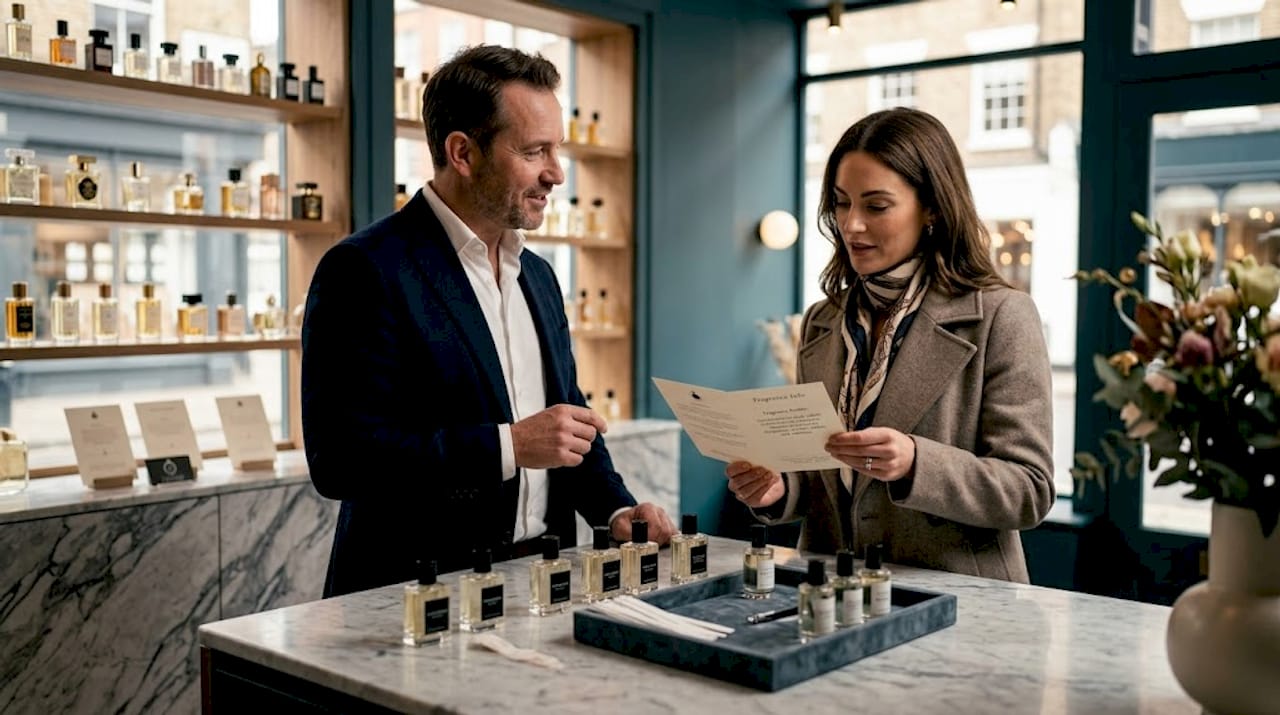
For serious luxury seekers, an expert-led consultation is worth considering. Well-trained fragrance consultants can map your preferences, lifestyle, and scent memories to specific fragrance families. This approach, recommended by Hello Magazine’s fragrance experts, is particularly effective when you are investing in a high-value purchase and want a more tailored experience.
4. Decants and sample sizes from specialist retailers
Decant retailers provide access to types of fragrance samples in 2ml, 3ml, 5ml, and 10ml sizes. This is the most flexible option. You select exactly what you want to test, from a wide range of designer fragrance sampling options, without committing to a full bottle.
| Method | Cost level | Variety | Personalisation | Best for |
|---|---|---|---|---|
| Official discovery sets | Medium | Limited to one house | Low | Brand-specific exploration |
| Subscription boxes | Low to medium | High | Medium | Broad discovery |
| Boutique consultations | Free to low | Curated by consultant | High | Targeted luxury purchases |
| Decant retailers | Low | Very high | High | Targeted, flexible testing |
Pro Tip: If you are new to luxury fragrance, start with a broad approach using decants or a subscription service to identify your preferred fragrance families. Once you know whether you lean towards woody orientals, fresh aquatics, or floral musks, narrow your focus to discovery sets or consultations for that category.
How to test and rank fragrances for real-world wear
Accessing samples is only half the process. The quality of your testing determines whether your eventual purchase is a success. Systematic testing produces reliable results. Ad hoc testing does not.
Step-by-step testing process:
-
Prepare your skin. Shower without heavily scented products. Avoid applying lotion or perfume beforehand. Your skin should be clean, lightly moisturised, and free from competing scents.
-
Apply to pulse points. Wrists, the inside of elbows, and the base of the throat are standard testing locations. These areas generate warmth, which activates fragrance development. Do not rub the wrists together; this damages the top notes.
-
Note the opening. Record your first impression within the first five minutes. This is the top note phase. It fades quickly and is not representative of how the fragrance will actually wear.
-
Track the heart. After fifteen to thirty minutes, the heart notes emerge. This is typically the most stable and revealing phase of the fragrance. Record how it has evolved and whether it still appeals.
-
Evaluate the dry-down. After two to four hours, the base notes dominate. This is what lingers on your skin and on clothing. It is also the phase that is most affected by your personal chemistry.
-
Score each fragrance. Use a consistent scoring system. Rate each sample on wearability, projection, longevity, and suitability for your intended use cases.
As confirmed by skin-based fragrance testing, tracking evolution over time across top, heart, and dry-down phases in multiple environments and days is the most reliable method for evaluating wearability.
| Testing phase | Timing | What to assess |
|---|---|---|
| Top notes | 0 to 10 minutes | Initial character, freshness, first impression |
| Heart notes | 15 to 45 minutes | Core character, complexity, appeal |
| Dry-down | 2 to 6 hours | Base notes, longevity, skin chemistry result |
| Environment re-test | Day 2 or 3 | Performance in different settings |
Use your notes to build a sample scent ranking that is based on evidence rather than memory. Memory is unreliable. Written notes are not.
It also helps to understand how the scent profile evolves across these phases. Fragrances with linear development can be easier to evaluate quickly, while complex, multi-layered scents may take several wears before you form an accurate opinion.
Pro Tip: Test your top three candidates in a real setting before making a final decision. Wear each one for a full day and notice how you feel wearing it, not just how it smells.
Troubleshooting common mistakes and maximising your results
Even with a structured approach, certain patterns undermine accurate results. Knowing what to watch for saves time and prevents poor purchasing decisions.
Common mistakes and how to fix them:
-
Over-sampling in one session. Testing more than three fragrances on skin in a single session causes olfactory fatigue. Your nose becomes unreliable after too many competing scents. Limit skin tests to two or three per day.
-
Relying solely on paper strips. Blotters are useful for quick elimination. They are not useful for evaluating wearability, longevity, or dry-down character. Always confirm on skin before ranking.
-
Testing immediately after eating strongly flavoured food. Garlic, spices, and alcohol can temporarily alter your skin chemistry and your olfactory perception. Test in neutral conditions.
-
Ignoring seasonal and environmental variables. A fragrance that performs beautifully in autumn may feel heavy and stifling in July. A light citrus that is perfect in summer might fade too quickly in cold weather. Scent behaviour varies by microclimate, so plan to re-test your shortlist on different days or environments before committing to a full size.
-
Making decisions on first impression alone. Top notes can be deceptive. They are designed to attract attention but they are not representative of the full fragrance experience.
“The most expensive mistake in fragrance is buying a full bottle based on a single wearing in a shop. Test multiple times, in multiple environments, before committing.”
When you are exploring niche fragrance sampling, be particularly patient. Niche fragrances are often more complex and unconventional than designer releases. They can require more wears before you reach an accurate judgement.
Understanding the key factors in picking a fragrance helps you set the right criteria before testing begins. If you know what you are evaluating, your notes will be far more useful.
Pro Tip: Keep a simple fragrance journal. Record the name, date, conditions, and your honest reaction at each stage. Review it after two weeks. Patterns will emerge that point clearly to the right choice.
Why the luxury fragrance sampling journey is about discipline, not abundance
There is a common misconception in fragrance enthusiast communities: that the best discovery process involves sampling as many fragrances as possible. More samples, more options, better decision. This is not accurate. In our experience, the opposite tends to be true.
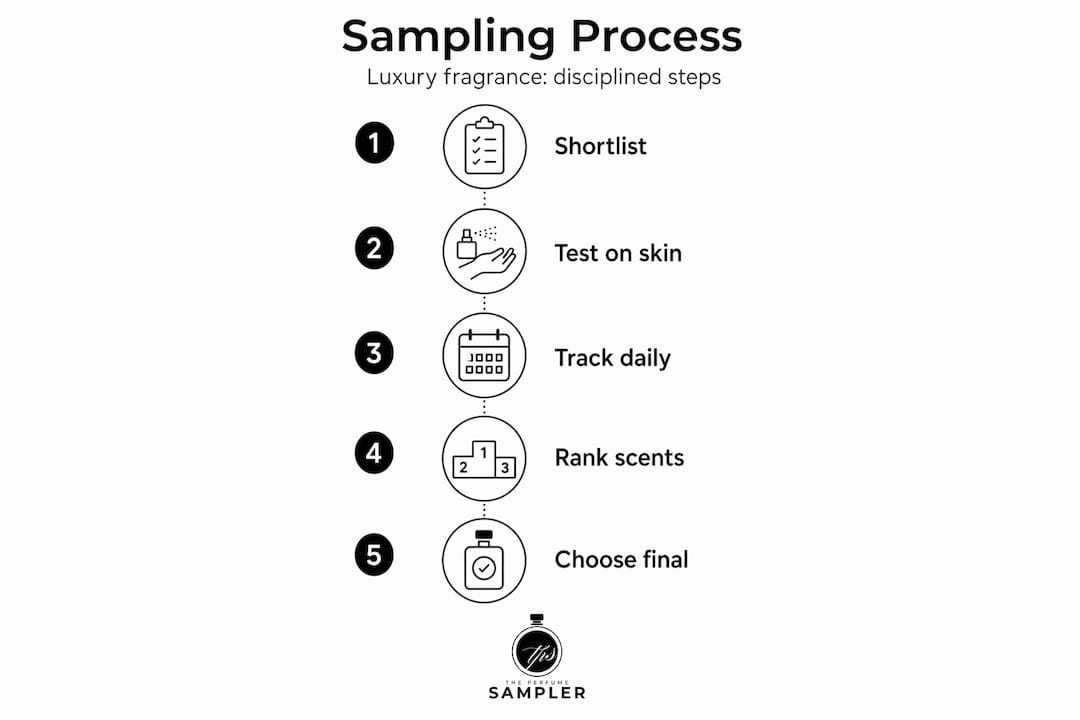
Discipline produces better outcomes than abundance. When you limit your shortlist to five or six candidates, you engage with each one more thoughtfully. You notice subtleties that get lost when you are rushing through a large batch. You give each fragrance the time it needs to reveal its full character.
Serious luxury fragrance discovery is an exercise in restraint. The goal is not to try everything. The goal is to find the right few. As one guide to shopping for perfume in Paris recommends, use a “fewer at a time” discipline and build a shortlist from paper first, then confirm on skin. This is the approach taken by perfumers, by seasoned collectors, and by boutique consultants.
It also connects to a deeper point about what luxury fragrance represents. These are not fast fashion purchases. A well-chosen fragrance becomes part of your identity. It is worth taking the time to find one that genuinely fits. Understand what defines luxury fragrances and you will approach the selection process with the seriousness it deserves.
Slower, more deliberate sampling leads to more satisfying choices. And more satisfying choices mean fewer expensive mistakes.
Continue your fragrance journey with curated samples
If you are ready to apply this process with access to genuine luxury and niche fragrance samples, ThePerfumeSampler offers exactly that. We provide 100% authentic fragrance decants in 2ml, 3ml, 5ml, and 10ml sizes, covering a wide range of high-end designer and niche houses.
Sampling before committing to a full bottle is a straightforward decision. Our decants are priced to make luxury fragrance accessible without compromise. You get the same quality as the full bottle, in a size that suits a proper testing routine. Find out more about why decants are the smart choice for any serious fragrance enthusiast, and browse our full range to build your shortlist today.
Frequently asked questions
What is the best way to test luxury fragrances for wearability?
Test on clean skin and track scent evolution hour-by-hour across multiple environments, taking detailed notes at each stage. This provides reliable data for making confident purchasing decisions.
How do fragrance subscription boxes help in the discovery process?
They provide regular exposure to different scents, which builds your knowledge of fragrance families and preferences faster. Subscription boxes can reduce decision paralysis by broadening your reference points steadily over time.
Why is testing on skin better than paper strips?
Skin testing shows how a scent actually develops throughout the day as it interacts with your personal chemistry. Testing on your own skin rather than paper reveals true performance and projection, which blotters cannot replicate.
How many fragrances should I test at once?
Limit skin tests to two or three per session, and build a shortlist from paper tests before committing to full skin trials. This keeps evaluations accurate and prevents olfactory fatigue.
Recommended
- Key factors for picking fragrance: Affordable luxury scents – ThePerfumeSampler
- Top luxury scent picks: accessible options for every budget – ThePerfumeSampler
- How to review luxury fragrances: step-by-step guide – ThePerfumeSampler
- Build a luxury fragrance collection with confidence – ThePerfumeSampler