
How to find your signature scent: a complete guide
TL;DR:
- Understanding fragrance families and notes helps narrow down scent choices effectively.
- Using proper tools and sampling methods ensures accurate testing and selection of a signature scent.
- Personalizing fragrances based on skin chemistry and context results in a more authentic and versatile scent wardrobe.
You’ve stood at a fragrance counter, sprayed something that smelled wonderful on a strip, bought the full bottle, and then worn it home only to find it smells completely different on your skin. It’s a frustrating and expensive lesson. Finding a signature scent is genuinely difficult because fragrance is personal, complex, and changes the moment it meets your body. This guide removes the guesswork. You’ll learn how to identify your preferences, use the right tools, test scents properly, and personalise your choice so you end up with a fragrance that truly belongs to you.
Table of Contents
- Understand fragrance families and notes
- Essential tools for fragrance discovery
- Step-by-step: test and evaluate your options
- Personalise your signature scent
- A personal approach to signature scent
- Discover your signature scent with expert-approved samplers
- Frequently asked questions
Key Takeaways
| Point | Details |
|---|---|
| Know fragrance families | Understanding scent categories is the foundation for a successful search. |
| Test on skin, not paper | Sampling on your body shows how the scent truly develops and lasts. |
| Avoid nose fatigue | Limit tests to a few fragrances per session for clear judgement. |
| Let it dry down | Wait for the dry-down phase to reveal the real long-lasting signature. |
| Sample before you buy | Try affordable discovery sets or decants to find your perfect match without risk. |
Understand fragrance families and notes
Before you start spraying anything, it helps to understand how the fragrance world is organised. Every perfume belongs to a family, and knowing which families appeal to you instantly narrows your search from thousands of options to a manageable shortlist.
The main fragrance families are:
- Floral – rose, jasmine, peony; classic, feminine, and romantic
- Woody – sandalwood, cedar, vetiver; warm, grounded, and long-lasting
- Fresh – citrus, aquatic, green; clean, light, and invigorating
- Amber/Oriental – vanilla, musk, resins; rich, sensual, and warming
- Fruity – peach, berry, apple; playful, sweet, and youthful
- Gourmand – caramel, coffee, chocolate; edible-smelling and indulgent
Each family contains hundreds of individual scents, so this is your starting point, not your final answer. As Elle recommends, identify preferred fragrance families by noting everyday liked smells and researching notes. Think about what you already enjoy: the smell of fresh linen, coffee in the morning, or a pine forest. Those associations point directly to a fragrance family.
Once you have a family in mind, it’s worth understanding how notes work. Perfumes are built in layers:
| Layer | When you smell it | Examples |
|---|---|---|
| Top notes | First 5-15 minutes | Citrus, herbs, light florals |
| Heart notes | 15-60 minutes in | Rose, jasmine, spice |
| Base notes | 60 minutes onwards | Wood, musk, amber, vanilla |
Top notes make the first impression, but they fade quickly. The heart and base are what you’ll actually wear all day. Many buyers make the mistake of judging a fragrance on the top notes alone. Exploring fragrance families in depth will sharpen your instincts, and reading up on perfume notes explained will help you decode any bottle’s description with confidence.
Pro Tip: Walk through your home and note which scents you actively enjoy, candles, cleaning products, fresh fruit on the counter. These preferences map directly onto fragrance families and give you an honest starting point before you ever visit a counter.
If you’re curious about how major houses approach scent creation, sampling designer scents from established brands is an excellent way to learn the vocabulary of each family firsthand.
Essential tools for fragrance discovery
Knowing the theory is useful. Having the right tools makes the practical side far more effective and enjoyable.
Here’s what you need before you start testing:
- Sample vials or decants – small quantities (2ml, 3ml, 5ml) to test over several days
- Scent strips (blotters) – useful for an initial impression before committing skin space
- Neutralising coffee beans – sniffing these between scents helps reset your nose
- Unscented moisturiser – hydrated skin holds fragrance better and gives a more accurate reading
- A notebook or notes app – record first impressions, dry-down impressions, and final verdicts
The comparison between buying discovery sets and purchasing full bottles blind is stark:
| Method | Cost | Risk | Flexibility |
|---|---|---|---|
| Discovery set / decants | Low | Very low | Test 10-15 scents per bottle cost |
| Blind full bottle | High | Very high | Stuck with one choice |
As research confirms, discovery sets make niche affordable with the cost of one bottle equalling 10 to 15 tests. That’s a compelling reason to sample first. You can read more practical sample testing advice to build your approach before investing.
Decants in particular are valuable for sampling niche perfumes that are otherwise priced out of casual experimentation. Many niche houses don’t offer testers in shops, so a 5ml or 10ml decant is the most honest way to evaluate them over several wearings.
Application technique matters too. Always apply to clean, moisturised skin. Spray or dab onto pulse points: inner wrists, neck, and inner elbows. Never rub. Rubbing crushes the molecular structure and distorts how the fragrance develops. Explore the various fragrance sampling methods to find the approach that works best for your testing routine.
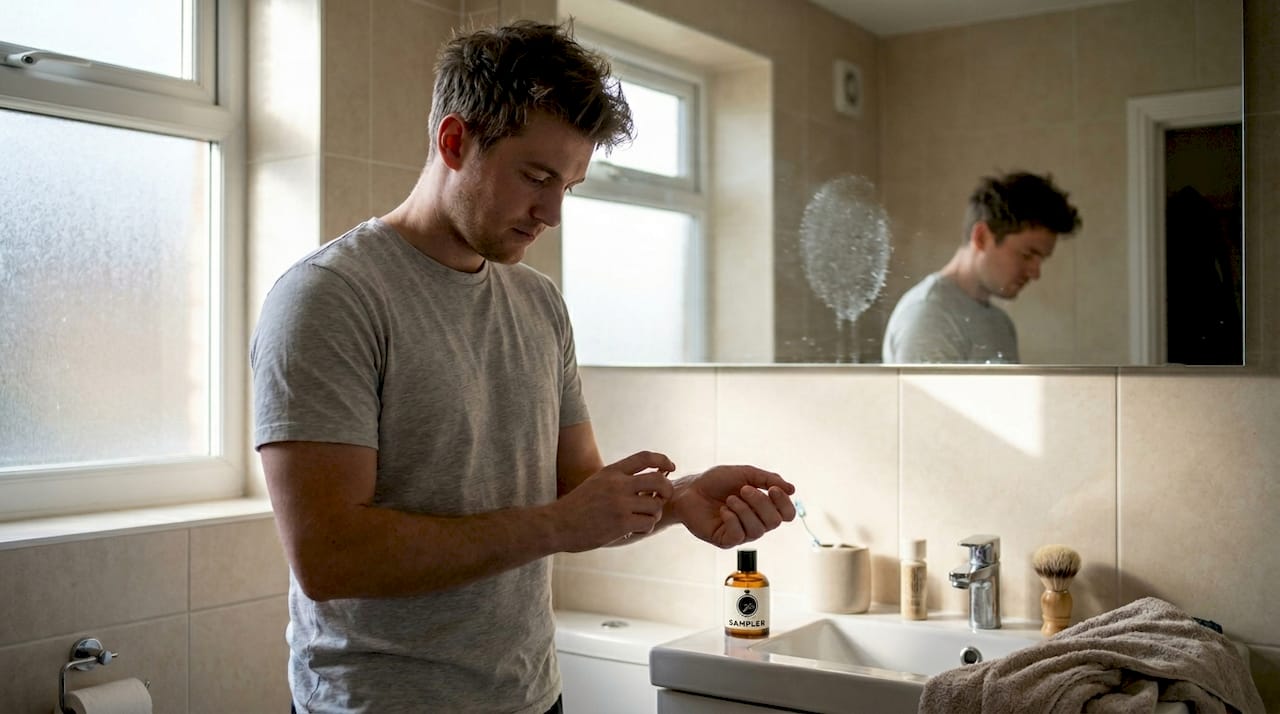
Pro Tip: Limit each testing session to 30-45 minutes. Olfactory fatigue, where your nose stops distinguishing between scents, sets in quickly. Keep sessions short, space them out across days, and return to candidates with a fresh nose for the most reliable results.
Step-by-step: test and evaluate your options
With the right tools available, you’re ready to move through the actual testing process. A structured approach here saves time and prevents wasted samples.
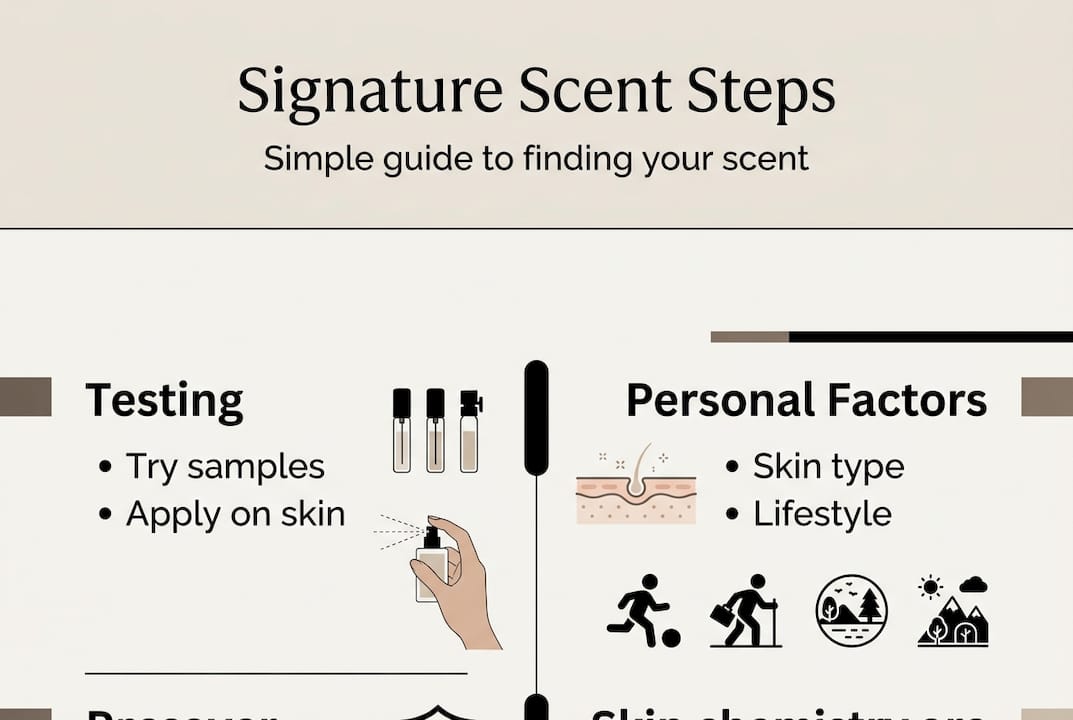
- Choose 3 to 4 candidates per session. Testing on pulse points and limiting to 3 to 4 scents per session gives the most reliable results. More than that and your nose becomes unreliable.
- Apply to skin, not strips. Strips give a useful first impression, but only skin reveals how a fragrance truly performs.
- Don’t rub. Let the scent settle naturally after application.
- Wait at least 30 minutes. The top notes that hit you first are not the scent you’ll wear all day. Patience here is essential.
- Evaluate the dry-down. Return to the fragrance after an hour and again after two hours. The base notes you experience at this stage are the real character of the scent.
- Log your impressions. Write down your immediate reaction, your 30-minute impression, and your hour-plus verdict. Note anything: an image, a feeling, a word. These records make comparison far easier later.
“The true signature emerges after the top notes fade. What remains in the dry-down is the version of the scent that becomes genuinely yours.”
Common mistakes to avoid include testing too many scents in one go, wearing other fragrances on the day, or applying directly after using strongly scented soap. All of these interfere with accurate assessment. Review skin testing guidance before your first serious session.
For best results, apply your candidates to different pulse points on the same day and keep notes comparing them directly. Information on applying perfume to pulse points gives a clear breakdown of optimal placement for both longevity and accurate evaluation.
Personalise your signature scent
Testing gives you candidates. Personalisation turns a candidate into your scent.
Skin chemistry plays a significant role. Body heat, pH, and your natural scent all interact with a fragrance and change how it develops. Skin chemistry alters scent, and multiple signature scents are entirely valid, especially for different seasons or moods. What smells outstanding on a friend may smell completely different on you.
Consider the context in which you’ll wear the fragrance:
- Work or daytime: lighter, fresher scents tend to be more appropriate and less overpowering in close environments
- Evenings or events: richer, deeper fragrances with strong base notes carry well and make more of an impact
- Casual everyday: something comfortable and easy to wear without overthinking
- Statement occasions: a bold or unusual choice that reflects personality
Building a small fragrance wardrobe is a practical and rewarding approach. Rather than searching for a single perfect scent, collect three or four that serve different purposes. There is no rule that limits you to one. Expert nuances on personal scent support this, noting that your signature evolves naturally over time.
Understanding how skin chemistry affects perfume helps you make sense of why the same bottle performs differently across wearers. And if you want to go deeper, mastering scent profiles explains how fragrances evolve across their full arc from application to dry-down.
Pro Tip: Never purchase a niche or high-end bottle without first wearing a sample on your skin for at least a full day. Bottle prices for quality niche fragrances can run into hundreds of pounds. A 5ml decant costing a few pounds is the most reliable insurance against an expensive mistake. This is especially true for bold or unconventional scents that polarise opinion. Read more about creating a unique fragrance identity before making that final investment.
A personal approach to signature scent
There is a common assumption that finding your signature scent means finding the one. One perfect fragrance that defines you forever. In practice, this idea causes more frustration than it solves.
Tastes shift. Your preferences at 25 are unlikely to be identical at 40. Seasons change. Your mood changes. A fragrance that felt right in winter may feel stifling in summer. The pursuit of one permanent answer often leads to burnout and missed opportunities to enjoy genuinely excellent scents.
Our view is that the search itself is valuable. Each sample you try teaches you something about your preferences. Each dry-down you evaluate sharpens your instincts. The process is not a problem to be solved and then forgotten. It’s an ongoing, genuinely enjoyable practice.
Judge fragrance by how it makes you feel on your skin, not by what’s trending or what a label suggests you should feel. Fragrance review wisdom is a useful resource for developing a critical, personal approach to evaluating scents on your own terms. Flexibility, curiosity, and patience will serve you far better than the pressure to find one definitive answer.
Discover your signature scent with expert-approved samplers
The most reliable and affordable route to finding your signature scent is through sampling before you buy. At ThePerfumeSampler, we offer 100% authentic fragrance decants in 2ml, 3ml, 5ml, and 10ml sizes, covering a wide range of high-end niche and designer fragrances.
Our decants let you wear a fragrance across multiple days, through every stage of its development, before committing to a full bottle. You’ll find carefully selected options across all fragrance families, from fresh and floral to deep woody and oriental. Discover exactly why decant samples are the smartest way to explore luxury fragrance. Start with a sample, wear it properly, and only then invest in the full bottle with complete confidence.
Frequently asked questions
How many scents should I test in one session?
Test 3 to 4 scents per session so your nose doesn’t become overwhelmed. Limiting to 3 to 4 scents per session gives the most accurate results and prevents olfactory fatigue from distorting your judgement.
What is the ‘dry-down’ and why does it matter?
The dry-down is the final, lasting phase of a fragrance after the top notes fade. Prioritising skin testing through the dry-down reveals the true character of the scent that will sit on your skin throughout the day.
Why does the same fragrance smell different on each person?
Skin chemistry and body heat change how a fragrance develops on each individual. Skin chemistry alters scent, with base notes blending with your natural odour to create a result unique to you.
Is it better to have one signature scent or a wardrobe of fragrances?
Both are valid approaches. A single scent offers consistency, while multiple scents allow flexibility across moods and occasions. Your signature evolves with life and mood, so allowing versatility is entirely reasonable.
Can I find a signature scent without spending a fortune?
Yes. Discovery sets and decants let you test high-end and niche scents affordably before committing. The cost of one bottle can fund 10 to 15 tests through well-chosen sample sets, making sampling the smartest financial decision.
Recommended
- What makes a fragrance truly unique: your scent guide – ThePerfumeSampler
- Explore fragrance families: find your signature scent affordably – ThePerfumeSampler
- How perfume empowers self-expression and personal style – ThePerfumeSampler
- How fragrances evolve: master scent profiles before you buy – ThePerfumeSampler