
Work professional fragrance guide: select, sample and impress
TL;DR:
- Choosing a professional fragrance involves selecting subtle, clean scents like citrus, soft woods, or green florals that subtly enhance your presence. Avoid bold, dense, or spicy perfume families such as gourmands, oud, or animalic musks to prevent overwhelming shared office spaces. Testing decants or sample sets allows you to find a suitable scent, respecting workplace policies and sensitivities, while maintaining personal expression with thoughtful rotation.
Choosing a fragrance for work sounds straightforward until you are standing in a department store, surrounded by hundreds of options, with no real way to know how a scent will perform across an eight-hour day in a shared office. The right fragrance can sharpen your professional presence and reinforce your personal identity. The wrong one can distract colleagues, trigger headaches, or flag you as someone who lacks self-awareness. Worse still, committing to a full bottle of a luxury scent before you truly know it can mean wasting significant money. This guide helps you make that decision with clarity and confidence.
Table of Contents
- How to choose a professional fragrance for work
- Best fragrance families for workplace success
- Sampling high-end fragrances without the commitment
- Fragrance etiquette: balancing self-expression and consideration
- What so many professionals overlook about office fragrance
- Explore premium fragrance decants and samplers
- Frequently asked questions
Key Takeaways
| Point | Details |
|---|---|
| Prioritise subtle scents | Opt for clean, light fragrances to make a positive, professional impression at work. |
| Sample before you buy | Use decants or samplers to discover your ideal scent without wasting money on full bottles. |
| Respect office policies | Always check workplace guidelines and consider colleagues’ sensitivities when wearing fragrance. |
| Balance confidence and courtesy | Your fragrance should boost your mood and professionalism, but never dominate the room. |
How to choose a professional fragrance for work
Before browsing bottles or sampling vials, it helps to understand what separates a workplace-appropriate fragrance from one better suited to an evening out. The core principle is restraint. A work scent should enhance your presence, not announce it from three metres away.
Fragrance families divide broadly into several categories. For workplace settings, the most consistently successful are:
- Clean citrus notes such as bergamot, lemon, and grapefruit. These are fresh, universally pleasant, and rarely offensive.
- Soft woods including cedarwood and sandalwood at low concentrations. They add quiet depth without heaviness.
- Green florals such as violet leaf or iris. These read as polished and understated in professional settings.
- Aquatics and musks at gentle concentrations. These are light, clean, and fade gracefully throughout the day.
Scent families to avoid in the office include dense gourmands (heavy vanilla, caramel, or chocolate notes), oud-based compositions, animalic musks, and heavily spiced orientals. These are bold by design and rarely land well in shared, enclosed spaces. Best office-friendly fragrances confirms the preference for clean, fresh, subtle scents like citrus, green floral, and soft woods over heavy gourmands, oud, or animalic notes.
Your workplace environment matters too. Open-plan offices, meeting rooms, and shared lifts all compress scent and amplify it beyond what you might notice when applying at home. Many organisations now also have formal or informal fragrance policies, particularly where staff members have documented allergies or respiratory sensitivities. Workplace fragrance allergy etiquette confirms that fragrances can boost confidence and mood, but the same source notes that allergies and no-fragrance policies are increasingly common in modern workplaces.
Before settling on a scent, review your employer’s HR handbook or ask your line manager whether a fragrance policy exists. This takes thirty seconds and could save a difficult conversation later.
You can also find detailed guidance in our luxury office fragrance guide and explore curated signature scent options tailored for professionals.
“The goal is to leave a pleasant impression, not a lasting trail. In professional settings, subtlety is the mark of considered taste.”
Pro Tip: If you wear a lighter eau de cologne concentration, apply it to clothing or hair rather than pulse points. This extends wear time without intensifying projection at body heat.
Best fragrance families for workplace success
Now that you have a framework, it is worth examining specific scent families in more detail and understanding why they work so well in business contexts.
| Scent family | Characteristic notes | Longevity | Best suited to |
|---|---|---|---|
| Citrus | Bergamot, lemon, neroli | 2 to 4 hours | Morning meetings, client-facing roles |
| Green floral | Violet leaf, iris, green tea | 3 to 5 hours | Office environments, creative sectors |
| Soft wood | Cedarwood, vetiver, light sandalwood | 4 to 6 hours | Professional services, finance |
| Aquatic musk | Sea salt, white musk, ambrette | 3 to 5 hours | Open-plan offices, travel-heavy roles |
| Fougère | Lavender, oakmoss, coumarin | 4 to 7 hours | Traditional business environments |
The table above makes it clear that soft woods and fougère styles offer the best balance of longevity and professional suitability. Citrus scents are excellent for morning wear but may fade before an afternoon of back-to-back meetings.
Standout examples worth exploring:
- Jo Malone London Basil and Neroli is frequently cited as an office-appropriate classic, combining clean citrus and herbal green notes with a subtle woody base.
- Hermès Eau de Gentiane Blanche is almost universally inoffensive, sitting in that clean musk territory that appeals to a wide range of preferences.
- Maison Margiela Replica: Coffee Break offers warmth without heaviness, ideal for creative industry professionals.
- Xerjoff Naxos leans slightly richer but, worn lightly, projects as quietly confident rather than bold.
For professionals looking at our workplace perfume recommendations or our curated designer fragrance picks, these families are well represented across both ranges.
The key insight here is this: fragrance that reads as “appropriate” in an office setting tends to be the kind that earns compliments without dominating the conversation. People notice it pleasantly, then move on. That is the target.
Sampling high-end fragrances without the commitment
Knowing which scent families suit your workplace is useful. Knowing which specific fragrance suits you requires actual testing. This is where decants and sample sizes change the equation entirely.
A fragrance decant is a measured quantity of authentic perfume transferred into a smaller bottle, typically 2ml, 3ml, 5ml, or 10ml. These allow you to test exactly how a scent performs on your skin, at work, across different seasons and times of day, without spending £100 to £400 on a full bottle first.
The financial case is simple:
| Option | Cost | Risk | Bottles worn out |
|---|---|---|---|
| Full bottle (50ml) | £80 to £350 | High if you dislike it | 1 |
| Decant (5ml sample) | £8 to £25 | Very low | 10 to 15 tests possible |
| Sample set (5 x 2ml) | £15 to £40 | Minimal | Multiple options explored |
The value proposition from decants is well established: brands like Xerjoff and Maison Francis Kurkdjian (MFK) sit at premium price points that make full bottle purchases a significant commitment. Decants give you access to these houses at a fraction of the cost.
How to evaluate a fragrance sample properly:
- Apply a small amount to your inner wrist or lower arm in the morning.
- Go about your normal routine for at least four to six hours.
- Check the scent at the two-hour mark, when top notes have settled.
- Check again at four to six hours to assess the dry-down and base notes.
- Ask a trusted colleague or friend for honest feedback, since our noses adapt quickly to our own scent.
- Repeat on a different day to confirm your response is consistent.
You can also find practical guidance in our articles on sampling designer scents and niche fragrance sampling tips.
Pro Tip: Test no more than two fragrances at a time. Any more than that and your olfactory system becomes confused, making accurate assessment unreliable. One on each wrist is the professional approach.
Decants also solve a problem that full bottles cannot: the fragrance wardrobe. Rather than committing to a single bottle year-round, you can rotate between a crisp citrus for warm months and a warm cedarwood for winter, without spending hundreds on each option.
Fragrance etiquette: balancing self-expression and consideration
Even if you have found the ideal professional fragrance and perfected your application, the final piece is behavioural. How and when you wear your scent matters as much as which scent you choose.
The workplace fragrance dos:
- Apply before leaving home, not in shared office spaces or communal bathrooms.
- Use one to two sprays maximum for office wear.
- Apply to the chest or the base of the neck for modest projection.
- Consider going lighter on days when you have back-to-back meetings or work in a smaller team space.
- Carry a sample vial for touch-ups only if the scent is genuinely undetectable after several hours.
The workplace fragrance don’ts:
- Do not apply to your wrists and then rub them together. This alters the molecular structure of top notes and creates an unintended result.
- Do not re-apply mid-morning simply because you can no longer smell it yourself. Colleagues may still detect it clearly.
- Do not layer multiple scented products, such as body lotion and perfume from different fragrance families, without checking they complement each other.
“Fragrance can enhance professionalism and personal energy, but in shared spaces it can also trigger migraines and allergic reactions, leading to HR interventions.” Harper’s Bazaar
Office scent sensitivity errors to avoid:
- Assuming colleagues who say nothing are comfortable with your fragrance level.
- Wearing fragrance on days when you know a meeting includes someone with documented sensitivities.
- Ignoring posted or emailed fragrance policy guidelines from HR or facilities.
- Wearing an intense concentration such as an extrait or parfum to the office without reducing your application quantity accordingly.
If your workplace has a formal fragrance policy, respect it unconditionally. One case study from a US-based organisation found 95% staff compliance was achievable through education and clear communication rather than enforcement. Awareness changes behaviour.
For technical guidance on how fragrance behaves across different conditions, our fragrance impact guide and fragrance guidelines are both practical references.
What so many professionals overlook about office fragrance
Here is an opinion you will not often read: the professionals who use fragrance most effectively at work are rarely the ones with the most expensive bottle. They are the ones who wear the least.
The assumption that a premium, complex, or bold fragrance signals status is widespread and, frankly, mistaken. In most professional environments, a scent that earns a single “that smells nice” from a colleague twice a week is worth infinitely more than one that dominates a meeting room. The latter signals a lack of social awareness, not confidence.
The concept of a fragrance wardrobe is something worth building intentionally. A morning spray of a clean citrus for a breakfast briefing. A soft cedarwood on a slower afternoon when you are at your desk. A polished fougère for an evening client dinner. Each scent is chosen for the context, not simply applied out of habit.
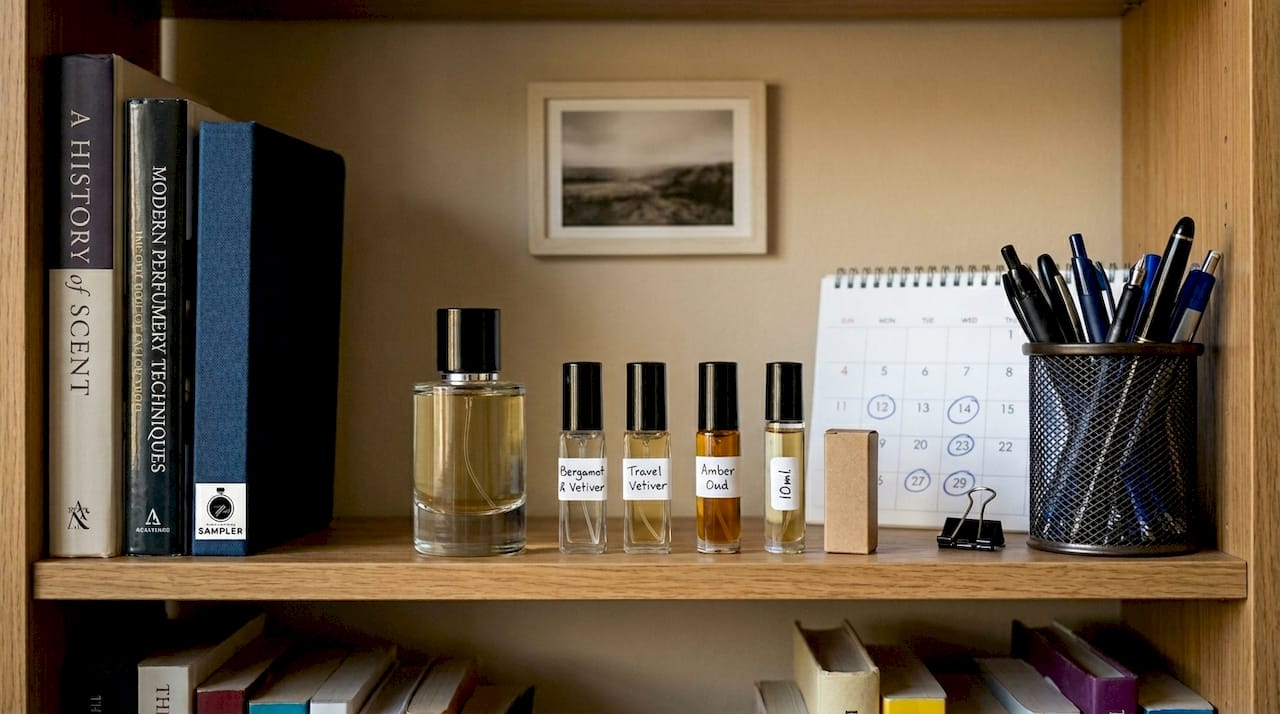
This is where decants earn their place in a working professional’s routine. They make rotation affordable. They make experimentation risk-free. And they prevent the frustrating situation of owning a beautiful but entirely impractical full bottle.
The other thing professionals routinely overlook is the connection between perfume and self-expression. Fragrance is a genuine element of personal branding. Used well, it is memorable and considered. Used carelessly, it becomes a distraction. The choice is yours, and it starts with testing first.
Explore premium fragrance decants and samplers
If this guide has clarified what you are looking for, the sensible next step is to start testing rather than buying blind.
At The Perfume Sampler, we offer 100% authentic fragrance decants in 2ml, 3ml, 5ml, and 10ml sizes across a curated range of designer and niche houses. Our samples let you wear a scent properly, across a full working day, before you decide whether to invest in a full bottle. You can read more about why decants are the smart professional’s approach to fragrance discovery. If you have already identified your ideal scent, our full bottles collection offers premium options at competitive prices. Start with a sample. Buy with confidence.
Frequently asked questions
What makes a fragrance ‘work appropriate’?
A workplace-appropriate fragrance is clean, subtle, and projects at a low level. Citrus, soft woods, and green florals are the preferred choices over bold, dense gourmands, oud, or animalic compositions.
How can I sample luxury fragrances affordably?
Decants and sample sets provide direct access to premium houses like Xerjoff and MFK without the cost of a full bottle, making it straightforward to test several options before committing.
What if my colleague is sensitive or allergic to fragrance?
Switch to hypoallergenic products or go fragrance-free on relevant days. Many workplaces have formal scent guidelines, and fragrance policies are common in environments where sensitivities have been documented by HR.
Is there an ideal way to apply fragrance for work?
Apply lightly to the chest or neck, avoid rubbing the wrists as this alters the fragrance notes, and test a sample across a full working day before settling on a regular office scent.