
Why perfume smells different on your skin
TL;DR:
- Your skin chemistry, including oils, hydration, and pH, causes perfumes to smell uniquely on each person. Environmental factors like season, temperature, and activity further influence fragrance performance, altering projection and longevity. Perfumer design accounts for skin variability, making personal testing essential to discover scents that truly suit individual chemistry.
The same bottle of perfume can smell completely different on two people standing side by side. That is not a coincidence or a sign that something is wrong. It is the result of your biology, your environment, and the way fragrance molecules interact with everything that makes you unique. Understanding why this happens does not just satisfy curiosity. It gives you a practical advantage when choosing, wearing, and getting the most out of every fragrance you own or try.
Table of Contents
- The science behind scent and skin
- How your skin chemistry changes a perfume
- The impact of environment: season, humidity, and activity
- How perfumers design for individual skin
- What most fragrance guides don’t tell you about skin chemistry
- Discover your signature scent experience
- Frequently asked questions
Key Takeaways
| Point | Details |
|---|---|
| Skin chemistry matters | Oils, hydration, and pH on your skin change how a perfume smells and lasts. |
| Environment influences scent | Heat, humidity, and activity levels affect a fragrance’s projection and development. |
| Sampling is essential | Testing on your own skin is the only way to know how a perfume will truly perform for you. |
| Personal signature | Every person creates a unique rendition of any perfume thanks to their individual biology. |
The science behind scent and skin
Fragrance does not exist in isolation. The moment you spray perfume onto your skin, a complex set of chemical interactions begins. Your skin is not a neutral surface. It is alive, constantly producing oils, moisture, and heat, all of which directly affect how fragrance molecules behave.
Skin oils (sebum) act as a fixative, helping fragrance molecules dissolve, adhere, and release more slowly. This means the same perfume can feel richer on oilier skin, blend differently with your natural scent, and genuinely last longer. Drier skin, by contrast, absorbs fragrance faster and may cause it to fade sooner. This is one of the most significant and frequently overlooked reasons why a scent that lasts all day on one person may disappear within a couple of hours on another.
“Your skin is the final ingredient in any fragrance. Without accounting for it, you are only ever smelling half the picture.”
Hydration levels also matter. Well-moisturised skin creates a slightly different chemical environment at the surface, which affects how individual fragrance notes emerge and evolve. pH, the measure of acidity or alkalinity, plays a supporting role too. Most human skin sits between pH 4.5 and 5.5, but this varies from person to person and even across different areas of the body. Fragrance molecules interact differently depending on the local pH level they encounter.
Understanding how fragrances evolve through their top, heart, and base notes is directly connected to these skin factors. The same fragrance structure unfolds differently depending on who is wearing it.
| Factor | Effect on fragrance |
|---|---|
| Sebum (skin oils) | Acts as a fixative; helps molecules adhere and release slowly |
| Skin hydration | Affects how notes emerge; dry skin absorbs faster |
| Skin pH | Can sharpen or smooth certain fragrance materials |
| Body temperature | Increases evaporation; boosts projection and diffusion |
The difference between skin and paper testing is significant. A blotter strip carries none of your natural oils, moisture, or warmth. It shows you a version of the fragrance, but not your version. Testing on your wrist or inner elbow is the only reliable way to experience how a perfume will actually develop on you.
How your skin chemistry changes a perfume
Your biology is not fixed. Skin type, hydration, hormone levels, and even what you ate for lunch can all shift your personal skin chemistry from one day to the next. This is why perfume can behave as if it is a different product entirely depending on who wears it and when.
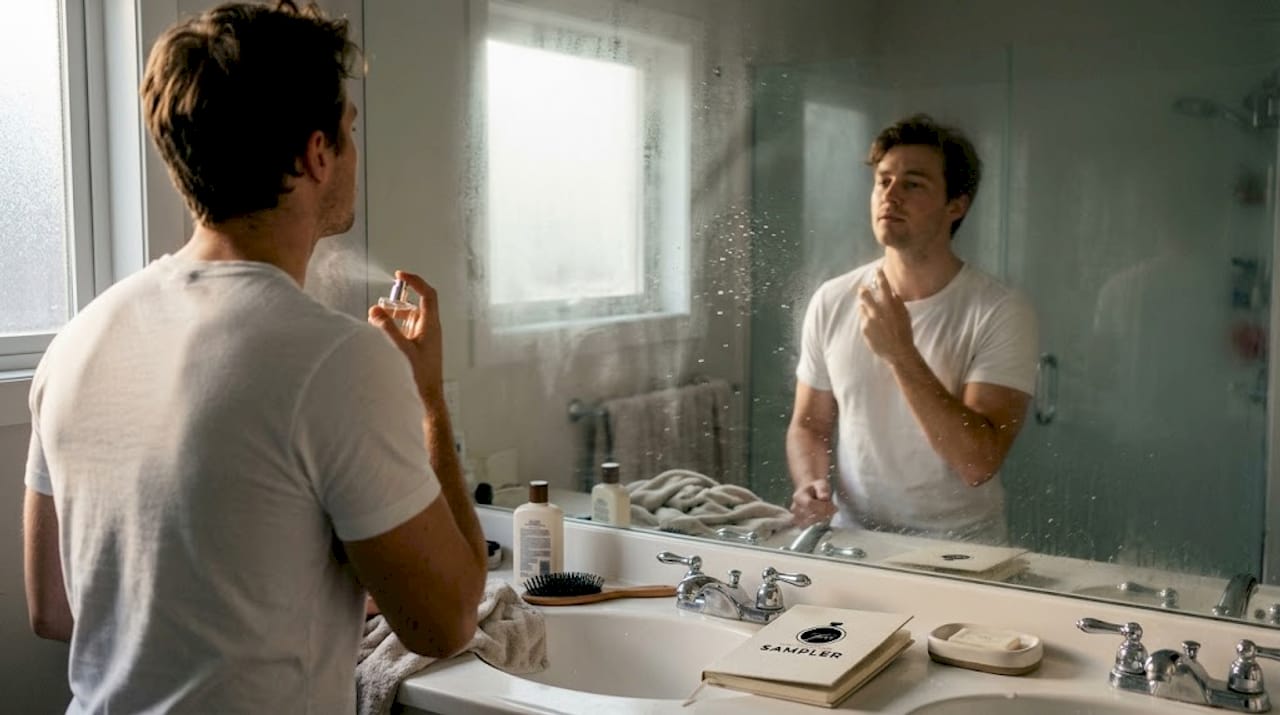
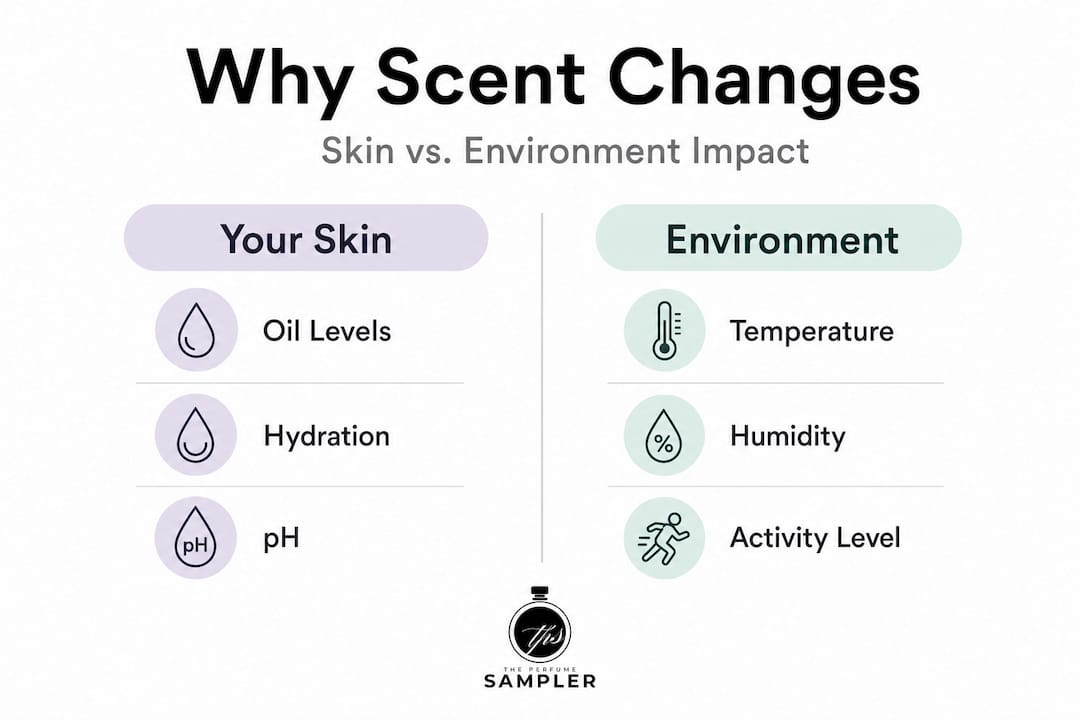
Skin pH can shift how certain fragrance materials read during wear. For most wearers, though, pH is not the single biggest driver of difference. Oil level, hydration, and temperature tend to have a more immediate and noticeable impact on how a fragrance performs day to day.
Body temperature and activity increase evaporation, so perfume can project more immediately after exercise or in heat, then drop off differently over time. A quick walk or a warm room can turn a soft, close-to-skin scent into something far more assertive and present. This is not the fragrance changing. It is your body influencing the rate at which it releases.
It is worth noting that tap water affects skin pH, and since most people shower daily, the water quality in your area may subtly influence your skin’s baseline chemistry. Hard water, in particular, can leave a residue that alters the surface environment where your fragrance sits.
| Skin type | Typical behaviour |
|---|---|
| Dry skin | Fragrance fades faster; top notes may disappear quickly |
| Balanced skin | Reasonable longevity; notes develop as expected |
| Oily skin | Longer lasting; fragrance may smell richer or more intense |
Here is how your skin type influences each stage of a fragrance:
- Opening (top notes): These evaporate quickly regardless of skin type, but drier skin may make them disappear even faster.
- Heart notes: Oilier skin holds the mid section of a fragrance longer, giving it more depth and development time.
- Dry down (base notes): The final stage is most affected by your skin’s oil content. Oily skin often makes base notes smell warmer and more anchored.
- Overall projection: Temperature and activity level play the biggest role here. Warm skin projects further.
Knowing about perfume performance factors helps you make better decisions when selecting a fragrance and also explains why a scent that has rave reviews may perform very differently for you personally.
Pro Tip: If your fragrances consistently fade within two hours, try applying an unscented moisturiser to pulse points before spraying. This simple step can significantly extend longevity, especially for those with drier skin. There are also specific techniques covered in detail in the guide on making fragrances last longer that are worth reading.
The impact of environment: season, humidity, and activity
Your skin is only part of the equation. The world around you has just as much influence on how a fragrance smells and performs. Temperature, humidity, season, and physical activity all interact with the evaporation rate of fragrance molecules, changing what you and others smell.
Season, humidity, and context affect how a fragrance behaves and how you perceive it, whether the scent projects outward or stays close to the skin. These environmental factors interact directly with how the perfume evaporates on your skin. A fragrance that seems perfectly balanced in spring can feel overwhelming in summer heat or barely noticeable on a cold winter day.
Here is how each season influences scent behaviour:
- Summer: Heat accelerates evaporation. Projection is greater, but longevity can actually suffer. Heavy, resinous fragrances may become overpowering. Lighter, citrus-based or aquatic scents tend to perform better.
- Autumn: Moderate temperatures allow fragrances to develop at a steadier pace. Woody and spicy notes often come into their own during this season.
- Winter: Cold air slows evaporation significantly. Top notes may not project as strongly. Base notes become more dominant and persistent. You often need to apply more to get the same presence.
- Spring: Humidity starts to rise. Floral and green fragrances tend to shine. Scent projection is moderate and development is often at its most balanced.
Physical activity adds another layer of complexity. Exercise raises your body temperature and increases perspiration. Both of these factors amplify evaporation, which can create a sudden burst of fragrance intensity followed by a faster fade. Some wearers find that their favourite scent smells slightly different after a workout not because it has changed, but because the heat and sweat have altered the skin environment around it.
Pro Tip: Consider keeping two versions of your signature scent: a lighter concentration such as an eau de toilette for summer and active occasions, and a stronger eau de parfum for winter or evenings. This approach works with your environment rather than against it.
Understanding the full picture of fragrance performance means you can make smarter choices about which fragrance to wear and when. It is also worth keeping in mind that reformulations can affect how a perfume behaves in different conditions. Reading up on perfume reformulation is useful context for any serious fragrance enthusiast.
How perfumers design for individual skin
Perfumers are aware that their creations will land on thousands of different skin types, in different climates, and under different conditions. This is not an afterthought. It is part of the engineering process from the very beginning.
Fragrance houses design molecules and blends for target performance, balancing character and longevity. Individual skin environments then create a personalised version of that intended profile. The perfumer sets the intention. Your skin writes the final chapter.
This is why two people wearing the same niche or designer fragrance can describe it in entirely different terms. One person might describe it as a warm, woody oriental. Another might experience the same bottle as a softer, floral amber. Neither is wrong. Both are accurate descriptions of what is genuinely happening on their skin.
“Your skin is always the co-author of any fragrance you wear.”
Paper lacks the skin’s oils, hydration layer, and live surface environment, so the same perfume typically opens differently on a strip than on skin. Testing on your skin is always the most reliable way to predict how a fragrance will develop for you personally.
Here are some practical guidelines for testing fragrances properly:
- In store: Apply to the inner wrist or inner elbow. Wait at least 20 to 30 minutes before making a judgement. The opening notes are rarely representative of the full experience.
- Limit your testing: Testing more than three or four fragrances at once makes it very difficult to distinguish between them. Your nose adapts quickly.
- Test on multiple days: Your skin chemistry can shift slightly depending on hydration, stress, and hormones. A second test on a different day gives you a more reliable picture.
- At-home sampling: This is where genuine discovery happens. Wearing a fragrance for a full day gives you information that no shop visit can replicate.
Understanding the fragrance house approach to creating and engineering scents helps you appreciate why a sample tested at home over several hours is worth far more than a quick spray in store.
What most fragrance guides don’t tell you about skin chemistry
Most fragrance guides treat skin chemistry as a footnote, a brief mention before moving on to notes pyramids and longevity ratings. That approach misses the point entirely.
The reality is that your skin chemistry is not a problem to be solved or a variable to be minimised. It is genuinely what makes fragrance interesting. The fact that a perfume smells uniquely different on you compared with anyone else is not a flaw in the system. It is the system working exactly as it should.
There is a tendency in the fragrance community to chase objectivity. People want to know the definitive answer to “does this smell good?” But fragrance is inherently subjective, and skin chemistry is one of the main reasons why. When a much-praised fragrance smells wrong on you, the issue is not your skin. It is simply that the particular combination of your biology and that blend did not connect. That is neutral information, not a failure.
We think the most useful shift any fragrance enthusiast can make is to stop looking for validation from reviews and start trusting their own senses. The person who wore a fragrance in a review you read has different skin, a different environment, and a different nose. Their experience is a starting point, not a verdict.
Fragrance and self-expression are deeply connected. Your skin chemistry is not an obstacle. It is actually what makes your fragrance choice genuinely personal. Sampling widely, testing properly, and paying attention to your own responses over time is the most practical approach available. No chart or rating system replaces the information you gather by wearing something yourself.
Discover your signature scent experience
Understanding your skin chemistry is one thing. Finding the fragrances that work best with it is another step entirely. The most effective way to do that is to sample broadly, test properly, and make decisions based on how fragrances actually perform on you.
At The Perfume Sampler, we offer fragrance decants in 2ml, 3ml, 5ml, and 10ml sizes, covering both niche and designer fragrances. These sizes are designed specifically for proper at-home testing, giving you enough product to wear through multiple stages and across different days. You can read more about the value of exploring decants before committing to a full bottle. All fragrances are 100% authentic. Sampling is not a compromise. It is the most informed way to build a fragrance collection that works for your skin, your lifestyle, and your preferences.
Frequently asked questions
Can my diet or medication affect how perfume smells on me?
Yes, factors like diet and medication can alter your skin chemistry, subtly changing how fragrances develop. Certain foods and medicines can shift your skin’s pH or oil production, both of which influence fragrance performance.
Why does my favourite scent smell ‘off’ during the winter?
Cold weather slows evaporation, making top notes less noticeable while base notes can last longer. Season and context affect how a fragrance behaves, which is why winter wear often requires reapplication or a heavier concentration.
Does everyone pick up the same notes in a perfume?
No, individual noses, skin chemistry, and sensory adaptation mean every wearer can experience different notes. Paper lacks the oils and live surface of skin, so even testing method changes what you perceive.
Is it worth testing a perfume on a blotter strip?
Paper strips give a useful initial sense of the fragrance direction, but only skin can reveal how it will truly smell on you. Testing on skin is the most reliable way to predict how a fragrance will develop for you personally.
Recommended
- What affects perfume performance: fragrance guide – ThePerfumeSampler
- Types of perfume notes: Unlock fragrance layers and lasting power – ThePerfumeSampler
- What makes a fragrance truly unique: your scent guide – ThePerfumeSampler
- Uncovering perfume prices: What makes fragrance cost vary? – ThePerfumeSampler