
What makes a fragrance truly unique: your scent guide
TL;DR:
- Fragrance uniqueness depends on composition, perfumer skill, and interaction with skin chemistry.
- The scent pyramid shows how top, middle, and base notes evolve, influencing overall scent perception.
- Niche and designer fragrances differ in ingredients, concentration, and creative freedom, affecting their distinctiveness.
Most fragrance lovers assume that what makes a scent special is simply the brand name on the bottle or a list of exotic ingredients on the label. That assumption misses a great deal. A fragrance’s uniqueness is shaped by its composition, the skill of the perfumer who created it, and critically, how it interacts with your own skin. No two people wear the same scent in exactly the same way. This guide covers the science of scent structure, the role of ingredients, the difference between niche and designer fragrances, and how the perfumer’s craft brings it all together, so you can make smarter, more confident choices when exploring new scents.
Table of Contents
- Understanding the fragrance pyramid: How scents evolve
- The role of ingredients: Natural, synthetic, and rare
- Niche versus designer fragrances: Creativity, rarity, and concentration
- The perfumer’s artistry: Crafting harmony and individuality
- Why true fragrance uniqueness is deeply personal
- Explore and sample fragrances to discover your unique scent
- Frequently asked questions
Key Takeaways
| Point | Details |
|---|---|
| Fragrance pyramid matters | Top, heart, and base notes shape how a scent evolves and lasts on your skin. |
| Ingredients drive uniqueness | Blends of natural, synthetic, and rare components can significantly impact a perfume’s signature. |
| Niche versus designer | Niche fragrances offer creativity and rarity, but designers can deliver reliability and wearability. |
| Perfumer expertise counts | Expert blending and maturation create harmony and individuality in each scent. |
| Personal testing is key | Test samples on your skin for hours to see how a fragrance truly reveals itself for you. |
Understanding the fragrance pyramid: How scents evolve
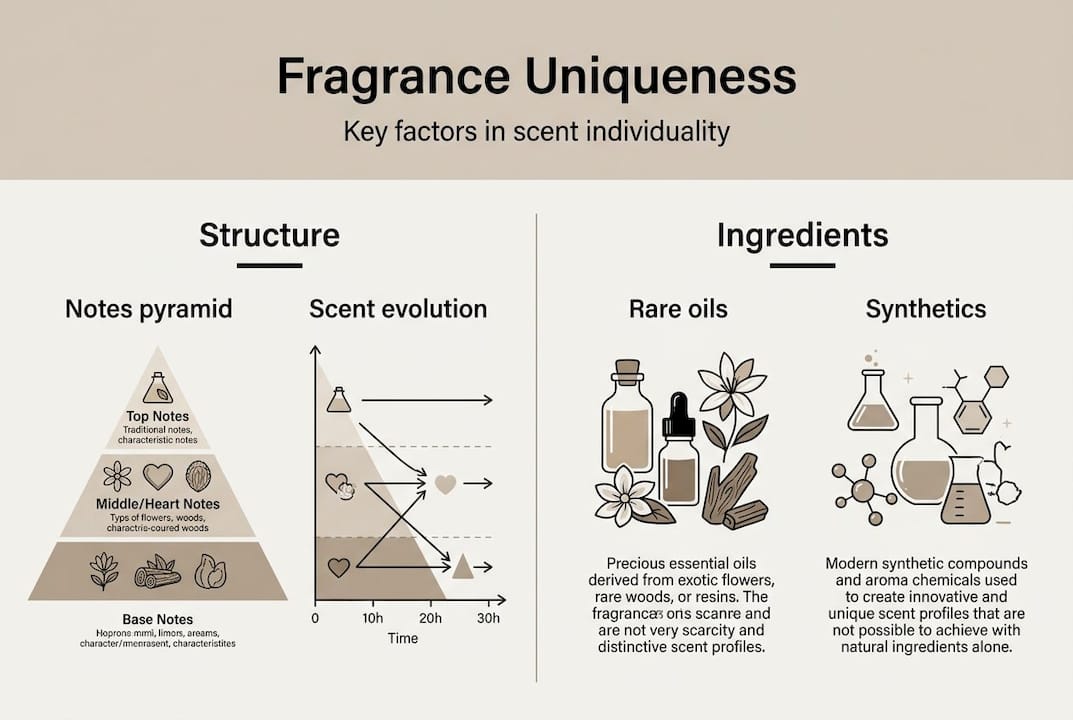
Every fragrance you wear is structured in layers. Fragrances are built as a pyramid of top, heart, and base notes that evaporate at different rates, creating a scent that shifts and evolves from the moment you apply it. Understanding this structure is the first step to understanding why two people wearing the same bottle can smell entirely different.
Here is how the three layers work:
- Top notes are what you smell first. They are light, fresh, and volatile, meaning they evaporate quickly. Citrus, herbs, and light florals are common here. Top notes typically last between 5 and 15 minutes.
- Heart notes form the core of the fragrance. They emerge once the top notes fade and tend to be richer and more complex. Florals, spice, and green notes are typical. Heart notes last anywhere from 15 minutes to around 3 hours.
- Base notes are the foundation. They are the heaviest molecules and the slowest to evaporate. Woods, musks, resins, and vanilla are common base notes. These can linger on skin for 3 hours or considerably longer.
This evolution is why you should never judge a fragrance solely from the first spray. What you smell in the opening moments is not what you will be wearing an hour later. The fragrance pyramid explained in full detail shows just how dramatically a scent can shift across its lifecycle.
| Layer | Typical notes | Duration on skin |
|---|---|---|
| Top notes | Citrus, herbs, light florals | 5 to 15 minutes |
| Heart notes | Floral, spice, green | 15 minutes to 3 hours |
| Base notes | Wood, musk, resin, vanilla | 3 hours and beyond |
Your skin chemistry plays a significant role in this process. Skin pH, moisture levels, and natural oils all influence how quickly notes evaporate and how prominently each layer comes through. This is why scent profile evolution is such a personal experience. You can also experiment with fragrance layering to build your own distinct combination across these note layers.
Fact: Base notes can account for up to 50% of a fragrance’s total formula weight, making them the structural backbone of any scent.
The role of ingredients: Natural, synthetic, and rare
Now that you understand scent structure, it is time to consider what truly sets each fragrance apart: the ingredients. Unique blends of natural and synthetic ingredients form the core composition of any fragrance, and the balance between them determines everything from the scent character to how long it lasts on your skin.
Natural ingredients are derived from plants, flowers, resins, and animal sources. They tend to be complex, nuanced, and sometimes unpredictable, as their quality can vary depending on the harvest or origin. Synthetic ingredients, by contrast, are created in a laboratory. They offer consistency, stability, and access to scents that do not exist in nature or are too costly to extract at scale.
Here is a breakdown of common ingredient types and their typical scent contributions:
- Rose and jasmine (natural florals): Rich, romantic, and feminine. Used in countless classic and modern fragrances.
- Bergamot (natural citrus): Fresh, slightly spicy, and uplifting. A staple top note in many designer scents.
- Sandalwood (natural wood): Warm, creamy, and smooth. Often used as a base note for longevity.
- Iso E Super (synthetic): A woody, cedar-like molecule that adds depth and skin-close warmth.
- Ambroxan (synthetic): A modern musk with a clean, skin-like quality. Widely used in contemporary fragrances.
- Oud (rare natural): Derived from infected agarwood resin. Intensely woody, smoky, and complex. One of the most expensive raw materials in perfumery.
Rare ingredients are where niche fragrances often distinguish themselves. Luxury fragrance ingredients such as Haitian vetiver, Grasse rose absolute, or aged oud can cost thousands of pounds per kilogram and contribute to a scent’s rarity and prestige.
| Ingredient type | Source | Typical role | Cost level |
|---|---|---|---|
| Natural florals | Plants, flowers | Heart notes | Moderate to high |
| Natural woods/resins | Trees, bark | Base notes | High |
| Synthetic molecules | Laboratory | Top or base | Low to moderate |
| Rare naturals (oud, iris) | Rare botanical sources | Signature notes | Very high |
Understanding perfume ingredient choices helps you evaluate why certain fragrances are priced as they are and what you are actually paying for.
Niche versus designer fragrances: Creativity, rarity, and concentration
Ingredients are only part of the story. The brand behind a fragrance shapes its uniqueness in meaningful ways. Niche fragrances achieve uniqueness through rare ingredients, higher concentrations, small-batch production, and artistic freedom, whereas designer fragrances focus on mass appeal and broad wearability.
Here is how the two categories compare in practical terms:
| Feature | Niche fragrances | Designer fragrances |
|---|---|---|
| Oil concentration | 20 to 30% | 10 to 20% |
| Ingredient sourcing | Rare, specialist | Widely available |
| Production scale | Small batch | Mass market |
| Creative direction | Artistic, experimental | Commercial, accessible |
| Price point | Higher | Moderate to high |
Niche houses such as Maison Margiela, Creed, and Amouage operate with fewer commercial constraints. Their perfumers can use unusual accords, unconventional structures, and costly raw materials without worrying about whether the scent will appeal to millions of customers. This creative freedom often results in fragrances that are polarising, complex, and memorable.
Designer fragrances from houses such as Chanel, Dior, and Hugo Boss are crafted with a different goal. They need to work on a wide range of skin types, in various climates, and across different occasions. This does not make them inferior. It makes them reliable and, in many cases, genuinely excellent.
Key considerations when choosing between the two:
- Consider the occasion. Niche scents can be bold and unusual. Designer scents are often more versatile.
- Consider your budget. Niche fragrances carry a premium. Sampling first is always the smarter approach.
- Consider longevity. Higher oil concentrations in niche fragrances often mean longer wear time.
Pro Tip: Use designer fragrance sampling and niche sample sets side by side to compare how each category performs on your skin before committing to a full bottle. The signature scent sampling approach saves both money and disappointment.
The perfumer’s artistry: Crafting harmony and individuality
Next, we reveal the human artistry behind every bottle. Perfumer expertise involves precise proportions, trial-and-error blending, and maturation for harmony and longevity. The perfumer, sometimes called a “nose,” is responsible for balancing hundreds of ingredients into a coherent, evolving scent experience.
The process from concept to finished fragrance typically follows these stages:
- Brief and concept: The perfumer receives a creative brief, whether artistic or commercial, and begins sourcing materials.
- Initial blending: Raw materials are combined in precise ratios. Even a fraction of a percentage can shift the entire character of a scent.
- Trial and evaluation: The blend is tested on blotter strips and skin, evaluated across time, and adjusted repeatedly.
- Maturation: The blended concentrate is left to rest, sometimes for weeks or months, allowing the molecules to bind and harmonise.
- Final adjustment: Small corrections are made before the formula is approved and production begins.
The heart notes are particularly important in this process. They define the scent’s core identity and carry the most weight in terms of longevity and character. A skilled perfumer uses perfumer blending techniques to ensure the transition from top to heart to base feels seamless rather than disjointed.
Your skin is the final stage of this process. The same fragrance can smell entirely different depending on your body chemistry, diet, and even stress levels. This is why personal scent discovery is a process that takes time and patience.
Pro Tip: When trying samples for uniqueness, always apply the fragrance to your wrist or inner elbow and wait at least two to three hours before making a decision. The dry-down tells you far more than the opening spray.
Why true fragrance uniqueness is deeply personal
Most articles about fragrance uniqueness focus entirely on the product: the ingredients, the house, the concentration. That is useful, but it misses the most important variable. You are the final ingredient.
Your skin’s pH, moisture levels, and natural oils interact with every layer of a fragrance. Fragrance uniqueness arises from composition and personal skin interaction, meaning the same bottle genuinely smells different on different people. This is not marketing language. It is chemistry.
There is also a tendency in fragrance communities to treat niche as automatically superior. That is not accurate. Niche is not always superior; designer fragrances offer real value and reliability, and some of the most distinctive, long-lasting scents in the world come from major commercial houses. Uniqueness is not about the label.
What actually matters is the relationship between the fragrance and your skin, your lifestyle, and your preferences. Sampling widely and patiently is the only reliable method. Keep notes on what you try. Record how each scent develops over time. Consider how perfume and self-expression connect for you personally, because your signature scent should feel like an extension of who you are, not just a reflection of what is fashionable.
Explore and sample fragrances to discover your unique scent
Having understood the journey to fragrance uniqueness, here is how to explore it further for yourself.
At The Perfume Sampler, we make it straightforward to try luxury niche and designer fragrances before committing to a full bottle. Our decants are available in 2ml, 3ml, 5ml, and 10ml sizes, giving you the flexibility to test a scent properly on your skin across multiple wearings. You can discover perfume samples from both niche and designer houses, all 100% authentic. Learn more about the benefits of decanting and why it is the smartest way to build your fragrance wardrobe. If you are looking for a starting point, consider trying Boss Bottled Intense, a reliable and distinctive designer option available in sample sizes.
Frequently asked questions
How does skin chemistry affect fragrance uniqueness?
Your skin’s pH, moisture, and oils alter how fragrance notes develop, making each scent smell a bit different for every person. Fragrance uniqueness arises from both composition and personal skin interaction.
What are the main differences between niche and designer fragrances?
Niche fragrances tend to use rare ingredients, higher concentrations, and creative blends, whereas designer scents are crafted for wider appeal and reliability. Niche fragrances achieve uniqueness through small-batch production and artistic freedom.
Should I always choose niche scents for uniqueness?
Not necessarily. Some designer fragrances are both reliable and distinctive, while not all niche scents perform well on every skin type. Niche is not always superior; balance creativity with wearability when making your choice.
How can I discover my unique signature scent affordably?
Try affordable sample sizes and test samples on skin over several hours to observe how the fragrance evolves and whether it suits your style and skin chemistry.
Recommended
- Explore unique fragrance profiles: niche and affordable sampling – ThePerfumeSampler
- How fragrances evolve: master scent profiles before you buy – ThePerfumeSampler
- How perfume empowers self-expression and personal style – ThePerfumeSampler
- How to layer fragrances for a unique signature scent – ThePerfumeSampler
- Zelf unieke geur samenstellen: jouw perfecte parfummix – Pure Parfum