

Demystifying the fragrance pyramid: How scents evolve
TL;DR:
- The fragrance pyramid models how scent notes evolve from initial application to prolonged wear, impacting perception and satisfaction. It categorizes notes into top, heart, and base layers, each with distinct volatility and duration, shaping a fragrance’s development over time. While useful, the pyramid is a perception-based guide that varies with skin chemistry and modern formulations, making real-world sampling crucial for accurate evaluation.
What you smell in the first few seconds of applying a perfume is not what you will smell an hour later. Many fragrance enthusiasts make purchasing decisions based on that initial burst, only to find the scent on their skin tells a completely different story. The fragrance pyramid is the model that explains this evolution. Understanding it properly changes how you shop, how you sample, and ultimately how satisfied you are with every fragrance you wear. This guide covers the structure of the pyramid, how each layer behaves, and how to use this knowledge practically.
Table of Contents
- Understanding the fragrance pyramid: Its history and structure
- Breaking down the notes: Top, heart, and base
- How the fragrance pyramid influences scent evolution
- Using the fragrance pyramid: Sampling, longevity, and personal fit
- Why the fragrance pyramid is a helpful myth – and what really matters
- Explore fragrance discovery with decants and samples
- Frequently asked questions
Key Takeaways
| Point | Details |
|---|---|
| Three-layer fragrance model | The pyramid divides perfume into top, heart, and base notes, each with unique longevity and purpose. |
| Scent evolves over time | What you smell instantly is not what remains—fragrances transform as lighter notes evaporate first. |
| Skin chemistry matters | Individual skin type influences which notes stand out, making sampling crucial before buying high-end bottles. |
| Longevity hinges on base notes | Strong base notes with fixatives make a fragrance last longer through the day. |
| Sampling trumps theory | Using the pyramid as a guide is helpful, but real experience on your skin is the best test for scent suitability. |
Understanding the fragrance pyramid: Its history and structure
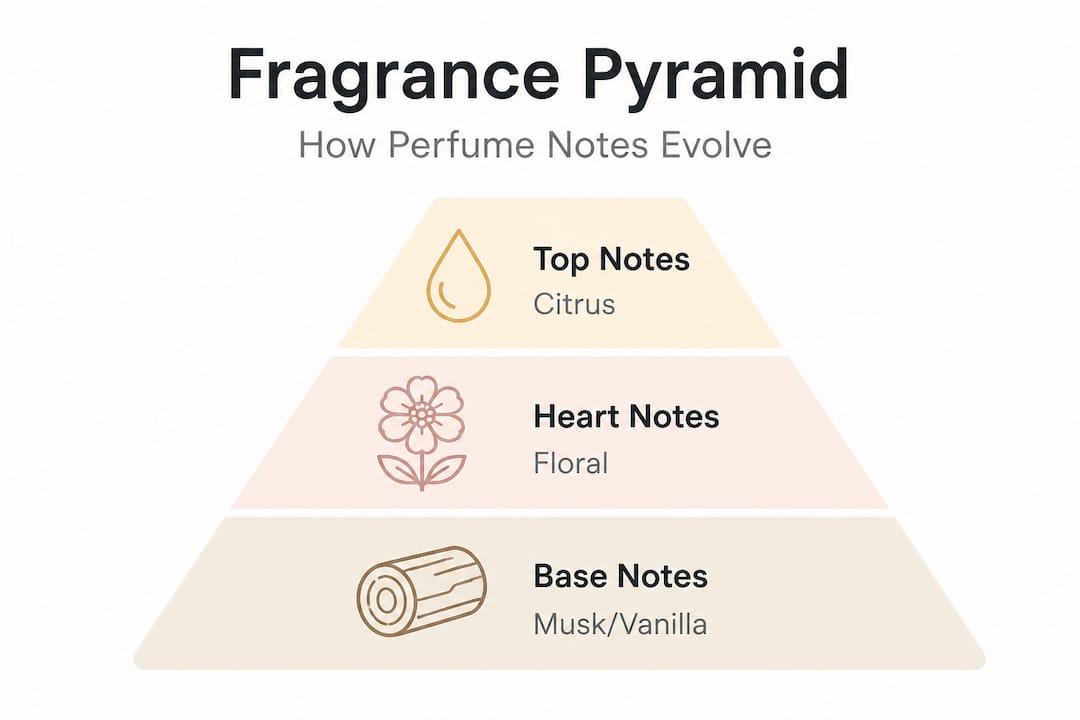
The fragrance pyramid is not just a marketing concept. It is a genuine working model used by perfumers when composing a scent. According to research, the fragrance pyramid structures perfume into three distinct layers: top notes, heart notes, and base notes, each defined by their volatility and evaporation rates. The more volatile a molecule, the faster it evaporates, and the sooner it registers in your perception.
The model was not always standard practice. Jean Carles developed it in the 20th century specifically to simplify how fragrance composition was taught to student perfumers. It gave a clear visual and conceptual framework for understanding how a blend works as a whole, rather than as a collection of isolated ingredients.
“The fragrance pyramid gives perfumers and wearers alike a shared language for describing how a scent moves through time, from its opening brightness to its lasting warmth.”
The structure of the fragrance pyramid is best understood visually, but the table below captures the key differences between each layer at a glance.
| Note layer | Volatility | Duration on skin | Common examples |
|---|---|---|---|
| Top notes | High | 5 to 30 minutes | Bergamot, lemon, grapefruit, basil |
| Heart notes | Medium | 30 minutes to 4 hours | Rose, jasmine, geranium, cardamom |
| Base notes | Low | 4 to 8+ hours | Sandalwood, vetiver, patchouli, vanilla |
Each layer serves a distinct purpose. Top notes create the first impression. Heart notes are the core identity of the fragrance. Base notes provide lasting depth and are what lingers on your skin long after others have faded. None of these layers acts in complete isolation, which is a point we will return to in detail later.
Breaking down the notes: Top, heart, and base
With the structure in place, it is worth examining what each layer actually delivers to the person wearing the fragrance. The experience is sequential in perception but not in chemistry, and that distinction matters enormously.
Top notes are the first thing your nose registers. These are light, volatile molecules that provide the initial impression, typically lasting between 5 and 30 minutes. Citrus ingredients such as bergamot, lemon, and grapefruit are classic top notes. So are light herbs like lavender and green notes like violet leaf. They are designed to attract and draw you in, functioning almost like a handshake. The problem is that too many buyers make a full purchase decision based solely on this handshake, which is one of the most common and costly mistakes in fragrance shopping.
Heart notes, also known as middle notes, emerge once the top notes begin to evaporate. This is where the true character of a fragrance is found. Florals like rose, jasmine, and peony are typical examples. Spices like cardamom and pepper also sit in this layer. The heart often lasts between 30 minutes and four hours, depending on the concentration of the fragrance and your skin type.
Base notes are the foundation. They are composed of large, heavy molecules that evaporate slowly. Ingredients like sandalwood, vetiver, oakmoss, vanilla, and musk are common base notes. These are what remain on your skin and clothes hours after application, and they are the notes most closely associated with a fragrance’s lasting impression.
Importantly, all notes are present simultaneously from the moment you apply a fragrance. The pyramid does not describe a sequence of ingredients appearing one after another. It describes which notes are dominant to your perception at any given time, as the lighter ones evaporate and the heavier ones remain.
Common examples by layer:
- Top notes: bergamot, lemon, pink pepper, neroli, mint, eucalyptus
- Heart notes: rose, jasmine, iris, ylang ylang, cinnamon, geranium
- Base notes: amber, cedarwood, vetiver, sandalwood, musks, benzoin
Understanding types of perfume notes in this level of detail gives you a genuine advantage when reading a fragrance’s listed notes before purchase.
Pro Tip: When testing a new fragrance, spray it on your wrist and smell it at three distinct points: immediately after application, after 20 minutes, and again after an hour. This gives you a clear picture of how the top, heart, and base layers actually present on your specific skin.
How the fragrance pyramid influences scent evolution
Having explained each note type, we can now look at how the pyramid plays out in real life as a fragrance changes over time on your skin. This is where theory becomes genuinely useful.
The most important thing to understand is that the pyramid is a model of perceptual dominance, not a mechanical timer. Lighter notes evaporate first, pushing heavier notes into greater prominence, but the base note molecules you cannot yet smell clearly were always present. This is why a fragrance can feel like it radically transforms over the course of a few hours.
“The pyramid does not dictate when each note ‘turns on.’ Every ingredient is blended into the formula from the start. What changes is simply what your nose perceives most strongly as molecules leave the skin.”
Skin chemistry plays a significant role in this. Oily skin tends to hold fragrance longer and can amplify certain base notes. Dry skin may see top notes evaporate even more quickly, compressing the opening phase. Body temperature, diet, and even hydration levels can shift which notes come forward on any given day. This is why how fragrances evolve on skin can vary so much between two people wearing the exact same bottle.
The concentration of the fragrance also affects how each layer presents. The table below outlines typical durations by concentration type:
| Concentration | Top note duration | Heart note duration | Base note duration |
|---|---|---|---|
| Eau de Cologne (EDC) | 5 to 10 minutes | 30 to 60 minutes | 1 to 2 hours |
| Eau de Toilette (EDT) | 10 to 20 minutes | 1 to 2 hours | 2 to 4 hours |
| Eau de Parfum (EDP) | 15 to 30 minutes | 2 to 4 hours | 4 to 6 hours |
| Extrait de Parfum | 20 to 40 minutes | 3 to 5 hours | 6 to 8+ hours |
Key stages as most wearers perceive them:
- Opening (0 to 15 minutes): Top notes dominate. The fragrance is bright, fresh, and sharp. This is the first impression.
- Development (15 to 60 minutes): Top notes fade and heart notes begin to emerge. The scent becomes warmer and more defined.
- Full bloom (1 to 3 hours): The heart is fully present. This is the true identity of the fragrance and the most important phase to assess.
- Dry down (3 hours onward): Base notes take over. The fragrance becomes more intimate, often softer and more skin-close.
- Final impression (6+ hours): Only the most tenacious base notes remain. Often a skin scent that is unique to the wearer.
Using the fragrance pyramid: Sampling, longevity, and personal fit
Once you understand scent evolution, you can focus on practical ways to use the pyramid when selecting and sampling fragrances. This is where your knowledge pays off most directly.
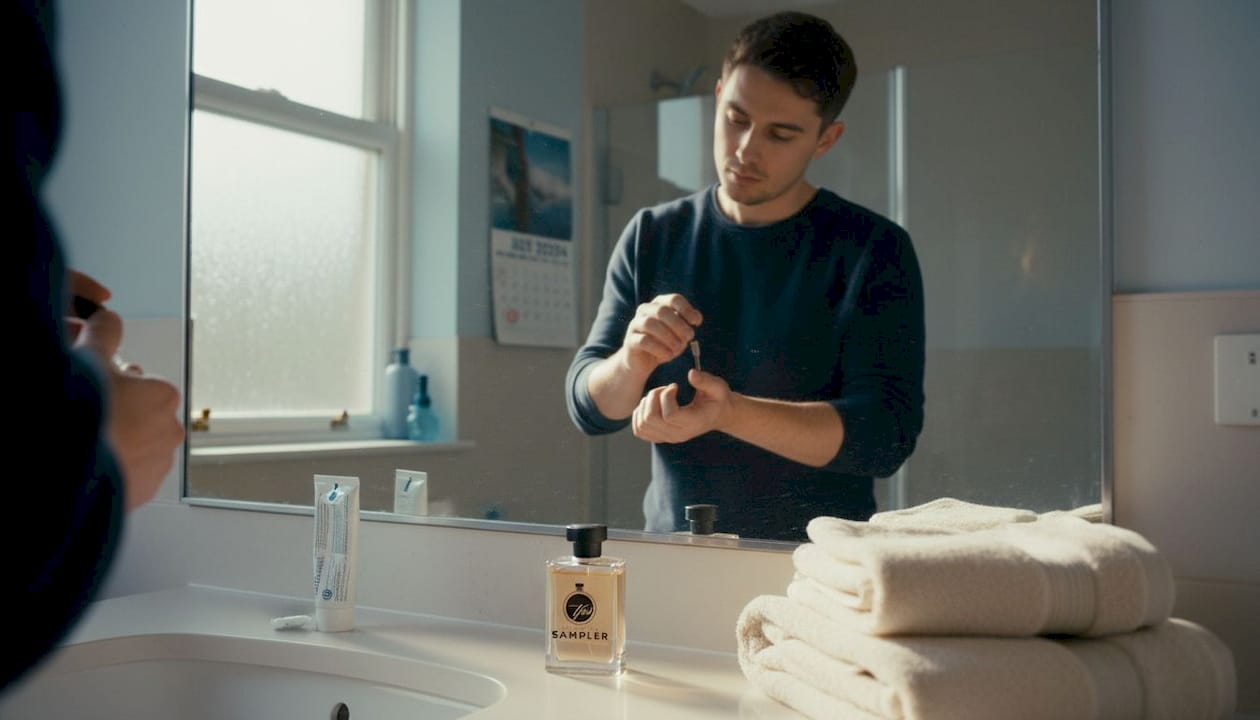
Sampling is essential when purchasing high-end or niche fragrances. A bottle can cost hundreds of pounds. Buying blind, based on a review or a smell strip in a shop, is a significant risk. Testing on skin and waiting at least 30 minutes gives you access to the heart and base notes that a quick sniff will never reveal.
Steps for sampling using the pyramid:
- Apply the fragrance to a pulse point, ideally the inner wrist or the crook of your elbow
- Wait five to ten minutes, then smell the opening. Note brightness, freshness, and first character
- Wait a further 20 minutes and assess again. The top notes should be fading, revealing the heart
- At the one hour mark, evaluate the fragrance properly. This is where you decide whether you genuinely like it
- At three hours or more, smell the dry down. This is what you will live with most of the day
- Record your impressions at each stage, noting which layer appeals most to you
The pyramid also helps predict longevity. Strong base notes with fixatives, such as patchouli or vanilla, indicate a fragrance with better staying power. A composition dominated by citrus top notes and light florals, with minimal base weight, will likely be a short-lived wear.
You can use a simple scoring system to assess a new fragrance’s potential before committing. A heavy, well-developed base adds confidence in longevity. A dominant heart adds character. An excess of top notes without base support suggests a beautiful opening with little follow-through.
Pro Tip: When reading a fragrance’s note list, count the base notes and check for fixatives. Amber, sandalwood, vetiver, benzoin, and musks all suggest lasting power. If the base note list is short or thin, expect a shorter wear, regardless of how impressive the opening is.
Making fragrances last longer is also partly a matter of how you apply the fragrance, not just what is in the bottle. Moisturised skin holds fragrance better. Applying to pulse points maximises warmth-driven diffusion.
Why the fragrance pyramid is a helpful myth – and what really matters
Here is the honest assessment, having walked through the full model: the fragrance pyramid is an excellent starting point, but it is not a precise map. It was designed to teach perfumers, not to perfectly predict your personal experience of a scent.
The pyramid assumes a fairly uniform skin chemistry and environment. In reality, no two people wear a fragrance the same way. Your skin pH, the climate you live in, what you ate that day, and even the fabric of your clothing all influence which notes present most strongly and for how long. A fragrance that reads as a heavy oriental base-note composition on paper can present as almost fresh and airy on certain skin types.
There is also the issue of modern perfumery. Many contemporary fragrances, particularly in niche perfumery, deliberately resist the traditional pyramid structure. Some are intentionally linear, meaning they smell essentially the same from application through to the dry down. Others use materials that behave unpredictably across the pyramid layers. The pyramid model was established in an era when perfume ingredients and compositions were more predictable and consistent.
Relying too heavily on the pyramid as a strict rulebook can actually limit your enjoyment. You might dismiss a fragrance because its listed notes suggest a profile you think you won’t enjoy, without ever testing how those notes actually behave together on your skin. Or you might expect a rich dry down based on a strong base note list, only to find that particular combination disappears quickly on your skin.
The real lesson from the pyramid is simpler than the model itself: fragrance is not static. It changes. You need to experience it across time to know whether it works for you. No chart replaces that lived experience.
This is why niche and affordable fragrance sampling is the most practical approach for any serious enthusiast. The pyramid gives you a useful hypothesis. Sampling gives you the answer.
Explore fragrance discovery with decants and samples
Understanding the fragrance pyramid is only useful if you are able to put that knowledge into practice. Testing a fragrance properly, across all its stages, requires more than a quick spritz on a paper strip.
At The Perfume Sampler, we offer fragrance decants in 2ml, 3ml, 5ml, and 10ml sizes. These give you enough volume to test a fragrance across multiple wears, through its full pyramid, and across different conditions. Our range covers high-end niche and designer fragrances, all 100% authentic, at prices that make proper sampling genuinely accessible. If you are new to decants or want to understand their value before exploring our catalogue, visit our why decants page for more detail. Start sampling before you commit.
Frequently asked questions
Is the fragrance pyramid always accurate for all perfumes?
No. While most fragrances use the pyramid concept as a compositional guide, some linear or modern scents blend and evolve differently. As research confirms, all notes are present simultaneously, so the pyramid describes perception rather than a fixed chemical sequence, meaning some fragrances resist clear pyramid categorisation entirely.
Why does the same perfume smell different on each person?
Personal skin chemistry, moisture levels, and body temperature all affect how notes develop over time. Because of these variables, testing on skin for at least 30 minutes is far more reliable than any other assessment method before purchasing.
Which notes last the longest in a fragrance?
Base notes last the longest, particularly those containing fixatives. Strong base note fixatives such as patchouli, vanilla, amber, and musks are specifically chosen to anchor the composition and extend how long the scent remains perceptible on skin.
How can I tell if a perfume has good longevity?
Look for a pyramid with substantial base and heart notes, particularly fixatives. You can evaluate pyramids by scoring the composition: a heavy base suggests strong longevity, a dominant heart adds sustained character, and a fragrance that relies heavily on top notes alone is likely to fade quickly.
Can I still use the fragrance pyramid when layering perfumes?
Yes. Understanding the pyramid helps you select fragrances whose top, heart, and base notes complement each other when combined, so the overall layered result feels balanced rather than discordant across the wear.
Recommended
- How fragrances evolve: master scent profiles before you buy – ThePerfumeSampler
- What makes a fragrance truly unique: your scent guide – ThePerfumeSampler
- Types of perfume notes: Unlock fragrance layers and lasting power – ThePerfumeSampler
- Explore fragrance families: find your signature scent affordably – ThePerfumeSampler
- Scent profiles explained: 4 fragrance families decoded