
How to layer fragrances for a unique signature scent
Finding a fragrance that truly represents you can feel impossible when every perfume counter offers the same mass-produced scents. You sample countless bottles, yet nothing quite captures your personality or mood. Layering fragrances solves this creative dilemma by allowing you to blend niche and designer scents into something entirely your own. This guide reveals practical techniques for combining affordable perfume samples to craft bespoke fragrances that evolve throughout the day, giving you complete control over your scent wardrobe without expensive commitment.
Table of Contents
Key Takeaways
| Point | Details |
|---|---|
| Materials and setup | Use affordable perfume samples and a range of notes, with blotter strips, cotton pads, small spray bottles and a dedicated notebook to structure your layering experiments. |
| Environment and timing | Prepare clean moisturised skin, neutral surroundings, and schedule sessions when alert to avoid olfactory fatigue. |
| Step by step method | Choose complementary or contrasting fragrances, review note pyramids, and layer gradually to build balance. |
| Common pitfalls | Watch for overpowering clashes and olfactory fatigue, testing on blotters first and cleansing between trials. |
| Evaluation and maintenance | Keep a dedicated notebook, store samples in a cool dark cupboard, and record successful blends for future use. |
What you need to start layering fragrances
Successful fragrance layering begins with assembling the right materials and creating ideal conditions for experimentation. Using affordable samples allows experimentation with layering without expensive commitment, making this creative process accessible to everyone from curious beginners to seasoned perfume enthusiasts.
Your foundation should include a diverse collection of niche and designer perfume samples spanning different fragrance families. Florals, orientals, woody scents, fresh citrus notes, and gourmands each bring distinct characteristics to blends. Samples in 2ml, 3ml, 5ml, and 10ml sizes provide enough volume for multiple testing sessions whilst keeping costs manageable. This variety lets you explore unexpected combinations that full bottles would make financially risky.
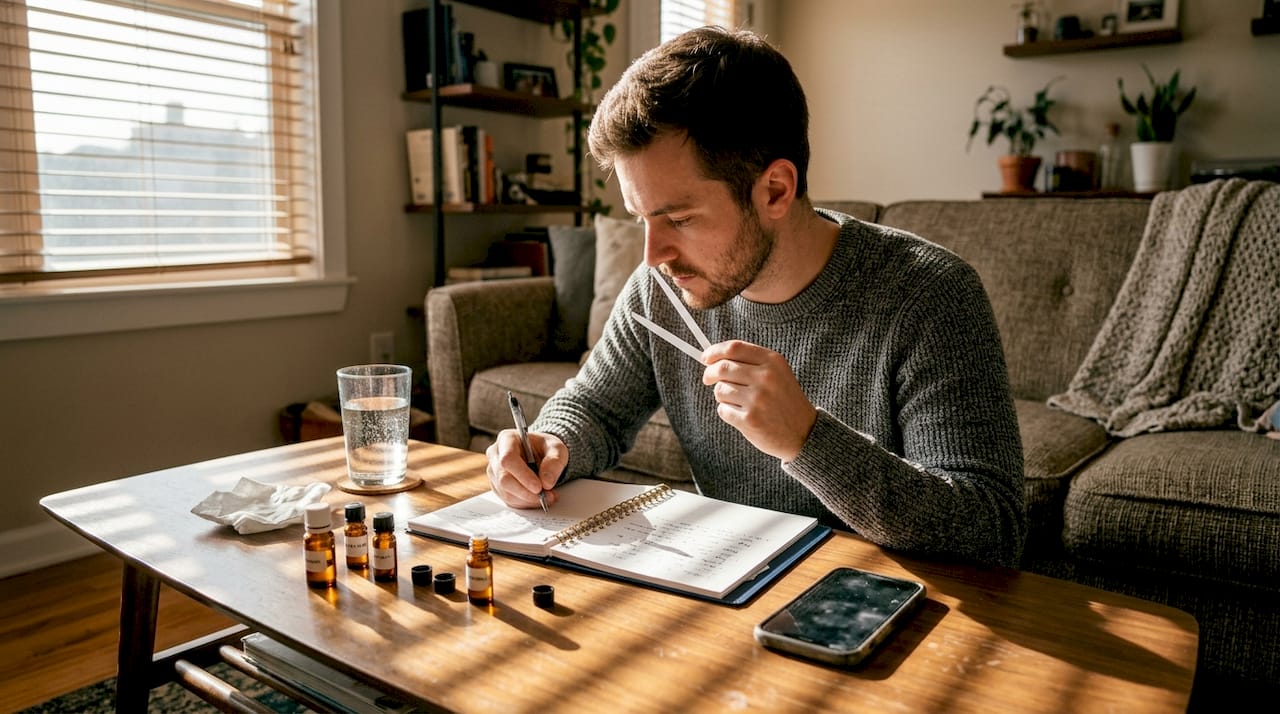
Essential accessories transform random experimentation into systematic exploration. Blotter strips allow you to preview combinations before committing them to skin, saving your wrists from overwhelming scent confusion. Cotton pads help cleanse application areas between tests, whilst small spray bottles enable you to preserve successful mixtures for future wear. A dedicated notebook becomes invaluable for documenting which combinations sing and which clash spectacularly.
| Item | Purpose | Pro tip |
|---|---|---|
| Fragrance samples (8-12 varieties) | Provides diverse notes for blending | Choose samples from at least 4 different fragrance families |
| Blotter strips (pack of 100) | Tests combinations before skin application | Label each strip immediately to avoid confusion |
| Cotton pads | Cleanses skin between testing sessions | Use unscented pads to avoid interference |
| Small spray bottles (5-10ml) | Stores successful blend recipes | Glass bottles preserve scent integrity better than plastic |
| Fragrance journal | Documents combinations and impressions | Include date, weather, and skin condition notes |
Environment matters more than most beginners realise. Your skin should be clean and moisturised with unscented lotion, as dry skin absorbs fragrance differently than hydrated skin. Avoid testing when you’ve recently applied strong-smelling products like scented hand cream or hair styling products. The surrounding air should be neutral too. Testing fragrances in a room filled with cooking smells, scented candles, or air fresheners skews your perception and leads to poor layering decisions.
Pro Tip: Store your fragrance samples and layering tools in a cool, dark cupboard away from direct sunlight and temperature fluctuations. Heat and light degrade perfume molecules, altering their scent profiles and ruining your carefully curated collection. A dedicated storage box maintains consistent conditions and keeps everything organised for your next creative session.
Timing your layering experiments strategically improves results. Your nose fatigues after smelling multiple fragrances, a phenomenon called olfactory adaptation. Schedule layering sessions when you’re alert and haven’t been exposed to strong scents for several hours. Morning sessions often work best, as your sensory perception is sharpest after sleep.
Step-by-step guide to layering fragrances effectively
Mastering fragrance layering requires following a systematic approach that builds complexity gradually whilst maintaining balance. Effective layering balances fragrance notes to avoid overpowering or clashing scents, transforming random spraying into intentional scent architecture.
-
Select complementary or contrasting fragrances thoughtfully. Begin by choosing two fragrances that either share a common note or offer interesting contrast. Complementary pairings might include a vanilla-based oriental with a woody amber, both sharing warm base notes. Contrasting combinations could pair fresh citrus with deep patchouli, creating tension that resolves into something unique. Review each fragrance’s note pyramid before combining. Top notes appear immediately, heart notes emerge after 15-30 minutes, and base notes anchor the scent for hours. Understanding this structure prevents mismatched layers that fight rather than harmonise.
-
Test combinations on blotter strips before skin application. Spray your first fragrance on a blotter strip, then immediately spray the second fragrance on the opposite end. Wave both strips together near your nose to preview how they interact in the air. This preliminary test reveals obvious clashes without committing the blend to your skin. If the combination shows promise, spray both fragrances on a single blotter strip, with the lighter scent first. Allow 30 seconds between applications so you can observe how they merge. This controlled testing saves your skin from becoming a chaotic scent laboratory.
-
Layer lighter scents first, then add deeper base notes. Apply your lightest, freshest fragrance directly to pulse points like wrists, inner elbows, and neck. These areas generate warmth that helps fragrance develop and project. Wait 60-90 seconds for the initial alcohol to evaporate and the scent to settle into your skin chemistry. Then apply your second fragrance, typically something richer or more complex. The lighter base creates a foundation that the deeper scent enhances rather than overwhelms. This sequencing mirrors how perfumers construct fragrances, building from bright top notes through floral hearts to resinous bases.
-
Apply in small amounts and wait between layers. Restraint separates successful layering from olfactory chaos. Start with a single spray of each fragrance rather than multiple pumps. You can always add more, but removing excess fragrance requires washing and starting over. After applying your second layer, wait at least five minutes before evaluating the blend. Fragrances need time to interact with your skin’s natural oils and pH levels. What smells sharp immediately after application often softens into something beautiful as the alcohol evaporates and the scent molecules settle. Rush this process and you’ll misjudge combinations that actually work brilliantly.
-
Document successful combinations for future reference. Record every layering experiment in your fragrance journal, noting which scents you combined, application order, quantities used, and your impressions at 5 minutes, 30 minutes, 2 hours, and 6 hours. Include environmental factors like temperature and humidity, as these affect how fragrances develop. Rate each combination on a simple scale for immediate appeal, development, longevity, and uniqueness. These detailed notes become your personal fragrance recipe book, allowing you to recreate beloved blends and avoid repeating disappointing experiments.
Pro Tip: Create a simple coding system in your journal using symbols or colours to mark exceptional combinations, interesting failures, and experiments worth revisiting. This visual system lets you spot patterns in your preferences quickly, revealing which fragrance families you naturally gravitate towards and which note combinations consistently deliver the signature scents you seek.
Consider the concentration levels when layering. Eau de parfum contains higher perfume oil concentration than eau de toilette, making it more dominant in blends. Pairing two eau de parfums requires more restraint than combining an eau de toilette with an eau de parfum. Understanding these strength differences helps you balance your layers appropriately.
Common mistakes and how to troubleshoot layering issues
Even experienced fragrance enthusiasts encounter challenges when layering scents, but recognising frequent errors accelerates your learning curve. Many avoid layering due to fear of clashing or overpowering scents, which can be mitigated by testing, yet these concerns often stem from correctable mistakes rather than fundamental incompatibility.
The most prevalent error involves combining too many strong fragrances simultaneously. Beginners often assume that layering three or four bold scents creates complexity, but this approach typically produces muddy, indistinct results where individual notes disappear into olfactory noise. Limit yourself to two fragrances initially, adding a third only after mastering simpler combinations. Each additional layer exponentially increases complexity and the potential for discord.
Ignoring your unique skin chemistry leads to disappointing results that work beautifully on blotter strips but fail on skin. Your skin’s pH level, natural oils, diet, medications, and even hormonal fluctuations affect how fragrances develop. A combination that smells divine on your friend might turn sour on you. Always test layered combinations on your actual skin rather than relying solely on blotter strips or others’ recommendations. What works for someone else provides inspiration, not gospel.
Neglecting proper testing protocols wastes samples and creates frustration. Spraying multiple combinations on different pulse points simultaneously prevents accurate evaluation, as the scents drift together and confuse your nose. Test one combination thoroughly before moving to the next. Cleanse your testing area with unscented soap and water between experiments, allowing your skin to dry completely before applying new fragrances. This disciplined approach might feel slow, but it produces reliable results.
“Patience and systematic experimentation separate fragrance layering from random spraying. The most captivating signature scents emerge from methodical testing, careful observation, and willingness to learn from combinations that don’t work as planned.”
Troubleshooting unsuccessful layers requires analytical thinking. If a combination smells harsh or chemical, you’ve likely paired fragrances with clashing synthetic notes. Try replacing one component with a more natural-smelling alternative. When blends smell muddled or indistinct, you’re probably using similar fragrances that blur together rather than complement each other. Introduce more contrast by selecting scents from different fragrance families.
Ratio problems plague many layering attempts. Equal amounts of two fragrances rarely produce optimal results, as different perfumes have varying projection strengths. If one fragrance dominates completely, reduce its application to a half spray whilst maintaining a full spray of the subtler scent. Experiment with 2:1 or even 3:1 ratios until you achieve the balance you seek. This adjustment process reveals how small changes dramatically alter the final impression.
Skin preparation issues undermine otherwise sound combinations. Applying fragrances to dry, flaky skin causes rapid absorption and poor development. Moisturise with unscented lotion 10-15 minutes before layering to create an ideal canvas. Similarly, testing immediately after showering with heavily scented products introduces competing smells that distort your perception. Use fragrance-free shower gel and shampoo on days you plan to layer.
Recognising when a combination needs modification rather than abandonment saves promising experiments. If a blend starts beautifully but turns unpleasant after an hour, the base notes are clashing whilst the top and heart notes harmonise. Try applying less of the fragrance with problematic base notes, or introduce a third scent with neutral base notes like clean musk to bridge the gap. Not every failed experiment deserves immediate rejection.
Understanding and evaluating your layered scent
Assessing layered fragrances requires developing evaluation skills that track scent evolution from initial application through final fade. Proper evaluation includes considering scent evolution over time and adapting layers accordingly, transforming casual experimentation into refined fragrance creation.
Monitoring your layered scent throughout the day reveals how the combination develops across its complete lifecycle. Top notes dominate the first 15-30 minutes, creating your initial impression. These bright, volatile notes evaporate quickly, giving way to heart notes that define the fragrance’s character for the next 2-4 hours. Finally, base notes anchor the scent, lingering on skin for 6-8 hours or longer. A successful layer maintains interest across all three stages rather than peaking early then disappearing or starting poorly but improving.
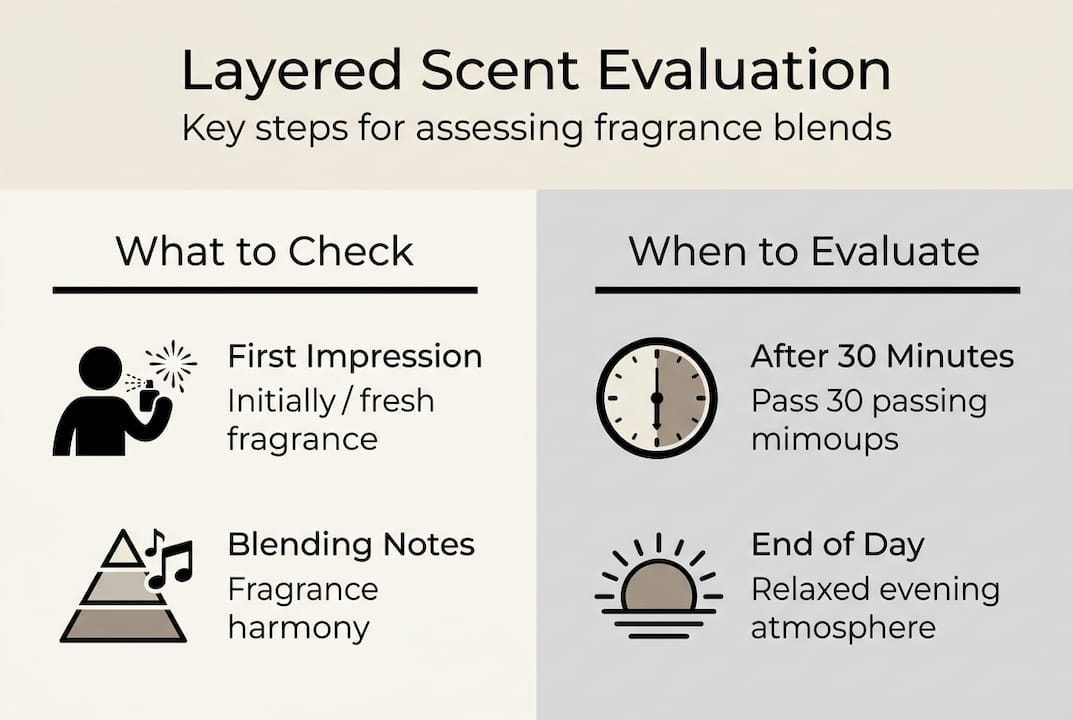
Set specific checkpoints for evaluation. Assess your layered fragrance immediately after application, then again at 30 minutes, 2 hours, 4 hours, and 6 hours. Note how the scent changes at each interval. Does it maintain balance or does one fragrance eventually dominate? Do the combined notes create something cohesive or do they separate into distinct layers that smell like you’re wearing two fragrances rather than one unified scent? These observations inform adjustments for your next attempt.
| Evaluation criteria | What to assess | Questions to ask |
|---|---|---|
| Scent strength | Projection and sillage throughout the day | Can you smell it without bringing your wrist to your nose? Do others notice it from arm’s length? |
| Harmony | How well the fragrances blend together | Do the scents merge into one unified fragrance or remain distinctly separate? Are there any jarring transitions? |
| Longevity | How long the layered scent remains detectable | Does it last through your workday? Does it fade gracefully or disappear abruptly? |
| Uniqueness | Whether the blend creates something distinctive | Does this smell like a commercial fragrance or something truly personal? Would you recognise it as your signature? |
Refreshing or adjusting layers maintains your desired effect as the day progresses. Carry small samples of your layered fragrances for touch-ups every 4-6 hours. Reapply the lighter, fresher component first, followed by the deeper base, maintaining your original application sequence. This reinforcement keeps the scent balanced rather than allowing the longer-lasting base notes to dominate as top notes fade.
Environmental factors influence how your layered fragrance performs. Heat amplifies projection, making scents stronger and potentially overwhelming in warm weather. Cold weather suppresses projection, requiring slightly heavier application. Humidity affects longevity, with fragrances lasting longer in moderate humidity than in very dry or very humid conditions. Adjust your layering ratios seasonally to account for these variables.
Storing successful blends in dedicated bottles ensures consistency when you want to recreate favourite combinations. Mix your layered fragrances in small glass spray bottles, maintaining the ratios that worked during testing. Label each bottle with the component fragrances, ratios, and creation date. These pre-mixed blends eliminate daily guesswork whilst allowing you to enjoy your signature scents reliably.
Pro Tip: Photograph your fragrance samples and journal entries together, creating a visual reference library. These images help you remember which bottles correspond to which experiments, especially as your collection grows. Digital photos also preserve fading handwritten notes and provide backup documentation if your physical journal gets damaged.
Develop your personal scent vocabulary to articulate what you’re experiencing. Move beyond generic terms like “nice” or “bad” to describe specific qualities. Is the blend powdery, green, animalic, ozonic, gourmand, or leathery? Does it evoke specific memories or emotions? Precise language sharpens your evaluation skills and helps you communicate with other fragrance enthusiasts about your discoveries.
Discover fragrance samples to perfect your layering technique
Transforming fragrance layering theory into personal signature scents requires access to diverse, high-quality perfume samples that let you experiment freely. The Perfume Sampler (ThePerfumeSampler.com) offers curated collections of niche and designer fragrances in practical 2ml, 3ml, 5ml, and 10ml sizes, perfect for exploring layering combinations without committing to expensive full bottles. Each sample provides enough volume for multiple testing sessions, allowing you to refine your technique and discover unexpected pairings that become your signature.
Explore carefully selected fragrances spanning every family from fresh citrus through opulent orientals, giving you the creative palette to craft truly unique blends. Whether you’re building a versatile scent wardrobe or searching for that perfect layering base, affordable fragrance samples make luxury experimentation accessible. Start your layering journey with confidence, knowing each sample represents an opportunity to discover combinations that capture your personality and style.
Frequently asked questions
What is fragrance layering and why should I try it?
Fragrance layering combines multiple perfumes to create a unique scent that doesn’t exist in any single bottle. It allows you to personalise your fragrance beyond standard commercial offerings, expressing your individuality through custom blends. This technique gives you creative control over your scent wardrobe whilst maximising the versatility of your fragrance collection.
Can anyone layer fragrances or do you need experience?
Anyone can layer fragrances successfully, from complete beginners to experienced perfume enthusiasts. Starting with affordable samples and following basic layering steps minimises risk whilst you develop your skills. Practice improves your ability to predict which combinations will work, but the creative exploration remains enjoyable at every experience level.
How do I know which fragrances will blend well?
Begin with fragrances from complementary families that share common notes, or try contrasting scents that create interesting tension. Test combinations on blotter strips before applying to skin, allowing you to preview the blend without commitment. Pay attention to each fragrance’s note structure, ensuring top, heart, and base notes will harmonise rather than clash as they develop.
What are common layering mistakes to avoid?
Avoid combining too many strong fragrances simultaneously, as this creates muddy, indistinct results rather than refined blends. Always test layers gradually, applying small amounts and waiting between applications to assess how scents interact. Neglecting to cleanse your skin between experiments leads to confusing results that prevent you from accurately evaluating individual combinations.