
How to rank sample scents for confident fragrance choices
TL;DR:
- A structured testing method helps fragrance enthusiasts accurately rank samples and avoid costly mistakes.
- Evaluating scent evolution over time using check-ins at multiple intervals provides reliable insight into performance.
You found a sample you love, but then you tested three more and now you have no idea which one actually performed best. That frustration is common among fragrance enthusiasts who try samples without a structured method. A single sniff tells you very little about how a scent will actually behave on your skin over a full day. This guide gives you a practical, repeatable system for ranking fragrance samples accurately, so you can invest in the right full bottle with confidence and avoid costly mistakes.
Table of Contents
- What you need to rank fragrance samples
- Structured step-by-step evaluation for accurate rankings
- Building your own ranking system for sample scents
- Factoring in cost and value: affordable sample ranking
- A fresh angle on scent sample rankings
- Where to try affordable luxury scents next
- Frequently asked questions
Key Takeaways
| Point | Details |
|---|---|
| Structured evaluations matter | Checking samples at set intervals reveals their true scent and value. |
| Separate objective and subjective scores | Define clear metrics for longevity, sillage, and price, apart from your personal preference. |
| Consider price per ml | Ranking samples by value for money ensures you get the most performance for your budget. |
| Skin chemistry affects results | Your skin and environment change how samples perform, so always test and log thoroughly. |
| Affordable samples ease decision-making | Trying affordable decants is a smart way to compare luxury scents risk-free before buying. |
What you need to rank fragrance samples
Before you start testing, gather the right tools and understand what you are actually measuring. Walking into a sample session without preparation leads to inconsistent results and poor decisions.
Essential tools for sampling:
- Fragrance blotters (at least two per scent, one for each arm or one to sniff on its own)
- A clean notebook or digital document for logging observations
- A pen and a timer or phone alarm set to 15-minute intervals
- Neutral-smelling soap for rinsing between tests
- Coffee beans or fresh air to reset your nose between samples
Your skin is the most important variable in any test. Avoid heavy moisturisers, unscented or lightly scented deodorants, and strong food smells before sampling. These interfere with how a fragrance develops and can give you a false impression of performance.
Understanding the fragrance notes and evolution before you start is essential. Fragrances are built in three layers: top notes (what you smell first, lasting roughly 10 to 30 minutes), heart notes (the core of the fragrance, emerging after 30 minutes and lasting several hours), and base notes (the dry-down, which can persist for 6 to 12 hours or longer). Each layer tells you something different about the scent’s character. A fragrance profile overview can help you understand how different ingredient families behave across these stages.
As structured check-ins guide you to evaluate samples over the full top, heart, and base timeline rather than relying on a single sniff, this approach is far more reliable than an instant impression at a counter.
The key metrics you need to track are longevity, sillage, personal preference, and price. Longevity is how long the scent remains detectable on skin. Sillage (pronounced “see-yazh”) is the scent trail a fragrance projects around you. Personal preference is simply how much you enjoy wearing it. Price relates to what affects scent performance in the context of whether you are getting fair value for what a fragrance delivers.
| Metric | What to measure | Why it matters |
|---|---|---|
| Longevity | Hours detectable on skin | Shows true performance |
| Sillage | Distance the scent projects | Affects your presence |
| Personal preference | Your enjoyment score 1 to 10 | Guides final decision |
| Price per ml | Cost divided by volume | Measures value |
Pro Tip: Before testing, write the fragrance name at the top of a fresh page in your notebook. Leave space for entries at 0 minutes, 15 minutes, 1 hour, 2 hours, and 4 hours. This structure keeps your notes consistent across every sample you evaluate.
Structured step-by-step evaluation for accurate rankings
With your tools and concepts ready, now follow this structured process to reliably evaluate and rank each fragrance sample.
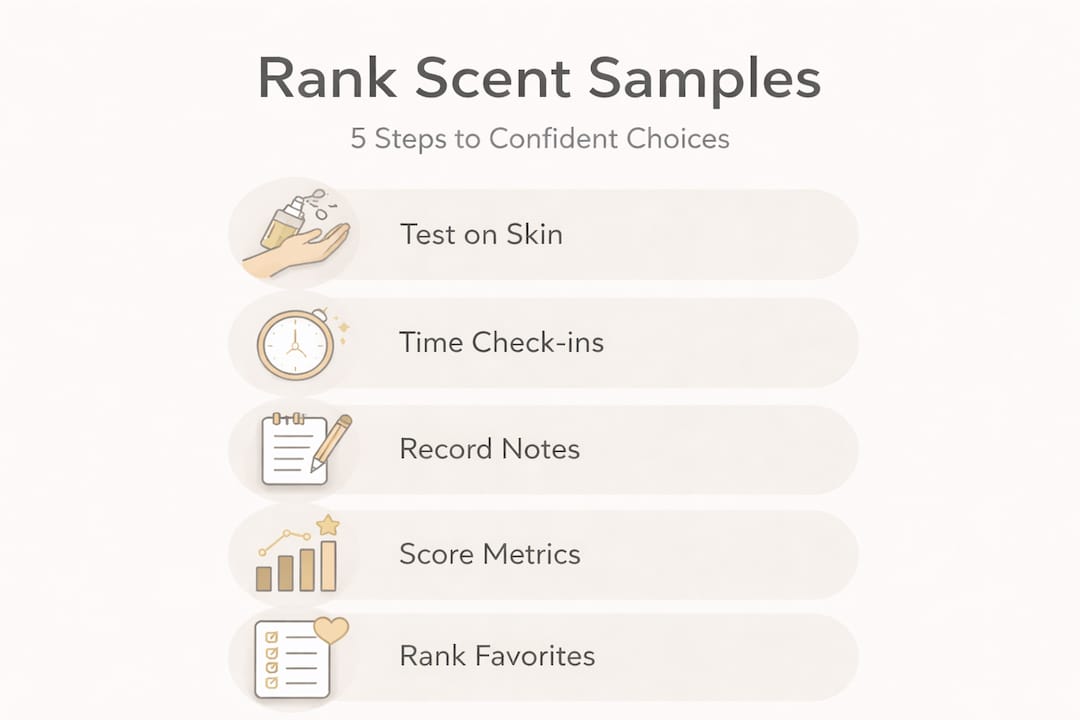
- Apply the sample to your wrist or inner elbow. Use a small amount, roughly the equivalent of one or two sprays from a decant. Apply to one arm and, optionally, on a blotter for a side-by-side comparison.
- Log your immediate impression at 0 minutes. Note the opening character: is it sharp, sweet, citrusy, green, or powdery? This is the top note. Write three descriptive words without overthinking.
- Check at 15 minutes. The top notes are fading now. Note any shift in character. Is it becoming warmer, softer, or more floral? The heart note is starting to emerge.
- Check at 1 hour. This is usually the clearest view of the heart note. Assess the scent’s character, how strong it is, and whether you still enjoy it.
- Check at 2 hours. Longevity performance becomes clearer here. Is the scent still clearly detectable or starting to fade? Note its strength on a scale of 1 to 5.
- Check at 4 hours or beyond. This is the base note stage. Note what remains on your skin and whether you find the dry-down appealing. Record the final longevity time when the scent fully disappears.
Following the review process steps used by experienced reviewers makes your evaluation more reliable and comparable across multiple tests.
Your skin chemistry plays a major role in how a fragrance performs. The fragrance note pyramid is a guide to ingredient sequencing, not a guarantee of outcome. pH levels, hydration, and body heat all modify how a scent unfolds, as detailed when considering skin chemistry impact on performance.
A useful data table to fill in as you go might look like this:
| Time | Scent A | Scent B | Scent C |
|---|---|---|---|
| 0 min | Citrus, fresh | Warm vanilla | Woody, green |
| 15 min | Fading citrus | Spice emerging | Earthy shift |
| 1 hour | Soft floral | Rich amber | Cedar forward |
| 2 hours | Faint, pleasant | Strong, warm | Moderate |
| 4+ hours | Barely there | Still present | Light trace |
| Longevity | 3 hours | 7 hours | 5 hours |
As noted in Perfume Atlas Methodology, your ranking should not treat the note pyramid as a proxy for performance, because actual experience depends on skin chemistry and real-world conditions. Two people wearing the same fragrance can have noticeably different results. This is why you must test on your own skin and not rely solely on other people’s reviews.
Room temperature, humidity, and even what you ate that day can subtly influence results. Test samples on multiple days if you want the most accurate data. Consistent conditions produce consistent rankings.
Building your own ranking system for sample scents
After evaluating the scents, it is time to structure your findings into a clear ranking. Here is how to build a system that works for you.
A good ranking system separates objective performance metrics from personal taste. Mixing them together produces confusion, not clarity. For example, a fragrance might have outstanding longevity but smell too sweet for your preference. Both facts are useful, but they serve different purposes in your decision.
Suggested scoring bands:
- Longevity: 1 point = under 2 hours; 2 points = 2 to 4 hours; 3 points = 4 to 6 hours; 4 points = 6 to 8 hours; 5 points = over 8 hours
- Sillage: 1 point = skin-scent only; 2 points = detectable at arm’s length; 3 points = noticeable to those nearby; 4 points = strong projection; 5 points = fills a room
- Personal preference: Rate your enjoyment on a scale of 1 to 10 separately from performance
- Value: Rate based on price per ml versus performance delivered
Sillage explained in detail shows why sillage varies so dramatically between concentrations and fragrance families. An Eau de Parfum will generally project further than an Eau de Toilette, but this is not always the case with niche or artisan formulations.
As noted in community discussions on rating systems, using explicit, repeatable definitions for what longevity and sillage scores mean, and keeping them separate from personal preference, produces more useful results than a single catch-all score.
Sillage in particular is harder to judge consistently without help. The same discussion highlights that sillage assessment benefits from observer input or defined distance thresholds, because you become accustomed to your own scent quickly and lose objectivity. Ask a friend or flatmate to stand at one metre and two metres away and let you know if they can detect the fragrance clearly.
“Use explicit, repeatable definitions for what longevity and sillage scores mean, and separate them from personal preference.” This principle keeps your ranking system honest and reproducible across all your sample tests.
When exploring unique profile sampling from niche brands, a structured scoring system becomes even more important. Niche fragrances can behave very differently from mainstream designer releases and may surprise you in either direction.
Pro Tip: Document each metric in your notebook immediately after each check-in rather than relying on memory at the end of the day. Fragrance impressions fade faster than you expect.
Factoring in cost and value: affordable sample ranking
Your ranking system is almost ready. Add in cost and value factors for the most meaningful comparison.
Price per ml is a simple but powerful metric. Divide the sample cost by its volume in ml to get a per-ml rate. Then compare this against the performance score you assigned during testing. A fragrance that costs £2 per ml but scores 5 out of 5 for longevity and 4 out of 5 for sillage offers better value than one that costs £1.50 per ml but scores 2 out of 5 for both.
This matters because luxury perfume pricing is influenced by many factors beyond the scent itself, including packaging, marketing, and brand prestige. Paying less per ml for a sample lets you evaluate the actual fragrance without those costs distorting your judgement.
Understanding perfume price variation across different brands and concentrations also helps you spot genuine quality versus inflated pricing. A niche fragrance sold at £120 for 50ml may deliver far better performance than a designer option at £80, making the cost-per-wear much more favourable.
Practical tips for affordable luxury sampling:
- Test at least three samples side by side to establish a meaningful performance comparison
- Note the price per ml for each sample at the start of your session
- Review your notes after testing all samples before deciding which to score highest on value
- Look for natural fragrance alternatives to expand your comparison base across different formulation styles
- Factor in how often you would realistically wear a scent when calculating cost-per-wear
As value-for-money ranking guidance confirms, including price per ml so your ranking matches what you will actually pay for performance is a critical step that many casual samplers skip. Including it gives your ranking real-world relevance and stops you from over-investing in fragrances that underperform relative to their price.
Buying 2ml, 5ml, or 10ml decants from a reputable source is the most efficient way to gather the data your ranking system needs without spending hundreds of pounds on full bottles you may not enjoy.
A fresh angle on scent sample rankings
With the mechanics laid out, here is an important perspective to make your sample rankings even more reliable.

Most fragrance enthusiasts, especially those new to niche and designer scents, make one consistent mistake: they decide too quickly. A 30-second sniff in a shop or a single spray at home does not give you enough information to rank anything accurately. Yet purchasing decisions worth £80, £120, or more get made on exactly that basis every day.
Skin chemistry routinely overturns first impressions. A fragrance that smells sharp and medicinal in the first 15 minutes might become rich and complex at the two-hour mark. Conversely, a scent that opens beautifully can collapse into a thin, sour base note an hour later. Neither outcome is predictable from a single sniff.
This is especially relevant for millennials and Gen Z buyers who often research purchases thoroughly before committing. Applying that same diligence to fragrance sampling, with structured notes and clear scoring, is simply consistent behaviour. You would not buy a phone based on a 30-second demo. Fragrance deserves the same approach.
Ranking also forces honesty. When you score longevity separately from preference, you may realise that a fragrance you adore actually performs poorly on your skin. That insight protects you from an expensive mistake. Equally, a fragrance you felt neutral about may score so highly on performance and value that it becomes the better purchase.
Affordability matters in this process. Using affordable scent selection tips and buying small decants for your sampling sessions removes financial pressure and lets you evaluate objectively. When you are not trying to justify a large purchase, your scoring is cleaner and more honest.
The most reliable rankers are not necessarily the most experienced fragrance enthusiasts. They are the most methodical ones.
Where to try affordable luxury scents next
When your ranking system is ready, here is where to find affordable samples and value-driven scent picks.
Putting a ranking system into practice requires samples you can trust. At The Perfume Sampler, every decant is filled from 100% authentic bottles, so your evaluation results reflect the genuine fragrance, not a substitute.
You can explore why decants work for methodical samplers before committing to a full bottle. If you want a specific starting point, the Boss Bottled Absolu sample is a strong candidate for testing your new ranking system, offering a clear evolution from top to base note that rewards patient evaluation. For seasonal testing, the top fragrances for fall collection gives you a curated set of options to rank side by side. Sizes from 2ml to 10ml mean you control the cost at every stage.
Frequently asked questions
Why does scent change over time when testing samples?
Fragrances evolve through top, heart, and base notes over several hours, reacting with your skin’s chemistry and environmental conditions, which means the scent you smell at the start is rarely what you will experience an hour later. As Perfume Atlas Methodology confirms, actual performance depends on skin chemistry and real-world conditions rather than the note pyramid alone.
How do I measure sillage when ranking sample scents?
Define distance thresholds such as arm’s length, one metre, or two metres, or ask a friend to observe how far the scent projects for consistent, objective results. Community guidance on sillage consistency notes that having another person observe or setting defined distance thresholds is the most reliable method.
Should price be included in my scent ranking?
Yes, including price per ml or value for money ensures your ranking reflects what you actually pay for performance, not just how a scent smells in isolation. Guidance from scent review methodology confirms this as a critical factor in producing meaningful rankings.
Can I use one sniff to decide on a scent purchase?
No, a single sniff only captures the top note, which is the shortest-lived part of the fragrance, and gives no information about longevity, sillage, or dry-down character. Structured check-in evaluation over the full note timeline is the only reliable method for making an informed purchase decision.
What is the best way to compare multiple sample scents?
Use a structured ranking table that scores each sample on longevity, sillage, personal preference, and value, then compare results side by side after all samples have completed their full dry-down cycle. As outlined in the parfumo rating discussion, using explicit, repeatable definitions for each metric keeps comparisons honest and useful.
Recommended
- Key factors for picking fragrance: Affordable luxury scents – ThePerfumeSampler
- Build a luxury fragrance collection with confidence – ThePerfumeSampler
- Top luxury scent picks: accessible options for every budget – ThePerfumeSampler
- How fragrances evolve: master scent profiles before you buy – ThePerfumeSampler