
Extrait de parfum explained: Discover luxury scent nuances
TL;DR:
- Extrait de parfum is the most concentrated form of fragrance with 20% to 40% perfume oils. Longevity and performance depend on skin chemistry and scent profile, not concentration alone. Sampling through decants offers a cost-effective way to evaluate luxury scents before purchasing.
You pick up a bottle labelled extrait de parfum, spray it once, and expect it to last all day. That is the common assumption. Yet higher oil percentage is not always a guarantee of longer-lasting scent. Many fragrance lovers are surprised to find that some eau de parfums outlast their extrait counterparts on skin. This guide cuts through the confusion. You will learn exactly what extrait de parfum is, how it compares to other concentrations, why it is so coveted, and how to experience it without spending a fortune.
Table of Contents
- Understanding extrait de parfum: Definition and origins
- Extrait de parfum vs other concentrations: What really sets it apart?
- Why choose extrait de parfum: Luxury, intensity, and self-expression
- How to experience extrait de parfum: Sampling, layering, and maximising your scent
- Why extrait de parfum is misunderstood: The truth most guides miss
- Sample extrait de parfum and luxury scents affordably
- Frequently asked questions
Key Takeaways
| Point | Details |
|---|---|
| Oil concentration isn’t everything | Extrait de parfum offers intense scent but longevity depends on more than oil percentage. |
| Luxury is affordable to sample | Sampling lets you experience high-end fragrances without the full price commitment. |
| Personal chemistry matters | Your skin type and scent preferences shape performance more than a fragrance label. |
| Test before you invest | Sample extrait de parfum to find your ideal match and avoid disappointment. |
| Layering enhances uniqueness | Experimenting with layering can create a signature scent and boost extrait enjoyment. |
Understanding extrait de parfum: Definition and origins
Extrait de parfum is the most concentrated form of fragrance available. It typically contains between 20% and 40% perfume oil, making it richer and more intense than any other category on the market. The remaining percentage is alcohol and, in some formulations, a small amount of water.
The term itself is French, meaning “perfume extract.” Historically, extrait de parfum was the original format in which fine fragrances were sold. Before modern production techniques made lighter concentrations commercially viable, extrait was simply what perfume was. It was applied sparingly, often with a stopper rather than a spray, and reserved for special occasions.
Today, extrait de parfum occupies a prestigious position in the fragrance world. It is favoured by collectors, connoisseurs, and those who want a scent that feels genuinely distinct from mass-market offerings. The higher oil content means the formula is often richer in base notes, which contributes to a different character rather than just a louder version of the same scent.
Here is what defines extrait de parfum within the broader fragrance landscape:
- Highest oil concentration among all fragrance types, typically 20% to 40%
- Richer base notes due to the density of aromatic compounds
- Applied sparingly because the formula is more potent per drop
- Premium pricing reflecting both the concentration and the craftsmanship involved
- Distinct scent evolution as the fragrance profile evolves differently compared to lighter concentrations
“Extrait de parfum does not always last longer than EDP in empirical tests. Concentration alone does not determine performance.”
This is a point worth sitting with. The assumption that more oil equals more hours on skin is widespread, but it is not reliably accurate. Skin chemistry, the specific aromatic molecules used, and even the weather all play a role. Understanding this nuance is what separates informed fragrance buyers from those who spend more and feel disappointed.
Extrait de parfum has also shaped the evolution of niche perfumery. Many niche houses, including those with roots in gourmand fragrance history, release extrait versions of their most celebrated scents as the definitive expression of a formula.
Extrait de parfum vs other concentrations: What really sets it apart?
Once you understand what extrait de parfum is, the natural next question is how it compares to the other options on the shelf. The three most common categories you will encounter are extrait de parfum, eau de parfum (EDP), and eau de toilette (EDT).
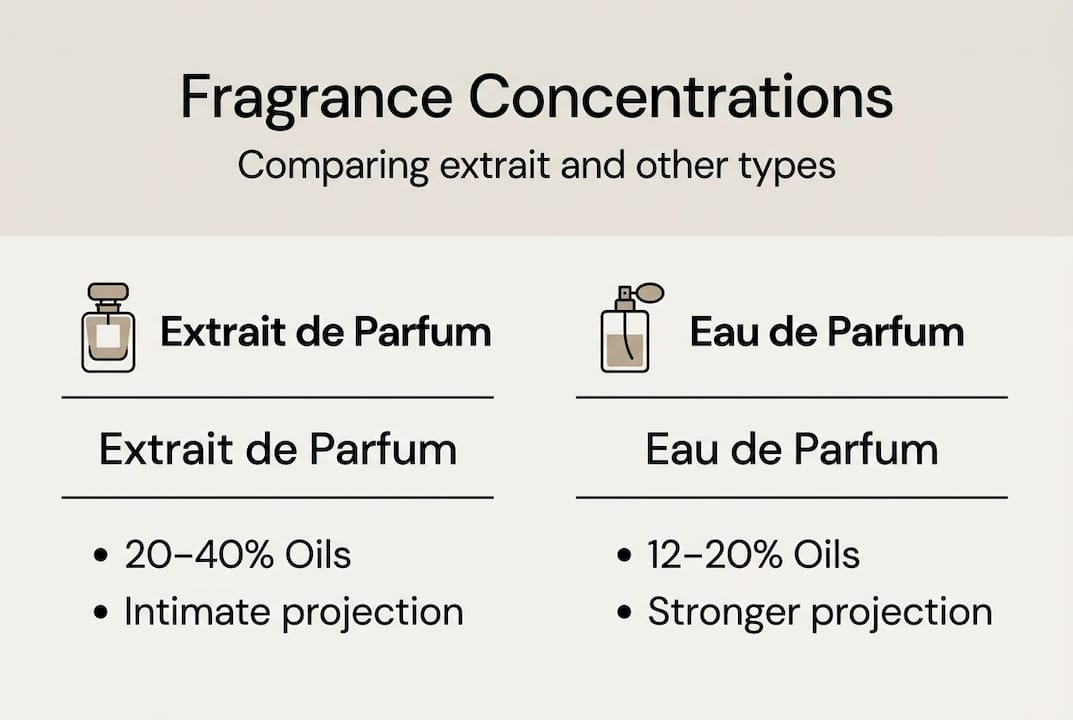
| Type | Oil concentration | Typical projection | Average wear time |
|---|---|---|---|
| Extrait de parfum | 20% to 40% | Close to skin | 6 to 12 hours |
| Eau de parfum | 15% to 20% | Moderate | 5 to 8 hours |
| Eau de toilette | 5% to 15% | Wider projection | 3 to 5 hours |
The table above reflects typical ranges. But here is the critical point: higher concentration does not always equal longevity. An EDP with a high proportion of skin-clinging musks may outlast an extrait built around volatile citrus or green notes.
There are several factors that influence how long a fragrance actually lasts:
- Skin chemistry — Dry skin tends to absorb fragrance faster, reducing longevity regardless of concentration.
- Scent profile — Woody, musky, and resinous notes last longer than fresh or citrus notes at any concentration.
- Application method — Pulse points and moisturised skin hold fragrance better.
- Environmental conditions — Heat and humidity affect how quickly a scent dissipates.
Pro Tip: Before assuming an extrait will outperform an EDP, test both on your skin. The eau de toilette explained guide is a useful reference for understanding how lighter concentrations can sometimes surprise you.
Extrait de parfum tends to project closer to the skin, which some wearers prefer. It creates a more intimate scent experience rather than a loud sillage that announces your presence across a room. If you want to understand the full picture of what drives perfume performance, concentration is just one piece of the puzzle.
Why choose extrait de parfum: Luxury, intensity, and self-expression
Knowing the technical differences is useful. But why do so many fragrance enthusiasts actively seek out extrait de parfum? The answer goes beyond concentration percentages.
Extrait de parfum offers a depth and complexity that lighter concentrations often cannot replicate. The higher oil content allows perfumers to include more expensive raw materials in greater quantities. The result is a scent that feels layered, nuanced, and genuinely luxurious rather than a simplified version of the original formula.

Extrait de parfum appeals to collectors and those seeking uniqueness and intensity. This is not marketing language. It reflects a real distinction in how the fragrance behaves on skin and how it makes the wearer feel.
Here are the most practical reasons to choose extrait de parfum:
- Statement-making presence — Even a small application creates a distinctive, memorable scent
- Collector value — Many extrait releases are limited or exclusive, adding desirability
- Personal signature — The intimate projection means the scent feels personal rather than broadcast
- Richer dry-down — Base notes develop more fully, rewarding those who appreciate scent evolution
- Less is more — You use less product per application, which can offset the higher price per bottle
“Extrait de parfum is not just a stronger version of a scent. It is often a different artistic statement by the perfumer, with different note balances and a distinct character.”
Fragrance is also a form of self-expression. Wearing an extrait communicates something specific about your taste and your relationship with scent. It is a considered choice rather than a default one. If you want to understand how fragrance connects to personal identity, the guide on how perfume empowers self-expression offers a useful perspective.
Pro Tip: Use small samples to explore high-end extrait scents before committing. Niche fragrance sampling is the most practical way to experience luxury without the full-bottle price tag.
How to experience extrait de parfum: Sampling, layering, and maximising your scent
Knowing why extrait de parfum is worth exploring is one thing. Knowing how to experience it properly is another. The good news is that you do not need to spend hundreds of pounds to find out whether a particular extrait works for you.
Sampling is the most sensible starting point. Decant services offer 2ml, 3ml, 5ml, and 10ml sizes that let you wear a fragrance multiple times before deciding whether to invest in a full bottle. Wear time of extrait de parfum is influenced by factors beyond oil concentration, which is exactly why wearing it on your own skin across different days and conditions is the only reliable test.
Here is a simple approach to layering extrait de parfum with lighter scents:
- Apply an unscented moisturiser to pulse points first. This creates a base that holds fragrance longer.
- Spray or dab a light EDT or body mist as the first scent layer.
- Apply the extrait de parfum sparingly on top, focusing on wrists, neck, and inner elbows.
- Allow the layers to settle for five minutes before assessing the combined effect.
- Adjust the ratio on subsequent wearings until you find the balance that works for your skin.
For reference, here is how some well-known extrait options typically perform:
| Fragrance | Concentration | Typical wear time | Projection style |
|---|---|---|---|
| Dior Sauvage Elixir | Extrait | 8 to 12 hours | Close to skin |
| Chanel No. 5 Parfum | Extrait | 8 to 10 hours | Intimate |
| Tom Ford Noir Extreme Parfum | Extrait | 7 to 10 hours | Moderate |
| Maison Margiela Replica Parfum | Extrait | 6 to 9 hours | Close to skin |
Pro Tip: Apply extrait de parfum to pulse points rather than spraying into the air and walking through it. Direct skin application maximises how the scent interacts with your body heat. For more strategies, the fragrance longevity tips guide covers the key techniques in detail. You can also explore layering fragrances to build a truly personal scent combination.
Why extrait de parfum is misunderstood: The truth most guides miss
Most fragrance guides treat concentration as the headline metric. Higher percentage, better performance. It is a clean narrative, and it sells bottles. But it is not the full picture.
The fragrance community has a tendency to treat oil concentration as a quality signal. It is not. It is a formulation choice. A well-constructed EDP with the right molecular profile will outperform a poorly balanced extrait on almost every measure. Performance varies and concentration is not the sole determinant of how a fragrance behaves on skin.
What this means practically is that you should approach extrait de parfum with curiosity rather than expectation. Do not buy it because you assume it will last longer. Buy it because you want the specific character it offers: the depth, the intimacy, the richness. Test it, sample it, and let your own skin chemistry inform the decision. Understanding what affects perfume performance gives you a more reliable framework than concentration alone.
The most informed fragrance buyers are the ones who test before they invest. That is not a compromise. It is the smart approach.
Sample extrait de parfum and luxury scents affordably
You now have a clear picture of what extrait de parfum is and how to evaluate it on your own terms. The next step is straightforward.
At The Perfume Sampler, we offer 100% authentic fragrance decants in 2ml, 3ml, 5ml, and 10ml sizes. You can try a Dior Sauvage Elixir extrait sample before committing to a full bottle. Our decant sizes are ideal for testing how an extrait performs on your skin across multiple wearings. Learn about decants to understand exactly what you receive. Browse the full range at The Perfume Sampler and explore luxury scents at a fraction of the full-bottle price.
Frequently asked questions
What makes extrait de parfum different from eau de parfum?
Extrait de parfum contains a higher concentration of fragrance oils, typically 20% to 40%, delivering a richer and deeper scent character. However, higher oil concentration does not guarantee longer wear on skin.
Is extrait de parfum worth the higher price?
For those seeking a luxurious, intense fragrance experience and a distinctive personal scent, extrait de parfum can be a worthwhile investment, particularly when you sample it first to confirm it suits your skin chemistry.
Does extrait de parfum always last longer on skin?
No. Longevity depends significantly on skin chemistry, scent profile, and application method. Performance varies beyond oil concentration level, as empirical testing consistently shows.
How can I sample extrait de parfum without buying a full bottle?
Decant and sample services offer affordable sizes from 2ml upwards, allowing you to wear a luxury extrait multiple times before deciding whether to purchase a full bottle.