
Eau de toilette explained: how to choose and test fragrances
Eau de toilette is widely misunderstood. Many assume it is simply a diluted version of perfume, a cheaper option with less staying power. In reality, eau de toilette is often a distinct formulation with its own character, not just a watered-down parfum. This guide clarifies exactly what eau de toilette is, how it compares to other fragrance types, and why testing before buying is the smartest approach. Whether you are new to fragrance or looking to refine your collection, understanding these differences will help you make confident, cost-effective choices.
Table of Contents
- What defines eau de toilette?
- Eau de toilette versus eau de parfum and cologne
- Regulations, safety, and changing formulas
- Sampling eau de toilette: Affordable strategies before buying
- Everyday use and skin chemistry: Making EDT work for you
- Why formulas matter: The overlooked realities of eau de toilette
- Discover niche fragrance samples for smarter decisions
- Frequently asked questions
Key Takeaways
| Point | Details |
|---|---|
| EDT concentration | Eau de toilette has 5-15% perfume oils, offering lighter, fresher scents with moderate longevity. |
| Comparison with EDP | EDT is not just a weaker version; it is usually formulated to emphasise freshness and top notes. |
| Sampling saves money | Discovery sets and decants let you test niche EDT fragrances affordably before buying full bottles. |
| Skin chemistry matters | EDT performance differs widely; always test on your skin before deciding. |
| Regulatory clarity | Safety standards regulate individual perfume ingredients, not total EDT concentration. |
What defines eau de toilette?
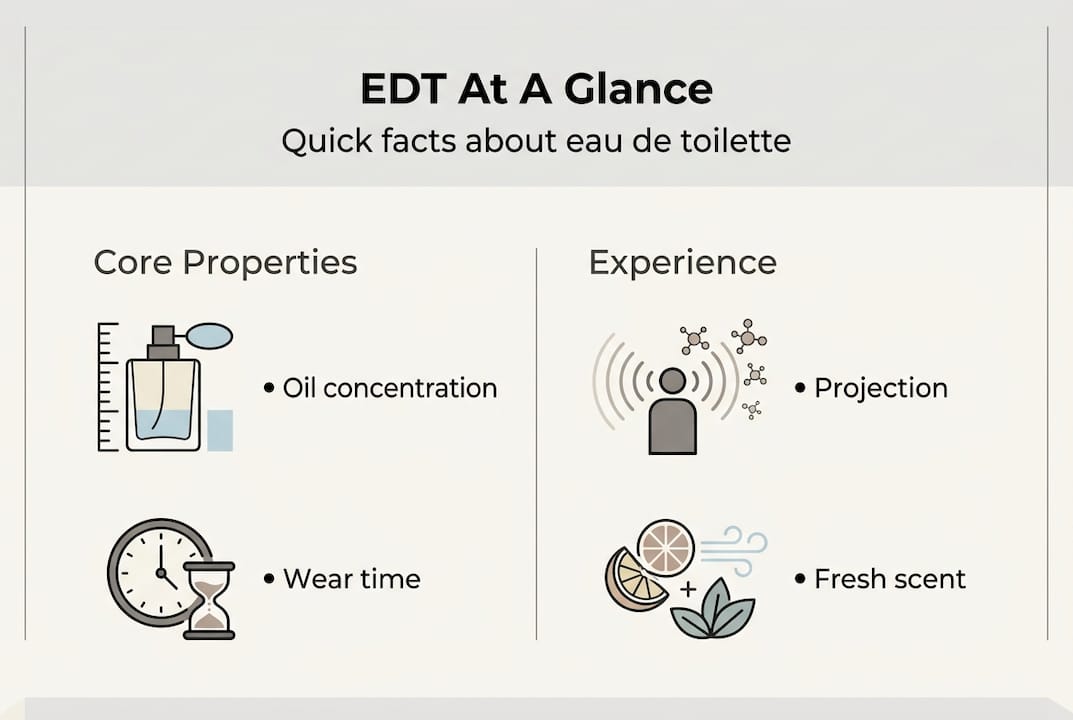
Eau de toilette (EDT) is a fragrance category defined primarily by its concentration of perfume oils. According to the eau de toilette meaning as recognised in standard fragrance terminology, it refers to a scented liquid applied to the skin or clothing. In practical terms, EDT concentration sits at 5 to 15% fragrance oil dissolved in alcohol and water, with a typical wear time of 3 to 6 hours.
This concentration level shapes the entire sensory experience. EDT tends to open with a brighter, fresher character. Top notes, the first impression you smell, are more prominent and project strongly in the first hour. As those top notes fade, the heart and base notes emerge more subtly than they would in a stronger formulation.
Key characteristics of EDT include:
- Concentration: 5 to 15% fragrance oil
- Longevity: Typically 3 to 6 hours on skin
- Projection: Strong initial sillage, softens over time
- Character: Fresh, light, and often citrus or aromatic in profile
- Best use: Daytime wear, warmer climates, office environments
| Property | Typical EDT value |
|---|---|
| Oil concentration | 5 to 15% |
| Wear time | 3 to 6 hours |
| Projection | High initially, fades moderately |
| Top note emphasis | Strong |
Importantly, EDT is not simply a diluted eau de parfum. Many brands formulate their EDT and EDP versions as entirely separate compositions, each designed to deliver a specific effect at its given concentration.
Pro Tip: Always test EDT on your skin rather than a paper strip. Skin chemistry reacts with fragrance oils in ways paper cannot replicate, and the true performance of an EDT only reveals itself over time on your wrist.
Eau de toilette versus eau de parfum and cologne
With the basics of EDT covered, understanding its place alongside other fragrance types provides perspective.
Fragrance types are organised by concentration. Cologne (eau de cologne) sits at roughly 2 to 4% oil, EDT at 5 to 15%, eau de parfum (EDP) at 15 to 20%, and parfum at 20 to 30% or above. Higher concentration does not automatically mean better. It means a different experience.
EDT is lighter and fresher compared to EDP, with stronger initial projection but shorter longevity. EDP, by contrast, leans into base notes, offering richer, more persistent depth. The EDP vs EDT distinction is not simply about strength but about how a fragrance unfolds over time.

Here is a direct comparison:
| Type | Oil concentration | Longevity | Character |
|---|---|---|---|
| Eau de cologne | 2 to 4% | 1 to 2 hours | Very light, citrus-forward |
| Eau de toilette | 5 to 15% | 3 to 6 hours | Fresh, balanced |
| Eau de parfum | 15 to 20% | 6 to 8 hours | Rich, base-note dominant |
| Parfum | 20 to 30%+ | 8 to 12 hours | Intense, long-lasting |
Consider these common use cases:
- EDT suits daytime wear, summer heat, and professional settings where subtlety is valued.
- EDP is better suited to evenings, cooler months, or occasions where lasting impact matters.
- Cologne works well for a light, refreshing application after sport or in very warm weather.
Understanding perfume projection is also useful here. EDT projects outward strongly at first, then settles closer to the skin. EDP maintains a steadier, more consistent projection throughout the day.
There is no universal ‘better’, just different conventions suited to different moments and preferences.
Brands frequently design EDT and EDP versions of the same fragrance as distinct experiences. The EDT may emphasise citrus and green notes, while the EDP of the same name leans into woods and musks. They share a name but not always a formula.
Regulations, safety, and changing formulas
Beyond formula design, regulations play an unseen but vital role in shaping how EDT is produced.
The International Fragrance Association (IFRA) sets global safety standards for fragrance ingredients. A common misconception is that IFRA controls how concentrated a fragrance can be. In fact, IFRA regulates individual ingredients for safety rather than setting strict overall concentration limits on EDT or any other fragrance type.
IFRA standards apply to specific material categories, including leave-on products such as body sprays and rinse-off products. The limits are based on dermatological and toxicological research, not on whether a product is labelled EDT or EDP.
Key points about fragrance regulation:
- IFRA limits apply to individual raw materials, not to the overall fragrance concentration
- Safety categories distinguish between products applied to lips, skin, or rinsed off
- Formula changes in well-known fragrances often reflect updated IFRA standards for specific ingredients
- Reformulations can alter a fragrance’s character noticeably, even when the name remains the same
- Regulatory adaptation is an ongoing process as new safety data emerges
This explains why a beloved EDT from a decade ago may smell different today. The brand may have reformulated to comply with updated ingredient restrictions, not to cut costs or reduce quality. Certain naturals, such as oakmoss or specific musks, have faced tighter restrictions over the years, leading to reformulated versions that smell noticeably different from earlier batches.
For fragrance enthusiasts, this makes sampling even more valuable. Buying a full bottle of a fragrance you last smelled years ago carries real risk. The current formula may differ significantly from your memory of it.
Sampling eau de toilette: Affordable strategies before buying
Once the technical and safety aspects are clear, choosing the right EDT is easier when you can try before you buy.
Discovery sets allow affordable trials of niche scents before committing to expensive full bottles. Decants, which are small measured portions of a fragrance transferred into a separate vial, offer similar benefits. Both approaches let you wear a fragrance properly over several days before deciding.
Benefits of sampling before purchasing:
- Avoids costly mistakes: Full bottles of niche or designer EDT can cost £100 or more
- Reveals true performance: You experience how the EDT develops over hours on your specific skin
- Enables comparison: You can trial multiple EDTs side by side to identify your preference
- Reduces waste: You only buy what you know you will wear
- Supports informed decisions: Particularly useful when exploring unfamiliar niche houses
Exploring the different types of fragrance samples available is a practical starting point. From 2ml vials to 10ml decants, there are options to suit every level of curiosity. For example, a [Dior Sauvage sample](https://theperfumesampler.com/products/dior sauvage eau de toilette) lets you properly assess one of the most popular EDTs on the market before committing to a full bottle.
Pro Tip: When trialling both EDT and EDP versions of the same fragrance, wear one on each wrist and note how each develops over four to six hours. The difference in base note richness and longevity will be immediately clear.
Everyday use and skin chemistry: Making EDT work for you
Finally, to truly enjoy EDT every day, understanding your own skin and routine can elevate the experience.
Skin chemistry affects EDT performance significantly. Dry skin tends to absorb fragrance faster, reducing longevity. Oilier skin retains scent longer. Body temperature, diet, and even hydration levels influence how an EDT smells and how long it lasts on you specifically.
Practical tips for daily EDT wear:
- Moisturise first: Apply an unscented moisturiser before spraying EDT to extend longevity on dry skin
- Target pulse points: Wrists, neck, and inner elbows radiate heat and amplify projection
- Reapply strategically: EDT fades faster than EDP, so carrying a small decant for midday top-ups is practical
- Match to climate: EDT performs well in heat as the alcohol disperses quickly; in cold weather, EDP may project better
- Layer carefully: A matching scented body lotion can extend the overall wear time of your EDT
Understanding the factors affecting perfume performance helps you plan your routine more effectively. For professional settings, fragrances for professionals tend to favour lighter, non-intrusive EDTs that project subtly without overwhelming a shared workspace. A well-chosen EDT such as [Dior Homme Sport](https://theperfumesampler.com/products/dior homme sport eau de toilette) illustrates how a fresh, clean EDT can work across multiple environments without adjustment.
The EDT performance insights from experienced fragrance communities consistently reinforce one point: personal testing is irreplaceable.
Pro Tip: When evaluating a new EDT for daily use, note the initial sillage (how far the scent projects) versus how long it remains detectable close to the skin. This helps you decide whether you need to reapply and when.
Why formulas matter: The overlooked realities of eau de toilette
Conventional wisdom says EDT is simply weaker than EDP. That framing misses the point entirely.
EDT and EDP are often distinct formulas, not mere dilutions of one another. A brand’s EDT may be crafted to emphasise a specific mood or occasion that the EDP version does not serve. Judging one as inferior to the other based on concentration alone ignores creative intent.
Scent perception is also deeply personal. What reads as fresh and vibrant on one person may smell flat on another. This is why marketing claims about a fragrance’s character should always be treated as a starting point, not a guarantee. The only reliable test is wearing it yourself.
Formula shifts, whether driven by regulation or reformulation, can surprise even experienced fragrance collectors. A fragrance you wore and loved years ago may perform differently today. Understanding the performance factors at play, from ingredient changes to skin interaction, gives you a more realistic expectation of what any EDT will deliver. Sampling is not optional for the serious fragrance buyer. It is the only way to know.
Discover niche fragrance samples for smarter decisions
Ready to put these insights into practice? ThePerfumeSampler makes it straightforward to trial high-end and niche EDTs before committing to a full bottle.
We offer authentic fragrance decants in 2ml, 3ml, 5ml, and 10ml sizes, covering a wide range of designer and niche houses. If you are unsure whether sampling is right for you, our guide on why decants explains the practical and financial benefits clearly. For curated recommendations, browse our top fragrance picks to find popular EDTs worth trialling. Avoid expensive mistakes. Sample first, then buy with confidence.
Frequently asked questions
How long does eau de toilette last when worn?
EDT typically lasts 3 to 6 hours, though results vary depending on skin chemistry, climate, and application method.
Why is eau de toilette usually lighter than eau de parfum?
EDT contains a lower concentration of fragrance oil and more alcohol, meaning top notes are more prominent and longevity is shorter compared to EDP.
Can I test eau de toilette before buying a full bottle?
Yes. Discovery sets allow affordable trials of niche and designer EDTs, and decants in small sizes let you wear a fragrance properly before committing to a full purchase.
Do regulations affect how eau de toilette is formulated?
IFRA regulates ingredient safety rather than overall fragrance concentration, meaning specific raw materials may be restricted or reformulated while the EDT label itself remains unchanged.
Recommended
- How to layer fragrances for a unique signature scent – ThePerfumeSampler
- Top fragrances for professionals: elevate your scent – ThePerfumeSampler
- Dior Sauvage Eau De Toilette – ThePerfumeSampler
- Discover types of fragrance samples for affordable trials – ThePerfumeSampler
- Perfume vs eau de toilette: choose your scent in 2026 – Be Frsh