
Why scents smell different: A guide to fragrance variation
TL;DR:
- People perceive the same fragrance differently due to genetic, biological, and psychological factors shaping olfaction. Personal skin chemistry, cultural influences, and environmental conditions significantly alter how a scent smells and lasts on an individual. Effective fragrance discovery requires patient, on-skin sampling and embracing scent variation as a personalized experience.
Two people can stand in the same perfumery, spray the same fragrance on their wrists, and walk away with completely opposite opinions. One finds it sweet and warm; the other finds it sharp and medicinal. This is not imagination. Olfaction is highly individual, shaped by genetics, personal experience, and biology in ways that make every nose genuinely unique. For anyone exploring niche and luxury fragrances, understanding why this happens is not just interesting. It is essential for making smarter sampling decisions.
Table of Contents
- The science behind scent variation
- How personal chemistry changes your fragrance
- Cultural, geographic and psychological influences
- Practical tips for sampling fragrances
- A new perspective: Why scent differences matter more than you think
- Discover your unique scent experience with ThePerfumeSampler
- Frequently asked questions
Key Takeaways
| Point | Details |
|---|---|
| Biology shapes scent | Genetics and individual receptors mean no two people sense a fragrance exactly alike. |
| Skin chemistry impacts aroma | A perfume’s character shifts due to unique body chemistry, warmth and lifestyle. |
| Culture and context matter | Where and how you smell influences which scents stand out and feel appealing. |
| Sampling is essential | Test fragrances on your own skin to see how the scent truly develops for you. |
| Embrace scent diversity | Differences in scent perception are a cause for curiosity, not concern. |
The science behind scent variation
To understand why people experience the same perfume so differently, you need to look at how the sense of smell, known as olfaction, actually works. When you inhale a fragrance, airborne molecules travel to the olfactory epithelium at the top of the nasal cavity. There, specialised receptor cells detect specific molecular shapes and send signals to the brain for processing.
The critical point is this: not everyone has the same receptors. Receptor genetics directly influence how odours are detected between individuals. One person may have a highly sensitive receptor for a woody or musky molecule, while another person’s version of that receptor barely registers it. This is not a flaw. It is simply biological variation, much like differences in colour vision.
Once the signal reaches the brain, things become even more complex. The brain’s scent-processing framework resists simple mapping, which is precisely why two people can disagree about the fundamental character of an odour. What one person codes as “floral” might register as “powdery” or even “soapy” to another. Understanding fragrance notes and user experience becomes much richer once you accept that the brain is doing active interpretation, not passive recording.
“Smell does not work like vision or hearing. There is no simple sensory map. Two people smelling identical molecules can arrive at entirely different perceptual outcomes.”
Here is a summary of the main factors that drive scent variation between people:
| Factor | Effect on scent perception |
|---|---|
| Genetic receptor variation | Alters sensitivity to specific aroma molecules |
| Brain processing differences | Changes how odour character is interpreted |
| Learned associations | Links smells to past experiences and emotions |
| Age | Reduces receptor sensitivity over time |
| Health and medication | Can blunt or distort the sense of smell |
Cultural and personal experience add another layer on top of biology. People develop scent associations through lived experience. Common psychological and cultural influences on scent perception include:
- Memory anchoring: A fragrance linked to a specific person or place from childhood becomes emotionally charged for that individual
- Cultural coding: Some cultures associate particular notes, such as oud or incense, with ceremony and reverence, making them smell “sacred” rather than simply “smoky”
- Expectation bias: Reading a perfume’s marketing copy before smelling it can change what you actually perceive
- Exposure frequency: Repeated exposure to a scent class, such as florals or orientals, builds familiarity that can make those scents smell more pleasant
Understanding this mix of biology and learned response is the starting point for anyone serious about fragrance discovery. Your nose is not wrong. It is just yours.
How personal chemistry changes your fragrance
Biology and psychology explain part of the story. Your own body explains the rest. When a perfume makes contact with your skin, it does not simply sit on the surface and radiate outward. It interacts chemically with everything your skin produces, including oils, sweat, and microbiome activity.
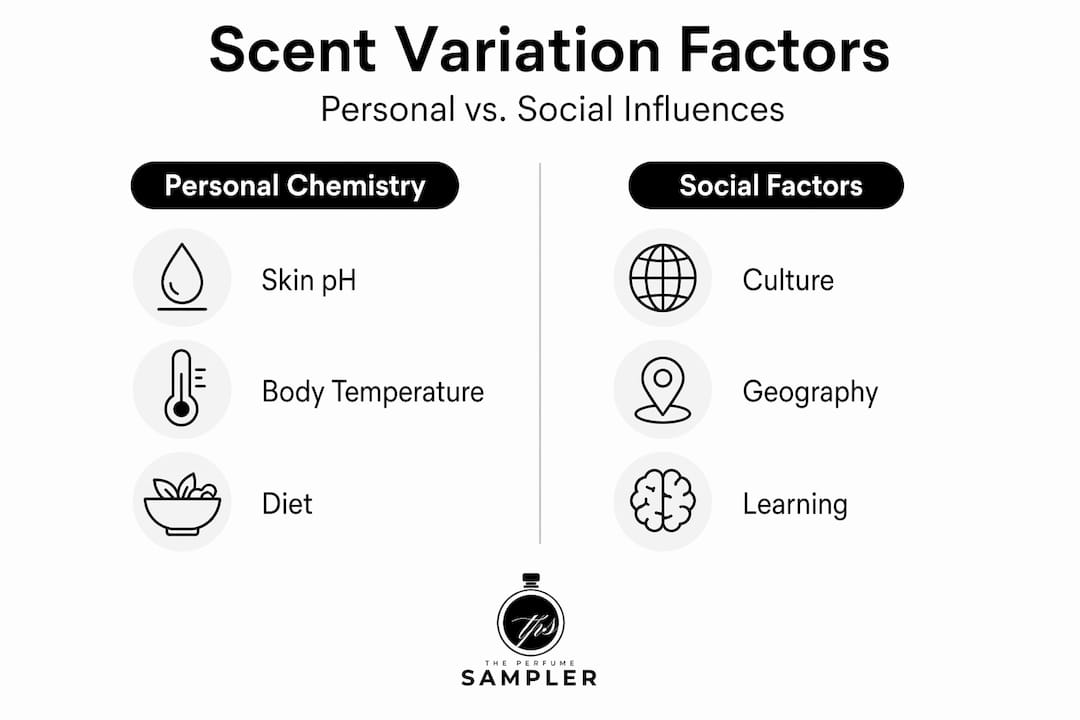
Skin chemistry directly affects how a fragrance smells, how long it lasts, and how far it projects. Your skin’s pH level plays a significant role. More acidic skin tends to make fragrances smell sharper and fade faster. More alkaline skin can amplify certain base notes, making a fragrance smell deeper and warmer. Hydrated skin holds fragrance molecules better, which is why moisturising before application generally extends longevity.
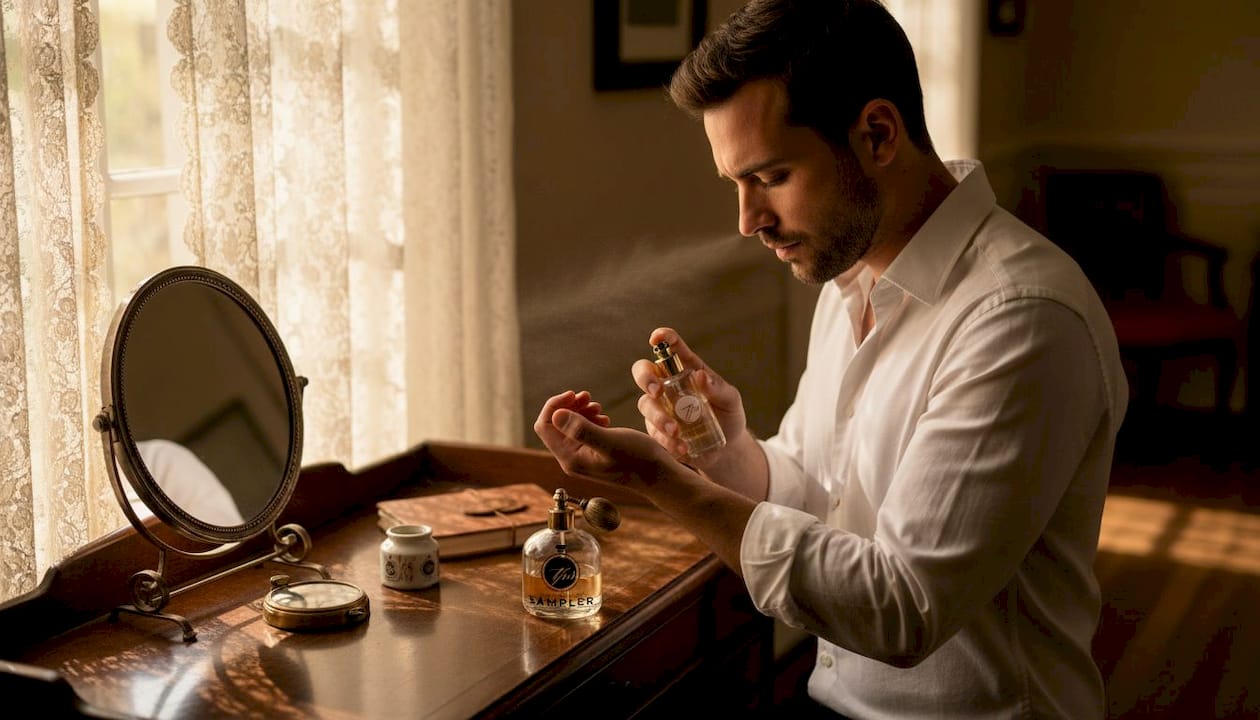
Diet and hormonal fluctuations also shift the picture. Foods rich in sulphur, such as garlic and onions, can alter how your skin’s natural oils interact with fragrance ingredients. Hormonal cycles affect skin temperature and sebum production, which in turn change how volatile fragrance molecules evaporate from the surface. Personal scents and fragrance interaction are far more intertwined than most people realise when they first pick up a bottle.
Body temperature is another underestimated variable. Warmer skin accelerates evaporation, pushing top notes away faster and bringing heart and base notes to the fore more quickly. This is why the same perfume smells different on a hot summer day compared with a cold winter morning, even on the same person.
Pro Tip: Always test a fragrance on your skin rather than just on paper. A blotter strip only tells you about the raw formula. Your skin tells you how that formula will actually perform as a personal scent for you.
Here is how fragrance performance compares across different testing surfaces:
| Testing surface | What you learn | What you miss |
|---|---|---|
| Paper blotter | Raw formula, initial top notes | Skin interaction, longevity, projection |
| Your own skin | Full development, personal wear | How it smells on others |
| Another person’s skin | Their personal chemistry result | How it works with yours |
| Clothing fabric | Long-term dry-down | All skin-chemistry effects |
This is why perfume on your skin is the only true test before committing to a full bottle. Sampling in realistic conditions is the only way to know what you are actually buying. The chemistry between scents and body chemistry is genuinely personal, and no review or description fully replaces your own skin test.
Cultural, geographic and psychological influences
Biology and personal chemistry explain individual variation. Culture and geography explain group-level patterns in how people perceive and respond to scent.
Olfactory sensitivity varies by location, with studies finding that geographic factors account for 17 to 20 per cent of the variance in chemosensory sensitivity across populations. This is a substantial figure. It suggests that where you grew up and where you live genuinely shapes how powerfully or subtly you register certain fragrances. This has real implications for fragrance discovery. A scent marketed as “lightly fresh” in one country may register as “barely there” to someone from a region with lower average sensitivity, and as “intensely bright” to someone from a region with higher baseline sensitivity.
At the same time, cross-cultural hedonic perception is more similar globally than many people assume. Most human beings, regardless of culture, share some broad preferences around fresh, clean, and sweet scents. The differences emerge more in what a scent means or evokes than in its basic pleasantness. Cultural context frames the narrative of a fragrance rather than completely rewriting whether it is enjoyable.
Some psychological influences worth understanding include:
- Memory and nostalgia: Scents processed through the limbic system can trigger vivid memories, making a fragrance feel deeply personal or unsettling with no logical explanation
- Context effects: The same fragrance smells different in a spa versus a department store versus your home. Environment shapes interpretation
- Verbal labelling: Being told a scent contains “leather” before smelling it increases the likelihood you will perceive leather, even if the note is subtle
- Social expectation: If someone you admire recommends a fragrance, you are more likely to evaluate it positively
These factors matter enormously when you approach self-expression and fragrance. The fragrance you choose communicates something about you, and cultural context shapes how others interpret that signal. Exploring fragrance family differences with an awareness of cultural nuance makes the discovery process significantly more rewarding.
There is also a practical risk here. What feels like a safe, inoffensive scent choice in one cultural context may read very differently in another. Understanding these dynamics reduces cultural mistakes in perfume choices and helps you pick fragrances that work across multiple settings.
Practical tips for sampling fragrances
Knowing all this, the question becomes: how do you sample fragrances intelligently, given all this biological and cultural noise?
The answer is structured, patient sampling. Here is a practical approach:
- Sample on skin, not paper. Always apply a small amount to your inner wrist or the inside of your elbow. These pulse points generate warmth that helps the fragrance develop naturally.
- Wait at least 30 minutes. Top notes, the initial burst you smell immediately, are volatile and fade quickly. Heart notes take 20 to 30 minutes to emerge. Base notes may take up to an hour. Judge the fragrance across its full arc.
- Sample in neutral conditions. Avoid sampling immediately after eating strong food, applying heavy lotion, or being in a smoky environment. All of these interfere with your olfactory baseline.
- Limit to two or three fragrances per session. Your nose fatigues quickly. Testing too many in one session creates confusion and unreliable impressions.
- Record your first impressions. Write down what you smell and how it makes you feel, without referencing the official notes list. This captures your genuine, unbiased response.
- Wear it again on a different day. A second wear in different conditions, different weather, different time of day, will often reveal entirely new aspects of the fragrance.
Pro Tip: Keep a simple fragrance journal. Note the date, the scent, the weather, the time of day, and your mood. Over time, patterns emerge that tell you a great deal about your genuine preferences and the way your personal chemistry interacts with different fragrance families.
Understanding how fragrances evolve through their top, heart, and base note phases is essential for anyone making informed sampling decisions. The key factors in picking a fragrance become much clearer once you slow down and give each sample the time it deserves. A niche perfume especially rewards patient, repeated sampling rather than snap judgements.
The same fragrance can register differently due to receptor-level differences, learned associations, and skin interaction. Knowing this lets you approach sampling with more open expectations and less frustration when a fragrance does not match its description.
A new perspective: Why scent differences matter more than you think
Most people experience scent variation as a problem. You read glowing reviews of a niche fragrance, order a sample, and it smells nothing like the description. The immediate reaction is disappointment. But this framing misses what is actually happening.
Scent variation is evidence that fragrance is a genuinely personal art form. Not many sensory experiences in life are so thoroughly shaped by who you are at a biological and psychological level. When a fragrance smells different on you compared with someone else, that is not a malfunction. It is the fragrance responding to you specifically.
Consider that when two people both perceive a scent as off or unusual, neuroscience research indicates this can reflect both genuine receptor-level differences and individual preference patterns. Neither person is wrong. Both experiences are valid and real.
This understanding should change how you approach fragrance discovery. The goal is not to find fragrances that match a review perfectly. The goal is to find fragrances that work beautifully within your specific biology, your personal associations, and your cultural context. This is a much richer brief, and it genuinely requires sampling.
Exploring a unique scent guide with this mindset shifts fragrance discovery from a transaction into an ongoing personal project. The variation is the point, not the obstacle. Celebrating scent diversity means accepting that your nose is a legitimate and irreplaceable instrument, not just a faulty receiver waiting to be corrected by expert opinion.
Discover your unique scent experience with ThePerfumeSampler
Putting this knowledge into practice requires access to a wide range of fragrances without the financial risk of buying full bottles blindly.
That is exactly what ThePerfumeSampler is built for. Our range of fragrance decants, available in 2ml, 3ml, 5ml, and 10ml sizes, gives you the chance to test luxury and niche fragrances across multiple wears and genuine conditions. Read about why decants make sense before committing to a full bottle. Whether you are exploring something rich and intense like the Boss Bottled Absolu or browsing our curated edit of top fragrances for autumn, every sample lets you discover how a fragrance genuinely performs on your skin, in your life, and within your unique nose.
Frequently asked questions
Why does my favourite perfume smell different when someone else wears it?
Body chemistry, skin type, and individual receptor genetics cause fragrances to develop and project in unique ways on different people. Perfume interacts directly with physiology, so the same formula will always smell at least slightly different on every individual who wears it.
Can people from different cultures smell the same scent differently?
Yes, cultural background and geographic factors alter both scent sensitivity and the ways people describe and react to fragrance. Research confirms measurable cross-cultural effects on odour perception, though some broad hedonic preferences are shared across populations.
Why do some people struggle to smell certain perfume notes?
Genetic differences in odourant receptors mean some people are less sensitive or even anosmic, meaning unable to detect, specific aroma molecules. Biology and genetics contribute directly to these differences in odour perception at the receptor level.
Is fragrance stronger or weaker in different parts of the world?
Olfactory sensitivity does vary by region, meaning the same scent can register as stronger or fainter depending on where you are. Studies found that location explains 17 to 20 per cent of the variance in chemosensory sensitivity across different populations.
Should I always test perfume on my skin before buying?
Yes, because only your skin chemistry will reveal how a scent truly unfolds for you across its full development. Perfume interacts with individual skin physiology in ways that no blotter strip, review, or description can accurately replicate.