

What is a complex fragrance: a complete guide
TL;DR:
- A complex fragrance features evolving accords that change across different phases of wear, creating a rich sensory experience.
- Perceived complexity depends on how ingredients interact, not the number of notes or ingredients in the formula.
A complex fragrance is defined as a scent built from multiple interacting accords that evolve across distinct phases over time, creating a rich and dynamic olfactory experience. The term “complex fragrance” is widely used by enthusiasts, but the industry standard concept is olfactory complexity, a measurable quality recognised by perfumers and bodies such as the International Fragrance Association (IFRA). Complexity is not about how many ingredients a formula contains. It is about how those ingredients interact, shift, and reveal new dimensions from the first spray to the final dry-down. Theperfumesampler stocks a wide range of niche and designer fragrances that demonstrate this quality across every price point.
What is a complex fragrance and how is it defined?
A complex fragrance is one that evolves across interacting accords rather than presenting a single, static scent impression. The brain finds these profiles harder to categorise rapidly, which is precisely what makes them feel rich and intriguing. A simple fragrance smells the same from first application to last. A complex one tells a different story at each stage of wear.
Olfactory complexity is a perceptual outcome, not a compositional checklist. Two fragrances with identical ingredient counts can produce wildly different levels of complexity depending on how those ingredients are balanced and sequenced. This distinction matters because it shifts the focus from marketing claims about “over 100 ingredients” to the actual sensory experience on your skin.
How are complex fragrances structured: the perfume pyramid
The perfume pyramid is the standard structural model used to explain how fragrance notes evolve across three distinct phases. Each phase is driven by molecular weight and evaporation rate. Understanding this structure is the clearest way to understand why complex fragrances feel so layered.
Top, heart, and base notes explained
Top notes are the lightest molecules. They evaporate within minutes of application and form your first impression of a scent. Common top notes include citrus, light herbs, and aldehydes. Heart notes, also called middle notes, emerge as the top notes fade. They last roughly 1–5 hours and define the character of the fragrance. Base notes carry the heaviest molecules. They anchor the scent and can linger for 12 or more hours.
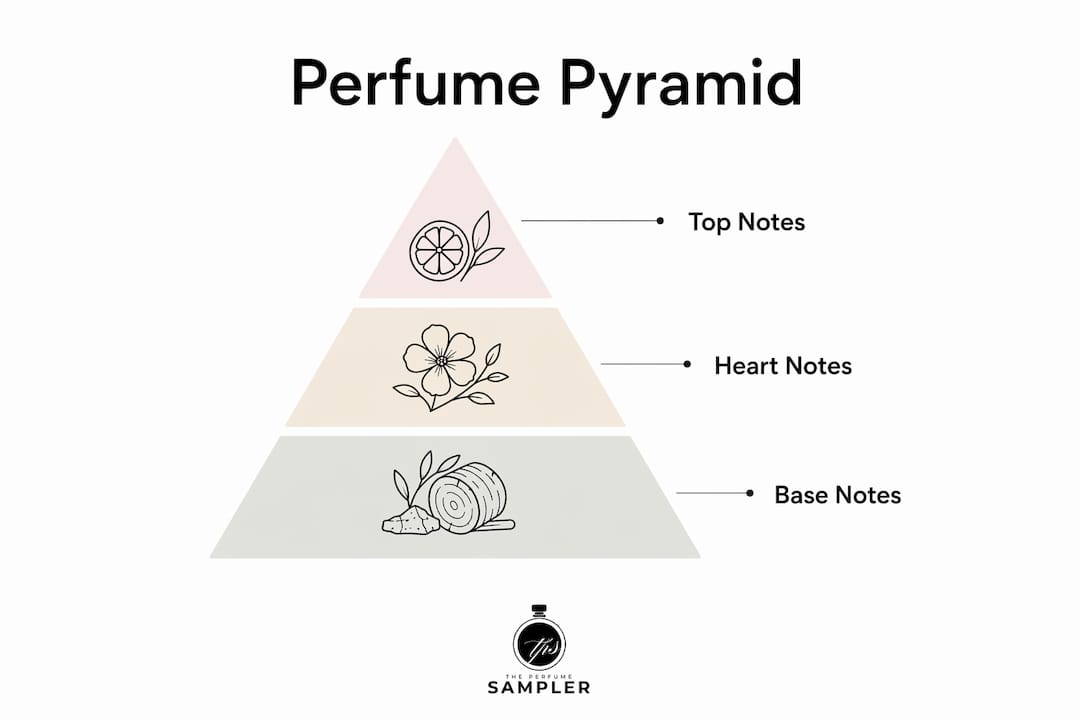
The interaction between these three phases is what creates temporal complexity. A fragrance that smells like sharp bergamot at first, then shifts to a warm rose heart, then settles into a woody amber base has demonstrated genuine olfactory complexity. Each transition reveals something new.
| Note category | Molecular weight | Evaporation time | Common examples |
|---|---|---|---|
| Top notes | Low | Minutes | Citrus, herbs, aldehydes |
| Heart notes | Medium | 1–5 hours | Rose, jasmine, spices |
| Base notes | High | Up to 12+ hours | Sandalwood, musk, amber |
Pro Tip: Spray a fragrance on your wrist and check it again at 30 minutes, 2 hours, and 4 hours. If it smells noticeably different at each stage, you are wearing a genuinely complex scent.
For a deeper look at how each note category functions, the guide on perfume note layers at Theperfumesampler covers the structural logic in full.
What really makes a fragrance complex: accords and perception
The most common misconception about complex fragrances is that more ingredients automatically means more complexity. Expert perfumers at IFRA-affiliated houses know that formulas with over 60 ingredients risk losing clarity because competing volatile molecules cancel each other out. Becoming a trained “nose” takes 7–10 years precisely because balance is harder than abundance.
What is an accord and why does it matter?
An accord is not simply a blend of ingredients. An accord produces a new scent impression that did not exist in any of its individual components. Think of it as a chemical conversation where the result is greater than the sum of its parts. Precise proportions and molecular cooperation determine whether that conversation produces something beautiful or muddy.
Complex fragrances typically contain multiple accords that interact with each other across the wear cycle. This is what activates higher cognitive processing in the brain. The brain works harder to categorise a scent that keeps shifting, which creates the sensation of depth and intrigue that enthusiasts associate with great perfumery.
Key characteristics that separate accords from simple mixtures:
- An accord produces a unified new scent impression, not a detectable list of ingredients
- Balance and proportion determine whether the accord reads as clear or chaotic
- Accords can interact with other accords in the same formula, creating secondary complexity
- The same accord smells different depending on what surrounds it in the formula
- Advances in biotechnology now allow perfumers to create novel molecular structures that were impossible through traditional extraction
Pro Tip: When reading about a fragrance, look for descriptions that mention multiple distinct phases or contrasting accords rather than a single dominant theme. That contrast is the clearest signal of genuine complexity.
For a thorough explanation of how accords create scent harmony, the perfume accords guide at Theperfumesampler is worth reading alongside this article.
Common misconceptions: note lists, illusions, and skin chemistry
Fragrance notes listed on packaging are not ingredient disclosures. They are interpretive scent descriptions designed to give consumers a vocabulary for what they might smell. A “rose” note may contain no natural rose at all. It is more likely a combination of aromachemicals engineered to recreate the impression of rose. Notes are marketing tools that provide olfactory shorthand, not a window into the formula.
This matters for understanding complexity because it means you cannot judge a fragrance’s depth from its note list alone. A fragrance listing twelve notes may smell flat and linear. One listing four notes may unfold in genuinely surprising ways. The overall balanced experience is the only reliable measure of true complexity.
How skin chemistry changes what you smell
Skin chemistry is one of the most underappreciated factors in fragrance perception. Skin pH, oil levels, and temperature can mute or amplify different accords within the same fragrance. A complex scent that reveals stunning depth on one person may smell linear or faint on another. This is not a flaw in the fragrance. It is the nature of skin interaction.
The essential oils present in many fragrance formulas also interact with the skin’s natural chemistry, which is why understanding essential oil properties can deepen your appreciation of how fragrances behave after application. Practical steps for testing complexity on skin:
- Apply to a pulse point, not paper, as skin warmth activates molecular evaporation properly
- Wait at least 15 minutes before forming any opinion about the scent
- Revisit the fragrance at the 1-hour and 3-hour marks to observe evolution
- Compare how the same fragrance performs on different areas of your body
- Test on a day when your skin is clean and unscented to avoid interference
Pro Tip: Avoid rubbing your wrists together after applying a fragrance. Friction breaks down the top note molecules faster and disrupts the natural evolution of the scent.
For a full explanation of why the same bottle can smell so different depending on the wearer, the article on why perfume smells different covers the science clearly.
How to recognise and appreciate complex fragrances
Recognising complexity is a skill that improves with deliberate practice. The most reliable method is structured skin testing across the full wear cycle. A fragrance that does not require many ingredients to feel complex proves that perception, not composition, is the true measure.
Practical ways to identify and appreciate complexity:
- Track the scent at three points: immediately after application, at 30–60 minutes, and at 3–4 hours
- Notice whether the character shifts or remains static across those checkpoints
- Pay attention to contrast within the fragrance, such as a fresh opening giving way to a warm, resinous base
- Resist the urge to judge a fragrance within the first five minutes, as top notes are the least representative phase
- Read reviews that describe the dry-down, not just the opening, as complexity lives in the later stages
Layering fragrances is another way to build complexity intentionally. Combining a simple, clean base with a richer, more textured scent can create a profile that neither fragrance achieves alone. The guide on layering fragrances at Theperfumesampler offers practical techniques for doing this well.
Pro Tip: Keep a brief scent diary when testing new fragrances. Note what you smell at each stage. After a few weeks, you will find your ability to detect and describe complexity improves significantly.
Key takeaways
A complex fragrance is defined by evolving, interacting accords across top, heart, and base phases, not by the number of ingredients in the formula.
| Point | Details |
|---|---|
| Complexity is perceptual | A fragrance with few ingredients can feel deeply complex if its accords interact and evolve well. |
| Accords create new impressions | An accord is a new scent born from precise ingredient combinations, not a simple mixture. |
| Note lists are not ingredient lists | Fragrance notes are interpretive descriptions, not disclosures of actual formula contents. |
| Skin chemistry shapes the experience | pH, temperature, and oil levels change how complexity unfolds on each individual wearer. |
| Testing over time is essential | Judging a fragrance only at first spray misses the heart and base phases where complexity lives. |
Why complexity is the most honest measure of a great fragrance
I have spent years testing fragrances across every category, from mass-market releases to rare niche compositions, and the single most consistent finding is this: complexity earned through precision is always more satisfying than complexity claimed through ingredient lists.
The fragrances I return to most are not the ones with the longest note pyramids. They are the ones that surprise me at the two-hour mark. A scent that opens with cool, sharp citrus and then quietly reveals a warm, smoky vetiver base has done something genuinely difficult. It has maintained coherence while changing completely.
The perfumery world is full of marketing language designed to make simple fragrances sound profound. Words like “opulent,” “multi-faceted,” and “layered” appear on bottles that smell identical from first spray to last. Trusting your nose over the label is the most useful habit you can develop. If a fragrance smells the same after four hours as it did in the first thirty seconds, it is linear, regardless of what the packaging claims.
The other thing I have come to believe strongly is that complexity is not exclusive to expensive fragrances. Some of the most genuinely evolving scents I have encountered have come from mid-range houses working with skilled perfumers who prioritise balance over spectacle. Price is not a reliable proxy for olfactory depth.
— Rupesh
Try complex fragrances before you commit to a full bottle
Testing a complex fragrance properly takes time and multiple wearings. Buying a full bottle before you have experienced the complete dry-down is a significant financial risk, particularly with niche and designer releases that carry premium price tags.

Theperfumesampler offers fragrance decants in 2ml, 3ml, 5ml, and 10ml sizes, covering a wide range of niche and designer releases. You can read more about the practical case for sampling on the why decants page. For those ready to experience a genuinely complex composition, the BOSS Bottled Absolu Parfum Intense is available as a decant. All products are 100% authentic, and Theperfumesampler ships internationally.
FAQ
What is a complex fragrance in simple terms?
A complex fragrance is a scent that evolves across multiple phases during wear, shifting from top to heart to base notes in a way that reveals new dimensions over time. Complexity comes from interacting accords, not from a long ingredient list.
How many notes does a complex fragrance need?
There is no minimum note count required for complexity. A fragrance with three well-chosen ingredients that interact and evolve can feel more complex than one with sixty poorly balanced components.
Why does a complex fragrance smell different after a few hours?
As lighter top-note molecules evaporate, heavier heart and base molecules become dominant. This molecular shift is what creates the evolving character that defines olfactory complexity.
Can skin chemistry affect how complex a fragrance smells?
Yes. Skin pH, oil levels, and body temperature all influence how accords develop and project. The same fragrance can smell rich and multi-layered on one person and flat on another.
Are complex fragrances always more expensive?
No. Price does not determine complexity. Some affordable fragrances from skilled perfumers demonstrate genuine olfactory depth, while some expensive releases smell linear throughout their wear cycle.