
Understanding perfume accords: your guide to scent harmony
TL;DR:
- Perfume accords are deliberately crafted blends of notes that create a unified, complex scent greater than individual ingredients. They form the foundation of fragrance structure, unfolding across top, heart, and base layers to influence the scent’s evolution and lasting power. Recognizing personal preferences for specific accords enhances sampling, layering, and selecting perfumes that resonate uniquely with each individual.
Most people assume a perfume is simply a collection of ingredients mixed together. In reality, the magic happens at a much more deliberate level. Perfumers do not just combine random ingredients and hope for the best. They craft accords: purposeful blends designed to produce a single, unified scent impression greater than the sum of its parts. Understanding what accords are, how they work, and how to identify them in the fragrances you wear will completely change how you shop for, sample, and experience perfume.
Table of Contents
- What is a perfume accord?
- How accords shape a fragrance
- Building and layering: crafting a signature scent with accords
- Why accords matter for sampling high-end fragrances
- The real secret of perfume accords: what most guides miss
- Experience perfumery’s harmony: sample, explore and find your perfect accord
- Frequently asked questions
Key Takeaways
| Point | Details |
|---|---|
| Perfume accords defined | An accord is a blend of multiple notes that creates a unique, recognisable scent signature. |
| Framework in the pyramid | Accords can be part of top, heart, or base layers, shaping how a fragrance evolves. |
| Practical sampling | Knowing accords empowers you to try, layer and select fragrances with confidence and creativity. |
| Personal experience matters | The magic of accords is often revealed only through real experience and sampling on your skin. |
What is a perfume accord?
An accord in perfumery is a balanced combination of individual notes that blends so completely the individual components become indistinguishable. The result is a new, singular scent identity. Think of it this way: just as individual musical notes combine to form a chord that sounds entirely different from any single note played alone, perfume notes combine in an accord to create something new.
This is fundamentally different from simply listing ingredients. A fragrance might contain bergamot, sandalwood, and musk, but if those three are blended in the right proportions and ratios, they stop being “bergamot plus sandalwood plus musk” and become something else entirely. That unified result is the accord.
Understanding accords also means understanding why they are the true foundation of fine fragrance. A perfumer’s skill lies not in choosing interesting ingredients in isolation but in constructing accords that are stable, memorable, and wearable. Without well-crafted accords, a fragrance falls apart. Notes clash, the scent feels disjointed, and the overall impression becomes confusing rather than captivating.
Research confirms that accords span multiple layers, meaning they can be constructed within one layer such as the top, heart, or base, or across multiple layers simultaneously. This aligns with how perfumes naturally unfold, moving from more volatile notes at the opening through to longer-lasting base notes. Understanding this is key to appreciating how a fragrance behaves across its full lifespan. It also helps explain why a perfume that smells one way in the bottle may smell entirely different an hour after application.
The fragrance layers and lasting power of any given perfume are directly shaped by how its accords are constructed and placed within the structure.
Three classic accord types you will encounter:
- Amber accord: A warm, resinous blend typically combining vanilla, benzoin, and labdanum. It feels rich and enveloping, and forms the backbone of many oriental fragrances.
- Chypre accord: A sophisticated combination of bergamot, oakmoss, and labdanum. It creates a mossy, earthy quality that is both timeless and distinctive.
- Fougère accord: Built around lavender, coumarin, and oakmoss, this accord is the foundation of countless classic masculine fragrances and carries a fresh, herbal quality.
Each of these accords has become so recognisable that entire fragrance families are named after them. Learning to identify these classic structures gives you a shortcut to understanding what a new fragrance will feel like before you even wear it.
How accords shape a fragrance
The structure of a perfume is commonly visualised using the olfactory pyramid, which divides a fragrance into three layers: top notes, heart notes, and base notes. Each layer has a different level of volatility, meaning each evaporates at a different rate. Top notes are the most volatile and are what you smell immediately upon spraying. Heart notes emerge as the top fades, typically after fifteen to thirty minutes. Base notes are the slowest to evaporate and define how the fragrance lingers on your skin for hours.
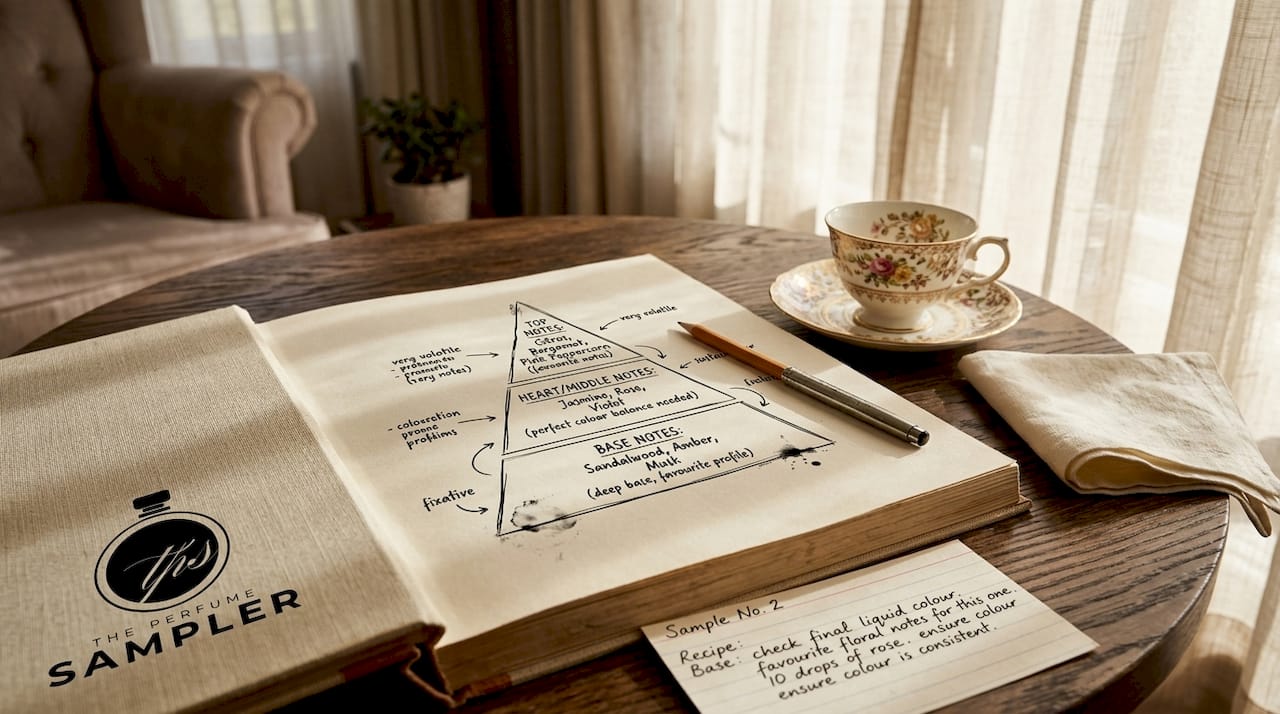
Accords can exist within any of these layers, or they can span all three, providing continuity and smoother transitions as the fragrance evolves on skin. Understanding how fragrances evolve helps you appreciate why a fragrance you sample in a shop might smell completely different after a few hours of wear.
| Layer | Typical accord type | Common ingredients | Duration on skin |
|---|---|---|---|
| Top | Citrus accord | Bergamot, lemon, grapefruit | 5 to 15 minutes |
| Heart | Floral accord | Rose, jasmine, iris | 30 minutes to 2 hours |
| Base | Amber or woody accord | Sandalwood, musk, vanilla | 2 to 8 hours or more |
| Spanning all | Fougère or chypre | Multiple notes across layers | Full lifespan of wear |
Here is how a typical accord unfolds as the fragrance develops on your skin:
- Initial application: The most volatile top notes hit first, often providing brightness or freshness. This is when citrus or green accords are most prominent.
- The dry-down (fifteen to thirty minutes): Top notes fade and heart accords emerge. Floral or spicy accords become more present and define the character of the fragrance.
- The base reveal (one hour onward): The base accord settles fully. Warm, woody, or resinous accords dominate and carry the scent throughout the rest of the wear time.
- Final phase (three to six hours): Only the deepest, most tenacious base notes remain. The fragrance feels quieter but can be remarkably intimate and personal at this stage.
Pro Tip: When testing a fragrance, wear it for a full three to four hours before making a purchase decision. The base accord is often the most important part of the scent experience, and it will not reveal itself in the first thirty minutes.
Exploring the broader fragrance families guide is an excellent complement to understanding accords, since most fragrance families are defined precisely by their dominant accord type.
Building and layering: crafting a signature scent with accords
Once you understand accords, you can start using that knowledge actively. This is where fragrance exploration becomes genuinely creative. Whether you are a seasoned enthusiast or completely new to the world of perfumery, recognising accords gives you the tools to experiment confidently.
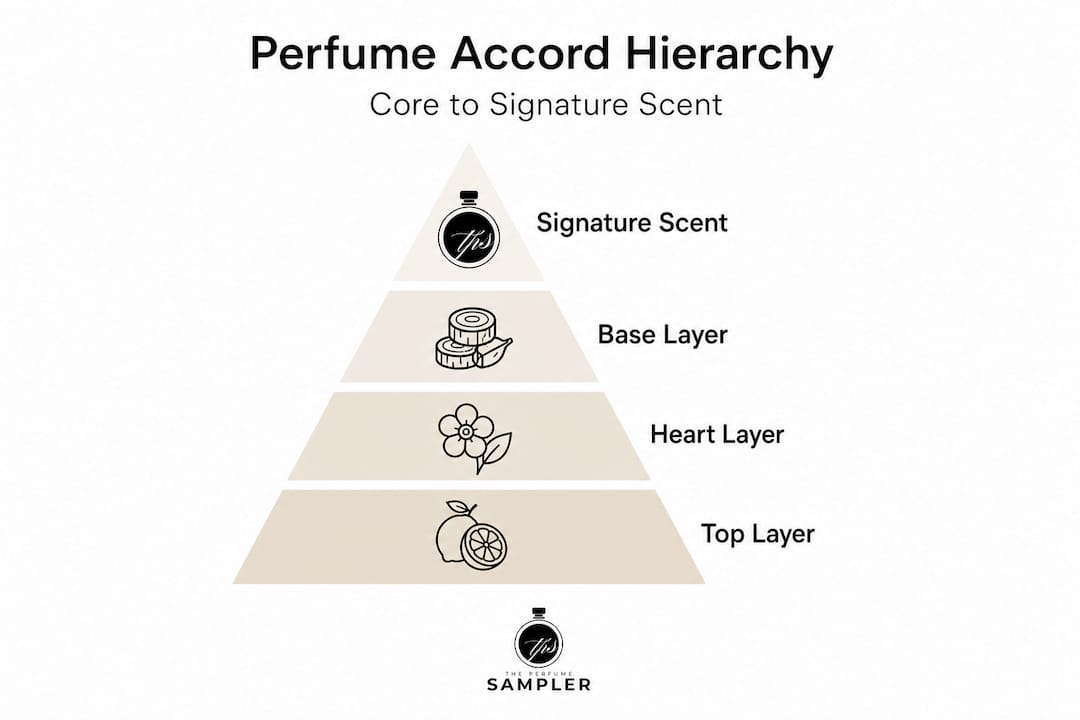
Accords can appear across the olfactory pyramid at any stage of development, and this is what allows for both smooth internal transitions and deliberate external layering between different fragrances. When you layer two fragrances, you are essentially creating a new accord on your skin in real time.
Common accord types and their effect on overall scent:
| Accord type | Dominant quality | Best suited for | Pairs well with |
|---|---|---|---|
| Citrus | Fresh, bright, clean | Daytime, warm weather | Aquatic, green, floral accords |
| Floral | Romantic, soft, feminine | Everyday, formal occasions | Musky, woody, powdery accords |
| Woody | Warm, earthy, grounding | Cooler weather, evenings | Amber, spice, resinous accords |
| Gourmand | Sweet, edible, cosy | Casual, autumn and winter | Vanilla, tonka, amber accords |
| Aquatic | Cool, airy, oceanic | Hot weather, sport, casual | Citrus, green, light woody accords |
| Chypre | Sophisticated, mossy | Formal, professional settings | Floral, fruity, leather accords |
The comparison above shows how accords are not isolated qualities. They interact, complement, and sometimes contrast with one another. Choosing fragrances based on their accord profiles rather than simply their listed notes gives you a far more reliable prediction of how a fragrance will behave.
Practical tips for layering fragrances to create harmonious results:
- Apply a base fragrance with a deep woody or amber accord first. Let it settle for a few minutes before adding a secondary fragrance.
- Layer complementary accord types, for example citrus over woody, or floral over musky. Avoid clashing accords such as heavy gourmand with fresh aquatic, as these tend to fight rather than blend.
- Apply the heavier, longer-lasting fragrance to pulse points such as wrists and the base of the throat. Apply the lighter fragrance over or near it.
- Test layering combinations on skin, not paper. Accords interact with your personal skin chemistry, and what works on a test strip may not behave the same way on your body.
- Record your favourite combinations. Keep a simple note on your phone with the fragrances and proportions that worked well together.
Pro Tip: Start with samples before you commit to full bottles for layering experiments. Trying out fragrance layering tips with affordable decants means you can explore dozens of combinations without the financial risk of buying multiple full bottles that may not work together.
Understanding which accords appeal to you personally also simplifies the often overwhelming task of luxury fragrance selection. When you know you love amber or woody accords, you immediately narrow your search from thousands of options to a manageable shortlist.
Why accords matter for sampling high-end fragrances
Here is where theory meets practice. Luxury and niche fragrances are often expensive, and purchasing a full bottle without knowing how the fragrance develops on your skin is a genuine risk. Understanding accords changes this entirely.
Identifying scent transitions as a fragrance develops on your skin is a learnable skill, and it directly leads to smarter, more satisfying purchases. When you can recognise the shift from a citrus top accord to a floral heart accord to a woody base accord, you can evaluate a fragrance at every stage rather than simply reacting to the initial spray.
Ways to spot your favourite accords in high-end samples before buying:
- Spray and wait. Do not evaluate a fragrance immediately. Give it at least thirty minutes before forming an opinion. This allows the heart accord to emerge.
- Note the dry-down. The base accord is the part of the fragrance you will live with the longest. Pay close attention to what remains after two hours of wear.
- Compare multiple samples side by side. Wearing different samples on different wrists or arms over several days reveals patterns in your preferences. You will quickly notice whether you gravitate toward woody bases, floral hearts, or fresh tops.
- Use your knowledge of accord families. If you know you love chypre accords, seek out fragrances described as mossy, oakmoss-forward, or built on a bergamot and labdanum base.
- Trust your skin, not the bottle. Always test on skin. Accords behave differently depending on skin chemistry, temperature, and even diet.
The fragrance community widely recognises that the majority of enthusiasts prefer to sample before purchasing, particularly at the luxury and niche end of the market. This is not surprising. When a bottle can cost well over one hundred pounds, sampling first is simply practical. Exploring niche fragrance sampling gives you access to complex, expertly constructed accords without the commitment of a full bottle purchase.
Olfactory education, the practice of actively learning to identify notes, accords, and families, makes every sampling session more productive. You stop reacting and start evaluating. You develop preferences grounded in genuine understanding rather than marketing language or packaging appeal.
The real secret of perfume accords: what most guides miss
Most articles about perfume accords stop at the technical explanation. They define the term, list some examples, and move on. What they rarely address is the deeply personal dimension of how accords actually feel.
The truth is that no two people experience the same accord identically. Your skin chemistry, your personal history, even your emotional state on a given day all influence how an accord registers. This is not a flaw in the system. It is precisely what makes fragrance so compelling. An amber accord that reads as warm and comforting on one person can feel heavy or cloying on another. A fresh aquatic accord that one person finds invigorating might feel cold and clinical to someone else.
We have seen customers come to us absolutely certain they hate a particular accord type, only to discover through sampling that a specific construction of that accord is the most flattering scent they have ever worn. The accord was the same in theory. The execution and their chemistry made all the difference.
There is also an emotional memory dimension that guides rarely acknowledge. Accords do not just smell of their ingredients. They smell of the first time you encountered them, the person who introduced you to that fragrance, or the place where you first wore it. This is why some accords feel immediately familiar and comforting, even in a fragrance you have never tried before. It is recognition, not just perception.
The only honest path to discovering your ideal accord is through real, hands-on sampling. Reading descriptions is useful context. But actual, mindful wear time is what builds genuine olfactory understanding. Exploring creativity in perfumery as an active participant rather than a passive consumer is what separates a fragrance enthusiast from someone who simply wears perfume.
No guide, however detailed, can tell you which accord will feel like yours. Only wearing it can.
Experience perfumery’s harmony: sample, explore and find your perfect accord
Now that you understand how accords work and why they matter, the most productive next step is to experience them first-hand.
At The Perfume Sampler, we offer high-end niche and designer fragrance samples in sizes of 2ml, 3ml, 5ml, and 10ml. These affordable decants are designed precisely for this kind of exploration. You can test multiple accords across different fragrances without the cost of full bottles. Read more about why sampling matters and how it removes the risk from luxury fragrance purchases. If you are looking for a specific example of a beautifully constructed base accord, Boss Bottled Absolu is an excellent starting point. It demonstrates how a well-built accord can carry a fragrance with depth and character across hours of wear. Sample before you commit.
Frequently asked questions
Can a perfume accord be made from just two notes?
Typically, an accord requires three or more notes to achieve a genuinely unified and complex impression, but some minimalist fragrance styles use just two for a subtle, paired harmony.
How do I recognise an accord in a new fragrance?
Focus on the prominent scent impression that persists and unifies the fragrance across its full development. As confirmed by research into fragrance structure, accords span multiple layers, so look for a consistent quality that runs through the top, heart, and base rather than disappearing at one stage.
Why do some accords smell different on my skin?
Accords interact with your unique skin chemistry, pH level, and body temperature, all of which can change how the blend develops and how strongly each element is perceived over time.
Are accords only used in luxury or niche perfumes?
No. Accords are fundamental to perfume structure regardless of a brand’s price point or status, though luxury and niche houses often invest more in complex or unusual accord constructions.
Recommended
- Types of perfume notes: Unlock fragrance layers and lasting power – ThePerfumeSampler
- How to find your signature scent: a complete guide – ThePerfumeSampler
- How fragrances evolve: master scent profiles before you buy – ThePerfumeSampler
- What makes a fragrance truly unique: your scent guide – ThePerfumeSampler