
Perfume reformulation: what every fragrance lover should know
TL;DR:
- Perfume reformulations are driven by regulation, cost, and creative choices, altering scent profiles.
- Changes often involve replacing natural ingredients with synthetics or adjusting concentrations, impacting smell and performance.
- Consumers should research batch codes, compare versions, and sample carefully to navigate reformulation effects.
That bottle of Chanel or Guerlain sitting on your shelf may not smell the same as it did five years ago. Perfume reformulation is happening constantly across the fragrance industry, affecting beloved cult classics and fresh launches alike. IFRA amendments are ongoing, meaning formulas continue to shift in response to regulatory pressure, ingredient costs, and evolving market tastes. Many collectors discover the change only after buying a new bottle, opening it, and realising something is different. This guide explains why it happens, what changes, how to spot it, and how to make smarter choices.
Table of Contents
- Why perfumes are reformulated: regulation, cost, and trends
- How reformulation actually happens: what changes in your favourite perfumes
- Spotting the differences: case studies from classics to modern launches
- Does reformulation always mean a worse perfume? Mixed opinions and new possibilities
- How to navigate reformulated fragrances: practical tips for buying and collecting
- The perfume lover’s dilemma: adapting without losing the magic
- Discover more and trust your nose with ThePerfumeSampler
- Frequently asked questions
Key Takeaways
| Point | Details |
|---|---|
| Regulation drives change | Most perfume reformulations are due to global safety regulations rather than creative decisions. |
| Detecting reformulation | Identifying changes involves checking batch codes, IFRA labels, and ingredient lists. |
| Not always worse | Reformulation sometimes results in safer, more wearable scents, not necessarily diminished quality. |
| Sample before buying | Trying decants lets you compare new and old versions and avoid disappointment. |
| Embrace fragrance evolution | Navigating reformulation is part of being a knowledgeable and adaptable fragrance enthusiast. |
Why perfumes are reformulated: regulation, cost, and trends
Understanding the reasons behind reformulation helps you separate changes you can accept from those worth avoiding. There are three main drivers: regulatory compliance, economics, and creative direction.
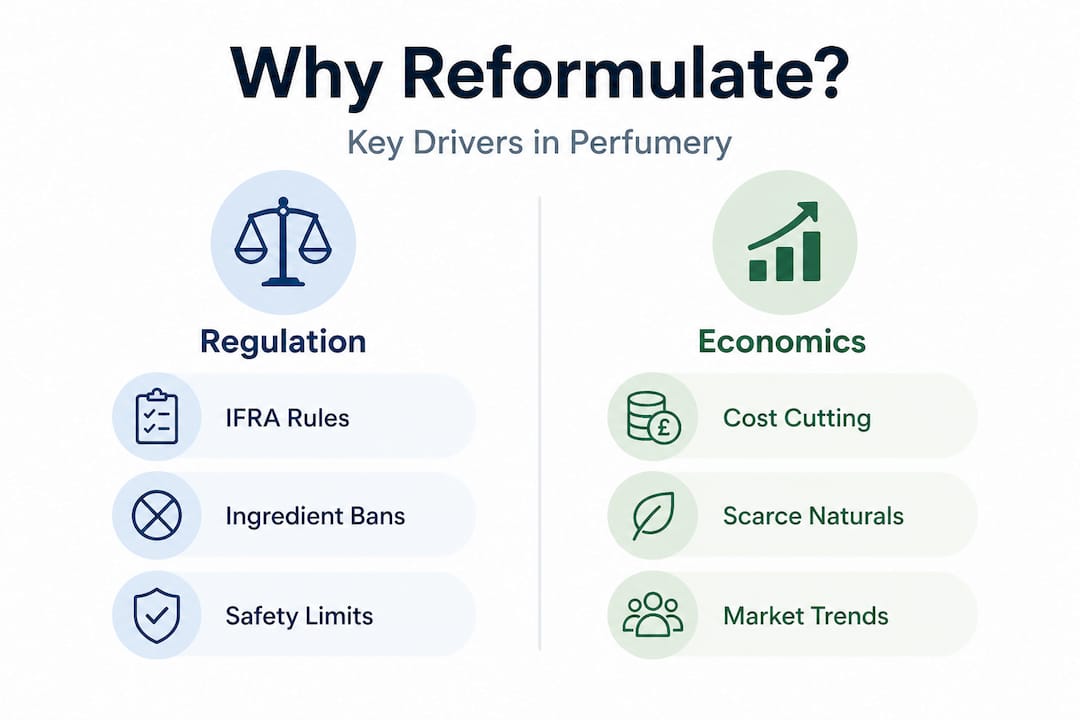
Regulatory pressure is the most significant force in modern perfumery. The International Fragrance Association (IFRA) regularly updates its standards, restricting or banning specific ingredients on safety or allergen grounds. The 52nd Amendment consultation in 2026 continues this pattern, introducing new limits on certain skin-sensitising materials. Brands must comply or face restrictions in major markets. This is not optional.
Economic drivers are equally powerful, though less openly discussed. Natural ingredients like rose absolute, oud, and real oakmoss are expensive and subject to supply chain volatility. When costs spike or availability drops, perfumers substitute synthetics or lower-concentration alternatives. These perfume pricing factors directly affect what ends up in your bottle. Cost-driven reformulations are often more harshly criticised by enthusiasts than regulatory changes, since they tend to feel like a reduction in quality without a clear justification.
Creative and commercial motivations round out the picture. A house may choose to modernise an older formula to appeal to a younger market, or simplify a complex composition to reduce production costs without technically changing its classification. The fragrance world has also seen a rise in niche and independent brands that market themselves as “vintage-inspired,” positioning their use of older ingredient traditions as a deliberate point of difference.
The key distinctions worth knowing:
- Regulation-driven reformulation: Forced by law or industry standards; often results in cleaner but flatter versions
- Cost-driven reformulation: Motivated by profit margins; frequently reduces depth, longevity, or complexity
- Creative reformulation: Intentional modernisation; quality depends on the perfumer’s execution
“Batch variations between production runs can turn buying a familiar fragrance into a lottery — especially with heavily reformulated classics.”
Pro Tip: If you notice a perfume smelling brighter or less complex than you remember, check the production year on the batch code before assuming it is your nose or skin chemistry.
How reformulation actually happens: what changes in your favourite perfumes
Knowing why reformulations occur, the next step is seeing how they are carried out at the formulation level. The process is more technical than most consumers realise.
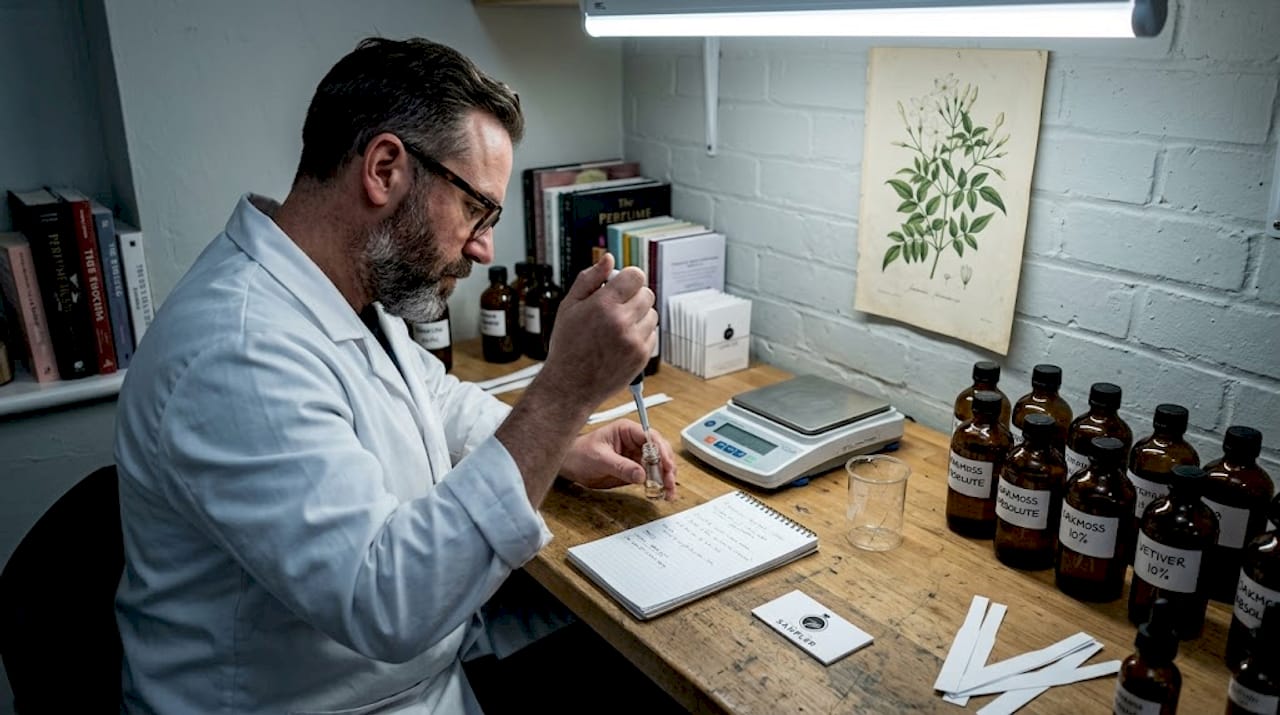
The most common method is replacing restricted natural materials with synthetic analogues. Oakmoss, a foundational ingredient in classic chypre fragrances, has been heavily restricted by IFRA due to its allergen content. Perfumers now use Evernyl or similar synthetic replacements to approximate the earthy, mossy quality. The synthetic version is safer and more consistent, but often lacks the multidimensional depth of the original. Entire formulas then require rebalancing, since changing one key material affects the interaction of all others.
Concentration adjustments are another common change. A perfumer may reduce the percentage of a restricted ingredient rather than removing it entirely. This retains a trace of the original character while meeting compliance thresholds. The result is often a diluted or simplified version of what once existed.
Here is a practical overview of what changes and how consumers detect it:
| Change type | What happens | How you detect it |
|---|---|---|
| Ingredient substitution | Natural replaced by synthetic | Flatter, less complex smell |
| Concentration reduction | Lower % of key material | Reduced longevity or projection |
| Formula rebalancing | Ratios of other notes adjusted | Different dry-down character |
| Carrier/solvent change | Different alcohol or base used | Altered opening; different skin feel |
How to check for reformulation in a bottle you already own:
- Locate the batch code on the bottom or back of the bottle (a string of letters and numbers stamped into the packaging).
- Use a batch code decoder such as CheckFresh to identify the production year.
- Compare the ingredient list on the box with a known earlier version sourced from online fragrance communities.
- Smell the opening, heart, and dry-down separately and note any differences from memory or online descriptions.
- Cross-reference with niche and unique profiles or community forums where enthusiasts document version differences.
Pro Tip: Older stock at duty-free shops and department store clearance shelves is sometimes pre-reformulation. Check batch codes before buying, not after.
Spotting the differences: case studies from classics to modern launches
With the process explained, let us look at how reformulation plays out in practice with recognisable examples.
Guerlain Mitsouko is one of the most cited casualties of IFRA restrictions. Originally a rich, powdery chypre anchored in oakmoss and natural peach, post-reformulation versions are noticeably drier and less creamy. The peach facet, once lush, now reads as lighter and more abstract. Long-time wearers immediately notice the difference.
Guerlain Samsara follows a similar trajectory. The original was a dense, orientalist composition with heavy sandalwood and jasmine. Current versions are drier and less creamy, with reduced warmth in the base. The sandalwood, once buttery and rich, now smells more synthetic.
Chanel No.19 has shifted from a green, mossy iris-forward composition to something considerably brighter. The oakmoss restriction is the primary cause. The modern version is still excellent by most standards, but it is a different scent experience to its predecessors.
Dior Sauvage Elixir offers a more recent example. Earlier batches had notably stronger projection and a richer dry-down. Some enthusiasts report that more recent batches show reduced projection, possibly linked to ambroxan and hedione concentration adjustments.
| Fragrance | Vintage character | Current character | Primary change |
|---|---|---|---|
| Guerlain Mitsouko | Rich, creamy, mossy chypre | Drier, flatter base | Oakmoss restriction |
| Guerlain Samsara | Dense, buttery sandalwood | Lighter, more synthetic base | Ingredient restriction |
| Chanel No.19 | Green, mossy, complex iris | Brighter, cleaner iris | Oakmoss, allergen limits |
| Dior Sauvage Elixir | Strong projection, rich dry-down | Lighter projection | Formula adjustments |
| L’Air du Temps | Soft, powdery carnation and rose | Less complex, thinner feel | Allergen compliance |
These changes affect more than just smell. Longevity and factors affecting performance like projection and sillage are often reduced. Understanding perfume projection helps you evaluate whether a current version still meets your expectations for presence and wear time.
“Classic chypres and orientals have suffered the most visible reformulations because their foundational ingredients, primarily oakmoss and animal-derived materials, are among the most restricted.”
Developing a discerning nose means regularly comparing notes with the fragrance community and being willing to test multiple batches before drawing conclusions.
Does reformulation always mean a worse perfume? Mixed opinions and new possibilities
Having seen how reformulation can change a scent, it is important to clarify whether these changes are always for the worse.
The honest answer is: no, not always. There is a real divide between purists who mourn lost originals and those who welcome safer, more wearable, and more accessible versions. Not all reformulations degrade quality; some improve safety profiles without meaningful olfactory sacrifice. Others make heavy, challenging compositions more approachable for modern wearers.
Consider these contrasting perspectives:
- Purist view: Original formulas represent the pinnacle of a perfumer’s intention; synthetic substitutes dilute that vision.
- Progressive view: Modern chemistry allows for safer, more consistent, and sometimes more innovative compositions.
- Practical view: If you cannot tell the difference on your skin in a real-world setting, does it matter?
Niche and independent fragrance houses often navigate this tension deliberately. Some actively source pre-restriction materials through legal channels for limited editions. Others use the creative constraints of IFRA compliance as a reason to innovate with new synthetic materials that offer unique olfactory qualities. The result is that niche fragrance discovery can lead you to scents that feel more aligned with traditional perfumery values, even if they are recently created.
The reformulation debate is also closely tied to expectation. If you have never smelled a pre-2000 Mitsouko, the current version might seem perfectly beautiful. It is only the comparison that creates disappointment. This matters when advising newcomers: experiencing a scent fresh, without a historical reference point, can be entirely valid and rewarding.
“Modern reformulated scents can be lighter and have reduced projection, but for some wearers this represents an improvement in wearability, not a downgrade.”
How to navigate reformulated fragrances: practical tips for buying and collecting
Whether you chase vintage treasures or love new releases, smart strategies can help ensure your next scent truly delivers.
The key is information and sampling. Buying blind has always carried risk, but in a reformulation-heavy market, it carries more. Here is a practical framework:
- Research the fragrance history before purchasing. Check Fragrantica, Basenotes, and dedicated collector forums for documented reformulation timelines.
- Use batch codes to identify production years. Sites like CheckFresh decode batch codes for most major brands and give you the manufacture date. Batch codes and labels are the most reliable starting point for vintage hunting.
- Sample before committing. This is the single most effective way to avoid disappointment. Testing a decant of the current version costs a fraction of a full bottle and tells you exactly what you are buying.
- Compare vintage and current versions side by side where possible. Decants of older batches are available through collector communities and specialist retailers.
- Note the retailer’s stock rotation. Duty-free shops, grey-market sellers, and small perfumeries sometimes hold old stock. Batch codes can reveal pre-reformulation bottles sitting unsold.
- Track fragrance evolution over time. Following a house’s output over several years builds a clearer picture of how their formulas change.
- Read structured community reviews. Understanding fragrance review tips helps you interpret the technical language reviewers use when describing reformulated versus original versions.
Pro Tip: When decanting or buying vintage batches, store them away from light and heat. Older formulas with natural materials degrade faster than modern synthetics, so proper storage is critical for preserving what you already have.
Collecting in a reformulation-aware way means building a library of experiences rather than blindly chasing full bottles. Smaller formats let you hold several versions of the same fragrance, compare them deliberately, and make informed decisions about what deserves space in your collection.
The perfume lover’s dilemma: adapting without losing the magic
There is a real tension at the heart of fragrance collecting that rarely gets addressed directly. You fall in love with a scent. You wear it consistently. Then, quietly, it changes. The bottle looks the same. The name is identical. But something is different.
The temptation is to mourn the original and dismiss the new version entirely. Many enthusiasts do exactly that. They stockpile older bottles, hunt vintage finds obsessively, and treat any change as a loss. This is understandable. It is also limiting.
The more productive response is to treat reformulation as a prompt for deeper knowledge. Understanding why a formula changed, what was altered, and how it affects the olfactory experience builds genuine expertise. It sharpens your nose. It teaches you what ingredients actually contribute to the character of a scent.
There is also something worth considering about the nature of attachment in perfumery. A scent you love is partly the formula and partly the memory, the context, the person you were when you first encountered it. No reformulation can take that from you. What it can do is give you a reason to explore, compare, and create a unique fragrance experience that is richer than the one you started with.
The enthusiasts who navigate reformulation best are not those who resist change but those who use it. They sample widely, stay curious, track down alternatives, and remain open to the possibility that a newer version might, occasionally, offer something the original did not. Growth as a fragrance lover comes from both knowledge and emotional flexibility.
Discover more and trust your nose with ThePerfumeSampler
For those ready to put all this knowledge into practice, the right approach to sampling and selection awaits.
The most reliable way to navigate reformulation is to sample. Testing a decant of any fragrance, whether it is a current formula or an older batch, costs far less than committing to a full bottle only to discover it is not what you expected.
At ThePerfumeSampler, we offer 100% authentic fragrance decants in 2ml, 3ml, 5ml, and 10ml sizes, covering top designer and niche houses. Our benefits of decants speak for themselves: test reformulated and original versions side by side, explore hard-to-find bottles, and build your collection with confidence. Browse our seasonal fragrance selections to discover what is performing well right now. Sampling is not just economical. It is the smartest decision any fragrance lover can make in a market that keeps changing.
Frequently asked questions
How can I tell if my perfume has been reformulated?
Check batch codes and ingredient labels to identify the production year, then compare the scent profile and ingredient list to earlier versions documented in fragrance communities.
Do reformulated perfumes lose their longevity and projection?
Many reformulated scents are lighter with reduced projection, particularly when key base ingredients are restricted, though the extent varies considerably between formulas and brands.
Are niche fragrances affected by reformulation?
Yes, both niche and designer brands are subject to IFRA compliance, but classic designer fragrances with long histories tend to show the most noticeable differences between old and new versions.
Why do some perfume ingredients get banned or restricted?
Regulatory bodies like IFRA restrict ingredients for allergen, safety, or environmental reasons, with ongoing IFRA amendments continuing to introduce new limits on specific materials used in fragrance formulation.
Is buying vintage perfume worth it?
Vintage perfumes can be genuinely rewarding, but batch variations between production runs mean the quality of any given find is unpredictable, making batch code research essential before purchase.