
How to rotate fragrance samples: a practical method guide
TL;DR:
- Rotating fragrance samples using a weekly or seasonal system helps prevent scent fatigue and aids in making confident full-bottle choices. A thorough inventory, consistent logging, and proper storage are essential for effective rotation and testing. Decants from Theperfumesampler offer the ideal volume to accurately evaluate scents over a 7-14-day testing cycle.
The most effective method for rotating fragrance samples combines a weekly rotation for a manageable number of items with a seasonal capsule of a smaller set of scents for larger collections. Start today by pulling out a limited number of samples, assigning one to each day this week, and logging what you wear.
TL;DR: which method fits you?
- Weekly rotation (7–14 samples active): best for focused collectors who want to work through a manageable set and make quick purchase decisions.
- Seasonal capsule (5–8 per season): best for larger collections; swap the capsule every three months to match weather and mood shifts.
- Wearable-driven mini-rotation (3–5 daily zones): best if your schedule is structured; assign samples to specific activities such as commute, work, and evening.
- Finish-first strategy: best for collectors with too many open bottles; commit to finishing one before opening the next.
- Mood/occasion rotation: best as a secondary layer on top of any of the above.
Rotating samples deliberately prevents scent fatigue and keeps every fragrance feeling considered rather than accidental.
Table of Contents
- Which rotation system suits your collection?
- How to set up your rotation in under an hour
- How should you store samples to keep test results accurate?
- What tools help you track wearings and manage rotation?
- How do you decide when a sample is worth a full bottle?
- Common problems and how to fix them
- Quick checklist to start rotating samples today
- Why structured rotation is worth the effort
- Theperfumesampler: try before you commit
- Further reading and useful links
- Key takeaways
Which rotation system suits your collection?
The right fragrance sample rotation technique depends on how many samples you own, how often you wear fragrance, and what you are trying to achieve.
Weekly rotation
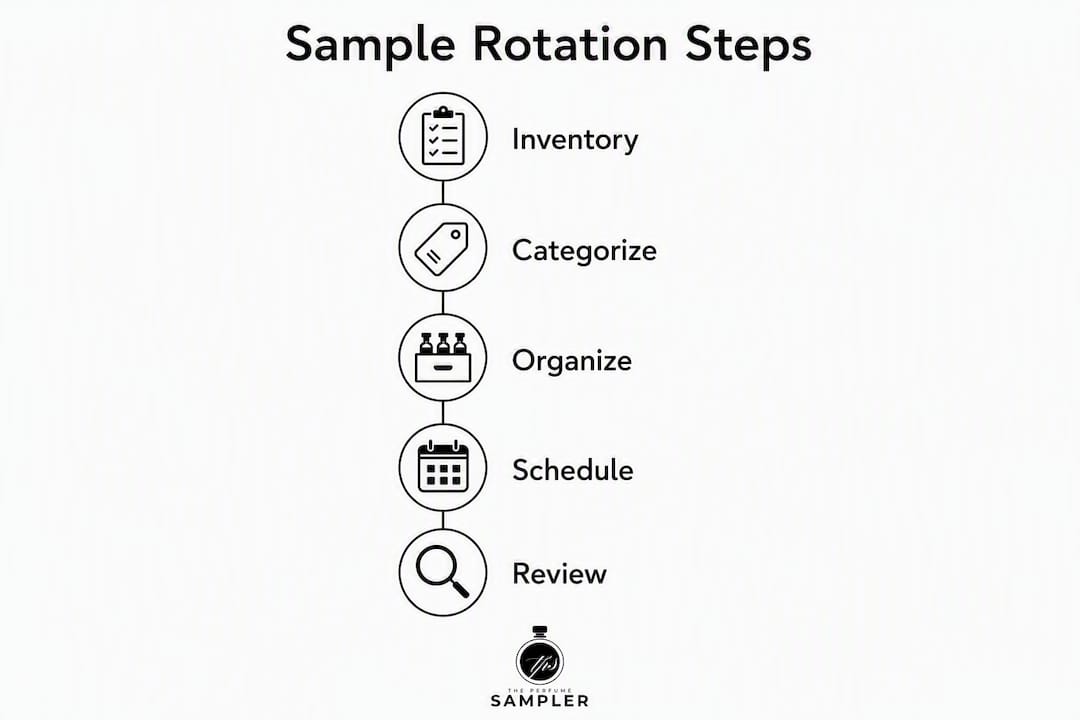
Assign one sample per day across a seven-day cycle. This suits collections of a moderate number of active items and works well when you want to evaluate each scent quickly. The rule is simple: lay out seven labelled samples on Sunday evening, wear one each day, and swap the set the following week. Smaller collections suit weekly rotation; anything larger benefits from a seasonal structure instead.
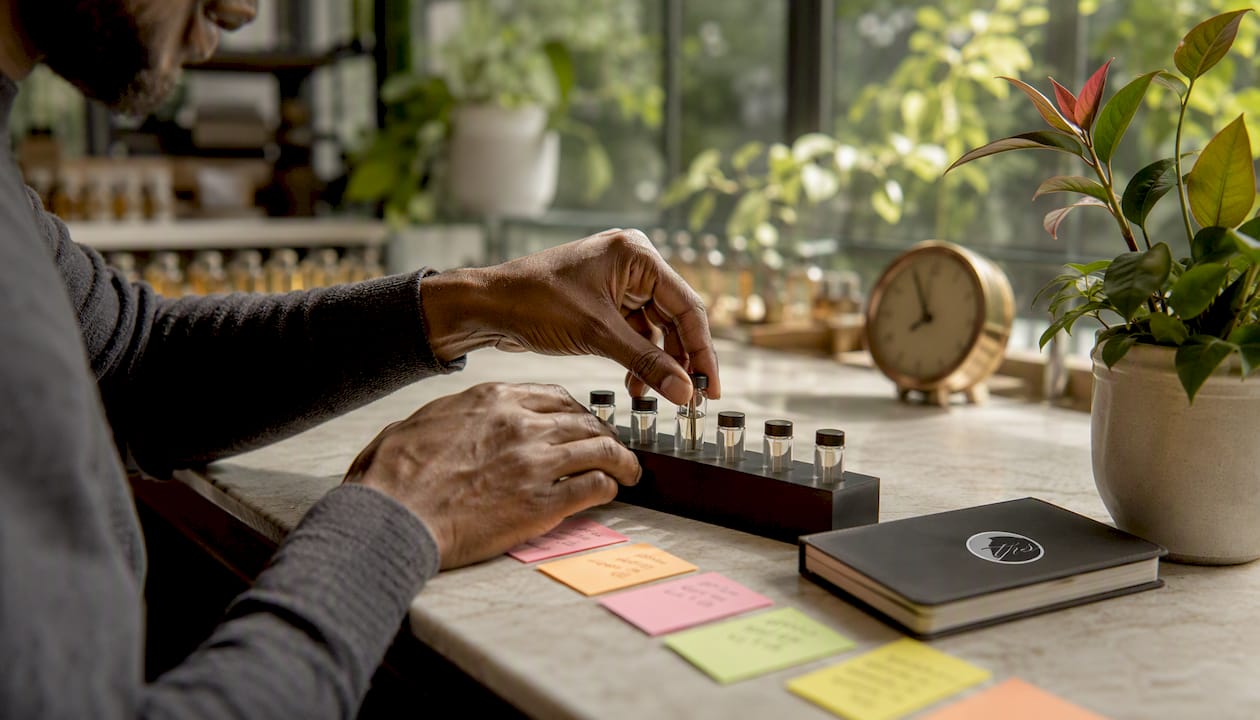
7-day starter plan (copy and use):
| Day | Sample slot | Notes |
|---|---|---|
| Monday | Fresh/citrus | Commute and office |
| Tuesday | Woody/aromatic | Focused work day |
| Wednesday | Floral | Lighter midweek wear |
| Thursday | Oriental/spicy | Evening or social |
| Friday | Gourmand | End-of-week treat |
| Saturday | Experimental | New or untested sample |
| Sunday | Comfort/skin scent | Rest day |
Seasonal capsule rotation
Build a capsule of a small number of fragrances per season and swap the set every few months. This is the preferred method for collectors with 30 or more samples because it limits decision fatigue without forcing you to reorganise everything at once. Spring and summer capsules lean towards fresh, aquatic, and floral families; autumn and winter capsules favour woods, resins, and spices. Fragrance performance depends on temperature and humidity, so seasonal rotation is as much about chemistry as personal preference.
Sample seasonal capsule counts:
- Spring: 5–8 samples (fresh florals, green notes, light musks)
- Summer: 5–8 samples (citrus, aquatics, light woods)
- Autumn: 5–8 samples (warm spices, ambers, dry woods)
- Winter: 5–8 samples (resins, orientals, heavy musks)
Wearable-driven mini-rotation
Audit 14 days of your activity data to identify distinct daily zones: workout window, commute, productive work hours, and evening wind-down. Assign 3–5 samples to those zones. This method produces the most accurate real-world test data because each sample is worn in a consistent context.
Finish-first and mood/occasion rotation
The finish-first strategy works as a decluttering tool: open nothing new until one sample is fully used. Mood/occasion rotation functions best as a secondary layer on top of a weekly or seasonal system, giving you flexibility without abandoning structure.
Pro insight: Keep a permanent core of 3–4 year-round staples and rotate a smaller set of 4–6 “guest star” slots for seasonal or experimental samples. This retail-style partial rotation prevents the need to rework your entire collection every season while still encouraging discovery.
Pro Tip: Combine systems by treating your seasonal capsule as the master list and your weekly rotation as the active subset drawn from it. You get structure at the macro level and variety at the daily level.
How to set up your rotation in under an hour
A rotation system only works if the inventory behind it is accurate. Here is a reproducible setup process.
Step 1: take a full inventory
Record every sample you own. The fields that matter most are:
- Fragrance name and house
- Concentration (EDP, EDT, extrait, etc.)
- Fill level (full, three-quarters, half, low)
- Fragrance family (floral, woody, oriental, fresh, chypre)
- Season suitability
- Last worn date
- Personal rating (1–5)
Detailed inventory fields turn a collection into an actionable rotation system rather than a passive shelf of bottles.
Step 2: categorise and build your active capsule
Group samples by season first, then by occasion (daily, office, evening, outdoor). From those groups, pull the samples that match the current season and your most frequent occasions. That shortlist becomes your active capsule.
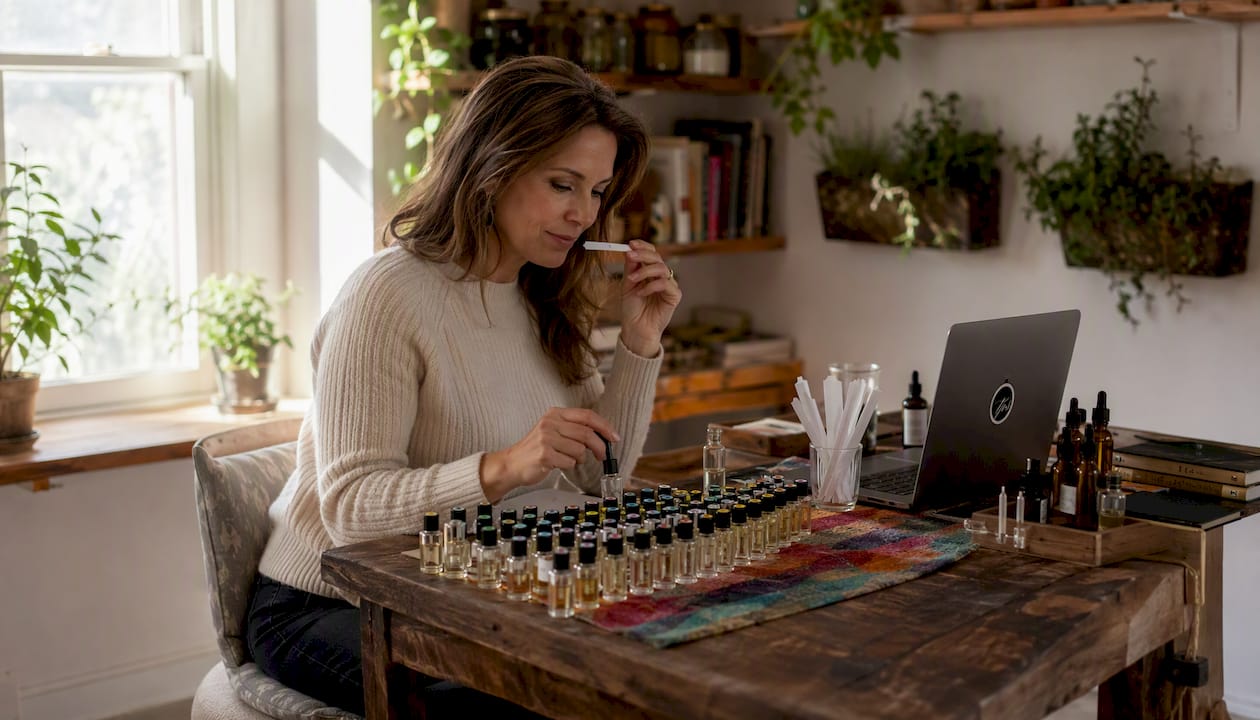
Step 3: label and organise physically
Use a small tray or divided box to hold your active capsule separately from stored samples. Label each atomiser or decant with a small sticker showing the name and date opened. Colour-coded dot stickers can help organise by season or status.
Step 4: create a rotation schedule
A simple spreadsheet with columns for Date, Sample Name, Occasion, Longevity (hours), Sillage (1–5), and Notes is enough to start. Physical alternatives include a notebook with one page per sample or sticky notes on a calendar.
Spreadsheet template outline (copy into Google Sheets or Notion):
Setup checklist (first hour): inventory all samples → categorise by season and occasion → select active capsule → label physically → enter into spreadsheet → assign first week’s schedule.
Pro Tip: Set a recurring calendar reminder every Sunday to review the active capsule and swap any sample that has been worn three or more times that week. Five minutes of admin keeps the rotation moving.
How should you store samples to keep test results accurate?
Poor storage produces false negatives. A sample that smells flat or off may simply have degraded, not failed. These rules apply to every sample in your collection.
Core storage rules:
- Cool and dark: a drawer, cupboard, or dedicated fragrance box away from windows.
- Dry: avoid bathrooms, where steam and temperature swings accelerate degradation.
- Upright storage: helps prevent leakage and air contact.
- Avoid direct sunlight: UV exposure can break down aromatic compounds and shift the scent profile.
UV, temperature, and humidity changes affect fragrance chemistry and perceived performance, which is why a sample stored on a sunny windowsill for a month may smell nothing like the same fragrance tested in-store.
In a UK home, the best locations are a bedroom drawer, a wardrobe shelf, or a cool interior cupboard. The worst are bathroom cabinets, kitchen windowsills, and anywhere near a radiator.
Handling and sealing:
- Write the date opened on the label as soon as you break the seal.
- Replace caps firmly after each use to limit air exposure.
- For long-term storage of decants, small glass vials with tight-fitting caps outperform plastic atomisers.
- Samples you are actively testing can sit in a front-row tray; everything else goes back into a box.
Pro Tip: Borrow the front-row/back-row method used by fragrance boutiques: keep your active capsule visible and accessible at the front of a tray, and store everything else in a closed box at the back. This reduces accidental UV exposure and makes the active set obvious at a glance.
What tools help you track wearings and manage rotation?
Consistent logging turns a rotation into a decision-making system. Without records, you repeat the same wears and miss the samples that need attention.
What to log for each wearing
- Date and day of the week
- Occasion and environment (office, outdoor, evening)
- Number of sprays and application points
- Opening, heart, and dry-down impressions (two to three words each)
- Longevity in hours
- Sillage rating (1–5)
- Overall impression and whether you would wear it again
Wear logs with date, sprays, context, longevity, and comments provide the evidence base for decluttering or purchase decisions. A log entry takes under two minutes and pays off every time you face a buy-or-pass decision.
Digital and analogue options
Digital:
- Google Sheets or Excel: the fastest starting point. Use the template outline from the setup section above. Add a filter on the “Sample Name” column to pull all wearings for one fragrance instantly.
- Notion or Airtable: add a gallery view with one card per sample, tags for season and family, and a linked table of wear logs. Useful for collections over 50 samples.
- Fragrantica’s personal collection tool: free, web-based, and lets you rate and note fragrances against a database of thousands of scents.
Analogue:
- A small ring-binder with one page per sample works well for collectors who prefer paper.
- Index cards in a recipe box, sorted by season, are portable and quick to update.
The two-week wearable audit
Map 14 days of your activity data to identify 3–5 daily zones: morning workout, commute, focused work, afternoon errands, evening. Assign one sample to each zone for the next two weeks. This produces structured, comparable data because each sample is tested in the same context each time.
Four-week test experiment: Week 1: follow your assigned schedule without changes. Week 2: adjust spray count and swap any sample that clearly does not fit its zone. Week 3: add layering experiments where two samples complement each other. Week 4: finalise a two-week rotation from the samples that performed consistently.
Pro Tip: Use the fragrance review documentation guide from Theperfumesampler to structure your opening, heart, and dry-down notes. Consistent note-taking across all samples makes comparisons far more reliable.
How do you decide when a sample is worth a full bottle?
The decision to buy a full bottle should be based on documented evidence, not a single good wearing. Practitioners recommend a 7–14-day sampling cycle across varied contexts before committing.
The testing protocol
Apply the sample across at least three distinct contexts: a quiet workday, an outdoor errand, and an evening occasion. This captures the full evolution of the scent across different temperatures, skin chemistry conditions, and social settings. A 5ml or 10ml decant from Theperfumesampler gives you enough volume to complete this protocol comfortably without paying full-bottle prices.
Decision rules
Use these criteria before buying:
- Favourable wears: at least four out of five wearings felt right for the occasion.
- Longevity threshold: the scent lasts long enough for your typical wearing occasion (e.g. six hours for a workday).
- Return-to test: after a day without it, do you actively want to wear it again?
- Compliment or fit check: does it feel like you, or does it feel like a performance?
- Context versatility: does it work across at least two of your regular occasions?
| Criterion | Pass threshold | Action if failed |
|---|---|---|
| Favourable wears | 4 out of 5 | Extend test by one week |
| Longevity | Meets occasion need | Try higher concentration |
| Return-to test | Yes on two separate days | Continue testing |
| Context fit | Works in 2+ contexts | Reassign to one specific occasion |
| Compliment/fit | Feels like you | Pass or archive |
Samples are the most intelligent test-before-buy strategy: they reduce returns and increase long-term satisfaction with full-bottle purchases. Boutique buyers and fragrance advisors consistently favour documented take-home testing over in-store strip decisions.
Testing protocol summary: wear the sample across at least three distinct contexts over 7–14 days, log each wearing, and apply the five decision criteria above before purchasing.
Pro Tip: Treat each sample test as a professional audit. Document every wearing with the same fields, then review the log as a whole before deciding. A fragrance that scores well on three out of five criteria but fails longevity is a candidate for a higher concentration, not a full bottle in the same format.
For a structured approach to blind fragrance trials, Theperfumesampler’s guide walks through objective testing methods that remove bias from the decision.
Common problems and how to fix them
Scent fatigue
If familiar scents stop registering, the rotation cadence is too slow. Shorten the cycle: instead of wearing the same sample three days running, limit each sample to one day before moving on. Take a 24-hour break from all fragrance if fatigue is acute. Coffee beans as a palate reset are a popular suggestion, though simply breathing fresh outdoor air works just as well.
Too many samples, not enough time
- Apply a one-season rule: any sample unworn for a full season goes into a “decision box.”
- From the decision box, give each sample one final wear before archiving or passing it on.
- Limit your active capsule strictly to 7–14 items. Everything else stays in storage.
- Use guest-star slots: two or three positions in the active capsule reserved for new or experimental samples, rotated weekly.
Travel and commuting
- Decant 1–2ml of your active rotation samples into labelled travel atomisers before any trip.
- Pre-set a mini-rotation of three samples for a trip: one fresh daytime option, one versatile all-rounder, one evening choice.
- Apply fragrance to clothing or hair rather than skin when in dry cabin air, as skin dehydration reduces longevity significantly.
- Keep travel atomisers in a small zip pouch with the sample name written on each one. Unlabelled atomisers are a fast route to confusion.
Pro Tip: For commuters, assign one sample to the morning commute for two weeks straight. The consistent context makes longevity and sillage data far more comparable than wearing the same sample across different occasions on different days.
Quick checklist to start rotating samples today
The most effective rotation method combines a clear inventory, a defined active capsule, and a simple log. Here is everything you need to get started in one hour.
Setup checklist:
- [ ] Inventory all samples (name, house, fill level, family, season, last worn)
- [ ] Choose a rotation system (weekly, seasonal capsule, or wearable-driven)
- [ ] Select your active capsule (7–14 items for weekly; 5–8 for seasonal)
- [ ] Label each sample with name and date opened
- [ ] Set up a wear log (spreadsheet, Notion, or notebook)
- [ ] Assign the first week’s schedule
- [ ] Run a four-week experiment: follow, adjust, layer, finalise
Storage reminders:
- Cool, dark, dry, and upright at all times
- Active capsule in a front-row tray; everything else in a closed box
Testing reminder:
- 7–14 days, three or more contexts, five decision criteria before buying a full bottle
Pro Tip: Start the four-week experiment this week. By week four, you will have a working two-week rotation and enough wear data to make confident full-bottle decisions on at least two or three samples.
Why structured rotation is worth the effort
Most collectors underestimate how much a rotation system changes the experience of owning fragrance. Without one, the same two or three bottles get worn repeatedly while the rest of the collection sits untouched. The problem is not motivation; it is the absence of a decision framework.
Structured rotation solves this by removing the daily choice entirely. When a sample is assigned to a day or a zone, you wear it. You log it. Over four weeks, you accumulate enough data to know exactly which samples deserve a full bottle and which ones were interesting once but not worth the investment.
The seasonal capsule approach is particularly underrated for UK collectors. British weather shifts meaningfully between seasons, and fragrance chemistry responds to those changes. A heavy oriental that felt suffocating in July may be exactly right in November. Rotation makes that discovery possible; a static shelf does not.
The other underrated benefit is what rotation does for your nose. Rotating samples preserves olfactory acuity so even familiar fragrances feel fresh when you return to them. Collectors who wear the same scent daily stop perceiving it within days. A structured rotation prevents that entirely.
Theperfumesampler: try before you commit
A 2ml, 3ml, 5ml, or 10ml decant from Theperfumesampler gives you exactly the right volume to run a full 7–14-day testing cycle without spending full-bottle prices. A 5ml decant typically provides enough applications to complete the five-criterion decision protocol described above across multiple contexts.
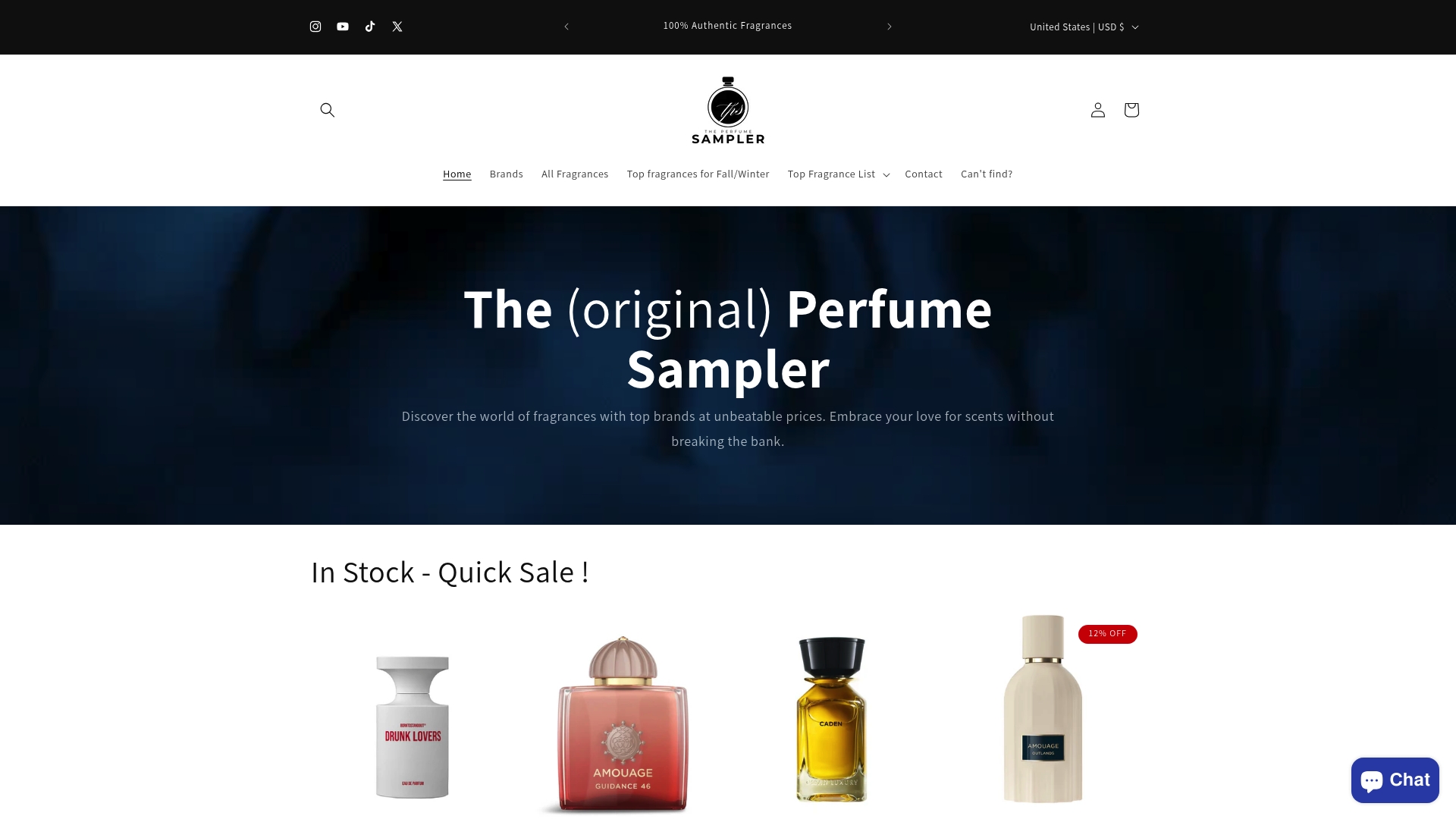
Theperfumesampler stocks niche and designer fragrance decants across both men’s and women’s fragrances, all 100% authentic, with UK shipping. The range covers the luxury and niche houses most collectors want to test, in the exact sizes that make structured rotation practical. Every decant is filled from a genuine bottle, so the performance you log during testing reflects the real product.
Find out why decants work for testing and rotation, or browse the full range at Theperfumesampler to build your next active capsule.
Further reading and useful links
The sources below support the methods covered in this article. A suggested reading order: start with setup and inventory, move to tracking, then apply the buying-decision protocol.
Setup and rotation systems:
- How to Create a Perfume Rotation Schedule — Perfumegini’s practical guide to building a seasonal capsule and weekly rotation, including inventory fields and schedule templates.
- How to rotate your perfume collection seasonally — covers the chemistry behind seasonal rotation and why fragrance performance shifts with temperature and humidity.
- Perfume sample rotation for wearable-driven routines — explains how to map daily activity zones and assign samples to them for structured real-world testing.
Tracking and logging:
- Rotate your perfume collection: prevent neglect and maximise enjoyment — WhatScent’s guide to wear logs, storage rules, and using tracking data to make decluttering decisions.
- How to track fragrance preferences effectively — Theperfumesampler’s practical guide to logging wearings and building preference data over time.
- How to document fragrance reviews — step-by-step note-taking framework for opening, heart, and dry-down observations.
Buying decisions and sampling:
- Build a fragrance wardrobe like a boutique — boutique-style testing protocols and the case for documented take-home sampling before full-bottle purchases.
- Sample size benefits: why fragrance sampling pays off — Theperfumesampler’s overview of the economics and testing advantages of decants.
- Your guide to blind fragrance trials — objective testing methodology to remove bias from purchase decisions.
Key takeaways
A structured method for rotating fragrance samples, combining a seasonal capsule of 5–8 scents with a weekly active rotation of 7–14 items, prevents scent fatigue, ensures no sample is neglected, and produces the wear data needed to make confident full-bottle decisions.
| Point | Details |
|---|---|
| Choose the right system | Weekly rotation suits 7–14 active samples; seasonal capsules of 5–8 suit larger collections. |
| Inventory first | Record name, house, fill level, family, season suitability, and last worn date before building any rotation. |
| Log every wearing | Capture date, occasion, longevity, sillage, and notes to build evidence for buy-or-pass decisions. |
| Test over 7–14 days | Wear each sample across at least three distinct contexts before applying the five decision criteria. |
| Theperfumesampler decants | 2ml–10ml decants from Theperfumesampler provide the right volume to complete a full testing cycle before committing to a full bottle. |