
Best decanting methods for perfume: a practical guide
TL;DR:
- Perfume decanting involves transferring fragrance with minimal scent loss and spillage. The sprayer-to-sprayer method is easiest for spray bottles, while funnels are best for splash bottles, and syringes offer precise control for small samples. Pump systems reduce oxidation for larger transfers, and proper cleaning ensures scent integrity across all techniques.
Perfume decanting is the process of transferring fragrance from one bottle to another with minimal scent loss and spillage. Whether you want to sample a niche scent before committing to a full bottle, or carry a luxury fragrance through airport security, the best decanting methods protect the perfume’s integrity while keeping the process clean and simple. Tools like atomiser sprayers, glass funnels, syringes, and pump systems each suit different bottle types and skill levels. Choosing the right one makes the difference between a clean transfer and a wasted, contaminated sample.
1. The sprayer-to-sprayer method: easiest and least wasteful
The sprayer-to-sprayer method is the most recommended technique for decanting spray bottles. It works by holding the nozzle of your source bottle directly against the opening of an empty atomiser and spraying directly in. Scent degradation is reduced because air contact during transfer is minimal. This makes it the best starting point for beginners.
The method suits sealed spray bottles only. You cannot use it with splash bottles or flacons that have a fixed, non-removable spray head that blocks direct access. For most standard designer and niche spray bottles, though, it works without any additional equipment.
Key advantages of the sprayer-to-sprayer method:
- No tools required beyond the two bottles
- Minimal evaporation of top notes during transfer
- Low contamination risk since the nozzle rarely touches the receiving bottle
- Fast and repeatable for multiple small decants
Key limitations:
- Requires a compatible spray nozzle on the source bottle
- Some perfume is lost with each spray press
- Not suitable for splash or open-neck bottles
Pro Tip: Hold the receiving atomiser upright and press the source nozzle flush against its opening before spraying. This reduces misting and captures more liquid per press.
2. Using funnels and adapters for precision pouring
Funnels are the correct tool for splash bottles, open-neck flacons, or any bottle where the spray head has been removed. Narrow-neck funnels made of glass or silicone are recommended for precision decanting because they reduce spillage and limit evaporation during the pour.
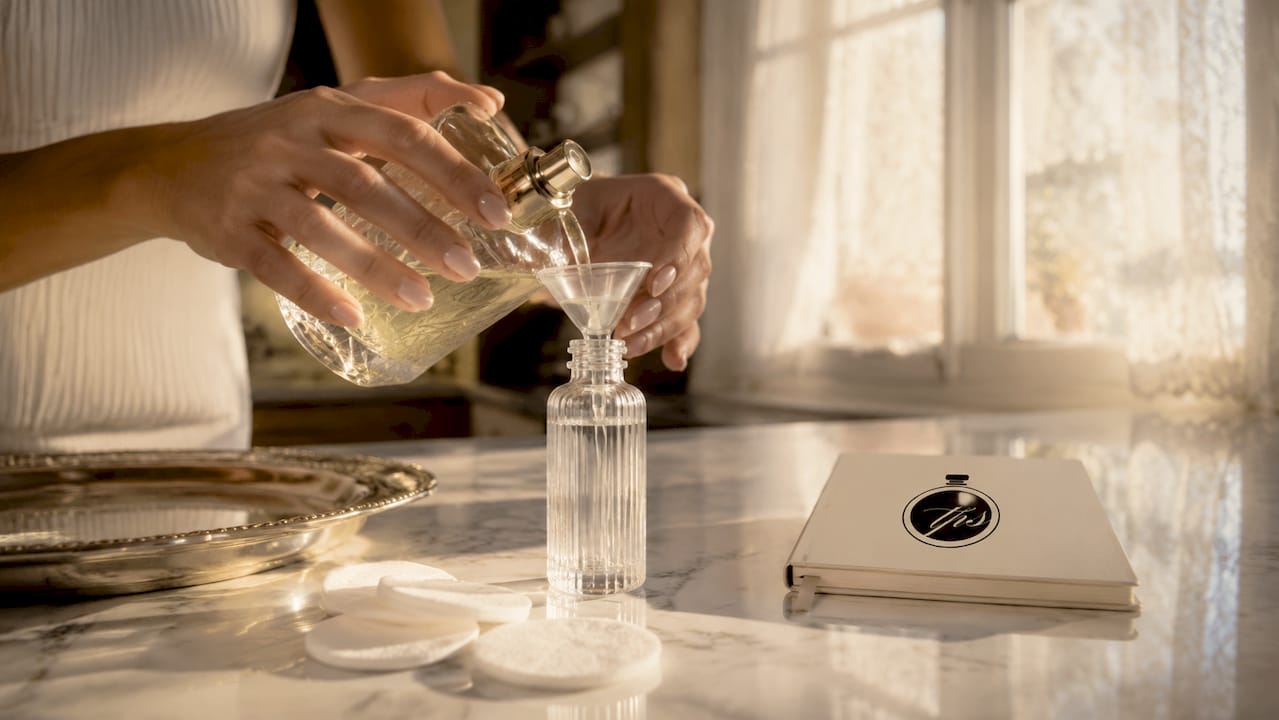
The choice of funnel material matters more than most beginners expect. Glass funnels are preferred by professionals for their scent neutrality and ease of cleaning. Silicone funnels are flexible and less likely to break, but they can retain odours between uses. Plastic funnels are the cheapest option, though they may react with alcohol-based fragrances over time.
Steps for a clean funnel transfer:
- Remove the spray head or cap from the source bottle
- Place the funnel securely in the neck of the receiving bottle
- Pour slowly and steadily, pausing to let the liquid settle
- Seal the receiving bottle immediately after transfer
Avoid funnels when working with very small receiving bottles under 2ml, as the funnel neck may be too wide to seat properly. In those cases, a syringe gives better control.
Pro Tip: Rinse your glass funnel with unscented isopropyl alcohol before each use. This removes any residue from a previous fragrance and prevents cross-contamination between scents.
3. Syringes and pipettes for controlled, no-mess transfers
Syringes and pipettes give the most control of any decanting method. Syringes with a capacity of 1–5ml are ideal for transferring small or precious samples where every drop counts. They draw liquid directly from the source bottle and deposit it precisely into the receiving container.
This method works best when the source bottle has a removable spray head or a wide enough neck to insert the syringe tip. Pipettes suit open bottles and are particularly useful for transferring from sample vials. Both tools reduce the risk of spilling compared to pouring.
| Tool | Best for | Capacity | Cleaning ease |
|---|---|---|---|
| Plastic syringe | Small decants, vials | 1–5ml | Moderate |
| Glass syringe | Precious or rare perfumes | 1–3ml | High |
| Disposable pipette | Single-use transfers | 1–3ml | N/A (dispose after use) |
| Blunt-tip needle syringe | Spray bottle extraction | 1–5ml | Moderate |
Syringes require thorough cleaning with alcohol and water before and after each transfer. Skipping this step introduces residue from a previous fragrance into your next decant. For very thick or viscous perfumes, syringes can clog, making funnels or pump systems a better choice.
Pro Tip: Draw a small amount of isopropyl alcohol into the syringe, shake gently, and expel it before use. Repeat once with clean water. This two-step rinse removes both oil residue and alcohol traces.
4. Pump and tube dispenser systems: advanced but efficient
Pump and tube systems are the most efficient option for transferring larger volumes with minimal air exposure. These systems reduce oxidation risk by keeping the perfume enclosed throughout the transfer. They work by inserting a thin tube into the source bottle and using a pump mechanism to draw liquid through into the receiving container.
Using a pump system correctly involves four steps:
- Remove the spray head from the source bottle carefully, without forcing the collar.
- Insert the pump tube into the bottle neck, checking it reaches the bottom of the liquid.
- Attach the receiving atomiser or vial to the pump outlet.
- Press the pump slowly and steadily, pausing between strokes to avoid air bubbles.
The main limitation is compatibility. Pump systems require a bottle neck wide enough to accept the tube, and not all designer bottles allow easy spray head removal. The upfront cost is higher than syringes or funnels, but for enthusiasts who decant regularly, the reduction in waste and mess justifies the investment. Incorrect decanting damages perfume through oxidation, so a sealed pump system offers real long-term protection for your collection.
5. How to choose the best decanting method for your needs
Choosing the right technique depends on four factors: bottle type, volume to transfer, your budget, and your experience level. Choosing the right tool for the bottle type and perfume viscosity avoids waste and frustration. The table below matches each method to its ideal use case.
| Method | Best bottle type | Volume | Skill level | Cost |
|---|---|---|---|---|
| Sprayer to sprayer | Spray bottles | 2–10ml | Beginner | None |
| Funnel | Splash or open-neck | 5–30ml | Beginner | Low |
| Syringe or pipette | Any with removable head | 1–5ml | Intermediate | Low |
| Pump and tube | Wide-neck spray bottles | 10ml+ | Advanced | Medium |
For travel-sized decants of 2ml, 3ml, or 5ml, the sprayer-to-sprayer or syringe method is most practical. For larger transfers into 10ml atomisers, a funnel or pump system saves time. Beginners should start with the sprayer method and progress to syringes once they are comfortable handling small volumes. Many beginners overcomplicate perfume decanting, but the simplest method works best for most situations.
Environmental and safety considerations also apply. Always work on a clean, flat surface. Keep a paper towel nearby to catch drips. Store decanted bottles away from direct sunlight and heat to preserve the fragrance. Airtight seals on receiving bottles are non-negotiable. Airtight seals preserve fragrance quality by preventing oxidation between uses.
Key takeaways
The most effective perfume decanting method is the one matched to your bottle type, volume, and skill level, with airtight seals and clean tools protecting scent quality throughout.
| Point | Details |
|---|---|
| Sprayer method is best for beginners | Spray directly into an atomiser to minimise air contact and scent loss. |
| Glass funnels suit splash bottles | Use a narrow-neck glass funnel for open or splash bottles to reduce spillage. |
| Syringes give maximum control | A 1–5ml syringe is ideal for small or precious samples where precision matters. |
| Pump systems reduce oxidation | Enclosed pump transfers protect volatile top notes during larger volume decants. |
| Clean tools prevent contamination | Rinse all equipment with isopropyl alcohol before and after every transfer. |
Rupesh’s take: why I stopped overthinking my decanting kit
Most people I speak to assume they need a full kit of specialist tools before they can start decanting. They do not. The sprayer-to-sprayer method handles the vast majority of transfers cleanly and quickly, and it costs nothing extra if you already own an empty atomiser. I spent months using syringes for everything before realising I was creating unnecessary work.
That said, the one investment I genuinely recommend is a small glass funnel. It handles splash bottles and open flacons that the sprayer method cannot reach, and it cleans perfectly with a quick alcohol rinse. Silicone funnels feel convenient, but after a few uses they hold onto the previous scent. Glass does not.
The biggest mistake I see is skipping the cleaning step between transfers. A syringe or funnel used for a heavy oud and then immediately used for a light citrus will ruin the second fragrance. Thirty seconds of cleaning protects hours of careful selection. Treat your tools the same way you treat your bottles, and your decants will stay true to the original every time.
— Rupesh
Fragrance decants made simple with Theperfumesampler
If you prefer to skip the decanting process entirely and receive a perfectly measured sample, Theperfumesampler has you covered. The full range of fragrance decants is available in 2ml, 3ml, 5ml, and 10ml sizes, covering high-end niche and designer fragrances at accessible prices.
Titles like BOSS Bottled Absolu Parfum Intense and Diptyque Paris Orphéon Eau De Parfum are available as decants, so you can try before committing to a full bottle. Every decant is 100% authentic and shipped with care. Theperfumesampler makes luxury fragrance sampling straightforward and affordable.
FAQ
What is the easiest perfume decanting method for beginners?
The sprayer-to-sprayer method is the easiest option. Hold the source bottle nozzle against the opening of an empty atomiser and spray directly in, with no additional tools required.
Can I decant a splash bottle without spilling?
Yes. Use a narrow-neck glass or silicone funnel placed securely in the receiving bottle’s neck, then pour slowly. Glass funnels are preferred for their scent neutrality and easy cleaning.
How do I prevent contamination between decants?
Rinse all tools, including syringes, pipettes, and funnels, with isopropyl alcohol and clean water before and after each transfer. Dirty tools introduce residue that alters the fragrance.
What size syringe is best for perfume decanting?
A 1–5ml syringe gives the most control for small decants. Blunt-tip needle syringes work well for extracting from spray bottles after the head has been removed.
Do decanted perfumes last as long as the original bottle?
Decanted perfume lasts well when stored in an airtight atomiser away from heat and direct sunlight. Oxidation from poor seals or repeated air exposure is the main cause of scent degradation in decants.