

Blending woody scents: master layering and sample techniques
TL;DR:
- Master blending woody scents through precise ratios, layering, and detailed record-keeping.
- Use natural and synthetic woody materials to create depth, sustainability, and balance.
- Iterative testing with small samples enhances fragrance complexity and personal signature.
Woody fragrances sit at the heart of some of the most acclaimed perfumes ever created, yet combining them well remains one of the most common challenges enthusiasts face. The frustration is real: you find a cedar, sandalwood, or oud you love, attempt a blend, and end up with something that feels dense, monotonous, or simply flat. The good news is that expert blending methods and thoughtful use of sample sizes remove most of that guesswork. This article walks you through everything you need to combine woody scents with confidence, from understanding the materials to refining your final creation.
Table of Contents
- What makes woody scents unique
- Preparing your sample blends: tools, materials, and ratios
- Step-by-step: combining woody scents for balanced layering
- The role of synthetics: modern woody depth and sustainability
- Assessing, refining, and enjoying your custom woody blends
- Why most guides miss the magic in woody blends
- Level up your blending with curated samples
- Frequently asked questions
Key Takeaways
| Point | Details |
|---|---|
| Essential woody blend ratios | Structure your blend with 30% top (lighter woods), 50% middle (vetiver), and 20% base (sandalwood, oud) for balance. |
| Natural and synthetic synergy | Combining natural woods and synthetics gives depth, consistency, and eco-friendliness to custom scents. |
| Transparent layering prevents heaviness | Layer lightly and experiment with sample sizes to avoid overpowering blends. |
| Benchmark pairings for inspiration | Cedar+citrus, sandalwood+vanilla, and oud+rose are proven winning combinations. |
| Experiment and refine | Use blotters and track ratios to perfect your blend before full wear. |
What makes woody scents unique
Woody fragrances are valued in perfumery for one primary reason: they anchor everything else. A well-chosen woody note provides depth, longevity, and a sense of warmth that lighter notes simply cannot deliver on their own. Understanding the different fragrance note types is the first step to using woods effectively.
The main woody materials you will encounter include:
- Cedar: Dry, pencil-shaving character; blends well with citrus and spice
- Sandalwood: Creamy, milky warmth; pairs beautifully with vanilla, rose, and musks
- Vetiver: Earthy, smoky, rooty; adds complexity and projection to almost any blend
- Oud: Resinous, animalic, deeply complex; demands careful use in small quantities
- Pine: Fresh, balsamic, and resinous; excellent as a top-to-middle bridge
- Oakmoss: Damp, green, forest-floor depth; now restricted but still found in vintage formulas
The distinction between natural and synthetic woods matters enormously in blending. Natural woods offer complexity but raise sustainability concerns, while synthetics provide consistency and ethical reliability, though with less organic depth. Most professional perfumers use both in combination.
| Woody note | Character | Best paired with | Natural or synthetic |
|---|---|---|---|
| Cedar | Dry, woody | Citrus, vetiver | Both available |
| Sandalwood | Creamy, warm | Vanilla, floral | Both available |
| Oud | Resinous, animalic | Rose, amber | Natural/synthetic |
| Vetiver | Earthy, smoky | Cedar, tobacco | Natural |
| Pine | Fresh, balsamic | Citrus, green | Both available |
Woods are almost always positioned as base or heart notes, meaning they are the last to develop on skin and the longest to linger. This is what gives woody blends their unique fragrance character and staying power.
Now that you know why woody scents are so coveted, let’s look at what is required to begin the blending process.
Preparing your sample blends: tools, materials, and ratios
Getting set up properly before you blend saves considerable time and product. The tools required are minimal but specific to the task.
Essential materials:
- Carrier oils: jojoba is the most stable and neutral option; fractionated coconut oil is a close alternative
- Small glass sample bottles (2ml, 3ml, and 5ml formats are ideal)
- Scent blotters, also known as perfume test strips
- Droppers or pipettes for precise measurement
- A notebook or spreadsheet for tracking ratios and observations
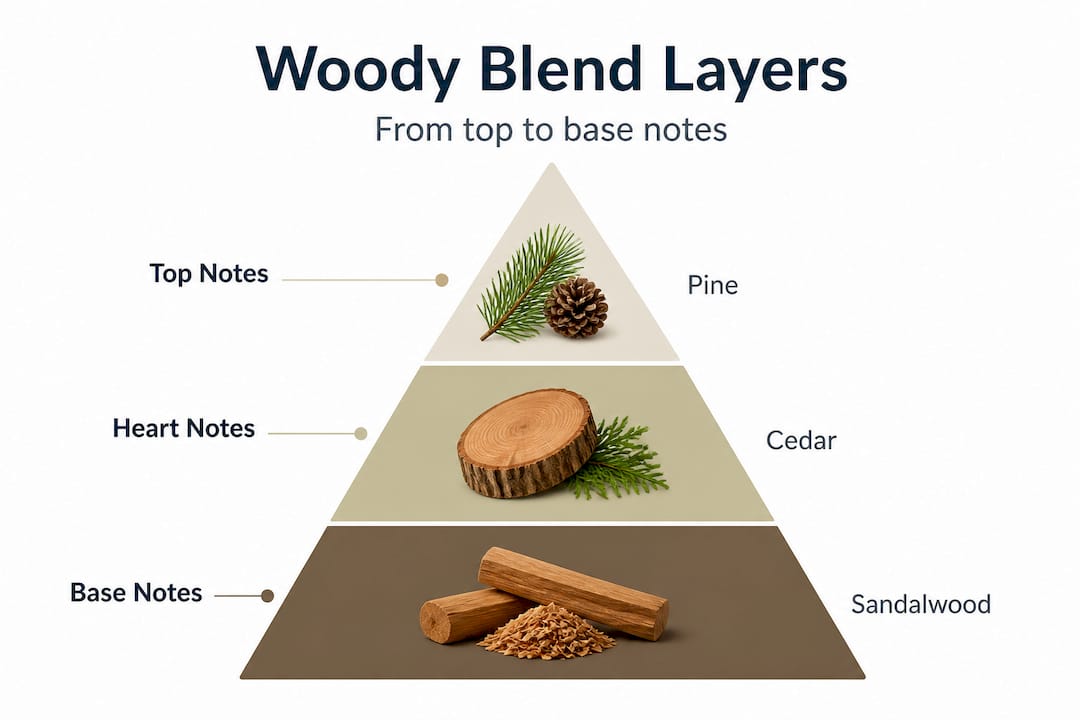
The fragrance pyramid provides the most reliable starting ratio for blending: 30% top notes such as pine or lighter woods, 50% middle notes such as vetiver or cedar, and 20% base notes such as sandalwood or oud. Use carrier oils like jojoba to dilute and extend your blend. This pyramid structure is not rigid, but it gives you a reliable starting point before you begin adjusting.
| Pyramid layer | Percentage | Woody examples | Role in blend |
|---|---|---|---|
| Top notes | 30% | Pine, juniper | First impression, fades quickly |
| Middle notes | 50% | Cedar, vetiver | Heart of the blend, longest presence |
| Base notes | 20% | Sandalwood, oud | Depth, longevity, skin warmth |
Starting with these ratios in a 5ml sample bottle is the most practical approach. You are not committing to a large quantity, which means you can adjust freely. When building fragrance collections, this kind of small-batch testing prevents expensive mistakes.
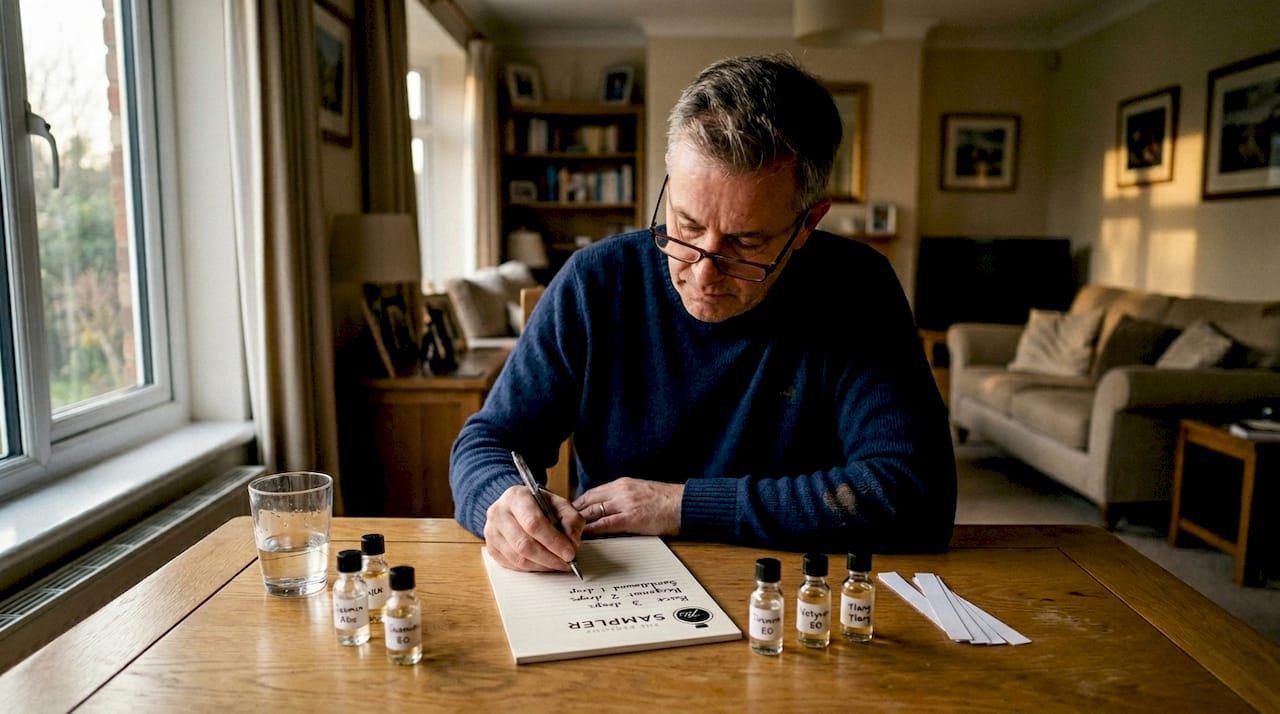
Pro Tip: Always label your sample bottles with the exact ratio and date. Memory is unreliable when you are testing multiple blends simultaneously. A simple code such as “C40:V30:S20:O10” (cedar, vetiver, sandalwood, oud) keeps your records accurate and reproducible.
Sampling before scaling is also how experienced enthusiasts approach niche fragrances, testing small quantities before investing in full bottles.
With tools and materials assembled, next comes the actual blending technique.
Step-by-step: combining woody scents for balanced layering
Balanced layering is the difference between a blend that smells professional and one that simply smells heavy. The following steps give you a reliable process to follow.
-
Choose your framework. Decide which woody notes you want to feature. For a beginner, two or three notes maximum is the most manageable starting point. Cedar and vetiver is a strong, versatile starting pair.
-
Measure by percentage, not drops. Using a 5ml bottle, calculate your measurements before adding anything. If your target is 50% cedar middle note, 30% pine top, and 20% sandalwood base, measure those quantities precisely.
-
Add base notes first. Pour your sandalwood or oud into the bottle first. This prevents the lighter notes from being overwhelmed and gives you a more accurate read of how the blend will develop on skin.
-
Layer middle notes next. Add your vetiver or cedar. Swirl gently rather than shaking. Shaking can create temporary aeration that distorts your initial scent reading.
-
Finish with top notes. Pine or lighter woody materials go in last. These will dominate your first impression but fade within 30 to 60 minutes, revealing the true heart and base beneath.
-
Test on blotters first. Place a small amount on a scent blotter and allow it to dry for two to three minutes before assessing. This removes the sharp, initial alcohol or carrier oil impression.
-
Apply to skin and wait. Test on your wrist and allow a full 20 to 30 minutes before making any judgements. Woody notes evolve significantly with body heat.
Transparent layering techniques prevent heaviness by ensuring no single note dominates. If your blend feels dense, reduce the base note percentage or introduce a citrus or green note to open up the composition.
“Experiment in samples via blotters; track ratios; transparent layering prevents heaviness in niche woody blends.”
Classic benchmark pairings provide an excellent reference point. Cedar with citrus, as seen in Terre d’Hermès, creates bright, dry elegance. Sandalwood with vanilla delivers warm, skin-close creaminess. Oud with rose is a Middle Eastern classic that produces deeply romantic, resinous depth. Modern blends frequently pair woody amber bases with synthetic molecules for a “skin-but-better” effect that feels natural yet polished.
Understanding how scent profiles evolve over time helps you assess whether your blend is working at every stage, not just on first spray.
Pro Tip: If your blend feels too heavy after testing, try adding a small percentage of bergamot or pink pepper to lift the composition. As little as 5 to 10% of a top-note citrus can shift a dense woody blend into something far more wearable.
Having tried your initial blends, you may wonder about further sophistication and the role of synthetics.
The role of synthetics: modern woody depth and sustainability
Synthetic woody molecules are not shortcuts. They are precision tools that the finest perfumers in the world use as a matter of course. Understanding them expands your blending options considerably.
The key synthetic molecules for woody blending include:
- Iso E Super: Adds a smooth, cedar-like woody texture with a slight smokiness; also boosts the projection of other notes
- Ambroxan: Derived from ambergris; provides a warm, skin-like woody amber quality with excellent longevity
- Georgywood: Delivers a fresh, orris-like, dry wood character that integrates cleanly into floral-woody compositions
- Clearwood: A clean, transparent, slightly aqueous woody molecule ideal for modern minimalist blends
Synthetic molecules like these provide sustainable, consistent woody depth without the variability of natural extraction. They are typically used at 5 to 15% in fine fragrance formulations, giving perfumers control over intensity and character.
The sustainability argument for synthetics is straightforward. Natural oud, for example, comes from agarwood trees that are critically endangered in several regions. Natural sandalwood from Mysore, India, is similarly under pressure. Synthetics protect these resources while still delivering characteristic scent profiles.
Balancing naturals with synthetics is where the real skill lies. A blend of real sandalwood at 15% combined with Ambroxan at 8% will outperform either material alone. The natural provides organic warmth and authenticity; the synthetic extends that quality and adds consistency across different skin types.
Pro Tip: When sampling niche fragrances, pay attention to whether a woody scent feels consistent from first spray to dry-down. Consistent longevity is often a sign of well-integrated synthetic molecules working alongside natural materials.
You now have a modern approach to combining woody scents. Let’s see how to assess and refine your blends effectively.
Assessing, refining, and enjoying your custom woody blends
The refinement stage is where most blenders either give up or make their best discoveries. Systematic evaluation is the key.
How to assess and refine effectively:
- Allow each test blend to rest for 24 hours in a sealed sample bottle before final assessment. Woody notes in particular need time to integrate and marry with other components.
- Use blotters for initial testing, but always confirm on skin. Skin chemistry changes everything, particularly with base-heavy woody blends.
- Test the blend at different times of day. Woody notes often perform differently in cooler morning air compared to the warmth of mid-afternoon.
- Invite honest feedback from someone else. You will habituate to your own blend quickly and stop perceiving it accurately.
- Record every adjustment with specific quantities. Note not just the ratio but also the brand and lot number of each material, as fragrance oil blending ratios can shift slightly between batches.
Keeping a dedicated blending journal is not optional if you want to reproduce your best results. A simple notebook with date, ratio, materials, first impression, dry-down notes, and an overall rating is all you need. Over time, patterns emerge that reveal your personal preferences and your most successful combinations.
Wearing your custom blend in daily life is the final and most meaningful test. Apply it to pulse points and observe how it makes the fragrance last longer throughout the day. If the blend still feels right after eight hours of wear, across different environments and temperatures, you have something genuinely worth keeping.
Approaching affordable fragrance selection with the same systematic mindset applied here makes the entire process more efficient and rewarding.
Having walked through the process, let’s reflect on what most guides miss about combining woody scents.
Why most guides miss the magic in woody blends
Most guides on blending woody fragrances treat the pyramid like a law. Follow the ratios, choose the right materials, and the result should be good. This is technically correct but practically incomplete.
The real magic in woody blending comes from iteration, not instruction. The first blend you make will almost never be your best one. What matters is whether you record it accurately enough to improve it. The enthusiasts who develop genuinely distinctive woody signatures are the ones who treat each sample as a data point rather than a finished product.
There is also a persistent bias in fragrance writing towards naturals as “authentic” and synthetics as compromises. This is simply not accurate. Some of the most beloved woody fragrances of the last two decades rely heavily on synthetic molecules. The result is not lesser quality; it is consistent quality at scale.
Transparent layering is another concept that most basic guides mention but few explain in practical terms. Transparency in a blend means that each note remains individually perceptible rather than collapsing into a single undifferentiated mass. You achieve this through restraint. Use less than you think you need at the base level, and build upward. A lighter hand with oud or vetiver almost always produces a more nuanced result.
Exploring niche scents through sample sizes gives you the freedom to study how master perfumers have already solved these problems. Wearing a 2ml or 5ml sample of a benchmark woody fragrance alongside your own blend is one of the most educational comparisons you can make.
Level up your blending with curated samples
Developing your skills in combining woody scents is significantly easier when you have access to the right reference points.
At The Perfume Sampler, we offer 100% authentic fragrance decants in 2ml, 3ml, 5ml, and 10ml sizes, giving you access to high-end niche and designer woody fragrances without the cost of a full bottle. Explore the why decants page to understand the full value of sampling before committing. If you want a benchmark for a refined woody base, the Boss Bottled Absolu sample is an excellent starting point. For a broader woody palette, browse our top fall woody fragrances collection, curated specifically for the season when woody scents perform at their best.
Frequently asked questions
Which woody scent combinations work best for layering?
Cedar with citrus, sandalwood with vanilla, and oud with rose are proven woody pairings for balanced, memorable blends. These combinations are well-documented in both niche and designer perfumery.
How much synthetic woody material should I add?
Use synthetics like Iso E Super or Ambroxan at 5 to 15% of your blend for sustainable, consistent woody depth without overwhelming natural materials.
What’s the best way to test blends before wearing them?
Experiment with blotters and small sample bottles, then record your exact ratios so you can refine and reproduce results accurately.
Can mixing woody and floral scents create unique results?
Yes, combining woody notes like oud with florals such as rose yields distinctive niche results that are well established in Middle Eastern and niche Western perfumery.
How can I ensure my woody blend isn’t too heavy?
Transparent layering and pyramid ratios prevent heaviness. Reduce base note quantities and consider adding a small citrus or green top note to lift the overall composition.
Recommended
- How to layer fragrances for a unique signature scent – ThePerfumeSampler
- How fragrances evolve: master scent profiles before you buy – ThePerfumeSampler
- Build a luxury fragrance collection with confidence – ThePerfumeSampler
- Explore unique fragrance profiles: niche and affordable sampling – ThePerfumeSampler