
How to analyse perfume notes using decants: a practical workflow
Test one decant in this order: blotter check, blind blotter elimination, single-skin wear with timed checkpoints, then record and score. Buy the full bottle if both the heart (30–60 minutes) and dry-down (2–8 hours) score 7/10 or above. If only one stage scores well, buy a larger decant and retest. Score below 6 across both stages: pass. Theperfumesampler’s decant sizes from 2ml to 10ml map directly to each stage of this workflow, making the process straightforward and cost-effective.
Key takeaways
A repeatable fragrance note evaluation workflow, using timed checkpoints and a consistent log, is the most reliable way to convert decant tests into confident full-bottle purchases.
| Point | Details |
|---|---|
| Core decision rule | Buy the full bottle only when heart and dry-down both score 7/10 or above across two sessions. |
| Session limits | Test a maximum of 3–5 fragrances per session; use blotters for all but one skin test. |
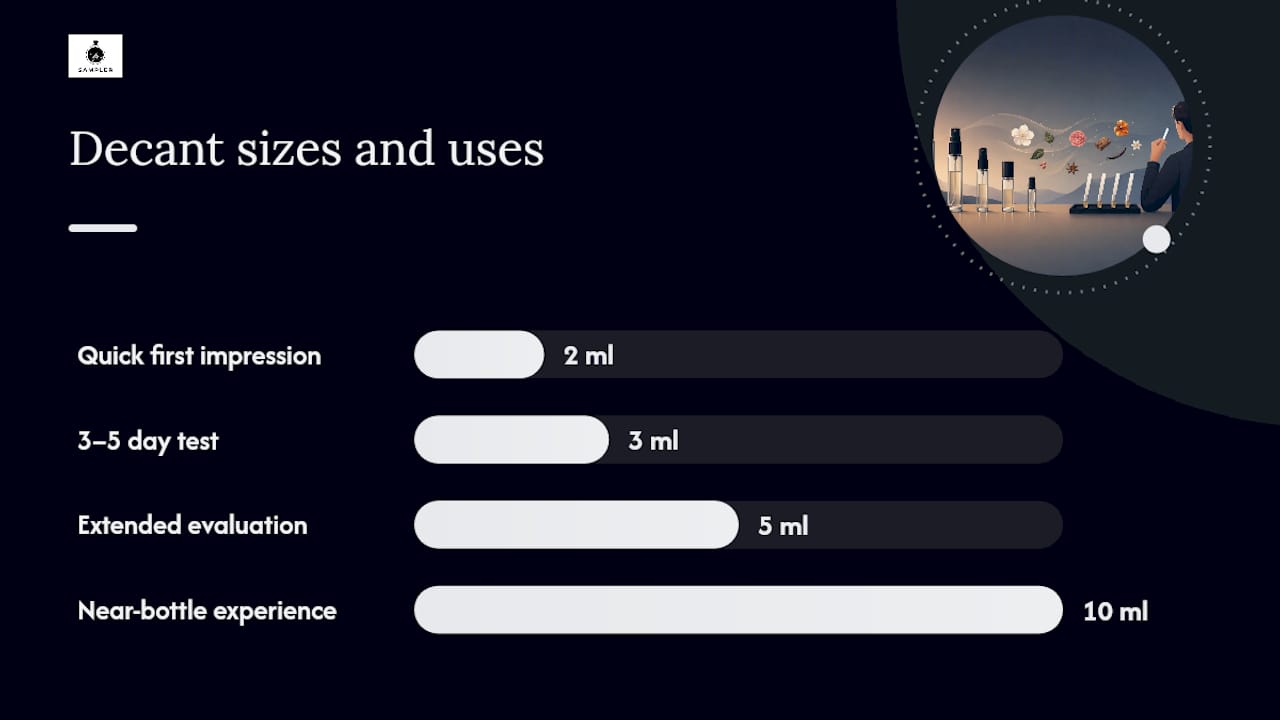
| Decant size guide | Use 2ml for a first check, 5ml for a 3–5 day evaluation, 10ml for a near-bottle collector decision. |
| Blind testing reduces bias | Label vials A/B/C and use one spray per blotter to keep comparisons objective. |
| Theperfumesampler | Stocks decants in 2ml, 3ml, 5ml, and 10ml, matching every stage of this workflow. |
Table of Contents
- What do you need to set up a reliable test environment?
- How does the step-by-step fragrance note evaluation work?
- How do you identify top, heart and base notes without perfumer training?
- How do you document and score your impressions reliably?
- How many samples can you test in one session?
- When should you buy a full bottle, a larger decant, or pass?
- Rupesh’s two-session testing template
- Why the workflow changed how I buy fragrance
- Theperfumesampler makes this workflow practical
- Sources
What do you need to set up a reliable test environment?
Consistent results depend on consistent conditions. Gather these before you start:
- Decants: 2ml–10ml sizes (see size guide below)
- Blotter strips: plain, unscented paper strips for initial screening
- Travel atomiser: for transferring decant liquid to skin without waste; a refillable travel spray bottle gives repeatable spray volumes
- Notebook or log template: paper or a notes app; fields covered in Section 5
- Phone timer: to mark checkpoints precisely
- Unscented moisturiser: applied 30 minutes before testing to hydrate skin without adding scent
- Neutral space: a room free of cooking smells, candles, or air fresheners
Wash hands with unscented soap before each session. Avoid scented deodorant, hair products, or body lotion on test areas. Store decants away from heat and direct sunlight; a cool, dark drawer is sufficient for short-term storage. Decanting done correctly preserves the fragrance’s integrity for weeks.
Which decant size should you use?
| Size | Best use case |
|---|---|
| 2ml | Quick first impression; check whether a fragrance is worth a deeper test |
| 3ml | A 3–5 day test covering multiple wears and conditions |
| 5ml | Extended evaluation for gourmands, heavy orientals, or anything with a complex dry-down |
| 10ml | Near-bottle experience; collector decision or gifting check |
How does the step-by-step fragrance note evaluation work?
This is the full protocol for a single test session. Follow the steps in order and keep conditions consistent across sessions.
-
Blotter screen (0–2 minutes). Spray or dip one blotter per candidate. Hold it 10cm from your nose and inhale briefly. You are checking top-note character and whether the opening is tolerable. Discard any fragrance that is immediately unpleasant; shortlist the rest.
-
Blind A/B/C blotter elimination. Label shortlisted blotters A, B, C on the reverse so you cannot see the name. Smell each in sequence with a 30-second gap. Rank them by preference. This step removes brand and packaging bias before skin contact. A full guide to running blind fragrance trials covers the labelling method in detail.
-
Single-skin application. Apply your top-ranked candidate to one site only: inner wrist, inner elbow, or the side of the neck. Two sprays from a consistent distance of 15cm. Do not rub. Rubbing breaks down top notes prematurely and distorts the opening. One fragrance per session on clean skin gives the most reliable read on sillage and dry-down.
-
Timed checkpoints. Note observations at each stage:
- 0–5 minutes: Top notes. Bright, volatile, often citrus or green. These fade quickly and are not a reliable guide to the full fragrance.
- 5–15 minutes: Transition. Top notes begin to recede; first hints of the heart emerge.
- 30–60 minutes: Heart notes. The true character of the fragrance. Record projection, comfort, and whether the scent feels wearable. This is the most important checkpoint for a buying decision.
- 2–4 hours: Mid dry-down. Note any shifts in character, sweetness, or heaviness.
- 6–8+ hours: Base notes and dry-down. Longevity, skin-scent quality, and whether the fragrance still pleases at low projection. A full-day wear protocol and repeating tests across 3–5 days substantially reduces false positives.
-
Record immediately after each checkpoint. Do not rely on memory. Fill in the log template (Section 5) while the impression is fresh.
Pro Tip: Label your vials A, B, C with masking tape before you start and use exactly one spray per blotter. Consistency in application volume is what makes blind comparisons meaningful.
How do you identify top, heart and base notes without perfumer training?
The top/heart/base structure is a useful guide, not a strict sequence. Notes overlap, and skin chemistry shifts how they present. Focus on what you actually smell at each checkpoint rather than what the brand says should be there.
A short vocabulary list to get you started:
- Citrus / green / ozonic: Fresh, sharp, watery. Typical of top notes. Fades within 15 minutes.
- Floral: Rose, jasmine, iris. Usually heart territory. Can read as powdery or soapy depending on the accord.
- Gourmand: Sweet, edible. Vanilla, caramel, praline. Often base-dominant but can bleed through from the start.
- Resinous / balsamic: Warm, amber-like, slightly sticky. Appears in the mid-to-late dry-down.
- Leathery / smoky: Dry, animalic, sometimes medicinal. Base note territory.
- Musky: Clean or animalic depending on the type. The final skin-scent layer.
Mapping descriptors to likely materials speeds identification. “Caramel” usually points to vanilla, tonka bean, or benzoin. “Soapy” often indicates aldehydes or clean musks. “Pencil shavings” is almost always cedarwood or violet leaf. Skin chemistry and environment change how notes present, so a fragrance that reads as powdery on one person may read as floral on another. Test on your own skin; blotters only tell you the opening.
How do you document and score your impressions reliably?
A simple log makes cross-day comparisons possible. Use these fields for every test:
- Date and session number
- Sample ID and decant size
- Blotter notes (top note impression, 0–2 minutes)
- Heart notes (30–60 minutes): character, projection, comfort (1–10)
- Dry-down (2–8 hours): character, longevity, skin-scent quality (1–10)
- Overall score (1–10)
- Verdict: buy full bottle / buy larger decant / retest / pass
Keeping consistent log fields across wears makes cross-day comparisons reliable. A score of 7/10 in the heart stage means the fragrance is genuinely pleasant and wearable at its peak. A 7/10 in the dry-down means you would still want it on your skin eight hours later. Both scores at 7 or above are the threshold for a full-bottle purchase. One score below 6 suggests a retest on a different day or in a different season before committing.
Example log entry:
How many samples can you test in one session?
Test a maximum of 3–5 fragrances per session. Beyond that, olfactory fatigue sets in and impressions become unreliable. Leave at least 5–10 minutes between each blotter smell. When fatigue hits, stop for the day rather than pushing through.
Palate reset techniques that work:
- Step outside for two minutes of clean air
- Sniff the inside of your own wrist (unscented skin) to neutralise
- Use a neutral, unscented fabric as a buffer between samples
Coffee beans are widely suggested but not reliably effective as a palate cleanser. Clean air and unscented skin work better.
Sequence lighter fragrances before heavier ones. Citrus and aquatics first, then florals, then orientals and woods. A scent mapping approach groups samples by family, which preserves sensitivity and makes comparisons more meaningful.
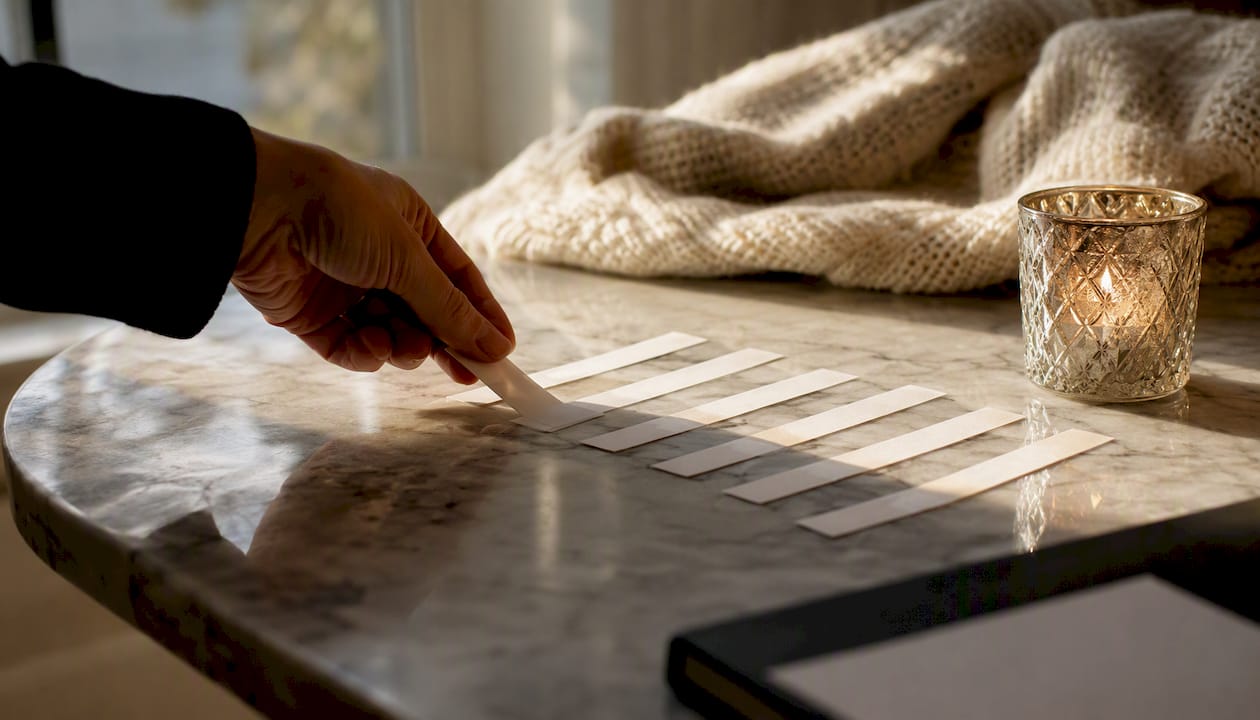
Pro Tip: Test only one fragrance on skin per session. Use blotters for the others. Skin tests are for your final shortlisted candidate only.
When should you buy a full bottle, a larger decant, or pass?
Use this checklist after completing at least two full-day wear tests:
- Buy the full bottle if heart and dry-down both score 7/10 or above across two sessions, and you reached for the decant voluntarily on both days.
- Buy a larger decant if one stage scores well but the other is inconsistent, or if you have only tested in one season or condition.
- Retest later if the fragrance felt right on day one but flat on day two. Skin condition, diet, and humidity all affect results.
- Pass if the dry-down is uncomfortable, the projection is too heavy or too weak for your needs, or the heart score is below 6 on both tests.
Size guidance: a 2ml decant is enough for a first impression. A 5ml covers 3–5 full-day wears, which is the minimum for a confident decision on a complex fragrance. A 10ml gives you a near-bottle experience and is worth ordering for anything you are seriously considering at full-bottle price. Decants let you test across conditions and avoid the cost of a wrong purchase.
If you are still undecided after two sessions, try a blind A/B test against your current favourite in the same family. If the new fragrance wins, that is a reliable signal.
Rupesh’s two-session testing template
This is the template used to document tests on the Theperfumesampler blog. Copy the fields directly into a notes app or print them.
Session 1 (blotter screen and first skin wear):
Session 2 (repeat wear, different conditions):
A briefcase study: a 5ml decant of a woody oriental. Session 1 on a warm afternoon: bergamot opening, smooth oud heart at 45 minutes, score 8/10. Session 2 on a cooler morning: the oud read heavier and slightly medicinal, dry-down score 6/10. Average: 7/10. Verdict: buy a 10ml decant before committing to a full bottle. A five-step conscious smelling method that emphasises written notes and repeated exposure is what makes this kind of cross-session comparison meaningful.
Why the workflow changed how I buy fragrance
Before using a structured scent analysis process, I bought full bottles based on a single counter spray. The result was a shelf of fragrances I wore once. The workflow above changed that. Testing with a 5ml decant across two days, scoring the heart and dry-down separately, and running at least one blind session removed most of the impulse-buy errors. The controlled, repeatable protocol of blotters, timed checkpoints, and a scoring sheet is what makes the difference between a confident purchase and a regretted one.
The most underrated part of the workflow is the dry-down score. Most people decide at the counter based on the opening. The fragrance you are still happy wearing at hour seven is the one worth buying.
Theperfumesampler makes this workflow practical
A 2ml covers a quick first impression. A 5ml gives you 3–5 full-day wears for a thorough evaluation. A 10ml is the collector’s decision size, close to a full-bottle experience without the full-bottle price.
Full bottles are also available for fragrances you have already tested and confirmed. Orders ship to the UK with discounted shipping, and every product is guaranteed authentic. Browse the full decant range to match your next test session to the right size, or go straight to the full bottles collection if you are ready to commit.
Sources
- The 5-Step Method to Decode a Perfume - Bois de Jasmin
- How to Test Perfume at Home: The Right Way – Maison Alhambra Website
- How to Test Fragrance Before You Buy: Sample Strategy · AgeFresh
- Must‑Know Guide to Perfume Notes and Accords | Perfume On Skin
- How to Test a New Perfume Like a Pro