
What is a formal event fragrance: your complete guide
TL;DR:
- A formal event fragrance should be balanced, reflecting the event’s weight and setting.
- Testing scents on skin with decants ensures suitability and proper development before purchase.
A formal event fragrance is a refined, well-balanced scent chosen to match the weight and setting of the occasion. The single most important rule: match scent weight to event weight. Lighter, fresher profiles suit daytime formal events; richer, warmer compositions belong at black-tie evenings. For concentration, eau de parfum (EDP) is the practical default for most formal occasions, offering longevity without constant reapplication. Apply to pulse points on clean skin, not directly onto fabric, and aim for projection within an arm’s length.
- Daytime formal: citrus, green, airy white floral, light woody notes
- Evening/black-tie: amber, oud, spice, resinous woods, deep florals
- Concentration: EDP or parfum for multi-hour events; EDT for shorter daytime occasions
- Application: two to three sprays to pulse points; wait a moment before dressing
- Testing: try via decants before committing to a full bottle
Theperfumesampler offers fragrance decants in 2ml, 3ml, 5ml, and 10ml sizes, making it straightforward to test formal-occasion scents in real settings before you spend on a full bottle.
Table of Contents
- What makes a perfume count as formal?
- Which fragrance families suit formal occasions?
- How do you match fragrance to the event, time and outfit?
- Parfum, EDP or EDT: which concentration is right?
- How should you adjust formal fragrances by season?
- How do you test a formal fragrance properly before buying?
- How do you apply formal fragrance and make it last?
- What mistakes do people make with formal fragrances?
- Why sampling solves the formal fragrance problem
- Key takeaways
- Why the right formal fragrance is worth getting right
- Try formal fragrances before you commit
What makes a perfume count as formal?
A formal fragrance is not simply an expensive one. It is a scent with depth, balance and controlled projection — qualities that signal refinement without demanding attention.
The characteristics that define a formal scent:
- Depth and complexity: formal fragrances typically have distinct top, heart and base notes that evolve over hours rather than fading quickly.
- Controlled sillage: projection stays close to the wearer, appropriate for seated dinners, ceremony rooms and close-quarters settings.
- Longevity: a formal scent should last through a multi-hour event without reapplication.
- Concentration: EDP and parfum concentrations are standard; EDT can work for shorter or daytime formal occasions.
- Balance: no single note dominates aggressively; the composition feels cohesive.
Occasions that call for a formal fragrance include black-tie dinners, state occasions, formal weddings, corporate galas and charity balls. Semi-formal events such as smart-casual office parties or garden parties allow slightly lighter, less complex compositions. Venue size and guest proximity matter too: a small dining room demands more restraint than a large ballroom, where a richer projection reads appropriately.
Which fragrance families suit formal occasions?
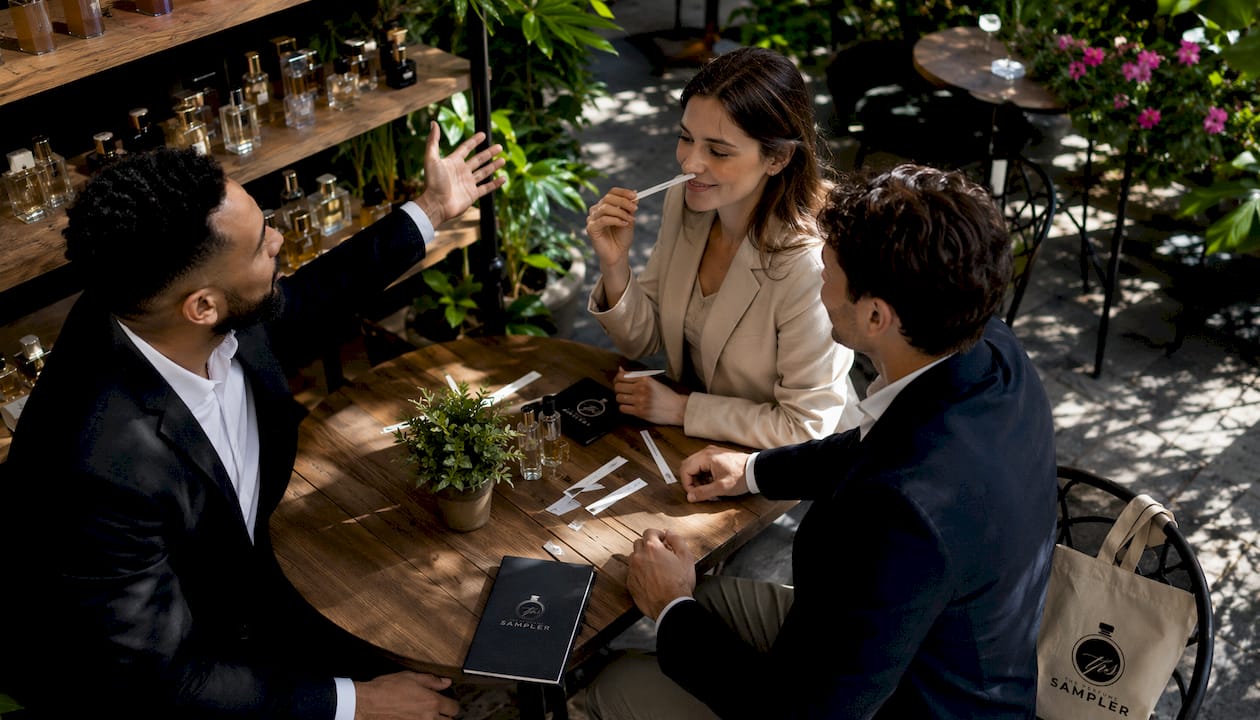
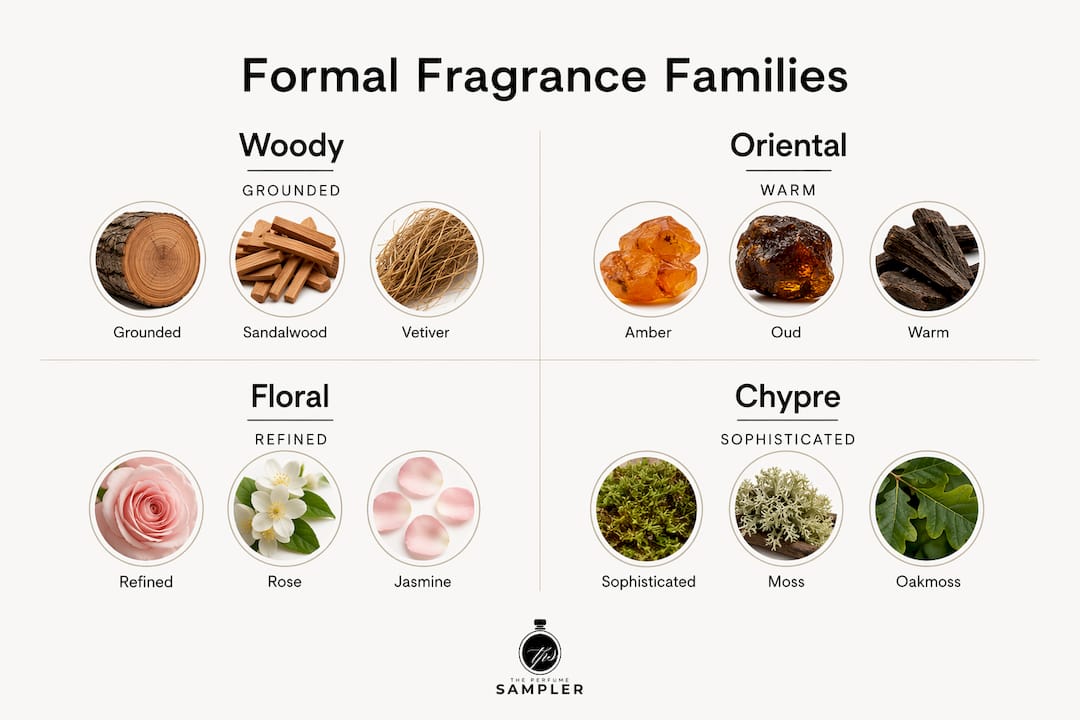
Scent families recommended for formal occasions include woody, oriental/amber, oud/resinous, refined florals and chypre. Each reads as formal for distinct reasons.
| Family | Mood | Classic formal notes |
|---|---|---|
| Woody | Grounded, authoritative | Sandalwood, cedarwood, vetiver, patchouli |
| Oriental/Amber | Warm, opulent | Benzoin, labdanum, vanilla, tonka bean |
| Oud/Resinous | Rich, ceremonial | Oud, frankincense, myrrh, dark rose |
| Chypre/Refined Floral | Elegant, structured | Oakmoss, bergamot, rose, iris, jasmine |
| Soft Leather | Sophisticated, restrained | Birch tar, suede accord, vetiver, cedar |
| Restrained Citrus/Green | Fresh, precise | Bergamot, neroli, green tea, white musk |
Woody and oriental families dominate evening formal wear because their base notes — sandalwood, amber, oud — develop slowly and project warmth across a long event. Chypre and refined florals are the classic choice for daytime formal occasions: structured enough to feel considered, light enough not to overwhelm. Restrained citrus and green notes work well for morning ceremonies and summer weddings where heavy compositions would feel out of place.
Pro Tip: Choose a family that reflects your personal style first, then adjust the specific composition to the event tone. A person who gravitates toward clean, woody scents will feel more confident in a formal woody EDP than in an oriental they find unfamiliar.
How do you match fragrance to the event, time and outfit?
Scent weight should follow the same logic as dress code. A morning wedding ceremony calls for something lighter than a midnight gala. The pairing below covers the most common UK formal settings.
Pairing checklist before you choose:
- Event type (wedding, black-tie dinner, corporate gala, state occasion)
- Time of day (morning/afternoon vs evening)
- Indoor or outdoor venue
- Proximity to other guests (intimate dining vs large ballroom)
- Whether this is a signature scent or a situational choice
Example pairings:
| Occasion | Time | Scent family | Fabric/outfit note |
|---|---|---|---|
| Church wedding ceremony | Morning | Refined floral/chypre | Silk or satin — apply to skin only |
| Corporate awards dinner | Evening | Woody/amber EDP | Wool suit — skin application, let settle before dressing |
| Black-tie charity gala | Evening | Oriental/oud | Velvet or heavy fabric — one extra spray on wrist |
| Garden party (smart dress) | Afternoon | Restrained citrus/green | Linen or cotton — lighter concentration acceptable |
| State or civic occasion | Any | Soft leather/chypre | Formal wool or silk — minimal projection, two sprays maximum |
Fabric interaction is a practical consideration many people overlook. Natural fibres such as wool and silk hold and modulate scent differently to synthetics; synthetics may not retain fragrance as effectively and alcohol-based perfume can damage delicate embellishments. Always apply to skin, not garments, and allow a minute before dressing. For occasion-based dressing, treating scent as the final layer of an outfit rather than an afterthought produces a more coherent impression.
Parfum, EDP or EDT: which concentration is right?
Eau de parfum is often the preferred choice for formal events because it balances projection and longevity without needing constant reapplication. Here is how the concentrations compare in practical terms:
- Parfum (extrait): highest concentration, typically 20–40% aromatic compounds; longest longevity, often 8–12 hours; one or two sprays sufficient; best for black-tie and state occasions.
- Eau de parfum (EDP): 15–20% concentration; strong base-note presence across 6–8 hours; the practical standard for most formal events; two to three sprays to pulse points.
- Eau de toilette (EDT): 5–15% concentration; lighter projection; appropriate for shorter daytime formal occasions or warmer weather; may need a discreet top-up mid-event.
- Eau de cologne (EDC): 2–5% concentration; too light for most formal settings; better suited to casual or warm-weather wear.
EDP and parfum concentrations provide the base-note longevity that multi-hour formal events require. EDT can be appropriate for a morning ceremony or a summer garden party where a heavier composition would feel excessive.
Pro Tip: If you are unsure whether a fragrance’s concentration suits the event, order a 5ml or 10ml decant and wear it for a full evening at home. You will know within three to four hours whether the projection and longevity are right.
Decant sizes are particularly useful here: a 2ml sample tells you whether you like a scent; a 5ml or 10ml decant tells you how it performs across a full event cycle.
How should you adjust formal fragrances by season?
Temperature directly affects how a fragrance projects. Warmer weather amplifies projection and can make heavy oriental or oud compositions feel cloying; cooler temperatures suppress projection, making richer bases more appropriate and comfortable.
| Season | Suggested families | Example notes | Concentration guidance |
|---|---|---|---|
| Spring | Refined floral, chypre, light woody | Rose, iris, bergamot, cedarwood | EDP; lighter application |
| Summer | Restrained citrus, green, airy floral | Neroli, white tea, green accord, white musk | EDT or light EDP; two sprays maximum |
| Autumn | Woody, soft leather, amber | Vetiver, sandalwood, labdanum, suede | EDP; standard application |
| Winter | Oriental, oud, resinous, gourmand | Oud, frankincense, benzoin, vanilla, spice | EDP or parfum; two to three sprays |
For UK formal occasions, this seasonal logic applies with particular force. British winters are cool enough to carry a rich oriental EDP without it becoming oppressive; British summers, while rarely extreme, still warrant restraint. A black-tie dinner in December suits a warm amber or oud composition; the same event in July calls for something considerably lighter.
How do you test a formal fragrance properly before buying?
Personal chemistry affects how a fragrance develops, which means a blotter test is only the starting point. The only reliable verdict comes from skin.
Testing steps:
- Blotter first: spray onto a strip to assess the top notes and general character. Eliminate anything that immediately reads as wrong.
- Skin application: spray one to two sprays on the inner wrist or forearm. Wait 10–15 minutes for the top notes to settle.
- 30–60 minute check: assess the heart notes. Does the scent feel appropriate for the occasion you have in mind?
- 3–4 hour wear test: this is where base notes reveal themselves. Longevity, projection and development all become clear at this stage.
- Full-evening test: where possible, wear the fragrance for a complete evening in a similar setting to the intended event. This is the most reliable test of suitability.
Blotter testing is useful for narrowing options, but top notes are the most volatile and behave differently on paper than on skin. Heart and base behaviour on skin reveals the real character of a composition.
Pro Tip: Use a luxury sampling guide to structure your evaluation. A 2ml sample covers a single-event test; a 5ml decant gives you enough to test across a full evening and assess longevity properly.
Decision checklist before buying a full bottle:
- Comfortable to wear for 4+ hours?
- Appropriate projection for the venue?
- Notes develop well on your skin chemistry?
- Longevity matches the event length?
- Received positive responses from others?
How do you apply formal fragrance and make it last?
Correct application makes a significant difference to both longevity and appropriateness. The goal at a formal event is a discreet, lasting impression, not a statement that precedes you into the room.
Application checklist before leaving home:
- Shower and apply an unscented or lightly scented moisturiser to pulse points; hydrated skin holds fragrance longer.
- Apply to pulse points: inner wrists, base of throat, behind the ears, inner elbows. These areas generate warmth that activates the fragrance.
- For EDP: two to three sprays. For parfum: one to two sprays.
- Hold the bottle 10–15cm from the skin; do not rub wrists together after application.
- Wait at least one minute before dressing to avoid staining fabric or embellishments.
Pro Tip: Carry a 2ml or 3ml decant in a small atomiser for discreet mid-event touch-ups. Apply to the inner wrist only, one spray, and allow it to settle before re-entering the room.
For longevity, layering with a matching scented body product from the same fragrance line extends wear time. Keep layering simple: matching body lotion plus the EDP is sufficient. Adding a second, different fragrance on top risks creating an incoherent composition that reads as confusion rather than complexity. For practical tips on extending wear, a guide on making fragrances last longer covers the key steps in detail.
What mistakes do people make with formal fragrances?
Most errors fall into two categories: choosing the wrong scent for the setting, or applying the right scent incorrectly.
Common mistakes:
- Over-spraying: the most frequent error. More than three sprays of an EDP in a close venue is almost always too much. Formal settings demand restraint.
- Wearing casual or sporty scents: fresh aquatic, ozonic or heavily synthetic compositions read as informal and can feel incongruous at a black-tie event.
- Spraying onto clothing: alcohol damages delicate embellishments and alters how the scent develops. Always apply to skin.
- Choosing on blotter alone: a fragrance that smells appealing on paper may develop very differently on your skin chemistry over several hours.
- Ignoring venue and guest proximity: a large ballroom tolerates more projection than an intimate dining room. Consider the setting before deciding on spray count.
- Strong animalic or synthetic notes in sensitive venues: some guests have fragrance sensitivities. Heavily animalic or synthetic compositions carry a higher risk of causing discomfort.
UK formal occasions carry specific etiquette considerations. At a church wedding, a registry office or a state ceremony, the enclosed space and the solemnity of the occasion demand particular restraint. One or two sprays of a well-chosen EDP is appropriate; anything more risks becoming intrusive for those seated nearby.
Why sampling solves the formal fragrance problem
Small decants are the practical unit of formal fragrance testing. A 2ml or 3ml sample is sufficient for a single-event test; a 5ml decant lets you assess development across a full evening; a 10ml decant covers testing across seasons and multiple occasions.
This matters because formal fragrances are often among the most expensive in any range. Committing to a full bottle of a niche or luxury EDP without testing it in a real setting is a significant financial risk. Sampling via decants gives a realistic, low-cost path to discovering how a composition interacts with your skin chemistry in formal conditions.
A practical sample plan:
- Single-event test: one 2ml or 3ml sample; wear for a full evening and assess longevity, projection and development.
- Multi-event or seasonal test: one 5ml decant; wear across two or three occasions in different temperatures.
- Signature scent evaluation: one 10ml decant; wear across a full season to confirm it suits your chemistry, wardrobe and the range of formal occasions you attend.
- Minimal starter set: three samples across different families (for example, one woody, one oriental, one chypre) to identify which family reads best on your skin.
Pro Tip: Order samples from at least two different fragrance families before a major formal event. Skin chemistry means the family that appeals on paper may not be the one that performs best on you.
Theperfumesampler stocks niche and designer fragrance decants in 2ml, 3ml, 5ml and 10ml sizes, covering a broad range of formal-appropriate compositions. The types of fragrance samples available make it straightforward to build a testing set without committing to full-bottle prices.
Key takeaways
A formal event fragrance is a refined, balanced scent matched to the occasion’s weight, time of day and setting, with EDP or parfum concentration as the practical standard for most UK formal events.
| Point | Details |
|---|---|
| Match weight to occasion | Lighter citrus and floral profiles for daytime; richer amber, oud and woody notes for evening black-tie. |
| Choose EDP or parfum | These concentrations provide the longevity and base-note depth that multi-hour formal events require. |
| Apply to skin, not fabric | Pulse points on moisturised skin give the best longevity; alcohol can damage delicate formal garments. |
| Test on skin for several hours | Blotter tests reveal top notes only; heart and base development on skin determines real suitability. |
| Use Theperfumesampler decants | 2ml–10ml sizes let you test formal fragrances in real settings before committing to a full bottle. |
Why the right formal fragrance is worth getting right
There is a tendency to treat fragrance as an afterthought when preparing for a formal event, something chosen quickly from whatever is already on the shelf. That approach rarely produces the right result. Formal occasions in the UK, whether a black-tie dinner, a state ceremony or a formal wedding, carry specific expectations around presentation. Scent is part of that presentation.
What I find most overlooked is the testing question. People spend considerable time and money on formal dress and then choose a fragrance in five minutes on a blotter strip in a shop. The fragrance they end up wearing may smell nothing like what they tested, because skin chemistry, body temperature and the development of heart and base notes over several hours change everything. A 5ml decant worn for a full evening at home is a far more reliable test than any in-store experience.
UK formal occasions also carry a cultural expectation of restraint. Projection that might be considered acceptable in other contexts can read as intrusive at a church ceremony or a formal dinner. One or two sprays of a well-chosen EDP, applied to the wrist and throat, is almost always sufficient. The goal is a scent that people notice when they are close to you, not one that announces your arrival.
Try formal fragrances before you commit
Choosing a formal fragrance without testing it in a real setting is the most common and most avoidable mistake. Theperfumesampler offers a practical alternative: decants in 2ml, 3ml, 5ml and 10ml sizes, covering niche and designer compositions across every formal-appropriate family.
A 2ml or 3ml decant covers a single-event test; a 5ml decant gives you a full evening to assess longevity and development; a 10ml decant covers a season of testing, ideal for evaluating a potential signature formal scent. All sizes are 100% authentic, and the range includes both well-known designer names and harder-to-find niche compositions.
Visit the why decants page to see the full range of sizes and find formal-appropriate options to test before your next occasion.