
Workday fragrance selection guide for professionals
TL;DR:
- A workday fragrance should be subtle, projecting within a 1-2 foot radius, and suited for office environments. Choosing light floral, citrus, or woody notes and testing application in your actual office climate help maintain professionalism. Proper sampling and moderation prevent fragrance from overwhelming colleagues and build your professional scent identity.
A workday fragrance is defined as a subtle scent worn in professional settings that enhances personal image without projecting beyond a 1–2 foot radius. The right choice respects colleagues’ comfort, reflects your professional identity, and holds up across an eight-hour day. This guide covers the scent profiles best suited to office wear, how to control projection and longevity, and how to test fragrances before spending on a full bottle. Getting these decisions right is the difference between a fragrance that quietly impresses and one that clears a meeting room.
What scent profiles are most suitable for office wear?
Soft florals, subtle musks, and woody notes are rated the most professional and approachable fragrance categories in workplace settings. That rating holds across genders, which makes these families a reliable starting point for any professional.
Fresh and citrus-led fragrances are the most universally accepted choice for office wear. Notes such as bergamot, lemon, grapefruit, and green tea project a clean, alert impression. They also tend to be light in sillage, meaning they stay close to the skin rather than filling a room.
Soft florals add a gentle lift without tipping into sweetness. Rose, peony, iris, and white musks work well because they read as polished rather than perfumed. They complement rather than compete with the professional environment around you.
Light woody and musky bases provide depth without weight. Sandalwood, cedarwood, vetiver, and clean musks anchor a fragrance and give it staying power without the heaviness of dense oud or resinous amber. These base notes are what separate a scent that smells considered from one that smells accidental.
Fragrance families to avoid during the workday include:
- Heavy orientals and gourmands: Vanilla-heavy, spiced, or caramel-forward fragrances project strongly and can trigger headaches in enclosed spaces.
- Dense oud compositions: Oud is a powerful material. Even a small amount can dominate a shared office for hours.
- Animalic or smoky notes: Leather, tobacco, and incense-heavy fragrances are striking in the evening but inappropriate for a professional daytime setting.
- Oversweet fruit bombs: Fragrances built around ripe tropical fruits or candy-like accords project loudly and can feel out of place in formal environments.
Pro Tip: If you are unsure whether a fragrance is office-appropriate, apply it in the morning and ask a trusted colleague at midday whether they can detect it from a normal conversational distance. If they cannot, you have found a suitable projection level.
The best workplace perfumes consistently share these characteristics: freshness, restraint, and a dry-down that stays close to the skin.
How to manage fragrance projection and longevity
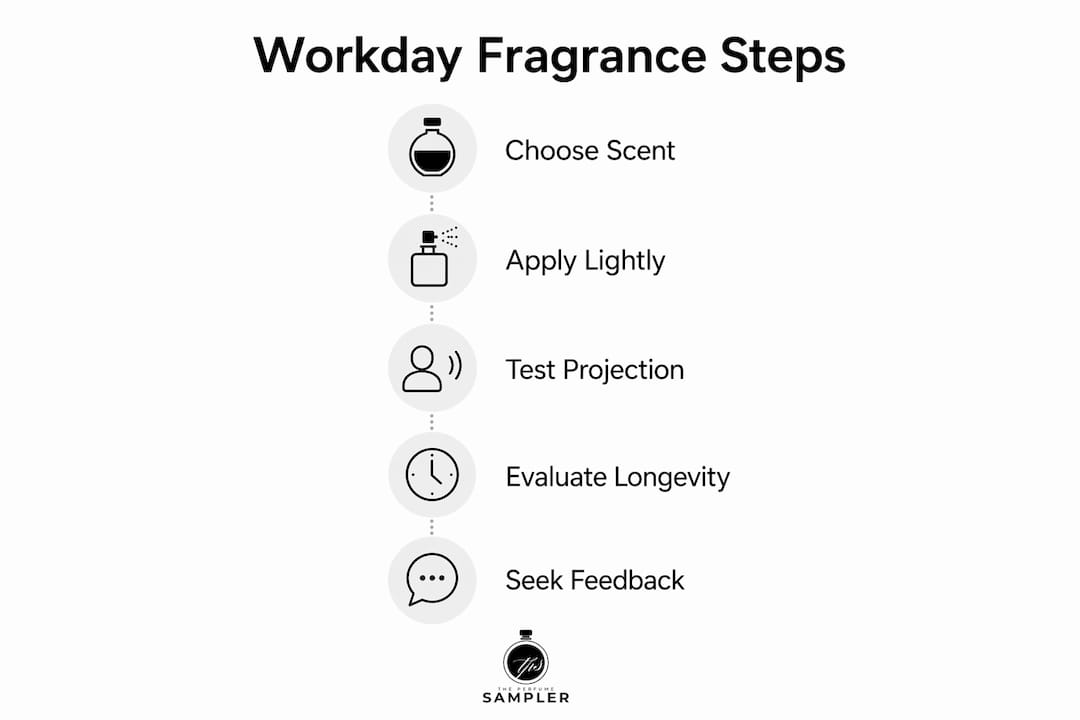
Workplace fragrances should maintain a projection of 1–2 feet, achieved by applying no more than 1–2 spritzes to pulse points. Applying more does not make a fragrance last longer. It makes it louder.
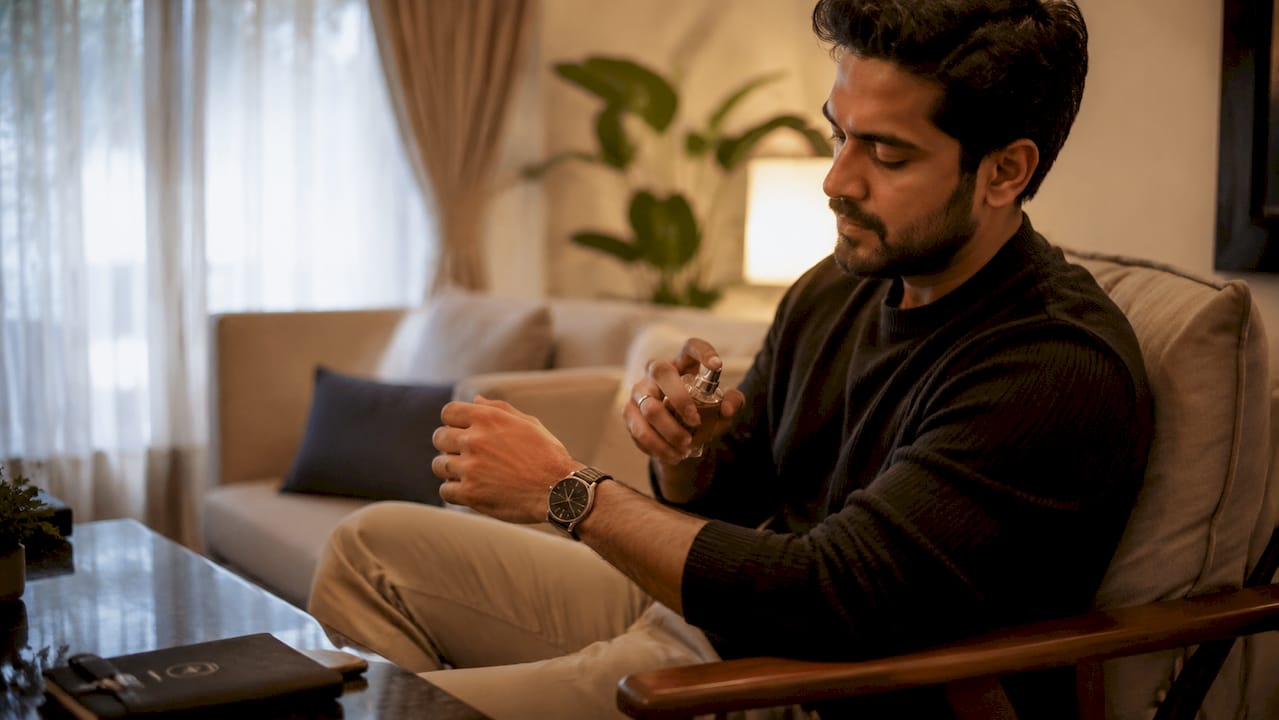
Understanding concentration is the most practical tool for managing longevity. The table below shows the two most relevant concentrations for office wear:
| Concentration | Oil content | Longevity | Office suitability |
|---|---|---|---|
| Eau de Toilette (EDT) | 5–15% | 3–5 hours | Good for warmer offices or shorter days |
| Eau de Parfum (EDP) | 15–20% | 6–8 hours | Suitable with restrained application only |
EDT lasts approximately 3–5 hours, making it a practical choice for morning meetings or warmer climates where projection increases naturally. EDP lasts 6–8 hours but requires a lighter hand, as the higher oil concentration amplifies projection in heated or poorly ventilated spaces.
Application placement matters as much as quantity. The standard advice to spray pulse points is correct, but the specific pulse points you choose change the result significantly.
- Inner wrists: Classic but exposed. Wrist movement carries scent outward, so use sparingly.
- Base of the throat: Projects gently upward toward the face of the person you are speaking to, keeping the scent intimate.
- Chest or torso, covered by clothing: Applying fragrance to covered areas allows scent to diffuse slowly and stay close to the body.
- Behind the knees: An underused application point. The warmth of the area releases scent gradually as you move, creating a subtle trail rather than an immediate blast.
Heat increases fragrance volatility, causing scents to bloom faster and project more strongly than they would in a cool, air-conditioned environment. A fragrance that behaves perfectly in a temperate office can become overpowering in a warm boardroom or during a summer commute.
Pro Tip: Test your chosen fragrance on a warm day before wearing it to an important meeting. What smells restrained in February may project aggressively in July.
How should you sample and test fragrances before buying?
Testing fragrances properly before committing to a full bottle is the single most effective way to avoid a costly mistake. A full bottle of a designer or niche fragrance typically costs significantly more than a sample or decant, and projection, longevity, and skin chemistry all affect whether a fragrance actually works for you in an office context.
Matching new fragrances to notes you already enjoy yields a 70% satisfaction rate, compared to 25% when buying without any reference point. That gap is significant. It means starting with your known preferences and expanding outward, rather than picking a fragrance based on packaging or popularity.
The testing process that works:
- Limit sessions to 2–3 fragrances. Testing more than three scents per session causes olfactory fatigue, which means your nose stops distinguishing differences accurately. Space testing across different days.
- Test on skin, not paper strips. Skin chemistry, influenced by pH, moisture, and diet, changes how a fragrance smells. A scent strip tells you almost nothing about how a fragrance will perform on your body.
- Wear it for a full day. The dry-down of a fragrance, the base notes that emerge after two to four hours, is what your colleagues will smell for most of the day. Test this before committing.
- Test in your actual office environment. Wear the fragrance on a normal workday and assess projection at your desk, in meetings, and in lifts. This is the only reliable test for office suitability.
- Record your impressions. Note the opening, the midday dry-down, and how the fragrance performs in different temperatures. This builds a reference library that makes future selections faster.
Decants and samples, available in sizes from 2ml to 10ml, cost a fraction of a full bottle and give you enough product to complete a proper multi-day test. Theperfumesampler offers fragrance decants for testing across a wide range of designer and niche fragrances, which removes the financial risk from the selection process entirely.
Pro Tip: Keep a simple notes app entry for each fragrance you test. Record the name, the date, the weather, and your impression at three points: application, two hours in, and end of day. After five or six tests, patterns in your preferences become obvious.
Common mistakes that undermine office fragrance etiquette
Wearing the wrong fragrance in a professional environment can cause headaches or discomfort for colleagues with scent sensitivities, and it affects how others perceive you professionally. Avoiding the most common errors is straightforward once you know what they are.
“Fragrances should be viewed as an extension of your personal brand, complementing your persona rather than dominating a professional setting.” — Harper’s Bazaar
The most frequent mistakes professionals make with office fragrance:
- Over-applying. More than two spritzes in a shared workspace pushes projection well beyond the acceptable 1–2 foot range. If you can smell your own fragrance strongly an hour after application, so can everyone else.
- Choosing by popularity rather than personal chemistry. A fragrance that smells extraordinary on someone else may smell entirely different on your skin. Skin pH, moisture levels, and even diet alter the final result.
- Rubbing wrists together after application. Rubbing wrists damages top notes and distorts the intended scent development. Apply and leave the fragrance to settle.
- Ignoring colleagues’ sensitivities. Some professionals have genuine fragrance allergies or sensitivities. If a colleague raises a concern, reduce application or switch to a lighter option. Pairing fragrance with fragrance-free skincare underneath can help manage overall scent load on sensitive skin.
- Buying without testing in the office environment. A fragrance tested at home on a cool evening will behave differently in a warm, busy office. Always conduct at least one full-day office test before making a fragrance part of your regular rotation.
- Wearing the same heavy scent year-round. Building a small fragrance wardrobe for professionals means rotating lighter, fresher options in warmer months and slightly richer options in cooler weather, while keeping projection controlled throughout.
Key takeaways
A workday fragrance works when it stays within a 1–2 foot projection radius, suits the office environment, and has been properly tested on skin before regular use.
| Point | Details |
|---|---|
| Projection limit | Apply 1–2 spritzes only; keep sillage within 1–2 feet of your body. |
| Concentration choice | EDT suits warmer offices and shorter days; EDP requires a lighter hand. |
| Scent families to choose | Soft florals, fresh citrus, and light woody musks are the most office-appropriate. |
| Test before you buy | Wear a sample or decant for a full workday to assess dry-down and projection. |
| Avoid common errors | Never rub wrists, never over-apply, and always test in your actual office climate. |
Why I think most professionals get office fragrance wrong
Most professionals treat fragrance as an afterthought, reaching for whatever is on the bathroom shelf without considering how it will perform across eight hours in a shared space. I have seen this play out repeatedly, and the consequences are rarely dramatic but always noticeable. A heavy oriental worn to a morning meeting, a gourmand that fills a lift, a fragrance reapplied at lunch because the wearer thought it had faded. These are small errors with a real professional cost.
The insight that changed how I approach office fragrance is this: fragrance is part of professional identity, not separate from it. The same care you put into choosing appropriate clothing for a client meeting should go into choosing a scent. Subtlety is not a compromise. It is the point.
Sampling changed everything for me practically. Spending a small amount on a 5ml or 10ml decant and wearing it across three different workdays tells you more than any counter test or online review. You learn how a fragrance performs in your specific office temperature, how it interacts with your skin chemistry, and whether it still feels right at 4PM. That information is worth far more than the cost of the sample.
My honest advice: build a small rotation of two or three office-appropriate fragrances rather than hunting for one perfect scent. A lighter, citrus-forward option for warmer months and a soft woody or musk for cooler weather covers most situations. Treat the full bottle vs sample decision as a process, not an impulse. Your colleagues will notice the difference, even if they cannot name it.
— Rupesh
Try before you commit: how Theperfumesampler can help
Selecting the right office fragrance is a process, not a single purchase. Theperfumesampler makes that process affordable and low-risk.
Theperfumesampler offers fragrance decants in 2ml, 3ml, 5ml, and 10ml sizes across a wide range of designer and niche fragrances. These sizes give you enough product to conduct proper multi-day office tests without the cost of a full bottle. The why decants page explains exactly how this approach saves money and improves satisfaction. For professionals who want a refined, office-ready option, the BOSS Bottled Absolu Parfum Intense is available as a decant, offering a controlled, polished scent suited to professional settings. All products are 100% authentic.
FAQ
What is the best scent family for office wear?
Soft florals, fresh citrus, and light woody musks are the most office-appropriate fragrance families. They project subtly, read as polished, and are unlikely to cause discomfort for colleagues.
How many sprays of perfume should I wear to work?
Apply no more than 1–2 spritzes to pulse points. This keeps projection within the recommended 1–2 foot radius and avoids overwhelming colleagues in shared spaces.
Is Eau de Toilette or Eau de Parfum better for the office?
Eau de Toilette, with 5–15% oil concentration and a 3–5 hour longevity, is generally the safer choice for office wear. Eau de Parfum lasts 6–8 hours but requires a very light application to avoid over-projection.
Why should I test a fragrance before wearing it to work?
Skin chemistry alters how a fragrance smells, and office temperature affects how strongly it projects. Testing a sample or decant across a full workday gives you accurate information that a counter test or scent strip cannot provide.
Can wearing the wrong fragrance affect my professional image?
Wearing an overpowering or inappropriate fragrance can cause discomfort or headaches for colleagues and reflects poorly on professional judgement. Choosing a subtle, office-appropriate scent is part of presenting yourself well at work.
Recommended
- Work professional fragrance guide: select, sample and impress – ThePerfumeSampler
- Why professionals wear perfume: confidence, branding, and scent – ThePerfumeSampler
- Student fragrance checklist: campus scents guide – ThePerfumeSampler
- The best workplace perfumes for everyday office wear – ThePerfumeSampler