
Test With 2–10ml Decants: Niche vs Designer Perfume for Collectors
Neither category is universally better: niche perfume buys creativity, rarity and often riskier compositions, while designer perfume buys accessibility, consistency and dependable value. The right choice depends on which axis matters most to you right now: ingredients, concentration and performance, price per wear, exclusivity, or how often a formula gets reformulated. This guide breaks down each axis so you can decide where your next bottle, or sample, should come from.
TL;DR:
- Many niche fragrances are priced between $150 and $500+, mainly due to raw material sourcing and production scale, not necessarily higher quality.
- Distribution and ownership influence class: boutique-only houses are more exclusive, but many brands blur lines by combining niche pricing with wider retail distribution.
- Perfume concentration affects performance significantly, with extrait offering the longest wear, while prestige packaging can boost perceived value without impacting scent quality.
- Reformulations driven by safety regulations like IFRA mainly impact designer fragrances more frequently, potentially altering their scent over time.
- Sampling with decants or smaller sizes is essential for making informed purchases, as dry-down and skin chemistry heavily influence scent perception.
Table of Contents
- Niche vs designer perfume: what the terms actually mean
- Ingredients, concentration and how they shape performance
- Production scale, exclusivity and distribution
- Price, value and cost per wear
- Reformulation, regulation and longevity of scent profiles
- How to choose: a practical decision guide for your collection
- Sampling and testing: how to try niche and designer scents affordably
- How niche and designer perfume grew into two different markets
- Marketing and storytelling: how niche and designer houses sell you a scent
- Who buys niche and who buys designer, and why
- Does the bottle matter? Packaging, presentation and perceived value
- Resale value and collector interest: niche versus designer
- Author’s perspective: how I build a balanced fragrance wardrobe
- Try before you commit: sampling options from Theperfumesampler
- Sources
- FAQ
Niche vs designer perfume: what the terms actually mean
A niche perfume house typically operates outside mass retail, with smaller production runs, an independent creative brief, and pricing that reflects scarcity rather than shelf space. A designer perfume, by contrast, is usually released by a fashion or lifestyle brand, distributed through department stores and large retailers, and built to sell at volume across a broad customer base.
The boundary gets messy fast. Commercial niche brands price like niche houses but distribute like designer ones. Some of the best known “niche” names on department store shelves are owned by the same conglomerates that own major fashion houses, selling in volumes that would make an independent perfumer blush. That hybrid model blurs the line between artistic exclusivity and mainstream retail muscle, and it means price alone is a poor way to sort one category from the other.
When classifying a house or release, look past the marketing and check these traits:
- Distribution footprint: sold in a handful of boutiques and online, or in every major department store worldwide?
- Ownership structure: independently run, or part of a larger beauty conglomerate?
- Batch size: limited or numbered releases, or continuous mass production?
- Creative control: perfumer-led concept, or brand-brief-led marketing concept?
- Price anchor: does the price reflect ingredient cost, or bottle and campaign spend?
None of these traits alone settles the question, but together they give a far more accurate picture than the price tag or the shop it’s sold in.
Ingredients, concentration and how they shape performance
Concentration tier explains more about how a fragrance performs than almost anything else on the label. Eau de toilette (EDT) typically carries a lower percentage of perfume oil, giving lighter, shorter-lasting wear. Eau de parfum (EDP) sits higher, with more depth and staying power. Extrait de parfum, the strongest common tier, delivers the densest, longest-lasting version of a composition, often at a noticeably higher price.
Rare raw materials add another layer of cost and complexity. Aged sandalwood, natural iris (orris butter), and quality oud are slow to produce, expensive to source, and used sparingly even in fragrances built around them. A house working with these materials faces real cost pressure that a mass-market EDT built on cheaper synthetic bases simply doesn’t carry.
That doesn’t mean higher price guarantees better composition. Some designer lines match or beat niche releases on performance, and the premium on a niche bottle sometimes buys scarcity and packaging rather than superior juice. Analysis comparing the two categories has found that price differences often trace back to raw material sourcing and production scale rather than any inherent creative superiority, and that designer fragrances can offer excellent performance and value without the niche price tag attached.
Statistic callout: Community-sourced pricing puts many niche releases in the $150–$500+ bracket, while designer and mass-market lines commonly sit well below that. The gap is real, but it doesn’t map cleanly onto quality.
A quick reference on how concentration typically breaks down:
- EDT: lighter concentration, shorter wear, usually the most affordable tier.
- EDP: mid-to-high concentration, the most common tier for both niche and designer houses.
- Extrait de parfum: highest concentration, longest wear, and usually the priciest option in a range.
Production scale, exclusivity and distribution
Small-batch perfumery changes the economics of a fragrance house entirely; understanding what makes such artisanal production different and why it’s worth it can clarify the premium pricing involved, as explained in this guide to hand poured soy candles. A boutique operation producing a few thousand bottles a year can afford to use pricier materials and take creative risks that a brand shipping into hundreds of department stores globally cannot easily justify. That scarcity is part of what buyers are paying for when they choose niche: not just the scent, but the knowledge that relatively few people will be wearing it.
Commercial niche brands sit awkwardly between these two models. They keep the pricing and boutique styling of independent perfumery while distributing at a scale closer to designer lines, which is why some enthusiasts view certain “niche” darlings with a degree of scepticism once they notice the bottle on every airport shelf.
Distribution also decides how easily you can actually try something before buying:
- Boutique-only niche releases often mean limited counter access, long shipping times for samples, and little chance to test before committing.
- Widely distributed designer lines are easy to sniff in-store but harder to find genuinely rare or limited.
- Online decant and sample sellers close that gap for both categories, giving access to scarce niche releases without a boutique visit.
This is where sampling becomes less a nice-to-have and more a practical necessity for anyone serious about building a considered collection.
Price, value and cost per wear
Price alone tells you almost nothing about value. Cost-per-wear does, and it’s the calculation serious collectors default to once the initial excitement of a new bottle wears off.
- Set a realistic wear frequency. A niche extrait you’ll wear twice a month has a completely different value profile to a designer EDP you’ll reach for daily.
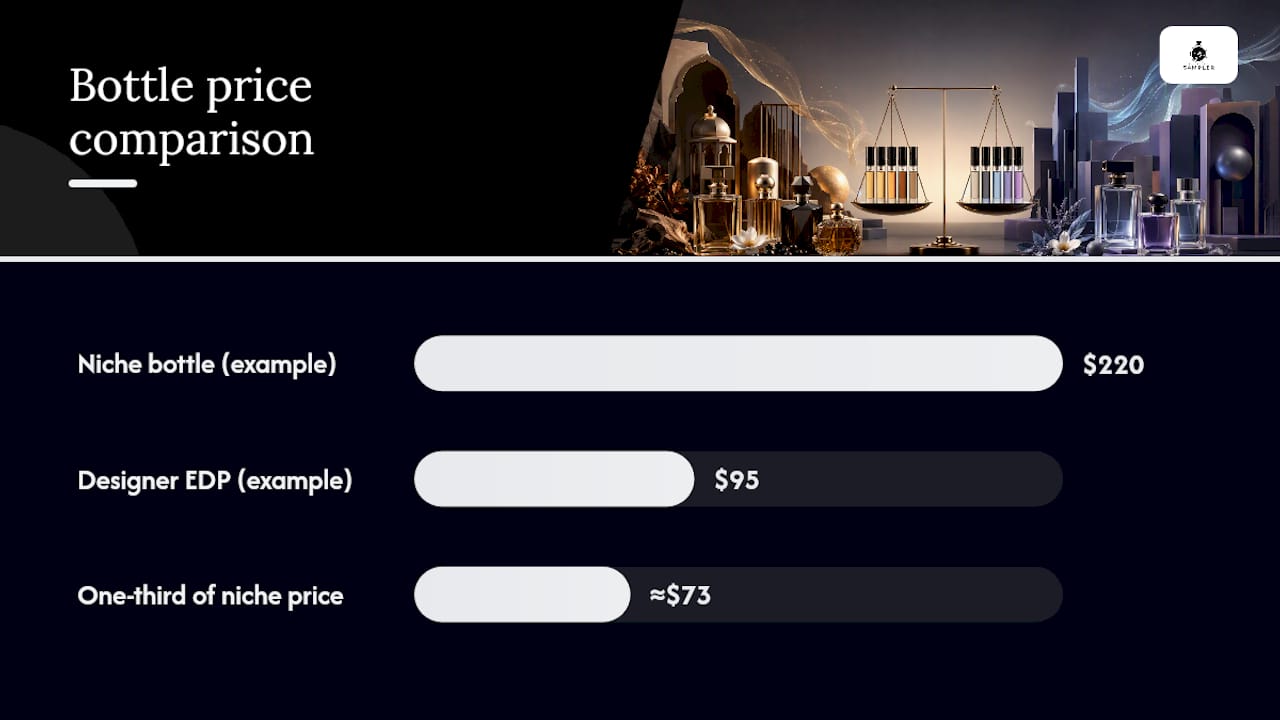
- Divide bottle price by realistic wears, not aspirational ones. A $220 niche bottle worn 100 times over two years costs $2.20 per wear. The same bottle worn eight times a year for the same period costs closer to $27.50 per wear.
- Factor in sprays per wear. Extrait concentrations often need fewer sprays than EDT, which changes how many wears a single bottle actually delivers.
- Compare against a designer alternative in the same olfactory family. If a $95 designer EDP delivers 80% of the character at a third of the price, the cost-per-wear gap can be difficult to justify on scent alone.
Cost-per-wear thinking works best when it’s grounded in how you actually live, not how you imagine wearing a bottle. A fragrance that sits on a shelf for two years because it needs “the right occasion” is expensive no matter what it cost at checkout.
Price inflation isn’t always about the liquid inside the bottle, either. Ornate glasswork, boxed presentation, and a marketing campaign fronted by a famous face all add cost that has nothing to do with the formula. Understanding what actually drives fragrance pricing helps separate the premium you’re paying for genuine raw material cost from the premium you’re paying for branding alone.
Reformulation, regulation and longevity of scent profiles
Regulatory restrictions have reshaped fragrance formulas more than most buyers realise. The International Fragrance Association (IFRA) periodically restricts or bans ingredients on safety grounds, and the oakmoss story is the example collectors cite most often: restrictions on oakmoss extract forced widespread reformulation of classic chypre compositions, changing how many decades-old fragrances smell today compared with their original release.
Designer lines tend to reformulate more frequently than niche houses, largely because they sell at higher volume and face more regulatory and cost pressure to adjust formulas over time. For a collector, that means a designer bottle bought today may smell noticeably different from the same name bought a decade ago, while a niche release from a smaller house sometimes holds closer to its original formula for longer, precisely because it isn’t being remade at the same scale.
A few practical checks help buyers spot likely reformulations:
- Check batch codes against online batch-code decoders to estimate a bottle’s production date.
- Research the release year and compare community notes on “old formula” versus “new formula” performance.
- Compare vintage and current reviews on enthusiast forums, where wear-time and note changes are often flagged in detail.
- Ask sellers directly about batch age when buying older stock, particularly for discontinued designer classics.
Statistic callout: IFRA-driven restrictions on oakmoss are the most commonly cited regulatory example in fragrance discussion, and their effects are still visible in how chypre-family scents perform today versus their original 20th-century formulas.
How to choose: a practical decision guide for your collection
Start by defining the job the fragrance needs to do. A signature scent worn daily has different requirements from an evening piece worn twice a month, and matching the category to the role saves both money and regret.
- Identify the role: signature (daily, needs value and consistency), statement (occasional, can justify a niche splurge), or seasonal (short window, favours a smaller size or sample over a full bottle).
- List the notes you keep gravitating towards. If you notice yourself repeatedly drawn to a specific note, oud, iris, a particular amber accord, that’s a strong signal to sample niche interpretations of it.
- Set a budget ceiling before you shop, not after you fall for a bottle. Decide what you’re willing to spend per wear, not per purchase.
- Ask the right questions at the counter or in a sample listing: what concentration is this (EDT, EDP, extrait)? What’s the batch or release year? How many sprays does the seller recommend for the concentration?
- Default to designer staples for everyday wear, and reserve niche purchases for notes or accords you’ve already confirmed you love through repeated exposure or sampling.
Pro Tip: Never buy a full bottle of a fragrance you’ve only smelled once on a card in-store. Dry-down can change a scent completely over two to four hours, and a strip test tells you almost nothing about how it will behave on your own skin.
This sample-first approach mirrors what enthusiast communities consistently recommend: start with designer staples to learn your preferences, then move to niche purchases once you know exactly what you’re chasing.
Sampling and testing: how to try niche and designer scents affordably
Sampling turns an expensive guessing game into an informed decision. A 2ml decant of a $300 niche extrait costs a fraction of the full bottle, letting you test dry-down, longevity and projection on your own skin before spending three figures on something you might wear twice.
Good testing technique matters as much as the sample size. Apply to skin rather than paper, since skin chemistry changes how notes develop. Wait through the full dry-down, ideally two to four hours, before judging a scent, since top notes rarely represent the finished composition. Test one fragrance at a time to avoid olfactory fatigue, and compare within the same concentration tier so you’re not judging an EDT against an extrait unfairly.
Theperfumesampler stocks niche and designer fragrances in sample form, across sizes that suit different testing needs, alongside full bottles for once you’ve confirmed a favourite.
| Decant size | Typical use case |
|---|---|
| 2ml | First-time test of a new or expensive niche release |
| 3ml | Short-term trial across a week of regular wear |
| 5ml | Extended trial or a travel-friendly backup |
| 10ml | Confirmed favourite you’re not ready to buy full-size yet |
How niche and designer perfume grew into two different markets
Niche perfumery as a distinct category is a relatively recent phenomenon, gaining real commercial traction from the late 20th century onward as independent perfumers pushed back against the increasingly formulaic, market-tested releases coming out of major fashion houses. Early niche houses positioned themselves explicitly as the antidote to designer perfumery: smaller runs, unusual materials, and compositions built around a concept rather than a sales forecast.
Designer perfumery, meanwhile, has a much longer commercial history tied directly to fashion houses using fragrance as a brand extension, a lower-cost entry point into a luxury name that a customer might not yet be able to afford in clothing or accessories. That positioning explains why designer fragrance marketing so often leans on the parent brand’s existing image rather than the scent’s own creative story.
Over the past two decades, the line between the two markets has moved considerably. Large beauty conglomerates began acquiring or launching “niche” divisions specifically to capture buyers who wanted the boutique feel without abandoning familiar retail channels, which is exactly how commercial niche came to exist as a category. The result is a market where niche no longer automatically signals independence, and designer no longer automatically signals compromise. Positioning has become as much a marketing choice as a description of how a fragrance is actually made or sold.
Marketing and storytelling: how niche and designer houses sell you a scent
Designer fragrance marketing leans heavily on the parent brand’s existing identity: a recognisable name, a celebrity face, a campaign built around lifestyle aspiration rather than the composition itself. The scent is often secondary to the story the brand is already known for telling.
Niche marketing, where it exists at all, tends to foreground the perfumer, the concept, or the raw materials. A niche house is more likely to talk about where an oud was sourced, or the specific memory a scent is meant to evoke, than to lean on a famous face. That storytelling style appeals directly to buyers who want to feel they’re buying craft rather than campaign.
Neither approach is dishonest, but they’re selling different things. Designer marketing sells belonging to a recognisable name at an accessible price point. Niche marketing sells discovery and a sense of having found something before it became widely known, even when, as with commercial niche, that scarcity narrative doesn’t always match the actual distribution footprint, recognising which story you’re responding to helps separate genuine interest in a composition from a well-executed pitch.
Who buys niche and who buys designer, and why
Designer perfume buyers are frequently motivated by reliability: a known name, a scent they can reorder without surprises, and a price point that doesn’t require agonising over cost-per-wear. That’s a completely rational way to buy fragrance, particularly for a daily signature scent worn to work or in social settings where consistency matters more than novelty.
Niche buyers are often motivated by a different psychological driver: the desire for individuality, or a fragrance that won’t be recognised by a stranger on the train. That desire for scarcity is a large part of what niche pricing is actually selling, alongside any genuine ingredient difference. Enthusiast communities tend to describe this shift happening in stages, starting with designer basics, then gradually chasing rarer notes and harder-to-find releases as personal preferences sharpen.
Neither buyer type is more “serious” about fragrance than the other. A collector with fifteen designer EDPs rotated thoughtfully by season understands their preferences better than someone with three unworn niche extraits bought purely for their reputation. The psychology worth watching is your own: buying niche because you’ve identified a specific note you love is different from buying niche because a bottle looks impressive on a shelf.
Does the bottle matter? Packaging, presentation and perceived value
Packaging shapes perceived value before a single spray happens. A heavy glass bottle, a lined presentation box, and considered typography all signal quality, sometimes accurately, sometimes as pure theatre layered over a fairly ordinary composition.
Niche houses often use minimalist, apothecary-style packaging that signals craft and restraint, while designer lines tend toward bolder, more decorative bottle design tied to brand identity. Both strategies work on the same psychological principle: buyers use visual cues to predict quality before they can smell anything, which is exactly why blind sampling is such a useful corrective. Testing a fragrance from an unlabelled sample vial, stripped of bottle and box entirely, is one of the fastest ways to judge a composition purely on its own merits.
That’s not an argument against enjoying a beautifully designed bottle. It is a reason to separate “I love how this looks on my shelf” from “I love how this smells,” since only one of those justifies paying extra for a full-size bottle over a sample.
Resale value and collector interest: niche versus designer
Discontinued or limited niche releases can develop real collector interest over time, particularly when a house closes a line, changes formulas, or shuts down entirely. A sealed bottle of a well-regarded, discontinued niche extrait can hold or even increase in value on the secondary market, driven by the same scarcity that made it appealing at launch.
Designer fragrances rarely see that kind of appreciation, because continuous production and frequent reformulation mean there’s usually a current version available, which caps resale demand for most releases. The exception is vintage designer bottles from decades-old formulas, particularly pre-reformulation stock, which enthusiast collectors do seek out specifically because the current version smells noticeably different.
For most buyers, resale potential shouldn’t drive a purchase decision. It’s a genuine consideration for serious collectors building a portfolio with an eye on rarity, but it’s a poor reason to buy a fragrance you’re not confident you’ll actually enjoy wearing. Treat any resale value as a pleasant possibility on top of a scent you already love, not the primary justification for the price.
Author’s perspective: how I build a balanced fragrance wardrobe
My own rotation leans on designer staples for daily wear, a couple of niche extraits reserved for evenings or occasions that call for something less common, and a standing drawer of samples for anything I’m curious about but not ready to commit to. That mix keeps cost-per-wear sensible without closing off discovery.
The habits that make this work matter more than the bottles themselves: logging first impressions and dry-down notes, rotating scents deliberately to avoid fatigue, and always buying a decant before a full bottle of anything above a modest price point. Fragrance expertise, in practice, is less about owning rare bottles and more about knowing your own skin, your own preferences, and resisting the pull of a good bottle design over a good composition.
— Rupesh
Try before you commit: sampling options from Theperfumesampler
Sample sellers offer a practical alternative to buying blind. Instead of committing $150 or more to a full niche bottle on the strength of a strip test, you can test the actual composition on your skin for a fraction of that cost, then decide with confidence.
Decants run from 2ml through to 10ml, a range built specifically around how people actually test fragrance: 2ml for a first impression, 5ml or 10ml once you know a scent works and want to live with it a little longer before buying full-size. The reasoning behind this approach, and why decants make sense as a buying strategy, comes down to reducing risk without reducing choice, since Theperfumesampler carries both niche and designer names, including full bottles such as the BOSS Bottled Absolu Parfum Intense for when a sample has already won you over. Start with a decant of whatever you’re currently curious about, and let the dry-down do the deciding.
Sources
- Niche vs Designer Perfume: Is Niche Worth It UK 2026 - ScentVerdict
- Niche vs Designer Fragrances: What Expensive Perfume Actually Buys You - FragPlace
- Niche vs designer style? : r/fragrance - Reddit
FAQ
Which is better, niche or designer perfume?
Neither is universally better. Niche typically offers more creative freedom, rarer materials and exclusivity, while designer offers consistency, easier availability and a lower cost-per-wear for most buyers.
Is Dior considered designer or niche?
Dior operates as a designer fragrance house, distributed widely through department stores and duty-free, though some of its higher-end lines carry pricing and presentation closer to commercial niche territory.
What is considered a niche perfume?
A niche perfume typically comes from an independent or boutique house with smaller production runs, perfumer-led creative direction, and distribution outside mainstream department stores, though commercial niche brands blur that line by combining niche pricing with wider retail reach.
Is it worth paying more for niche perfume?
It’s worth it when the extra cost demonstrably buys rarer ingredients, a higher concentration tier, or a composition you’ve already confirmed suits you through sampling, rather than paying purely for scarcity or packaging.
How can I test niche fragrances without buying a full bottle?
Decants and samples in sizes from 2ml to 10ml let you test dry-down, longevity and projection on your own skin at a small fraction of full-bottle cost.