
How to refresh fragrance on the go: practical tips
TL;DR:
- Carrying small, portable fragrance formats and applying scent to pulse points helps maintain freshness discreetly throughout the day. Layering with moisturiser and timing touch-ups at natural breaks extend scent longevity without overdoing it. Using travel decants, roll-ons, or solid perfumes ensures compliance and convenience on the go.
Seven quick actions keep your scent fresh throughout the day without overpowering anyone around you. Carry a travel atomiser or rollerball, moisturise before you apply, mist pulse points lightly, use the shoulder-to-shoulder hair mist technique, time your top-ups at natural breaks, keep containers within the 100 ml cabin-luggage limit, and choose decant sizes that fit your bag.
- Pack a pump-to-fill atomiser (under 100 ml) for carry-on compliance
- Use a rollerball or solid perfume for desk or commute touch-ups
- Apply unscented moisturiser first to hold scent on skin
- Mist pulse points: base of neck, inner elbow, behind the ear
- Spray shoulder to shoulder so hair movement diffuses scent naturally
- Refresh at natural breaks (post-lunch, pre-evening) rather than waiting for the scent to vanish
- Choose Theperfumesampler decants in 2 ml, 3 ml, 5 ml, or 10 ml sizes for a carry-on-ready kit
Table of Contents
- Which portable fragrance formats work best?
- How to reapply correctly: technique, pulse points, and the “don’t rub” rule
- When to refresh and how layering extends a scent’s life
- How to pack and carry fragrances safely in cabin luggage
- How to revive a fading fragrance and store your decants
- Scent etiquette in shared spaces: office, transport, and restaurants
- What to buy for on-the-go: a practical travel kit
- Key takeaways
- The routine that actually works for a full day
- Theperfumesampler: decants built for travel and daily carry
- Useful sources and further reading
Which portable fragrance formats work best?
Choosing the right format is the single biggest factor in how discreetly and effectively you can refresh perfume anytime.
Refillable pump-to-fill atomisers are the most versatile option. They accept most eau de parfum and eau de toilette formulas, hold 5–10 ml, and produce a fine mist that gives even coverage. The closed-loop fill system keeps the fragrance away from air, which matters for preserving top notes.
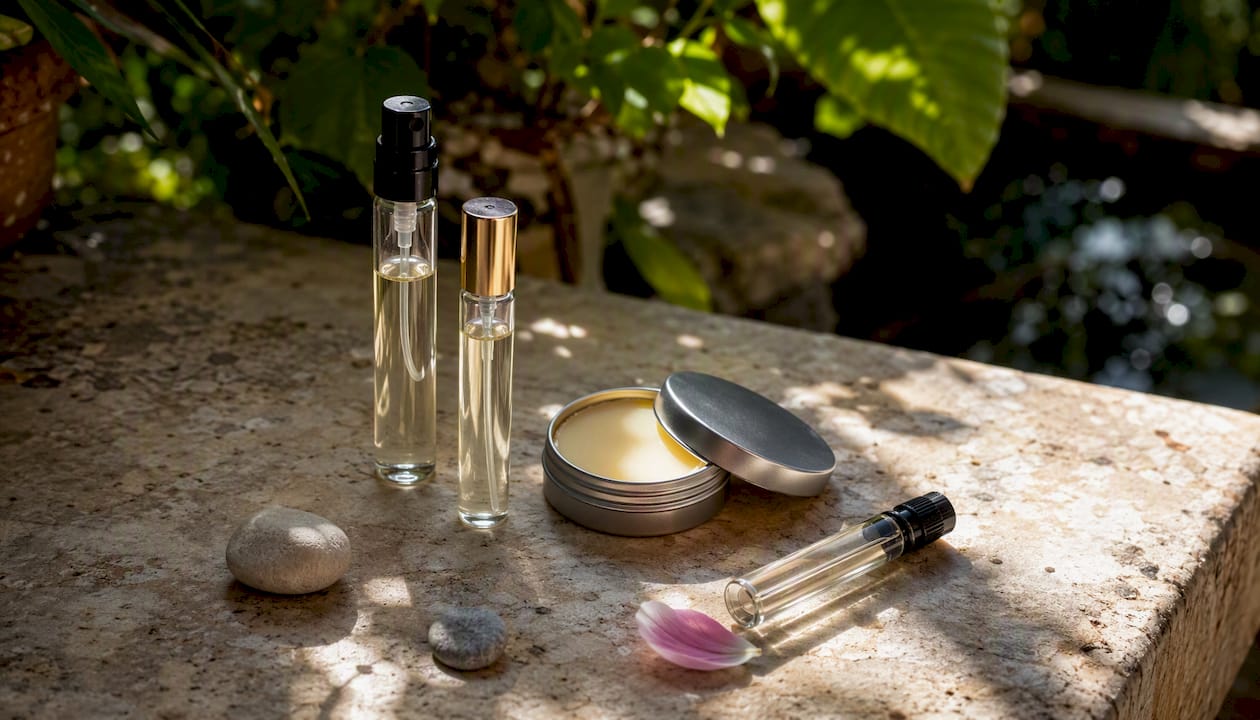
Rollerballs and fragrance oils are the most discreet format. No spray, no mist cloud, no noise. A quick roll on the inner wrist or behind the ear takes three seconds and draws no attention. The oil base also tends to sit on skin longer than an alcohol-based spray.
Solid perfumes are leak-proof by design, which makes them ideal for checked luggage or a gym bag. Longevity is moderate; they suit lighter, fresher compositions better than heavy orientals.
Disposable travel sprays (pre-filled, sealed units) are convenient but wasteful and often limited to mass-market scents. They are a reasonable backup rather than a primary solution.
Decants and sample vials from Theperfumesampler give you access to niche and designer fragrances in sizes that fit any bag. A 5 ml or 10 ml decant in a spray vial is a practical carry-on scent solution for a weekend trip; a 2 ml or 3 ml vial suits a day bag or a tester run before committing to a full bottle.
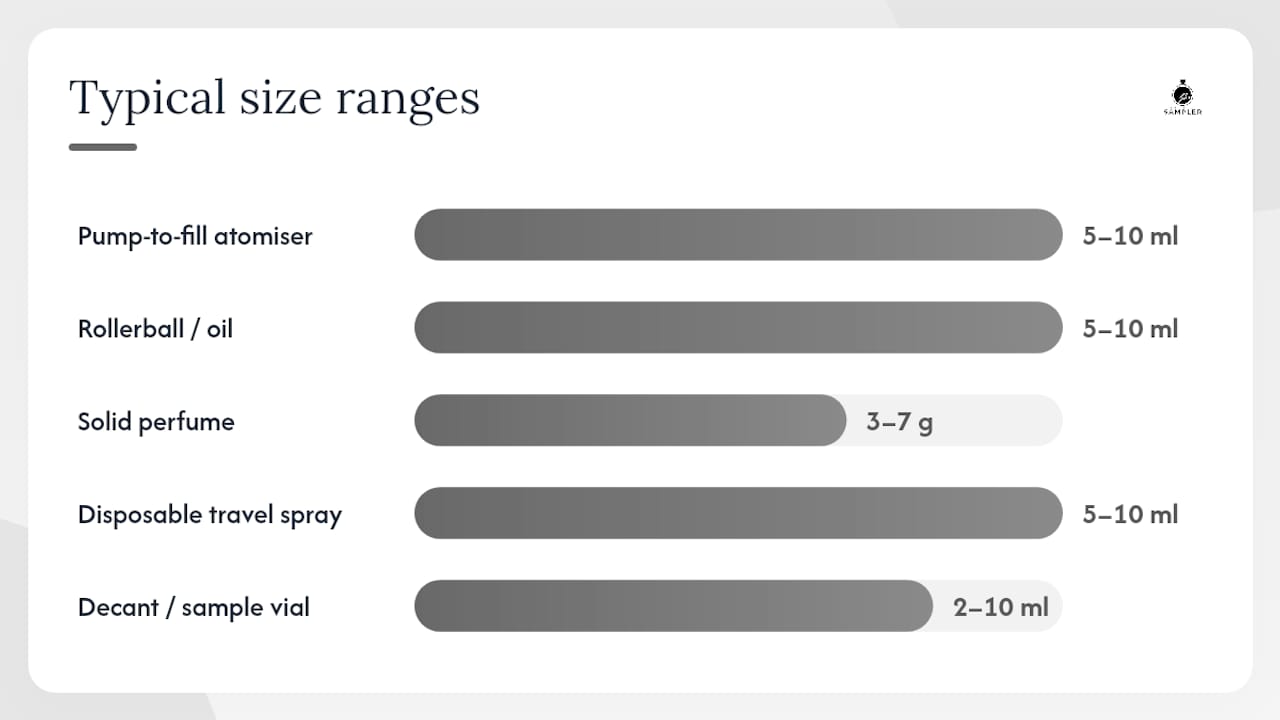
| Format | Size range | Leak risk | Discretion | Best for |
|---|---|---|---|---|
| Pump-to-fill atomiser | 5–10 ml | Low (sealed) | Medium | Daily carry, travel |
| Rollerball / fragrance oil | 5–10 ml | Very low | High | Office, commute |
| Solid perfume | 3–7 g | None | High | Gym bag, checked luggage |
| Disposable travel spray | 5–10 ml | Low | Medium | Backup / one-trip use |
| Decant / sample vial | 2–10 ml | Low (sealed) | Medium–high | Trying new scents, travel |
How to reapply correctly: technique, pulse points, and the “don’t rub” rule
Two light applications to the right spots beat five heavy sprays to the wrong ones. For a discreet, effective refresh, one or two sprays (or rolls) to a single warm pulse point is sufficient.
The best pulse points for on-the-go application:
- Base of the neck (most effective for projection without overpowering)
- Inner elbow (warm, naturally covered, low intrusion)
- Behind the ear (close to others during conversation, subtle)
- Back of the knee (scent rises with body heat throughout the day)
- Hair and shoulders (longest-lasting diffusion with movement)
Warmth is the mechanism. Pulse points sit close to the surface of the skin where blood vessels generate heat, and that heat activates the fragrance and pushes it outward. The base of the neck and inner elbow are the most practical for a quick midday touch-up because they are easy to reach and easy to cover.
The “don’t rub” rule is one of the most consistently misunderstood pieces of fragrance advice. Rubbing wrists together after spraying crushes volatile top-note molecules and speeds evaporation, which means the scent fades faster and the opening notes are lost. Let the fragrance dry naturally. It takes about 30 seconds.
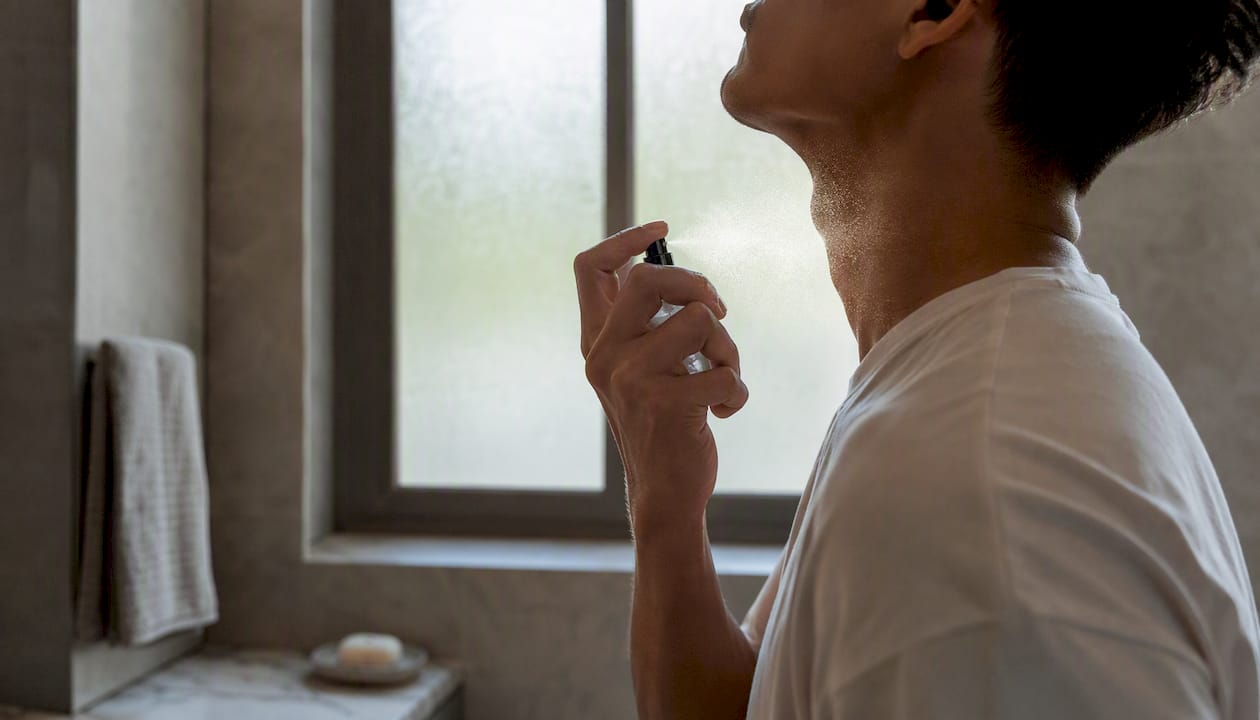
Pro Tip: Diptyque recommends spraying from one shoulder to the other, passing the mist above the head so it settles on both shoulders and the hair. As you move, the scent diffuses gently rather than projecting in a single direction. This is the most discreet technique for a public refresh.
Clothing can also hold scent longer than skin, but check fabric sensitivity before spraying directly on to a garment, and use sparingly in office or professional settings where fragrance on clothing can linger beyond what is appropriate.
When to refresh and how layering extends a scent’s life
Refresh at natural breaks in your day rather than waiting until the scent has completely faded. Post-lunch and pre-evening are the two most practical moments: the first keeps you fresh through the afternoon, the second transitions you into an evening setting without a jarring reapplication mid-conversation. Experts advise this timing specifically for discretion — a subtle, considered touch-up is far less intrusive than a heavy spray applied reactively.
Layering is the simplest way to reduce how often you need to refresh. Applying an unscented moisturiser or a matching body oil before perfume creates a hydrated base that prevents the scent absorbing too quickly into dry skin. Dry skin is the main reason fragrance fades within two hours on some people and lasts six on others.
A simple travel-day layering routine:
- Cleanse or dampen skin (a quick splash of water works)
- Apply unscented lotion or a compatible scented body balm
- Wait 60 seconds for the base to absorb
- Apply your travel spray, rollerball, or decant to pulse points
- Allow to dry naturally without rubbing
For touch-ups during the day, a matching-scent balm or oil applied to the inner elbow is more effective than a raw spray on dry skin. For deeper guidance on combining products, the fragrance layering guide from Theperfumesampler covers pairings in detail.
Pro Tip: Match your refresh frequency to concentration. An eau de parfum typically lasts six to eight hours, so one midday touch-up is usually enough. A body mist or eau de cologne needs more frequent refreshing throughout the day.
How to pack and carry fragrances safely in cabin luggage
The rule is straightforward: each liquid container must be 100 ml or less, and all containers must fit within a single one-litre transparent resealable bag. This applies at all UK airports and aligns with IATA and TSA standards. A 10 ml decant, a 5 ml rollerball, and a small solid perfume all fit comfortably within that allowance alongside other toiletries.
Packing tips for carry-on:
- Place all fragrance items in the resealable clear bag before reaching security
- Use pump-to-fill atomisers rather than open-top funnels, which expose the fragrance to air and risk spillage
- Check that spray nozzles are locked or covered to prevent accidental discharge in the bag
- Keep the clear bag accessible in your hand luggage for the security tray
For checked luggage, wrap bottles individually in clothing or bubble wrap and place them inside a sealed plastic bag. Pressure changes in the hold can cause leaks from poorly sealed caps.
Refilling safely: Bottom-fill pump-to-fill atomisers transfer fragrance without exposing it to air, which preserves top notes and reduces oxidation. Funnel or syringe methods work but introduce oxygen into the reservoir. If you are switching scents in the same atomiser, flush the reservoir with high-proof unscented alcohol and allow it to air-dry for 24 hours before refilling.
Theperfumesampler’s decant sizes (2 ml, 3 ml, 5 ml, 10 ml) are all well within the 100 ml limit and arrive sealed, making them a straightforward carry-on scent solution with no refilling required.
How to revive a fading fragrance and store your decants
Move fragrances away from heat and humidity immediately. The bathroom shelf is one of the worst storage spots: steam and temperature fluctuations accelerate oxidation and flatten the scent profile. A cool, dark drawer or cupboard is the correct environment, and it applies equally to full bottles and small decants.
Practical revival and storage steps:
- Store decants and vials upright in a dark box or drawer at a stable room temperature
- Keep bottles away from windowsills, radiators, and bathroom surfaces
- For a slightly faded scent, allow the bottle to rest undisturbed for 24–48 hours in cool storage; this can partially restore the balance of middle and base notes
- Repurpose heavily oxidised top notes by spraying lightly on to hair or fabric rather than skin, where the remaining base notes still perform well
- Before switching fragrances in a reusable atomiser, flush with high-proof unscented alcohol and air-dry for a full 24 hours to prevent cross-contamination
- Label decants with the fragrance name and fill date so you can track age and rotate stock
Small decants from Theperfumesampler are particularly practical here: because the volumes are small, you use them up quickly and the fragrance stays fresh throughout. A 2 ml or 3 ml vial rarely sits long enough to degrade.
Scent etiquette in shared spaces: office, transport, and restaurants
Always reapply in a private space when you have the option. A toilet cubicle, an empty stairwell, or a quiet corner of a changing room is preferable to the open-plan office or a crowded train carriage. When a private space is not available, use the most targeted, low-projection format you have.
Dos and don’ts for shared spaces:
- Do use a rollerball or solid perfume for office and commute touch-ups — both formats limit sillage to the immediate area around you
- Do apply to covered pulse points (inner elbow, base of neck) rather than exposed skin that projects outward
- Do check with colleagues if you work in a scent-sensitive environment before refreshing at your desk
- Don’t spray an atomiser in an enclosed space such as a lift, train carriage, or small meeting room
- Don’t apply heavy oriental or oud-based fragrances in confined areas; opt for lighter citrus, aquatic, or green compositions that dissipate quickly
- Don’t apply more than one or two targeted touches when refreshing in a semi-public setting
For professional environments specifically, the guide to refreshing work fragrances from Theperfumesampler covers office-appropriate scent choices and application strategies in more detail.
Pro Tip: If you are unsure whether your scent is projecting too strongly, step outside for 60 seconds and re-enter the room. Fresh air resets your nose and gives you a more accurate read on how the fragrance is landing.
Understanding fragrance note structure helps here too: top notes are the most volatile and project furthest immediately after application, while base notes are quieter and longer-lasting. Choosing a fragrance with prominent base notes (woods, musks, ambers) means less initial projection and a more considerate presence in shared spaces.
What to buy for on-the-go: a practical travel kit
A compact, effective kit for refreshing scent on the move needs four items: one pump-to-fill atomiser, one rollerball, a small scented balm or solid perfume, and a decant or sample vial of your chosen fragrance.
What to look for in each item:
- Pump-to-fill atomiser: metal or glass reservoir, bottom-fill valve, capacity of 5–10 ml, lockable nozzle. Avoid plastic reservoirs with open-top fill ports.
- Rollerball: glass or stainless-steel ball, oil-based formula, 5–10 ml capacity. Check that the cap seals tightly.
- Solid perfume or scented balm: wax or oil base, compact tin or twist-up format. Useful as a layering base and a backup when sprays are not appropriate.
- Decant or sample vial: sealed, labelled, under 100 ml. Theperfumesampler supplies these in four sizes.
| Decant size | Volume | Best use |
|---|---|---|
| Sample vial | 2 ml | Single-day tester, handbag backup |
| Small decant | 3 ml | Weekend trip, daily carry |
| Mid decant | 5 ml | Short holiday, regular daily use |
| Standard decant | 10 ml | Extended travel, regular rotation |
All four sizes sit well within the 100 ml cabin-luggage limit. The 2 ml and 3 ml options are particularly useful for trying a new fragrance before buying travel-size perfume or committing to a full bottle.
Key takeaways
Refreshing fragrance on the go comes down to three things: the right portable format, correct application technique, and timing your touch-ups at natural daily breaks rather than reacting to a faded scent.
| Point | Details |
|---|---|
| Cabin-luggage rule | Each container must be 100 ml or less and fit in a single one-litre resealable clear bag. |
| Application technique | Apply to warm pulse points and never rub; let the fragrance dry naturally to preserve top notes. |
| Layering for longevity | Moisturise before applying perfume; hydrated skin holds scent significantly longer than dry skin. |
| Timing touch-ups | Refresh post-lunch and pre-evening rather than waiting for the scent to vanish entirely. |
| Theperfumesampler decants | Decants in 2 ml, 3 ml, 5 ml, and 10 ml are sealed, carry-on compliant, and cover every travel scenario. |
The routine that actually works for a full day
Most people approach fragrance as a morning-only task. Apply once, hope for the best, and wonder why the scent is gone by 2 PM. The reality is that a two-step routine, morning and midday, with a light pre-evening refresh, keeps you consistently present without ever being intrusive.
The morning step is the most important: moisturise first, apply your main fragrance to two or three pulse points, and allow it to dry. That base layer does the heavy lifting. By midday, a single roll of a matching oil or one light spray from a 5 ml decant to the inner elbow is enough to carry you through the afternoon. Before an evening commitment, a quick shoulder-to-shoulder mist from a travel atomiser completes the day.
What surprises most people is how little product this actually requires. A 5 ml decant, used this way, lasts several weeks of daily wear. The common mistake is over-applying in the morning to compensate for expected fade, which creates the opposite problem: an overpowering opening that clears the room, followed by nothing by afternoon.
If you forget your kit, the simplest substitution is a scented hand lotion applied to the inner wrist. It is not the same as a proper EDP, but it maintains a quiet scent presence and is available almost anywhere. For a more structured approach to making fragrances last longer, the Theperfumesampler blog covers the full technique.
Theperfumesampler: decants built for travel and daily carry
Theperfumesampler supplies niche and designer fragrance decants in 2 ml, 3 ml, 5 ml, and 10 ml sizes. Every size is sealed, labelled, and well within the 100 ml cabin-luggage limit, so there is no decanting, no refilling, and no security delays.
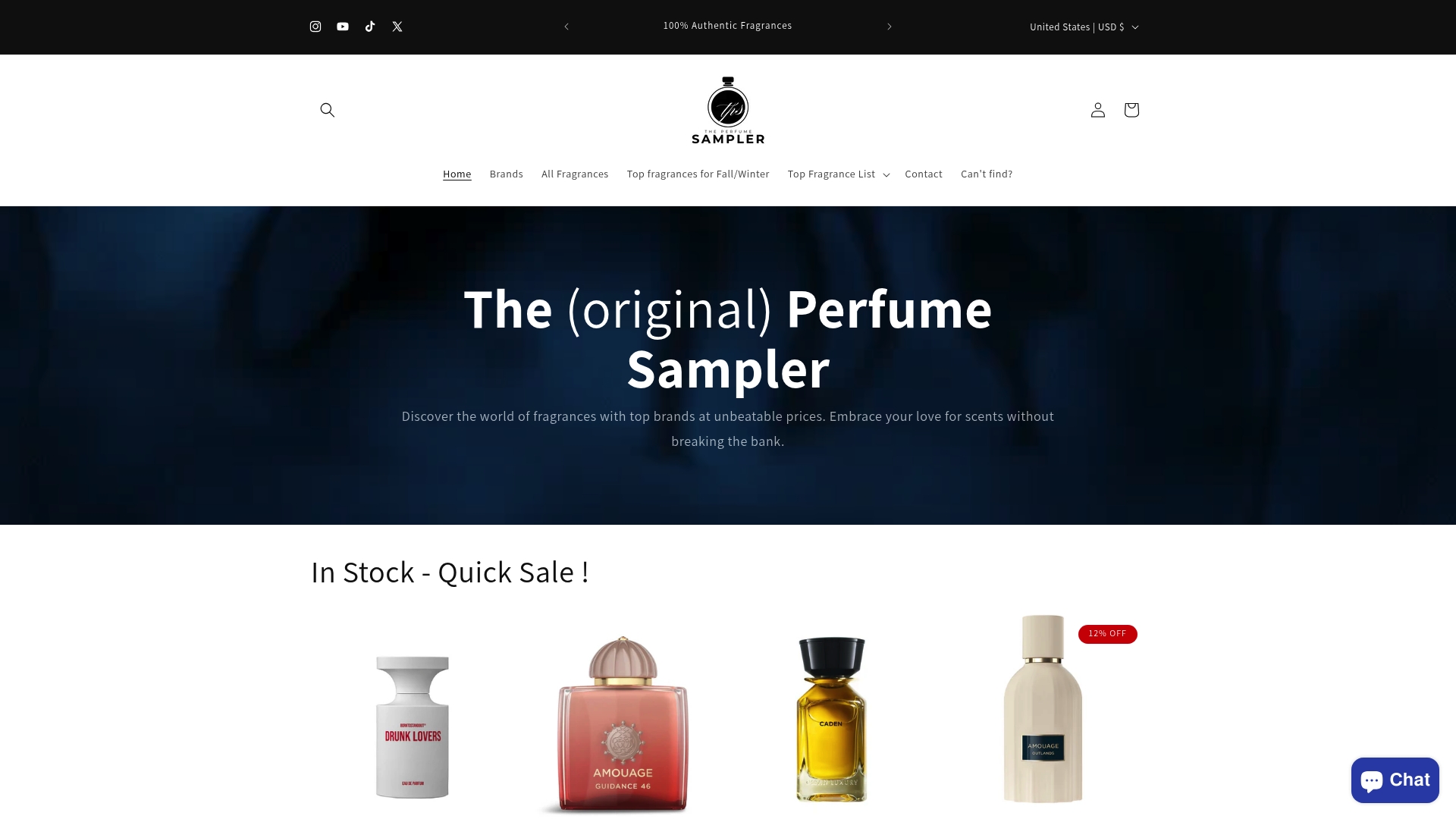
The practical advantage over a full bottle is straightforward: you carry only what you need, you can rotate between two or three scents without weight or bulk, and you can try a fragrance properly across a full day before deciding whether to invest in a full bottle. All fragrances are 100% authentic, sourced directly, and available for both men and women across niche and designer categories.
Browse the decant range at Theperfumesampler to find a travel-ready size that fits your routine.
Useful sources and further reading
- Diptyque: how to apply fragrance — shoulder-to-shoulder misting technique and pulse-point advice from the brand directly
- Cosmopolitan: the right way to apply perfume — concentration guide and clothing application advice
- Theperfumesampler: best decanting methods — practical refill and decant instructions
- Theperfumesampler: why layering scents is popular — step-by-step layering advice for extending wear
- Theperfumesampler: cost-saving perfume hacks — budget-conscious strategies for maintaining scent presence with decants