
Guide to refreshing work fragrances for professionals
TL;DR:
- Choosing subtle, skin-like scent profiles like citrus, light florals, or musks helps maintain professionalism without overwhelming coworkers.
- Discreet mid-day fragrance refreshing involves applying a single spray in private, using low-projection formats, and timing application correctly.
A guide to refreshing work fragrances is defined as a practical framework for maintaining a clean, office-appropriate scent throughout the workday without overwhelming colleagues or breaching workplace etiquette. Scent in a professional setting is not simply a personal preference. It functions as a quiet signal of self-awareness and attention to detail. The right fragrance, applied correctly and refreshed thoughtfully, reinforces your professional presence. This guide covers the best scent profiles for office wear, the most effective application techniques, the tools that make mid-day refreshing discreet, and the common mistakes that undermine even the best intentions.
Which fragrance types work best for refreshing at work?
The best scent profiles for office wear share one quality: they project close to the skin rather than filling a room. Preferred fragrance profiles in professional contexts include citrus, light florals, skin-like musks, and subtle woody notes. These categories read as fresh and clean without demanding attention.
Citrus-forward blends, such as those built around bergamot, lemon, or grapefruit, are particularly well-suited to the office. Citrus-forward blends improve focus and workplace performance, which means they benefit the wearer as much as they respect those nearby. Light florals, such as white tea, peony, or soft rose, carry a similar restraint. Skin musks project so close to the body that they function almost as a second skin, making them ideal for open-plan offices.
Heavy gourmand notes, intense spice, oud, and animalic accords are inappropriate for office refreshing. These scent families project strongly and cling to fabrics, which creates problems in shared spaces. The same applies to very sweet vanilla-heavy blends, which can become cloying in enclosed environments.
Concentration matters as much as the scent family itself. Eau de toilette or cologne concentrations offer lighter projection and make mid-day refreshing far more manageable than higher-concentration parfums. A lighter concentration gives you more control over how much scent you put into a shared space.
- Citrus: bergamot, lemon, grapefruit, yuzu
- Light florals: white tea, peony, soft rose, lily of the valley
- Skin musks: clean musk, ambrette, white musk
- Subtle woods: cedarwood, sandalwood, vetiver (used lightly)
- Avoid: oud, heavy spice, gourmand vanilla, animalic accords
Pro Tip: If you are unsure whether a fragrance is office-appropriate, apply it in the morning and ask a trusted colleague for honest feedback after an hour. Their reaction tells you more than any nose test at a counter.
How to refresh your scent discreetly during the workday
Discreet mid-day refreshing follows a clear set of principles. The most important is the proximity rule: your scent should only be noticeable to someone within close conversational distance, not perceptible across a room or corridor. This single principle governs every decision about how, where, and when to refresh.
The right timing and location
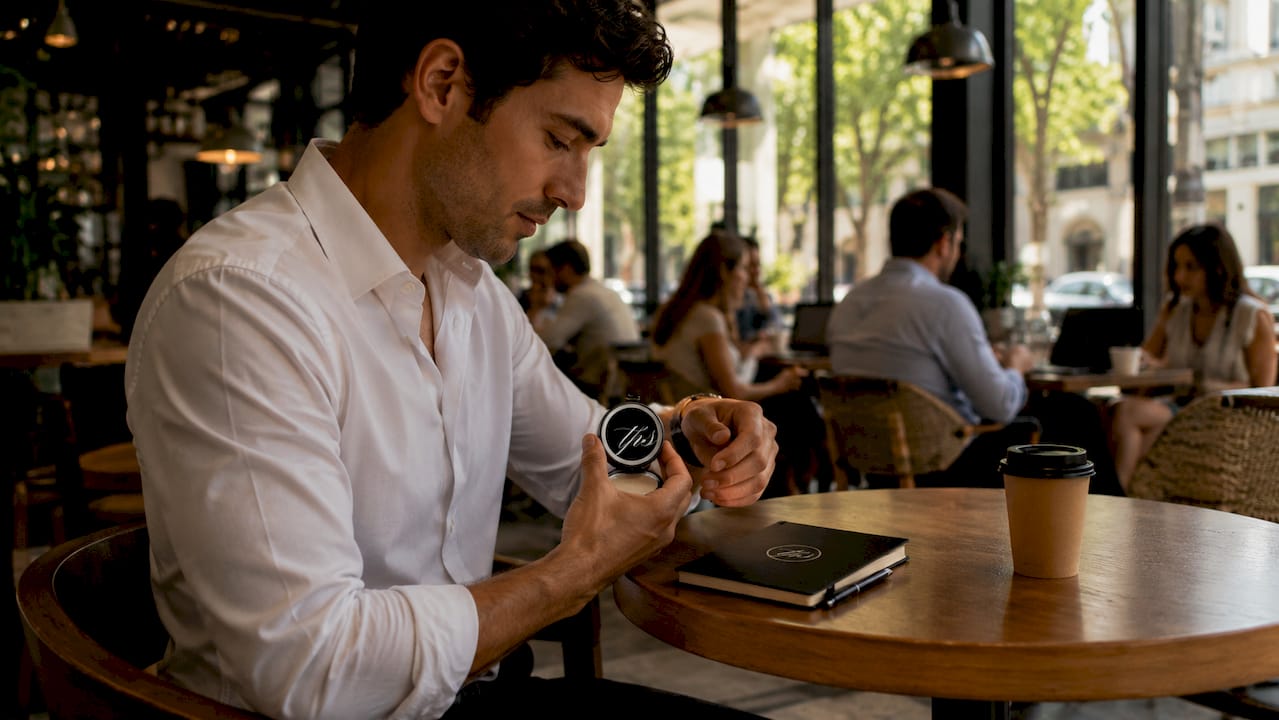
Applying fragrance 30 minutes before arrival allows the scent to settle into a subtle trail rather than arriving as a fresh blast. Any mid-day refresh should happen in a private space, specifically a restroom or an empty corridor, never at your desk or in a meeting room. Applying at your desk sends scent molecules directly into shared air and gives colleagues no option to move away.
Step-by-step approach to mid-day refreshing
- Step away from shared spaces before applying anything.
- Use one spray maximum, directed at a pulse point such as the inner wrist or the base of the throat.
- Do not rub the wrist together after spraying. Rubbing breaks down the top notes and distorts the scent.
- Wait 30 seconds before returning to shared areas, allowing the initial alcohol burst to dissipate.
- Assess the result after five minutes. If you can still smell it clearly on yourself, you have applied enough.
Tools that make refreshing easier
| Format | Projection level | Best use case |
|---|---|---|
| Eau de toilette spray | Moderate | Morning application and very occasional refresh |
| Fragrance solid | Low | Discreet mid-day touch-up at the desk or in a meeting |
| Hair mist | Low to moderate | Refreshing without adding to skin concentration |
| Scented lotion | Low | Layering base that extends morning scent gently |
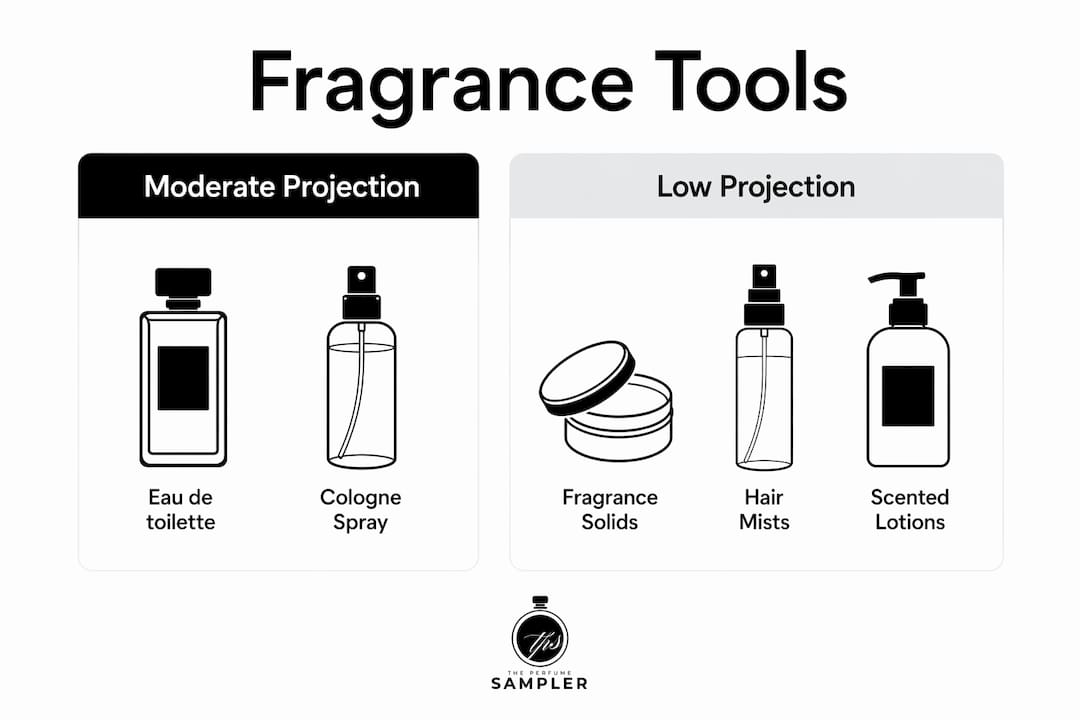
Fragrance solids, hair mists, and scented lotions offer lower projection than sprays and complement the initial application without overwhelming the workspace. A fragrance solid in a tin is also the most portable and least intrusive option for carrying in a bag or desk drawer.
Pro Tip: A matching scented lotion applied before your morning spray extends the scent’s life significantly. This reduces the need to refresh at all, which is always the better outcome in an office setting.
How to avoid scent fatigue and common refreshing mistakes
Scent fatigue, also called olfactory adaptation, is the single biggest cause of over-application in professional settings. Fragrance fatigue causes people to stop perceiving their own scent, which leads to repeated reapplication and a scent trail that colleagues find overpowering. The wearer genuinely cannot detect the problem, which makes it particularly difficult to self-correct.
The practical fix is straightforward. Switch to a lower-projection format for any mid-day refresh rather than reaching for the same spray bottle used in the morning. A fragrance solid or a single application of scented lotion delivers a small amount of scent without compounding what is already present on the skin and fabric.
Overapplication causes scent molecules to cling to fabrics and persist long after leaving the office, creating a counterproductive sensory overload for others. The solution is not to refresh less often but to refresh with less product each time.
Common mistakes to avoid:
- Applying at your desk. This traps scent in shared air and gives colleagues no escape route.
- Using the same spray bottle for morning and mid-day application. Sprays deliver too much product for a refresh. Use a solid or lotion instead.
- Scent layering without care. Combining multiple fragranced products, such as a scented deodorant, a body lotion, and a perfume, can amplify total scent strength beyond what any single product would suggest.
- Ignoring office fragrance policies. Some workplaces have fragrance-free policies in place to protect colleagues with sensitivities. Refreshing in this context is not appropriate regardless of how subtle the scent.
How does fragrance refresh affect workplace atmosphere and professionalism?
Fragrance in a professional setting carries effects beyond the individual. Companies increasingly address fragrance sensitivities by encouraging subtle use and, in some cases, enforcing fragrance-free policies in enclosed spaces. This reflects a broader shift in how workplaces think about shared air quality and colleague comfort.
Fragrance can also function as a subtle personal branding tool, enhancing confidence and perceived competence when used thoughtfully. A consistent, clean scent becomes part of how colleagues and clients remember you. That association is built over time and is easily undermined by a single instance of over-application.
The table below summarises the key effects of thoughtful versus careless fragrance refreshing in a shared office environment.
| Factor | Thoughtful refreshing | Careless refreshing |
|---|---|---|
| Colleague comfort | Neutral to positive | Negative, potential complaints |
| Air quality | Unaffected | Degraded in enclosed spaces |
| Personal impression | Polished, self-aware | Inconsiderate, oblivious |
| Productivity impact | Neutral to positive | Distraction, headaches reported |
| Policy compliance | Maintained | Risk of formal complaint |
Workplace fragrance presence must balance personal expression with respect for colleagues’ various scent sensitivities. The professionals who get this right treat fragrance the same way they treat volume in a shared space: present enough to be noticed when appropriate, absent enough to never be a problem.
A well-chosen office scent also connects to the broader picture of professional presentation. Pairing your fragrance choices with a considered everyday wardrobe reinforces the same message: that you pay attention to detail without making a performance of it.
Key takeaways
The most effective approach to refreshing work fragrances is to choose low-projection scent profiles, apply minimally at pulse points, and use solid or lotion formats for any mid-day touch-up.
| Point | Details |
|---|---|
| Choose the right scent family | Citrus, light florals, and skin musks project subtly and suit shared office environments. |
| Apply before arrival | Spray 30 minutes before reaching the office so the scent settles before you interact with colleagues. |
| Use the proximity rule | Your scent should only be detectable within close conversational distance, not across a room. |
| Refresh with lower-projection formats | Use fragrance solids or scented lotions for mid-day touch-ups rather than a second spray. |
| Recognise scent fatigue | If you cannot smell your own fragrance, do not reapply. Ask a trusted colleague for an honest assessment. |
Scent as a professional habit, not an afterthought
by Rupesh
I have been paying close attention to fragrance in professional settings for years, and the pattern I see most often is not over-application. It is under-thinking. Professionals who struggle with office fragrance are usually wearing something they love at home and applying it the same way. The office is a different environment entirely.
My own habit is straightforward. I apply one spray of an eau de toilette to my wrist before leaving the house, never after arriving. I carry a fragrance solid for any mid-day refresh, and I use it in the restroom, not at my desk. That is the entire system. It takes no more thought than checking your collar before a meeting.
The scents I return to most often for work are clean musks and light cedarwood blends. They read as polished without announcing themselves. Colleagues rarely comment on them directly, but the absence of complaints is itself the goal. The best workplace fragrances are the ones that support your presence rather than compete with it.
My honest recommendation is to treat your work fragrance as a separate category from your personal collection. What you wear on a weekend is irrelevant to what belongs in an office. Sample widely, test in real conditions, and build a small rotation of two or three scents you know work in professional settings. That rotation is worth more than a shelf of bottles you are not confident wearing at work.
— Rupesh
Try before you commit: Theperfumesampler and office-ready scents
Finding the right professional fragrance is easier when you are not committing to a full bottle on the basis of a brief counter test.
Theperfumesampler offers fragrance decants in 2ml, 3ml, 5ml, and 10ml sizes, covering a wide range of niche and designer options suited to professional wear. You can test a citrus, a clean musk, and a soft woody in real office conditions before deciding which earns a permanent place in your routine. The benefits of decants are straightforward: lower cost, no commitment, and the ability to build a considered collection rather than guessing. All products are 100% authentic. For professionals who want a proven office-appropriate option, the BOSS Bottled Absolu Parfum Intense is available in sample sizes through Theperfumesampler.
FAQ
What is the best fragrance concentration for office wear?
Eau de toilette or cologne concentrations are best for office wear. They project less strongly than eau de parfum or parfum, making mid-day refreshing easier to control.
How often should you refresh your fragrance at work?
One morning application is sufficient for most office environments. If a mid-day refresh is needed, use a fragrance solid or scented lotion rather than a second spray.
What causes over-application of fragrance at work?
Olfactory adaptation, commonly called scent fatigue, causes people to stop perceiving their own scent. This leads to repeated reapplication and a scent level that colleagues find overwhelming.
Where should you apply fragrance before going to the office?
Apply to pulse points such as the inner wrist or base of the throat, approximately 30 minutes before arriving. This allows the scent to settle into a subtle trail rather than projecting as a fresh blast.
Are fragrance-free office policies common?
Fragrance-free policies are increasingly common in enclosed office environments, particularly where colleagues report scent sensitivities. Always check your workplace policy before refreshing your fragrance during the day.