
How to Choose Perfume Online: A Step-by-Step Guide
The safest way to choose perfume online is to narrow your options by scent family and notes, order small samples, wear them on skin, and buy the full bottle only after a scent has proved itself. Check the seller before you pay. This guide covers each step, in order.
TL;DR
- Start from scents you already like. Note their families and notes, then look for perfumes with similar profiles.
- Read reviews that describe notes and how they smell. Skip vague praise.
- Order samples or decants and test them on skin over a full day. Decants in 2ml, 3ml, 5ml and 10ml cost far less than a bottle.
- Check the retailer: contact details, return policy, secure payment and a fair price.
- Buy the full bottle only when you still like the scent after several wears.
Table of Contents
- Why buying perfume online works
- Step 1: Start with what you already like
- Step 2: Learn the scent families
- Step 3: Read notes the right way
- Step 4: Understand concentration
- Step 5: Use reviews, quizzes and finders well
- Step 6: Test samples on skin
- Step 7: Pick the right sample size
- Step 8: Check the retailer before you pay
- Perspective: why we start with samples
- Step 9: Buy the full bottle with confidence
- Shop samples and bottles with us
- FAQ
- Sources
Why buying perfume online works
You cannot smell a screen. That is the main worry. It is also the reason many people now prefer to shop this way.
One perfume expert quoted by Who What Wear says buying online is arguably better than buying in a store. You can read about a scent in quiet. You can look up the perfumer. You can try samples at your own pace, away from other customers’ fragrances.
The method below removes the guesswork. It works for a first fragrance, a replacement for a discontinued favourite or a gift.
Step 1: Start with what you already like
Do not start with a bottle. Start with a list.
Write down the perfumes you have worn and enjoyed. Add scents you notice on other people and like. Then look for patterns.
Business Insider quotes Brianna Arps, founder of Moodeaux. She suggests noting the categories you enjoy, such as gourmands, florals or citrus. Then narrow to specific notes. She also advises keeping a running list of the scents you try, so you can see which notes keep appearing.
The Perfume Society’s Suzy Nightingale, quoted in Woman & Home, adds two useful checks. Compare the top, heart and base notes of perfumes you love. Then find out who the perfumer is. Perfumers often return to similar characteristics across the scents they compose.
A simple notebook or phone note is enough. Use three columns: perfume, notes you liked, notes you did not.
Step 2: Learn the scent families
Scent families give you a shortcut. Most retailers sort fragrances this way. The common groups are:
- Floral: rose, jasmine, peony, orange blossom.
- Fresh: citrus, aquatic, green and clean notes.
- Fruity: apple, pear, berries, tropical fruit.
- Woody: cedar, sandalwood, vetiver.
- Oriental or amber: vanilla, resin, spice, warm musk.
- Gourmand: sweet, edible notes such as caramel, coffee or almond.
Pick the two families you reach for most. Browse only those at first. This cuts thousands of options to a manageable few dozen.
Step 3: Read notes the right way
Notes are listed as top, heart and base. The top notes come first and fade first. The base notes stay longest. Our guide to the role of top notes explains the first minutes of a scent in more detail.
Do not treat the pyramid as a strict schedule. Perfumer Gilbert, quoted in Bustle, calls it an oversimplification. You smell the whole scent first. Over time the top fades, then the heart, until the base remains.

A note list also cannot tell you everything. The expert in the Who What Wear piece warns against choosing by raw materials alone. He compares it to two cakes with the same ingredients made by different bakers. Use notes to shortlist. Use your nose to decide.
Step 4: Understand concentration
Concentration is the share of fragrance oil in the bottle. It affects strength and how long a scent lasts.
Best Buy’s fragrance guide gives these typical ranges:
| Type | Oil concentration | Typical wear |
|---|---|---|
| Parfum | 20-30% | All day, with base notes that cling to fabric |
| Eau de parfum | 15-20% | About 5 to 8 hours |
| Eau de toilette | 5-15% | A few hours to all day |
| Eau de cologne | 2-5% | Light, fades within the hour |
| Eau fraiche | 1-3% | Brief wear, suited to hot weather |
Treat these as guides. Longevity depends on the formula and on your skin too. Our article on concentration versus longevity covers what really makes a perfume last.
Longevity is also not everything. Carlos Huber of Arquiste Parfumeur, quoted in Business Insider, calls it a little overrated, since you can reapply. He suggests asking how a scent makes you feel and where it takes you.
Step 5: Use reviews, quizzes and finders well
Online tools help you shortlist. They do not replace testing.
Quizzes and finders. Many fragrance sites offer a short quiz or a tool that suggests scents similar to ones you already like. Use them to generate names to try. Do not treat the result as a final answer.
Reviews. Good reviews describe what the reviewer smelled. Maiya Nicole, founder of Black Girls Smell Good, tells Bustle to look for specific notes and how they came across. Her example is a rose that read as a little medicinal. A review that only says it is pretty tells you nothing.
When you read reviews, look for:
- the notes the reviewer names;
- the season or setting they wore it in;
- how long it lasted on them;
- reviewers whose taste matches yours.
If you want to judge which review platforms can be relied on, this overview of beauty review sites looks at how editors vet content.
Step 6: Test samples on skin
This is the step that matters most. A scent on a screen, a card or a shop blotter is not the scent on you.
Harper’s Bazaar quotes a fragrance expert who names the most common mistake. People smell a blotter, say they love it, and walk away. On skin it smells different or changes over time. British Vogue makes a related point: at-home sample sets let a scent react with your natural oils, and many fragrances smell completely different on different people.
The Guardian’s fragrance adviser says to test scents on skin, not on a blotter. She also says to watch for changes in character, intensity and longevity.

Samples make this affordable. Our posts on skin versus paper testing and testing on skin or clothes with a 2ml decant show how to do it.
A simple testing routine
- Test one to four scents per session. Romano Ricci of Juliette Has a Gun, quoted in Business Insider, suggests three to four scents with about 10 minutes between sniffs. This avoids olfactory fatigue.
- Spray on clean skin. The inside of the wrist or forearm works well. Arps suggests smelling clean skin between scents.
- Smell at intervals. Check after 10 minutes, one hour, four hours and at the end of the day.
- Judge the whole day. Huber says that if you do not like a scent within an hour, it is not meant to be your signature scent.
- Do not trust a nose that has adapted. Catalani, quoted in The Guardian, notes that losing the smell after a few hours does not mean it does not suit you. Your nose adapts.
- Wear it more than once. A scent you like on day one should still please you on day three.
- Record your notes. Add the result to your list.
Our five-step sample testing routine covers the same ground in a printable format.
Step 7: Pick the right sample size
Sample sizes let you match the test to your budget and your level of interest.
- 2ml: enough for a few wears. Good for a first look at a scent.
- 3ml: a little more room for repeat testing across different days and weather.
- 5ml: suits a scent you are fairly sure about and want to live with.
- 10ml: close to a travel size. Useful for a favourite you want to wear for weeks before buying the bottle.
We sell decants in all four sizes. Our post on why 2 to 10ml decants save money explains the reasoning. You can also read about the benefits of sampling.
Some brands also sell hair mists or body sprays in the same scent. The Guardian notes these can be a much cheaper way to try a scent before the full perfume.
Step 8: Check the retailer before you pay
Choosing the scent is half the job. The other half is choosing where to buy it. Fake and mislabelled perfume exists, and a few checks reduce the risk.
Check the basics
The FTC’s guidance on buying online tells shoppers to check:
- the seller’s terms, shipping fees and return policy;
- seller ratings and recent buyer comments;
- whether the listing includes contact information;
- the item’s photos and description.
It also recommends paying by credit card, which carries legal protections if something goes wrong. Gift cards, cash reload cards and cryptocurrency generally cannot be recovered once sent. It advises against wire transfers. Keep track of return and refund deadlines. Save your messages with the seller.
Watch for red flags
The Better Business Bureau lists signs to leave a site:
- the address bar shows a different domain from the one you clicked;
- spelling errors or broken links;
- constant pop-ups and pushy ads;
- requests for a Social Security number or unnecessary financial details;
- a seller that only takes wire transfers, cryptocurrency or gift cards.
It also advises confirming the site uses https with a padlock at checkout, and reading the privacy, return and refund policies first.
Check the price and the product
Consumer Reports says the safest approach is to shop from a trusted site you go to directly, or from the brand itself. On some marketplaces you can be steered to a third-party vendor, which raises the risk of a fake. It also says even a small discount can be a red flag, because some counterfeiters now charge almost the real price.
Business Insider’s collector interview points to packaging. Loose cellophane, cheap-looking boxes and low-quality labels are telltale signs of a counterfeit. It recommends comparing label art and lettering with the manufacturer’s website, and looking for clear photos of the bottle and batch code. It also advises caution with secondhand sellers who hold a suspiciously large stock of expensive bottles.
Perspective: why we start with samples
We run a decant business, so our view is simple. A perfume should be tested before it is bought.
A full bottle is a commitment. A 2ml, 3ml, 5ml or 10ml decant is a trial. It lets you wear a scent through a work day, a dinner and a warm afternoon. You learn how it behaves on your skin, not on a card.
This suits every kind of buyer. Students can try several scents without spending bottle money. Professionals can find a scent that fits the office. Enthusiasts and reviewers can explore niche and designer houses without buying a bottle of each.
We guarantee the authenticity of every fragrance we sell. We are rated Excellent on Trustpilot. We offer discounted shipping and free shipping thresholds, and we ship worldwide.
Start small. Buy the bottle when you already know you will use it.
Rupesh
Step 9: Buy the full bottle with confidence
By now you have a shortlist, a tested favourite and a trusted seller. Before you buy the bottle, run a last check:
- You wore the sample on at least two or three different days.
- You still liked it in the dry-down, the later stage after the top notes fade.
- The scent suits the seasons and settings you will wear it in.
- The listing shows the brand name, fragrance name, concentration and size clearly, with clear photos.
- You know the shipping cost and the return terms.
If you want to compare online and in-store sampling, our post on avoiding buyer’s regret covers both.
Shop samples and bottles with us
We sell niche and designer fragrance samples in 2ml, 3ml, 5ml and 10ml sizes. We also sell full bottles of high-end designer fragrances, for men and women. All fragrances carry our authenticity guarantee.
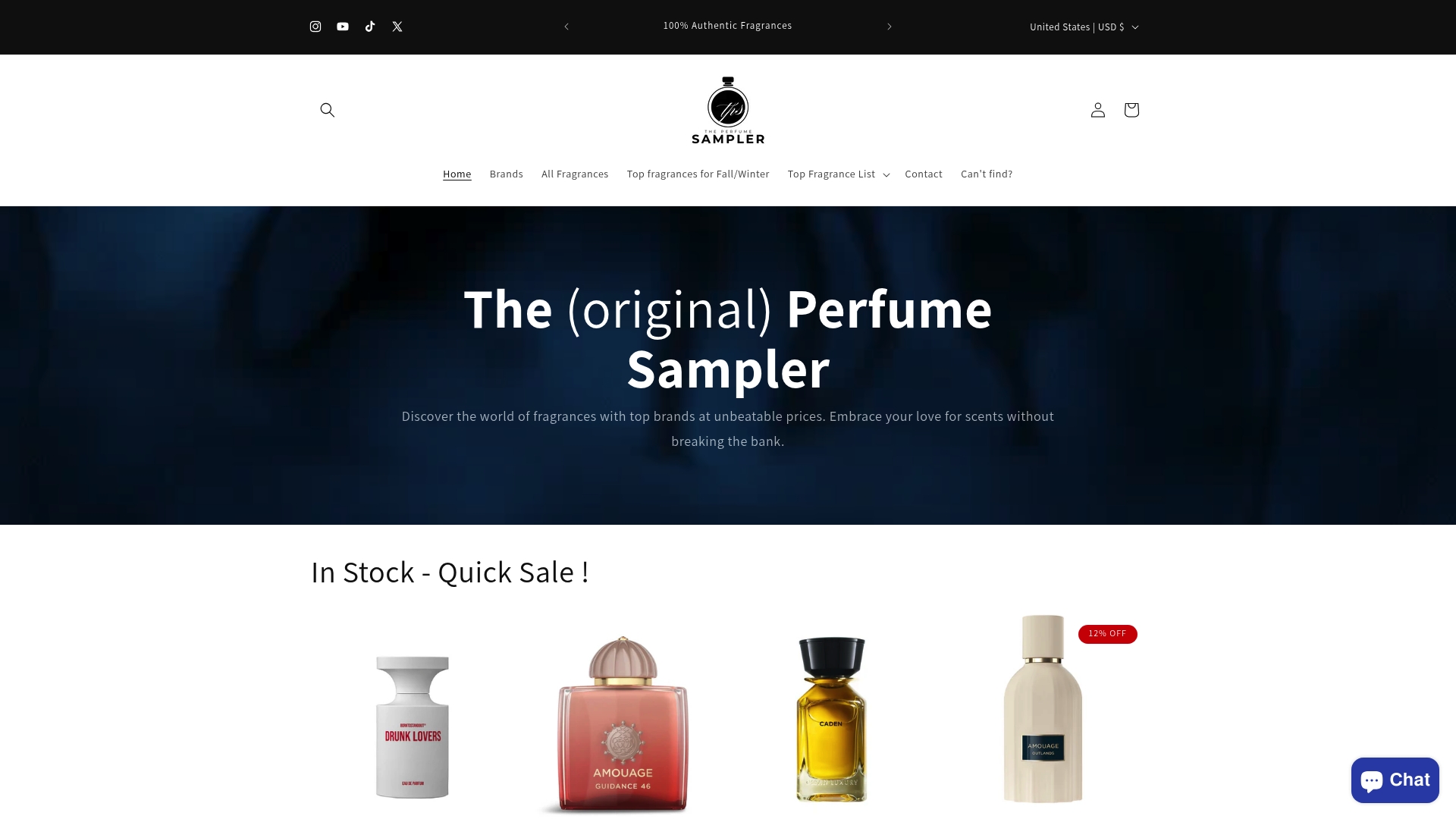
Browse all fragrances to pick samples. When a scent has earned its place, see our full bottles. Buying for someone else? Our guide to giftable perfume samples shows how to start with decants.
FAQ
Is it better to buy perfume online or in store?
Both work, but online gives you time. You can research notes and perfumers in quiet and test samples at home. One expert quoted by Who What Wear says it is arguably better than a store. The key is to sample first and buy from a seller you have checked.
What is the 5 spray rule?
It is a popular guideline for how much perfume to apply, usually around five sprays in total. We have not found an official standard for it, so treat it as a starting point. Begin with fewer sprays and adjust to the strength of the formula and the setting.
How do I know which perfume suits me?
Start with the scents you already like and note their families and notes. Test shortlisted scents on skin and wear them through a full day. Ask how the scent makes you feel, and see whether you still like it after several wears.
How can I tell whether an online perfume seller is trustworthy?
Check for contact details, clear return and refund policies, recent buyer reviews and a secure https checkout. Pay by credit card where possible. Be wary of prices far below other retailers and of listings with poor photos or spelling errors.
How many perfumes should I test at once?
Three to four is a sensible limit, with about 10 minutes between each. More than that and your nose tires. Wear the best one for a full day before deciding.
Sources
- Who What Wear: How to Buy Perfume Online
- Business Insider: How to Figure Out Which Fragrance Is Best for You
- Woman & Home: How to buy fragrance online
- Bustle: How To Buy Perfume Online
- Best Buy: Fragrance buying guide
- Harper’s Bazaar: How To Buy Perfume Online
- British Vogue: How To Choose The Perfect Fragrance
- The Guardian: How do I know if a perfume is going to suit me?
- FTC: Buying From an Online Marketplace
- BBB: How to shop smart online
- Consumer Reports: How to Avoid Buying Counterfeit Products Online
- Business Insider: Red Flags When Buying Perfume