

The role of top notes in perfume composition
TL;DR:
- Top notes are the initial, volatile scents that create an immediate impression and fade within 15 to 30 minutes. They are primarily composed of light compounds like citrus oils, herbs, and light spices, influencing both perception and purchase decisions swiftly. The full fragrance experience unfolds through heart and base notes, which develop over hours and define the scent’s true character and lasting power.
Top notes are defined as the first scents you perceive immediately after applying a fragrance, lasting between 15 and 30 minutes before fading to reveal the heart and base. Their role is precise: to capture attention, create an immediate impression, and set the opening tone of the entire scent experience. Ingredients like bergamot, lemon, and pink pepper are chosen specifically for this purpose. The role of top notes extends beyond the wearer’s experience into retail environments, where consumer decisions form) within the first 5 to 15 minutes of smelling a fragrance. Understanding what top notes do, and what they do not do, is the foundation of intelligent fragrance appreciation.
Why do top notes evaporate so quickly?
Top notes are composed of low molecular weight compounds, typically in the range of 130 to 180 g/mol, which gives them a high vapour pressure and causes rapid evaporation from the skin. This is the chemical reason they disappear within 15 minutes to 2 hours depending on concentration and the specific materials used. The physical chemistry principle at work here is the same one described by the Clausius-Clapeyron equation, which models how vapour pressure increases with temperature. In plain terms, lighter molecules escape into the air faster, which is exactly what top note ingredients are designed to do.
Heart notes, by contrast, have molecular weights in the range of 150 to 300 g/mol, and base notes are heavier still. This weight difference directly determines how long each layer lingers on your skin. Skin conditions also play a significant role. Warm or oily skin accelerates evaporation, meaning top notes can disappear even faster on some individuals than the standard timeframes suggest. This is why the same fragrance can smell noticeably different on two people within the first ten minutes of application.
| Note layer | Molecular weight (approx.) | Typical duration on skin |
|---|---|---|
| Top notes | 130 to 180 g/mol | 15 minutes to 2 hours |
| Heart notes | 150 to 300 g/mol | 2 to 4 hours |
| Base notes | 200 g/mol and above | 4 to 8 hours or more |
Pro Tip: Test a fragrance on your wrist and wait at least 30 minutes before forming any opinion. What you smell in the first two minutes is chemistry at its most volatile, not the fragrance at its most representative.
What ingredients are commonly used as top notes?
Perfumers select top note ingredients based on two criteria: high volatility and immediate olfactory impact. The most widely used materials fall into three categories.
- Citrus oils. Bergamot, lemon, grapefruit, and mandarin are the backbone of most top note compositions. Bergamot is the most common opening note in modern perfumery, valued for its bright, slightly floral citrus character and exceptional volatility. Lemon and grapefruit deliver sharper, crisper freshness, while mandarin adds a softer, sweeter quality.
- Light herbs. Basil, mint, and rosemary contribute green, clean facets that feel immediately alive on the skin. Mint in particular creates a cooling sensation that registers within seconds of application, making it highly effective as an opening statement.
- Light spices. Pink pepper is the standout here. It adds a sparkling, slightly peppery brightness that lifts a composition without the heaviness of deeper spices like cardamom or clove, which are better suited to heart or base positions.
- Aldehydes and light florals. Some classic fragrances, including Chanel No. 5, use synthetic aldehydes as top notes to create a distinctive, soapy effervescence in the opening seconds.
These ingredients are chosen because their high volatility and immediate presence make them ideal for the opening layer. A perfumer building a fragrance thinks of top notes the way a composer thinks of an opening chord: it must be arresting, clear, and set the right expectation for what follows.
How do top notes shape your experience and purchasing decisions?

The role of top notes in fragrance marketing is direct and well-documented. Top notes serve as a marketing hook) in retail environments, where purchasing decisions are frequently made within the first 5 to 15 minutes of smelling a fragrance. This is the window in which top notes dominate, which means the opening of a fragrance carries disproportionate commercial weight relative to its actual duration.
Their function in the wearer’s experience is equally specific. Top notes provide the sparkle and magical freshness that prevent a perfume from feeling flat or heavy from the first spray. Without a well-constructed opening, even a beautiful heart and base can feel inaccessible. The top notes act as an invitation.
However, this creates a well-known problem for buyers. Consider the following sequence of events that many fragrance enthusiasts have experienced:
- You spray a fragrance on a test strip in a shop.
- The opening is bright, fresh, and immediately appealing.
- You purchase the bottle based on that impression.
- At home, after 20 minutes, the top notes have faded and the fragrance smells entirely different on your skin.
“The paper tells you about the initial cycle, not the conversation unfolding after on skin.” Fragnatique
This is the core caution around top notes. Judging a fragrance solely on its opening is like judging a book by its cover. A striking top note can mask a thin or poorly constructed heart and base, which is a tactic more common in mass-market fragrances than in quality niche or designer compositions. The opening is an engineered burst designed for impact, not a complete representation of the scent.
How do top, heart, and base notes compare in a fragrance’s evolution?
Understanding the full structure of a fragrance requires seeing top, heart, and base notes as three distinct phases of a single, continuous experience. Each layer has a defined role, a different chemical profile, and a different relationship with time.
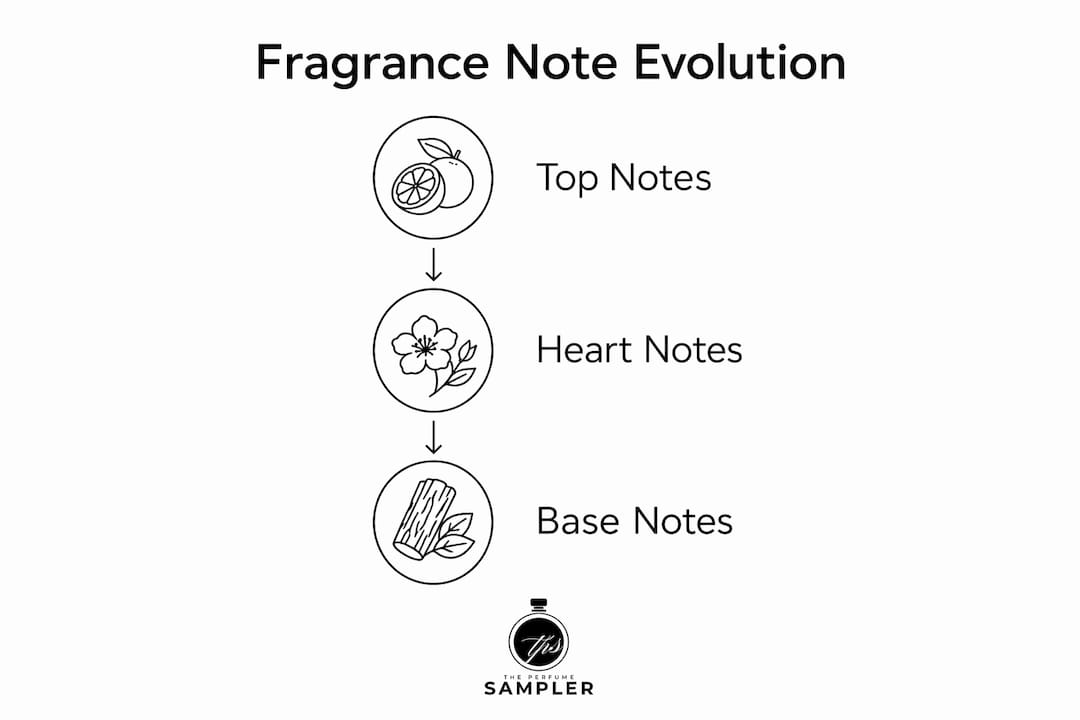
Top notes fade quickly, typically within 15 to 30 minutes. Heart notes, also called middle notes, emerge as the top notes dissipate and become dominant after approximately 20 to 30 minutes. They form the main identity of the fragrance, the character you associate with a scent after wearing it for an hour. Common heart note ingredients include rose, jasmine, geranium, and spices like cinnamon or nutmeg. These molecules are heavier and slower to evaporate, which is why they persist.
Base notes are the foundation. They provide depth, longevity, and the final impression a fragrance leaves on skin and fabric. Ingredients like sandalwood, vetiver, musk, and amber are typical base note materials. They can linger for 4 to 8 hours or longer, and they are what you smell on a shirt the morning after wearing a fragrance. You can read more about how these layers interact in this guide to fragrance note types.
The olfactory pyramid, the standard model used to describe this structure, is best understood as a sequence rather than a hierarchy. No layer is more important than another. The top notes create the opening, the heart notes carry the story, and the base notes provide the resolution. Skipping any stage in your assessment of a fragrance means you are only hearing part of the composition. For a detailed look at how this transition unfolds in real time, the guide on how fragrances evolve is worth reading before you make any purchasing decision.
Pro Tip: When testing a new fragrance, spray it on your wrist in the morning and check it again at midday and in the evening. You will experience all three layers in their natural sequence and form a far more accurate opinion of whether the scent suits you.
Key takeaways
Top notes define the opening of a fragrance but not its character; the full scent story only emerges after the heart and base notes develop over several hours.
| Point | Details |
|---|---|
| Top notes are fleeting by design | Low molecular weight (130 to 180 g/mol) causes evaporation within 15 minutes to 2 hours. |
| Bergamot leads modern openings | It is the most common top note ingredient due to its bright, volatile, and versatile profile. |
| Skin chemistry alters perception | Warm or oily skin accelerates evaporation, making top notes disappear faster on some individuals. |
| Purchasing decisions are top-note driven | Retail fragrance decisions form within 5 to 15 minutes, the window where top notes dominate. |
| Never judge on the opening alone | Heart and base notes define the true character; always test on skin and wait before deciding. |
Why I think the opening spray is the most misunderstood moment in perfumery
By Rupesh
Most people smell a fragrance for the first time and make a decision within 30 seconds. I understand why. The opening is designed to be arresting. Bergamot, pink pepper, lemon: these are ingredients chosen specifically to create an immediate reaction. The problem is that this reaction tells you almost nothing about what you are actually buying.
I have seen this pattern repeatedly. Someone dismisses a fragrance because the top notes feel too sharp or too generic, and they never wait to discover a genuinely beautiful rose or sandalwood heart underneath. The reverse also happens: a stunning citrus opening leads to a purchase, and the flat, thin base that follows is a disappointment that could have been avoided with ten more minutes of patience.
My honest advice is to treat the opening spray as an introduction, not a verdict. Spray on skin, not paper. Wait. Come back to it. The fragrances I have found most rewarding over the years were rarely the ones that impressed me in the first minute. They were the ones that kept revealing something new an hour later. Understanding the role of top notes means understanding their limits, and that knowledge makes you a far more confident and satisfied fragrance buyer. You can also use a structured approach to rank sample scents to make the process more systematic.
— Rupesh
Explore fragrances properly with Theperfumesampler
The only reliable way to judge a fragrance across all three note layers is to wear it for several hours. Theperfumesampler makes this straightforward. The range of fragrance decants covers 2ml, 3ml, 5ml, and 10ml sizes across high-end niche and designer fragrances, giving you the opportunity to experience the full evolution from top notes through to base without committing to a full bottle. For those already confident in their choice, full bottles of designer fragrances are available at accessible prices. Every product is 100% authentic. Testing properly before buying is the most practical decision you can make.
FAQ
How long do top notes last on skin?
Top notes typically last between 15 and 30 minutes, though they can persist up to 2 hours depending on the concentration of the fragrance and the specific ingredients used.
What are the most common top note ingredients?
Bergamot, lemon, grapefruit, mandarin, mint, basil, and pink pepper are the most frequently used top note materials. Bergamot is the most common opening note in modern perfumery.
Why should you not judge a perfume by its top notes alone?
Top notes are the most volatile and fleeting part of a fragrance. The true character of a perfume is defined by its heart and base notes, which only emerge after 20 to 30 minutes on skin.
Do top notes smell different on different people?
Yes. Skin temperature, oil levels, and hydration all affect how quickly top notes evaporate. On warm or oily skin, top notes can disappear noticeably faster than on cooler or drier skin.
What is the difference between top, heart, and base notes?
Top notes provide the opening impression and fade within 30 minutes. Heart notes form the main identity of the fragrance and last 2 to 4 hours. Base notes provide depth and longevity, often lasting 4 to 8 hours or more.
Recommended
- What affects perfume performance: fragrance guide – ThePerfumeSampler
- How fragrances evolve: master scent profiles before you buy – ThePerfumeSampler
- Understanding perfume accords: your guide to scent harmony – ThePerfumeSampler
- Types of perfume notes: Unlock fragrance layers and lasting power – ThePerfumeSampler