

Guide to personal scent style: build your scent wardrobe
TL;DR:
- Your personal scent style involves a rotation of fragrances tailored to role, mood, and skin chemistry.
- Testing different scent families on skin over a week helps identify which qualities resonate best with you.
Your personal scent style is not a single bottle you wear every day. It is a small, intentional rotation of fragrances chosen by role, mood, and skin chemistry. The fastest way to find it: pick three contrasting scent families, sample each on skin across a week, and note which two you reach for most. That pattern is your starting point.
- What you are building: a compact wardrobe of a handful of scents covering distinct roles (everyday, evening, weekend, seasonal, special occasion), not a collection of similar bottles.
- The 5-core-scenarios method: ScentVerdict’s wardrobe framework identifies five core slots as the sweet spot for a functional starter wardrobe.
- The 30/50/20 rule: Luxaro’s fragrance guide explains that a perfume’s life on skin breaks down roughly as 30% top notes, 50% middle notes, and 20% base notes. Knowing this stops you judging a scent too early.
- Low-risk testing: Theperfumesampler’s decants in 2ml, 3ml, 5ml, and 10ml sizes let you test multiple families before committing to a full bottle.
Table of Contents
- How fragrances are built: notes, concentration, and scent families
- How to map your preferences to scent families
- How to test fragrances properly on your skin
- How to build a small, intentional fragrance wardrobe
- Choosing by season, occasion, and self-expression
- A practical 4-step sampling plan you can follow this week
- Key takeaways
- Why sampling is the only sensible starting point
- Theperfumesampler: try before you commit
- Further reading and useful resources
How fragrances are built: notes, concentration, and scent families
Understanding how a perfume is constructed removes the guesswork from choosing one. Every fragrance has three layers, and they reveal themselves at different times.
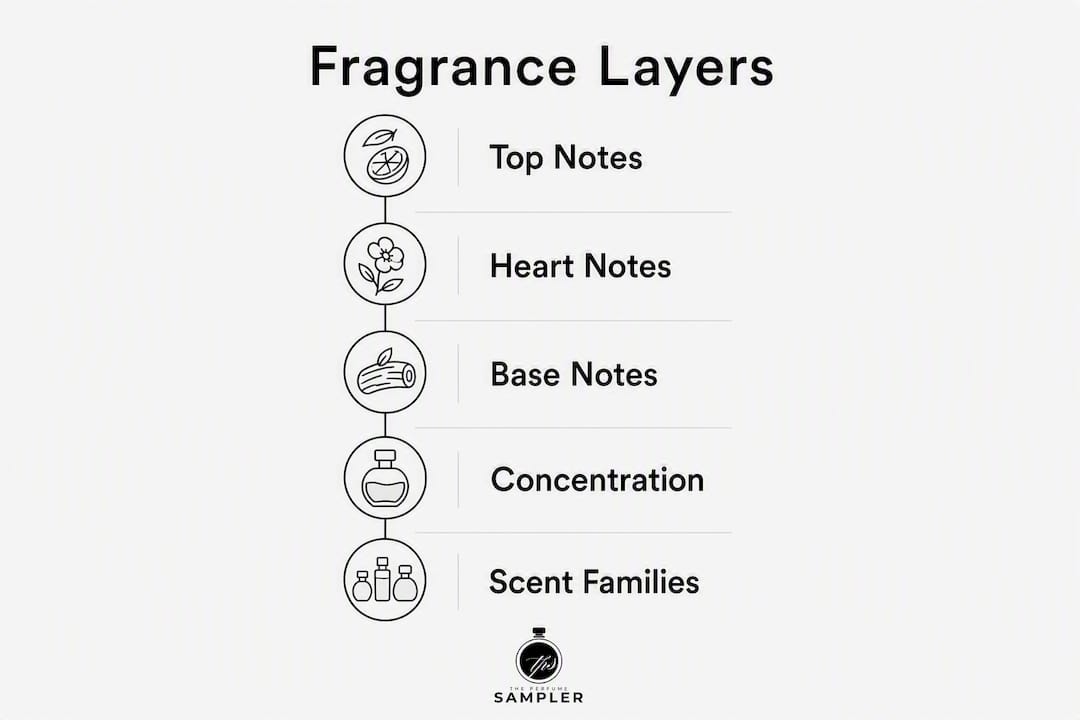
Top notes are what you smell in the first 5–15 minutes: bright, volatile ingredients such as citrus, bergamot, or aldehydes. They create the first impression but fade quickly. Middle (heart) notes form the core character of the fragrance and last 30–90 minutes. Rose, jasmine, lavender, and spices live here. Base notes are the foundation: woods, musks, resins, and vanilla that linger for hours and define how the scent settles on your skin.
The 30/50/20 rule gives you a realistic map of this journey. Roughly 30% of your experience is the top-note opening, 50% is the heart, and 20% is the dry-down. Never buy a fragrance based on the opening alone.
Concentration changes how a scent performs:
- EDT (Eau de Toilette): lighter, 5–15% concentration; suits daytime and warmer months.
- EDP (Eau de Parfum): richer, 15–20%; better projection and longevity for evenings or cooler weather.
- Parfum (Extrait): highest concentration, 20–40%; long-lasting, intimate projection, best for special occasions.
For a beginner’s overview of these terms, Theperfumesampler’s starter guide covers the basics clearly.
The major olfactive families are the categories perfumers use to group scents by character:
- Fresh/citrus: bergamot, lemon, grapefruit; clean and energising.
- Aromatic/green: lavender, herbs, cut grass; often used in fougère compositions.
- Floral: rose, jasmine, peony; ranges from powdery to lush.
- Woody: sandalwood, cedar, vetiver; warm and grounding.
- Amber/oriental: vanilla, benzoin, labdanum; rich, warm, and sensual.
- Gourmand: tonka bean, caramel, praline; edible-adjacent and cosy.
- Fougère: a classic accord of lavender, oakmoss, and coumarin; the backbone of many classic masculine fragrances.
How to map your preferences to scent families
Identifying which families resonate with you takes less time than most people expect. These exercises work in a single sitting or spread across a weekend.
-
Run a non-perfume smell audit. List five smells you genuinely love outside of fragrance: a bakery, the sea, cedar pencils, fresh linen, warm spices. Each maps to a family. Bakery and warm spices point to gourmand and amber/oriental. The sea maps to fresh/aquatic. Cedar points to woody. This audit gives you a starting shortlist without setting foot in a shop.
-
Use emotional anchors. Perfumers consistently advise choosing scents that make you feel a specific way rather than chasing trends. Ask yourself: which emotion do you want your everyday scent to carry? Confidence tends to align with woody and aromatic compositions. Comfort often points to gourmand and amber. Joy and energy pull towards fresh/citrus and floral.
-
Map personality prompts to families. If you gravitate towards calm, structured environments, try woody and aromatic. If you prefer warmth and intimacy, test amber/oriental and gourmand. If you are drawn to brightness and movement, start with fresh/citrus and green. For help aligning scent families with personality traits, Theperfumesampler’s personality profiling guide is a practical next step.
-
Build a shortlist of three families. Based on steps 1–3, write down your top three suspected families. These become the families you sample in the testing phase. Three is enough to reveal a clear pattern without overwhelming your nose.
-
Note aversions too. If you know you dislike heavy musks or sharp aldehydes, record that. Aversions narrow the field as effectively as preferences and save you from wasted samples.
How to test fragrances properly on your skin
Paper blotters are useful for a first orientation, but they tell you nothing about how a scent performs on your skin. Skin chemistry, pH, hydration, and even diet can shift a fragrance’s balance noticeably.
The correct test sequence:
- Spray or dab a blotter to get a rough sense of the family and opening character.
- Apply to one pulse point (inner wrist or inner elbow) and leave it completely undisturbed.
- Test no more than two or three scents in a single session to avoid olfactory fatigue.
- Return to the skin at three distinct intervals to judge each stage properly.
| Stage | Timing | What to assess |
|---|---|---|
| Top notes | 5–15 minutes | First impression; brightness, opening character |
| Heart notes | 30–90 minutes | True personality of the fragrance |
| Base notes (dry-down) | 4–8 hours | How it settles on your skin; longevity |
Do not rub the fragrance in. Rubbing breaks down the molecular structure and accelerates the top notes, giving you a distorted reading of the heart. Apply and leave it.

Reset your nose between samples by smelling the crook of your own elbow or a handful of coffee beans. Both neutralise scent fatigue effectively.
Skin chemistry variables to control: test fragrances on clean, unscented skin. Avoid applying over another fragrance or heavily scented body lotion. Hydration matters: dry skin tends to absorb fragrance faster and project less, which is why the same EDP can smell faint on one person and bold on another.
Pro Tip: Apply an unscented moisturiser to pulse points 10–15 minutes before testing. It gives the fragrance something to bind to and improves longevity on drier skin, giving you a more accurate read of how the scent will perform day-to-day.
Perfumers recommend reassessing your collection twice a year, because skin chemistry shifts with age, diet, and season. A scent that felt wrong two years ago may now be exactly right.
How to build a small, intentional fragrance wardrobe
The 5-core-scenarios method organises your wardrobe by role rather than by brand or bottle count. Each slot serves a distinct purpose, which prevents redundancy and gaps.
The five core roles:
- Everyday/office: low projection, clean and professional. Fresh/citrus, light woody, or aromatic compositions work well here. For detailed workday fragrance guidance, Theperfumesampler covers office-appropriate options specifically.
- Evening/confidence: richer projection, more complex. EDP or parfum concentration; amber, woody, or floral oriental.
- Casual/weekend: relaxed and approachable. Lighter gourmand, green, or fresh floral.
- Seasonal statement: a scent chosen specifically for the season’s demands. A bright aquatic for summer; a deep resinous amber for winter.
- Special occasion: your most distinctive or precious scent, worn sparingly.
Building by role rather than brand prevents the common mistake of owning five similar woody scents with no fresh option and no evening choice. Beginners are generally well served by aiming for five versatile scents spanning fresh, floral, woody, and amber families.
Wardrobe audit checklist:
- List every fragrance you currently own.
- Assign each one to a role from the five above.
- Identify any role with no scent assigned: that is your next purchase.
- Identify any role with three or more similar scents: that is where you are over-collecting.
Sample size guide before committing:
| Purpose | Recommended size | Why |
|---|---|---|
| First impression test | 2ml | Covers one or two full wears |
| Week-long evaluation | 5ml | Enough to test across occasions and moods |
| Pre-purchase confirmation | 10ml | Tests longevity, projection, and seasonal fit |
| Full bottle commitment | 30ml+ | Only after a 10ml confirms you love it |
Rotating between fragrances also prevents olfactory desensitisation: wearing the same scent daily causes your nose to stop registering it. A wardrobe of even three scents keeps your perception fresh.
Store all fragrances and decants away from heat, light, and humidity. A cool, dark cupboard away from radiators and windows is sufficient for most collections. Vogue’s fragrance wardrobe guide notes that some collectors refrigerate bottles for long-term preservation, though a stable room-temperature environment is adequate for regular-use decants.
Choosing by season, occasion, and self-expression
Season is one of the most practical filters when choosing which scent to reach for. In the UK, where temperatures shift considerably between July and January, the same EDP that feels perfect in October can become oppressive in a warm office in August.
Season rules of thumb:
- Spring/summer: lighter concentrations (EDT), fresh/citrus, aquatic, and green compositions. Heat amplifies projection, so reduce application to two sprays rather than four in warm months.
- Autumn/winter: richer concentrations (EDP, parfum), amber, woody, and gourmand families. Cold air suppresses projection, so these heavier compositions come into their own.
Occasion guidance:
- Close quarters (meetings, public transport, cinema): choose low-projection options. EDT concentration, fresh or light floral families.
- Evening and statement moments: richer compositions with more sillage are appropriate and expected.
Layering basics: applying a complementary scented body lotion or oil before your fragrance adds depth and longevity without requiring a second bottle. For a more deliberate approach, layering two fragrances from compatible families creates a personalised accord. A practical starting point: layer a woody base (applied first) with a fresh or floral top spray. The wood grounds the composition; the fresh note lifts it. For technical layering approaches, Maison Voyageur’s layering guide covers the method in detail.
Pro Tip: When layering two fragrances, apply the heavier, denser scent first and let it settle for two minutes before adding the lighter one. The lighter fragrance sits on top and leads the opening, while the denser one anchors the dry-down.
Emotional alignment: choosing a scent to support a desired state is more reliable than following trends. A woody aromatic for a high-stakes presentation. A soft gourmand for a relaxed evening. A sharp citrus to start a productive morning. Perfume’s role in self-expression goes beyond aesthetics; it is a consistent, low-effort signal of who you are that day.
A practical 4-step sampling plan you can follow this week
This plan takes seven days and requires six samples across three or four families.
-
Shortlist six samples. Choose two samples from each of your top three suspected families (identified in the mapping exercises above). Aim for contrast within each family: one lighter, one richer. Order 2ml or 3ml sizes for this stage.
-
Follow a structured wear protocol. Wear one sample per day on clean skin. Assign each sample to a context: two samples worn on workdays, two on a casual day, two in the evening. This tests each scent in the environment where it will actually be used, not just in a shop.
-
Keep a simple reaction log. For each sample, record three things after the dry-down:
- Comfort: does it feel like you, or does it feel like you are wearing someone else’s scent?
- Compliments: did anyone comment, or did you notice people responding positively?
- Desire to reapply: did you want more of it by midday, or were you relieved when it faded?
-
Make a decision on each sample. Three outcomes are possible: keep it and order a 5ml or 10ml decant for longer evaluation; swap it for a different option within the same family; or cross it off entirely. Building a sample library before committing to full bottles is the most reliable way to avoid buyer’s remorse. Experts consistently recommend discovery sets and decants to test performance over time and across different settings before spending on a full bottle.
Key takeaways
A personal scent style is built from five role-based fragrances tested on skin across multiple occasions, not chosen from a blotter in a shop.
| Point | Details |
|---|---|
| Build by role, not brand | Assign each scent a job: everyday, evening, weekend, seasonal, or special occasion. |
| Test on skin across the dry-down | Judge heart notes at 30–90 minutes and base notes at 4–8 hours; never decide on the opening alone. |
| Use samples to avoid waste | A 2ml covers one or two wears; a 10ml confirms fit before you commit to a full bottle. |
| Rotate to stay engaged | Wearing the same scent daily causes olfactory desensitisation; a small wardrobe keeps your nose fresh. |
| Theperfumesampler for sampling | Decants in 2ml, 3ml, 5ml, and 10ml let you test multiple families at low cost before buying full bottles. |
Why sampling is the only sensible starting point
The conventional advice to “find your signature scent” implies a single, permanent answer. In practice, the people who build the most satisfying fragrance wardrobes treat it as an ongoing process of elimination and refinement, not a one-time decision.
What most guides understate is how dramatically skin chemistry changes the outcome. A fragrance that smells rich and balanced on one person can turn flat or sharp on another within an hour. No amount of reading reviews or smelling blotters resolves that. The only reliable test is wearing the fragrance on your own skin, in your own life, across a full day.
This is precisely why the wardrobe-first approach, built on samples and decants, produces better results than buying full bottles based on hype or counter impressions. A 5ml decant of a fragrance you are unsure about costs a fraction of a full bottle and gives you enough product for five or six genuine wear tests. That is enough data to make a confident decision.
The signature scent idea is not wrong, but it is incomplete. A small, intentional wardrobe gives you a more resilient and interesting personal scent identity than any single bottle can.
Theperfumesampler: try before you commit
Buying a full bottle of a fragrance you have only smelled on a blotter is one of the most common and avoidable mistakes in fragrance. Theperfumesampler offers a direct solution: authentic niche and designer fragrance decants in 2ml, 3ml, 5ml, and 10ml sizes, so you can test properly before spending on a full bottle.
For the sampling plan above, a 2ml or 3ml covers your initial one-week test. A 5ml gives you enough for a full evaluation across occasions and seasons. A 10ml is the final confirmation step before committing to a 30ml or 100ml bottle. Every decant is 100% authentic, and full bottles are also available for fragrances you have already confirmed you love.
Find out why decants work and browse the full sample range at Theperfumesampler to start building your wardrobe this week.
Further reading and useful resources
- Build a Curated Artisanal Fragrance Wardrobe (Maison Voyageur) — niche and artisanal perspective on wardrobe curation.
- How to Find Your Signature Scent: Complete Guide (Theperfumesampler) — step-by-step guide to turning preferences into a personal scent identity.
- Building a Fragrance Sample Library: Your 2026 Guide (Theperfumesampler) — how to organise and grow a decant collection systematically.
- Build a Luxury Fragrance Collection with Confidence (Theperfumesampler) — advice on scaling from a starter wardrobe to a larger, more considered collection.