
Guide to profiling fragrance personalities: find your scent
TL;DR:
- Fragrance personality profiling helps individuals identify scent families, notes, and concentrations that suit their style and chemistry.
- Testing on skin and limiting sessions to three or four fragrances enhances accuracy and reveals true scent personalities.
Fragrance personality profiling is the practice of identifying which scent families, notes, and concentrations align with your personal style, mood, and body chemistry. The industry term for this process is “scent profiling,” and it sits at the intersection of personal expression and sensory preference. Most people buy fragrance based on top notes alone, which is the single biggest mistake in scent selection. A structured approach to scent profiling considers the full fragrance pyramid, your skin chemistry, and the occasions you dress for. Theperfumesampler offers decants from 2ml to 10ml precisely so you can test this process without committing to a full bottle.
What is the guide to profiling fragrance personalities?
Scent profiling starts with fragrance families, which act as a map to reduce the thousands of available perfumes to a manageable shortlist. Targeting your preferred scent family is the single most effective filter in any fragrance selection guide. Once you know your family, you can narrow further by notes, concentration, and occasion.
The five core scent families are:
- Fresh: Citrus, aquatic, and green notes. Conveys energy and cleanliness. Common notes include bergamot, lemon, and sea salt.
- Floral: Rose, jasmine, peony, and lily. Conveys femininity, romance, and softness. The most widely produced category in perfumery.
- Woody: Sandalwood, cedarwood, vetiver, and oud. Conveys warmth, depth, and confidence.
- Gourmand: Vanilla, caramel, tonka bean, and praline. Conveys comfort and indulgence. Popular in cooler months.
- Oriental: Amber, musk, spice, and resin. Conveys mystery and sensuality. Often overlaps with woody and gourmand families.
To identify your family, think about the scents you already enjoy in daily life. Do you gravitate towards fresh linen, baked goods, or pine forests? Those instinctive preferences map directly onto fragrance families. Cross-reference at least three familiar notes across candles, skincare, or food to confirm your preference before testing any perfume.
Pro Tip: Write down three scents you find pleasant in everyday life, such as coffee, clean cotton, or fresh grass. Match each to a scent family. The family that appears most often is your starting point.
How do you match scents to occasions and moods?
Selecting the right fragrance for an occasion depends on two technical properties: projection and sillage. Projection and sillage describe how far a scent disperses into the air and the trail it leaves behind. Both directly affect whether a fragrance is appropriate for a given setting.
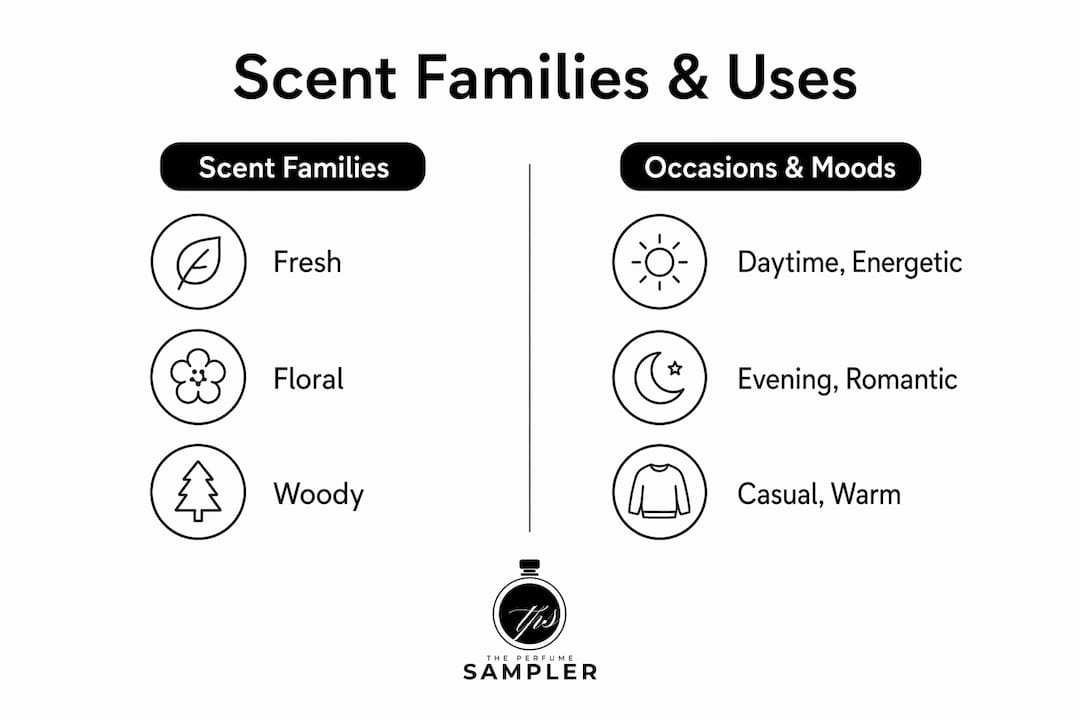
For daytime and professional environments, lighter fresh or soft floral scents work best. They project modestly and avoid overwhelming colleagues or fellow commuters. For evening wear or social events, woody and oriental families carry better in low light and cooler temperatures. A signature scent sits between these two poles: something versatile enough to wear across contexts without feeling out of place.
| Scent family | Best occasion | Mood it conveys |
|---|---|---|
| Fresh | Daytime, office, sport | Energetic, clean, approachable |
| Floral | Daytime, casual social | Romantic, soft, feminine |
| Woody | Evening, formal events | Confident, warm, grounded |
| Gourmand | Casual, autumn/winter | Comforting, playful, indulgent |
| Oriental | Evening, date nights | Sensual, mysterious, bold |
Scent also functions as an intentional mood signal. Wearing a citrus fresh fragrance before a morning meeting primes alertness. Choosing a warm amber in the evening signals a shift in pace. This idea of “scent intention” treats fragrance as an invisible accessory, an extension of how you present yourself rather than just a finishing touch.
Pro Tip: Before choosing a fragrance, decide the mood you want to project. Pick your scent family from the table above, then test within that family only. This removes indecision and keeps your selection purposeful.
How do fragrance concentrations affect your scent personality?
Fragrance concentration determines how long a scent lasts and how strongly it projects. Concentration affects longevity in measurable terms: Eau de Toilette lasts 3–5 hours, Eau de Parfum lasts 6–8 hours, and Parfum or Extrait lasts 8 hours or more. Choosing the wrong concentration for your lifestyle is as limiting as choosing the wrong scent family.
The three main concentration types are:
- Eau de Toilette (EDT): Lower concentration, lighter projection. Best for daytime, warm weather, and casual wear. Generally the most affordable option.
- Eau de Parfum (EDP): Mid-range concentration, balanced projection and longevity. Suits most occasions. The most popular format in niche and designer fragrance.
- Parfum / Extrait: Highest concentration, richest projection, longest wear. Best for evenings, special occasions, and cooler climates. Typically the most expensive format.
Concentration also shapes how a fragrance expresses itself on your skin. A woody EDP will read differently from the same woody accord in an EDT. The higher oil content in an EDP or Parfum allows base notes like sandalwood or oud to develop more fully. For guidance on choosing scent strength, consider your typical wear duration and the environments you move through daily.
Pro Tip: If you need a fragrance to last through a full working day and into an evening, choose an EDP rather than an EDT. You will use less product and get more consistent performance.
How to sample and test fragrances effectively
Sampling is the most reliable method for accurate scent profiling. Discovery sets cost significantly less than full bottles, making them the practical choice for testing multiple options before committing. Decants from Theperfumesampler in sizes of 2ml, 3ml, 5ml, and 10ml give you enough product to test a fragrance across different days and conditions.
Follow these steps for accurate testing:
- Test on skin, not paper. Paper strips show top notes only. Skin reveals how a fragrance interacts with your body chemistry across all three note stages.
- Apply to pulse points. Wrists, inner elbows, and the base of the neck are standard application points. Do not rub the wrists together. Rubbing breaks down the top notes prematurely.
- Wait at least 30 minutes. Testing on skin requires time for the scent to settle and reveal heart and base notes. Judging a fragrance in the first five minutes is judging only the top notes.
- Limit sessions to 3–4 scents. Olfactory fatigue sets in quickly. Space each test by approximately 10 minutes, and stop after four fragrances to preserve your ability to evaluate accurately.
- Track your impressions. Write a brief note after each test: the scent family, the dominant notes you detect, and how it made you feel. Review these notes after 24 hours.
| Testing method | Best for | Key limitation |
|---|---|---|
| Paper strip | Initial top note impression | Does not show heart or base notes |
| Skin test | Full scent development | Requires 30+ minutes per fragrance |
| Decant over multiple days | Real-life wear assessment | Requires advance planning |
| Discovery set | Comparing multiple families | Limited quantity per sample |
Perfumes develop in three phases: top notes evaporate within 15–30 minutes, heart notes emerge over the next hour, and base notes settle into the skin and last the longest. Evaluating all three phases gives you an accurate picture of the fragrance’s full personality. For a practical overview of sampling options, Theperfumesampler covers the main formats available.
Pro Tip: Keep a simple fragrance log with the name, family, and a one-line impression for each scent you test. After testing 8–10 fragrances, patterns in your preferences become clear and your profiling becomes faster.
What are the most common fragrance profiling mistakes?
The most frequent error in fragrance selection is buying based on top notes alone. Consumers regularly mistake the opening burst of a fragrance for its full character. Top notes last 15–30 minutes. The scent you wear all day is the base note, not the opening.
Common mistakes and how to correct them:
- Buying because of trends. A fragrance that suits someone else’s skin chemistry and lifestyle may not suit yours. Use trends as a starting point for discovery, not as a purchase decision.
- Testing too many scents at once. Limit sessions to 3–4 fragrances to avoid olfactory fatigue and inaccurate impressions.
- Ignoring skin chemistry. The same fragrance smells different on different people. Skin pH, diet, and hydration all affect how a scent develops. Always test on your own skin before buying.
- Skipping the base note evaluation. Wait several hours after application to assess the full scent personality. Base notes are where the fragrance’s true character lives.
- Layering incompatible families. Layering scents works best when you pair adjacent families, such as fresh with floral, or woody with oriental. Combining complex fragrances from opposite families creates confusion rather than depth.
Fragrance notes are marketing descriptions designed to evoke impressions, not literal ingredient lists. True formulas are proprietary blends of aromachemicals and naturals. Understanding this prevents over-reliance on note descriptions and encourages you to trust your own sensory response instead.
Pro Tip: Build a fragrance wardrobe of three to four scents rather than searching for one perfect fragrance. Assign each to a role: daytime, evening, weekend, and occasion. This approach removes pressure from any single choice and reflects how personal style actually works.
Key takeaways
Profiling your fragrance personality requires identifying your scent family, matching concentration to occasion, and testing systematically on skin across all three note phases.
| Point | Details |
|---|---|
| Start with scent families | Identify your preferred family from fresh, floral, woody, gourmand, or oriental before testing individual fragrances. |
| Match concentration to occasion | Choose EDT for daytime, EDP for all-day wear, and Parfum for evenings or special events. |
| Test on skin, not paper | Skin testing reveals heart and base notes, which define the fragrance’s true character. |
| Limit sessions to 3–4 scents | Olfactory fatigue distorts your perception after four fragrances; space tests by 10 minutes. |
| Build a fragrance wardrobe | Assign different scents to different roles rather than searching for one universal fragrance. |
Scent profiling: what I’ve learned from years of testing
The most underrated insight in fragrance profiling is that most people already know their scent family. They just have not connected the dots yet. The person who always buys vanilla-scented candles and orders coffee-flavoured desserts is a gourmand personality. The person who gravitates towards pine, rain, and fresh air is a fresh or woody type. The profiling work is largely about making conscious what is already instinctive.
What I have found consistently is that people abandon their instincts the moment they walk into a fragrance counter. The environment, the sales pressure, and the sheer volume of options override their natural preferences. Sampling outside that environment, at home, over multiple days, produces far more accurate and satisfying results.
The science behind scent profiling is real: body chemistry, skin pH, and even what you have eaten that day affect how a fragrance develops. But the art is simpler. Treat fragrance as you would any other element of personal style. You would not buy a coat without trying it on. You should not buy a fragrance without wearing it for a full day.
The well-being dimension of scent is also worth taking seriously. Fragrance affects mood, memory, and how others perceive you. A scent that aligns with your personality does not just smell good. It functions as a consistent, personal signal that reinforces your identity.
— Rupesh
How Theperfumesampler helps you find your fragrance personality
Knowing your scent profile is only useful if you can act on it without spending a fortune. Theperfumesampler exists precisely for this stage of the process.
Theperfumesampler offers 100% authentic fragrance decants in 2ml, 3ml, 5ml, and 10ml sizes, covering niche and designer fragrances at a fraction of full-bottle prices. You can test across multiple scent families, compare concentrations, and evaluate base notes over real wear time before committing to a purchase. The benefits of decants are straightforward: lower cost, accurate testing, and no wasted investment on a fragrance that does not suit your skin or lifestyle. For those building a fragrance wardrobe, Theperfumesampler also stocks full bottles of high-end designer fragrances when you are ready to commit.
FAQ
What is fragrance personality profiling?
Fragrance personality profiling is the process of identifying which scent families, notes, and concentrations align with your personal style and body chemistry. It uses scent family preferences, occasion matching, and systematic sampling to guide confident fragrance choices.
How many fragrances should I test in one session?
Limit testing to 3–4 fragrances per session and space each test by approximately 10 minutes to avoid olfactory fatigue, which distorts your ability to evaluate scents accurately.
Why does a fragrance smell different on my skin than in the bottle?
Skin chemistry, including pH levels and hydration, interacts with fragrance compounds and changes how a scent develops. The same fragrance can smell noticeably different on two people due to these individual chemical differences.
What is the difference between top, heart, and base notes?
Top notes are the opening impression and last 15–30 minutes. Heart notes emerge next and define the fragrance’s character. Base notes settle into the skin and represent the longest-lasting phase of the scent.
Is an Eau de Parfum better than an Eau de Toilette?
Neither is universally better. Eau de Parfum lasts 6–8 hours and suits all-day wear, while Eau de Toilette lasts 3–5 hours and works well for daytime or casual use. The right choice depends on your occasion and how long you need the fragrance to perform.