

How to optimise scent usage for home and personal wear
Optimise scent use by matching concentration to the occasion, preparing your skin or surface before application, and controlling delivery and placement. These three rules govern everything from how long a fragrance lasts on your wrist to how evenly a diffuser covers a living room.
- Choose concentration and notes for the occasion. Eau de parfum for evenings and cooler months; eau de toilette or body mist for daytime and warm weather. Start with two sprays and adjust.
- Prepare the skin or surface. Apply personal fragrance to slightly damp, moisturised skin straight after showering. For home devices, clean the reservoir and position the unit away from direct airflow before filling.
- Control delivery and placement. Spray pulse points from 10–15cm away. Place diffusers near natural air circulation, not directly in front of vents or in corners.
- Test before committing. Use blotters first, then a skin trial over two days. Theperfumesampler’s decants in 2ml, 3ml, 5ml and 10ml sizes let you test a fragrance through its full dry-down before buying a full bottle.
- Follow IFRA guidelines for shared spaces. The International Fragrance Association sets usage limits for fragrance ingredients. Staying within those limits matters most in offices, small rooms and households with sensitivities.
Key takeaways
Optimising scent use comes down to three decisions made consistently: choose the right concentration for the setting, apply or place the fragrance correctly, and test before committing to a full purchase.
| Point | Details |
|---|---|
| Match concentration to occasion | Use EDP for evenings and cooler months; EDT or body mist for daytime and warm settings. |
| Prepare skin before applying | Apply to slightly damp, moisturised skin after showering to extend wear and improve molecule binding. |
| Never rub after spraying | Rubbing breaks the fragrance structure and alters the dry-down; let it settle naturally on pulse points. |
| Place diffusers near air circulation | Avoid vents, corners and direct sunlight; position near doorways for even scent distribution. |
| Test with decants before buying | A 2ml–5ml decant from Theperfumesampler lets you confirm skin chemistry and longevity before committing to a full bottle. |
Table of Contents
- How do you choose a fragrance for the right occasion and season?
- How to apply personal fragrances so they last and evolve well
- Which home scenting devices suit your space?
- How do you get the best performance from a reed diffuser?
- Why do fragrances change over time, and what does that mean for you?
- What are the most common scent mistakes, and how do you fix them?
- How to test fragrances properly and store them to preserve quality
- A retailer’s perspective on the sampling path
- Sampling and decants: the practical, low-risk route to finding your scent
- Sources
How do you choose a fragrance for the right occasion and season?
Concentration is the first decision. Body mists and eau de cologne fall below that, ideal for casual wear or layering under a stronger scent.
Match olfactive families to the setting:
- Daytime and summer: Citrus, aquatic and light floral notes diffuse quickly and feel fresh without overpowering. Two sprays of an EDT are a reasonable starting point.
- Evening and autumn/winter: Woody, amber, oriental and gourmand families carry better in cool air and lower light. An EDP with one or two additional sprays suits these conditions.
- Office and shared spaces: Opt for softer, close-wear fragrances. Musk-forward or lightly floral EDTs project less aggressively. One spray on the wrist is often enough.
- Intimate settings: Skin-close base notes such as sandalwood, vetiver and musks work well. These require proximity to detect, which suits the context.
Intensity and projection are not the same thing. A dense oriental EDP can project strongly in a warm room; the same fragrance in cool outdoor air may feel muted. Adjust your spray count accordingly, not your bottle choice.
Testing is the step most people skip. Blotters give a first impression of top notes, but skin chemistry changes the picture entirely. A fragrance that smells sharp and citrus-forward on a strip may open warm and woody on your skin within twenty minutes. Testing on skin, across two separate days, gives a far more reliable read. Theperfumesampler’s fragrance decants let you run that test without committing to a 50ml or 100ml bottle.
For shared spaces, basic awareness of IFRA guidelines is worth having. IFRA sets maximum usage levels for fragrance ingredients across different product categories. If you are blending oils for a home diffuser or making your own reed diffuser, checking those limits protects anyone in the space with sensitivities or allergies.
Pro Tip: When testing multiple fragrances in one session, limit yourself to three. Olfactory fatigue sets in quickly, and your nose stops distinguishing accurately after that. Smell coffee beans or your own skin between trials to reset.
How to apply personal fragrances so they last and evolve well
The single most effective step for longevity is applying fragrance to slightly damp, moisturised skin immediately after showering. Research confirms that perfume molecules bind more effectively to hydrated skin, extending perceived wear. An unscented body lotion applied first achieves the same result if you are not spraying post-shower.
Step-by-step application:
- Shower and pat skin dry, leaving it slightly damp. Apply an unscented moisturiser if you prefer a dry-skin starting point.
- Hold the bottle 10–15cm from the skin. Closer than that and the alcohol hits the skin before the fragrance disperses; further away and too much evaporates before contact.
- Spray pulse points. Inner wrists, the base of the throat, behind the ears, the inside of the elbows and behind the knees are all warm areas where blood vessels sit close to the surface. That warmth activates and diffuses the fragrance continuously.
- Spray two times for an EDT, one to two for an EDP. Parfum or extrait concentrations often need only one spray. More is rarely better.
- Do not rub. Vogue’s fragrance guidance is clear on this: rubbing the skin after spraying crushes the top notes and alters the dry-down. Let the fragrance settle on its own.
- Allow the fragrance to dry naturally before dressing. Fabric contact immediately after spraying can transfer the scent and reduce what stays on skin.
Hair holds fragrance well and diffuses it with every movement. Spraying a light mist into the air and walking through it, or applying a tiny amount to a hairbrush, works without the drying effect that direct alcohol contact has on hair. Clothing is another option, though some fragrance oils can stain light fabrics.
For heat, exercise or crowded environments, reduce your spray count by one and choose an EDT over an EDP. Warmth amplifies projection significantly. What feels appropriate at room temperature can become overwhelming on a packed commute or in a gym.
Pro Tip: If you want to make fragrances last longer through a full working day, apply to pulse points and also spray the inside hem of your shirt. The fabric releases scent slowly as you move, giving a subtle background presence without reapplication.
Which home scenting devices suit your space?
Choosing a device is a systems decision, not a product one. Scenting professionals treat airflow, temperature, room volume and occupancy as variables that must be designed together. Increasing output is rarely the fix for poor performance; repositioning or switching device type usually is.
Device types and when to use each
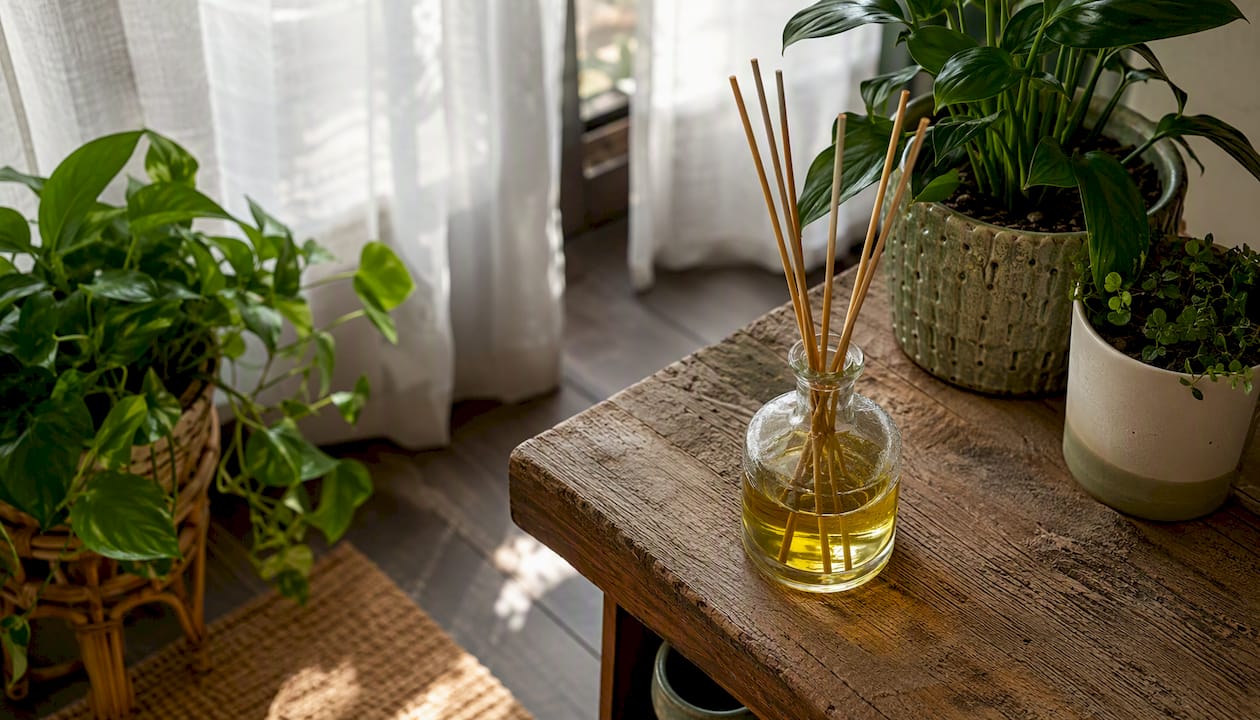
Reed diffusers are passive and require no power. They work through capillary action, drawing oil up through porous reeds and releasing it slowly into the air. Best for small to medium rooms (up to roughly 20–25 square metres) where a consistent, low-level background scent is the goal.
Ultrasonic diffusers use water and vibration to create a fine mist carrying diluted fragrance oil. They humidify as well as scent, which suits dry environments. The water dilutes the oil, so projection is moderate. Suitable for bedrooms and home offices up to around 30 square metres.
Nebulising diffusers atomise undiluted oil directly into micro-particles without heat or water. Output is stronger and more precise than ultrasonic models. They suit larger rooms and work well where fragrance quality matters, since no heat or water alters the oil’s chemistry.
Cold-air (waterless) diffusers use pressurised air to atomise oil without heat. Aroma360’s guidance confirms these preserve fragrance integrity and are effective for large rooms. HVAC integration extends coverage to whole-home or commercial-scale scenting by distributing atomised oil through existing ductwork.
Coverage and placement
Coverage recommendations must account for ceiling height and airflow, not just floor area. Manufacturers’ stated ranges are a starting point. Real-world layouts with open-plan areas, high ceilings or active ventilation often need a buffer above the calculated capacity, or multiple units placed strategically.
Coverage rule of thumb: place diffusers near natural air circulation (a doorway, a hallway junction) but not directly in front of an air vent, fan or open window. Fast airflow disperses scent before it can settle, reducing perceived intensity without improving distribution.
Practical placement rules:
- Avoid corners. Scent pools and does not circulate.
- Avoid direct sunlight. Heat accelerates oil breakdown and shortens device life.
- Position at mid-height where possible. Scent rises with warm air, so a floor-level placement in a cool room underperforms.
- For multi-room coverage, use multiple smaller units rather than one large unit in a central position.
Maintenance and scent load
Clean ultrasonic and nebulising diffusers every one to two weeks to prevent oil residue build-up, which affects output quality and can damage the device. Reed diffusers need no cleaning but benefit from occasional bottle wipes to prevent drips.
Fragrance load guidance varies by format. Always check IFRA limits when blending your own oils for any device. Schedule diffusers to run in intervals rather than continuously. Running a device for 30–60 minutes, then pausing for an equal period, reduces scent fatigue and extends oil life.
How do you get the best performance from a reed diffuser?
Reed diffusers work through capillary action: the porous reeds draw fragrance oil upward from the bottle and release it passively into the surrounding air. Oil viscosity and reed porosity determine how fast that happens. A thin, low-viscosity oil in a wide-pored reed will diffuse quickly but exhaust itself faster. A denser oil in a finer reed releases more slowly and lasts longer.
Practical steps for better performance:
- Place the diffuser in a small to medium room. Reed diffusers are passive and cannot compete with active devices in large open-plan spaces.
- Position near a doorway or a gentle source of air movement. Natural circulation carries the scent without overwhelming it. Avoid placing directly under an air conditioning vent or near an open window.
- Flip the reeds every 5–10 days. Air Aroma’s guidance recommends flipping sparingly. Flipping too frequently over-saturates the space and accelerates oil consumption. Flipping too rarely lets the exposed ends dry out and reduces output.
- Use all the reeds supplied, or fewer. More reeds increase diffusion speed but shorten the bottle’s lifespan. Removing two or three reeds slows output and extends life, useful if the scent feels too strong.
- Keep the bottle away from direct sunlight and heat sources. Both degrade the oil and reduce the fragrance’s complexity over time.
When a reed diffuser weakens significantly, the reeds are usually the cause rather than the oil level. Reeds become saturated and clogged with use. Replacing them with fresh reeds and topping up the bottle with new oil restores performance. If the oil itself has thickened or smells flat, it has degraded and the bottle should be replaced.
Fragrance concentration in reed diffuser oils is typically higher than in candle wax, often around 25%, because the passive delivery mechanism needs a stronger base to project effectively. If you are blending your own reed diffuser oil, that figure is a useful starting benchmark, adjusted for the specific fragrance and room size.
Pro Tip: Place a reed diffuser on a small tray or coaster. Oil drips are common when flipping reeds, and a tray protects surfaces from staining. A light wipe of the bottle neck after each flip keeps the setup clean and prevents residue build-up around the cap.
Why do fragrances change over time, and what does that mean for you?
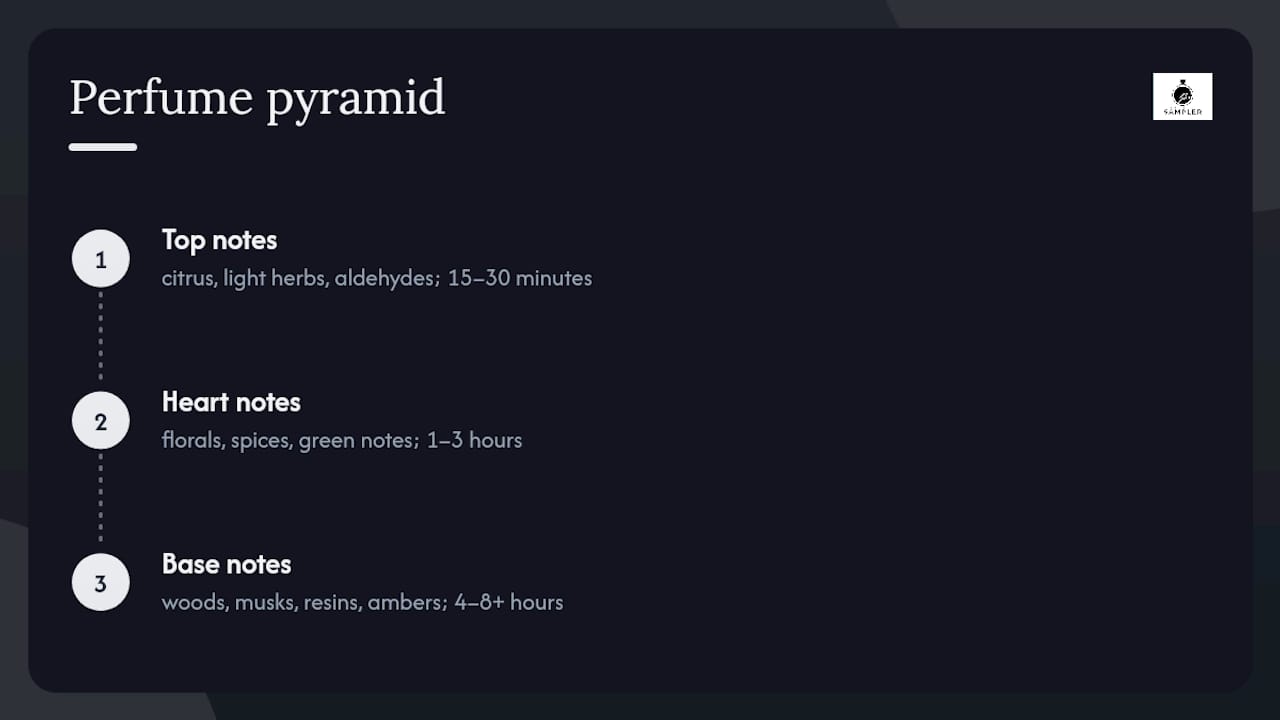
The core reason is straightforward: different fragrance molecules evaporate at different rates. Lighter, more volatile molecules leave the skin or diffuser surface first, giving the immediate impression. Heavier, less volatile molecules linger. This is the basis of the perfume pyramid, the structure that organises a fragrance into top, heart and base notes.
Top notes (citrus, light herbs, aldehydes) are the most volatile. They create the first impression but typically fade within 15–30 minutes. Heart notes (florals, spices, green notes) emerge as the top notes dissipate and form the fragrance’s character for the next one to three hours. Base notes (woods, musks, resins, ambers) are the least volatile and provide the lasting impression, often detectable for four to eight hours or longer on skin.
Fixatives slow the evaporation of more volatile components, extending the time before a fragrance’s character shifts. Traditional fixatives include musks, resins and certain woody materials. Modern perfumery also uses synthetic fixatives that bind to skin proteins and extend tenacity without adding their own strong odour.
Givaudan highlights encapsulation as a means to preserve delicate notes in challenging product formats and to enable sustained or triggered release on textiles and in laundry. In practical terms, this technology is already present in many fabric conditioners and some premium home scenting products, where microcapsules rupture on friction or heat to release a burst of fragrance.
For personal wear, this means choosing fragrances with strong base notes when longevity is the priority. For home scenting, it means selecting devices and oils that match the release profile you want: a nebuliser for immediate, strong presence; a reed diffuser for slow, continuous background scent. Understanding the pyramid also helps with fragrance layering: applying a base-heavy scent first, then a lighter fragrance on top, creates a more complex and longer-lasting result than either alone.
What are the most common scent mistakes, and how do you fix them?
The most frequent errors are over-spraying, poor placement, incorrect storage, rubbing after application and choosing the wrong concentration for the environment. Most are easy to correct once identified.
| Problem | Likely cause | Quick fix |
|---|---|---|
| Fragrance fades within an hour | Dry skin, low concentration, or no moisturiser base | Apply to damp skin over unscented lotion; switch to EDP |
| Scent is too strong on arrival | Over-spraying or high-concentration EDP in a warm room | Reduce to one spray; choose EDT for warm or indoor settings |
| Reed diffuser output is weak | Clogged reeds, wrong placement, or undersized for the room | Replace reeds, reposition near air circulation, or add a second unit |
| Diffuser scent disappears quickly | Placed near a vent or open window | Move away from fast airflow; use a timer to run in intervals |
| Fragrance smells flat or off | Degraded oil from heat, light or age | Store in a cool, dark place; check for colour change or altered smell |
| Scent irritates others in shared spaces | Too much projection for the environment | Switch to a close-wear EDT; reduce spray count to one |
Application mistakes:
- Rubbing wrists together after spraying is the most common error. It breaks the fragrance’s molecular structure and alters the dry-down, as Vogue’s application guidance confirms. Spray and leave.
- Spraying into the air and walking through the mist wastes most of the fragrance. Direct application to pulse points is more efficient.
- Applying fragrance to clothes before skin means you miss the warmth-driven diffusion that skin provides.
Shared-space etiquette:
In offices, small meeting rooms or any space with poor ventilation, one spray of a light EDT is the maximum. Fragrance sensitivity is common, and projection that feels subtle to the wearer can be significant to someone nearby. For home diffusers in shared spaces, run the device on a low setting with a timer rather than continuously, and choose softer fragrance families such as light woods, clean musks or mild citrus.
How to test fragrances properly and store them to preserve quality
A repeatable testing routine
Testing a fragrance properly takes at least two days. A single blotter impression tells you almost nothing about how a scent will perform on your skin over time.
- Blotter test first. Spray once on a blotter strip and smell immediately, then again after five minutes. This gives a rough read of the top and early heart notes.
- Skin trial on day one. Apply one spray to the inner wrist. Note the top notes on first contact, then revisit after 20 minutes (heart notes emerging) and again after two hours (base notes dominant).
- Repeat on day two. Skin chemistry, diet and even stress levels can shift how a fragrance smells. A second trial confirms whether your day-one impression holds.
- Blind comparison. If you are deciding between two fragrances, apply one to each wrist without looking at the labels. Evaluate on scent alone, then check which is which.
- Judge the dry-down, not the opening. Many fragrances open sharp or synthetic and settle into something far more appealing. Discard a first impression only after the full dry-down, typically two to three hours in.
Skin chemistry genuinely changes how a fragrance smells, which is why a 2ml or 3ml decant from Theperfumesampler is the most practical way to test. A 2ml sample covers several wrist applications. A 5ml or 10ml decant gives enough volume to wear a fragrance for a full day or two, testing it across different temperatures and activities before deciding on a full bottle.
Storage rules
Do:
- Store bottles in a cool, dark place with a stable temperature. A wardrobe shelf or a dedicated drawer works well.
- Keep the original box if possible. It blocks light and insulates against temperature fluctuation.
- Decant infrequently used fragrances into small, opaque vials to reduce oxygen exposure each time you open the main bottle.
Avoid:
- Bathroom storage. Steam and humidity accelerate the breakdown of fragrance chemistry, as Women’s Health confirms.
- Windowsills and dressing tables in direct sunlight. UV light degrades fragrance molecules quickly.
- Extreme temperature swings, such as near a radiator in winter.
Signs a fragrance has degraded: a noticeable colour change (usually darkening), an off or sour smell in the top notes, or significantly muted projection compared to when the bottle was new. Older fragrances do not become unsafe, but the scent profile changes, sometimes beyond recognition. If a bottle is more than five years old and has been stored poorly, the opening impression is a reliable indicator of whether it is still worth using.
A retailer’s perspective on the sampling path
The most consistent pattern seen at Theperfumesampler is this: customers who sample before buying are significantly more satisfied with their full-bottle purchase. The reason is straightforward. Fragrance is one of the few product categories where the item you receive can smell entirely different from what you expected based on a description, a review or even a department store counter spray.
The typical journey looks like this. A customer starts with a 2ml or 3ml decant to check basic chemistry and whether the fragrance suits their skin. If it does, they move to a 5ml or 10ml decant to wear it across different occasions, temperatures and outfits. That extended test answers the questions a brief counter spray cannot: does it last through a working day? Does it suit both a casual Saturday and a formal evening? Only after that does a full bottle make sense.
The sampling path also applies to home scenting. Buying a large bottle of diffuser oil for a new device without testing the scent in your specific space is a common and avoidable mistake. A smaller decant lets you confirm that the fragrance works in that room, at that concentration, before committing to a larger volume.
Theperfumesampler stocks samples and decants across niche and designer fragrance lines, in sizes from 2ml to 10ml, precisely to support this workflow. The full-bottle purchase becomes a confident decision rather than a gamble.
Sampling and decants: the practical, low-risk route to finding your scent
Theperfumesampler sells fragrance samples and decants in 2ml, 3ml, 5ml and 10ml sizes, covering niche and designer lines at prices that make testing genuinely affordable. The logic is simple: a 2ml decant of a £200 niche fragrance costs a fraction of the full bottle and tells you everything you need to know about whether it works for you.
For chemistry testing, start with a 2ml or 3ml decant. For extended wear testing across multiple days and occasions, a 5ml or 10ml decant gives enough volume to be thorough. Once you have confirmed the fragrance works on your skin and suits your lifestyle, the full bottle is a straightforward next step. Browse Theperfumesampler’s decant range to find your next fragrance without the risk of buyer’s remorse.
Sources
The following sources informed the guidance in this article and are worth consulting for deeper reading on specific topics.
- How to apply perfume — Women’s Health
- How to buy, wear and store perfume — Vogue
- Guide to scenting systems | SensoryCo
- The how to guide on optimising your reed diffuser’s scent — Air Aroma
- How to use scent diffusers for large rooms and homes — Aroma360 Insights
- Coverage area guide for diffusers — Saintdeland
- Fragrance usage guide — Scentify