

How to avoid fragrance fatigue: a practical plan
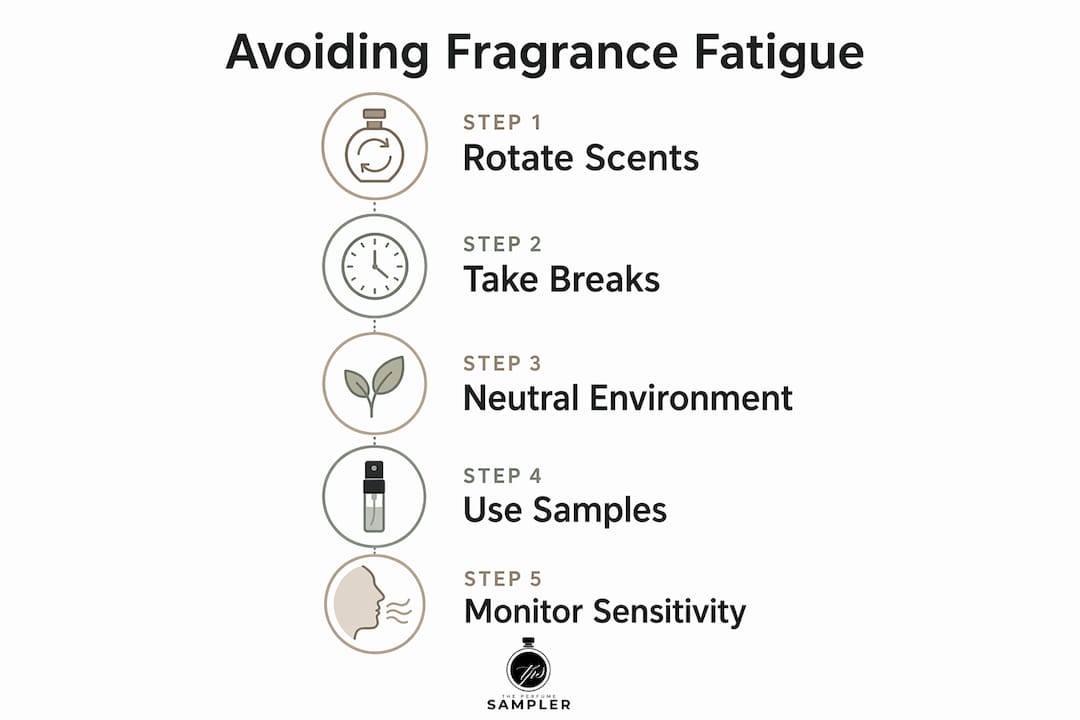
Deliberate rotation and short scent breaks are the most effective way to prevent and reset fragrance fatigue. If you are nose-blind right now, step outside for five minutes, then return to your normal environment. Tomorrow, wear a different fragrance with a contrasting profile. Keep your application to two sprays maximum. One reassurance worth holding onto: your scent is almost certainly still projecting to everyone around you, even when you can no longer detect it yourself.
- Step outside or move to neutral air for five minutes
- Limit application to two sprays on pulse points
- Rotate to a different fragrance tomorrow
Table of Contents
- What is fragrance fatigue and how does it differ from smell loss?
- Why fragrance fatigue happens: the science behind it
- How to avoid fragrance fatigue every day
- What actually resets your nose: evidence versus myth
- Building a scent wardrobe that prevents adaptation
- When fragrance fatigue might be something more serious
- Key takeaways
- The case for treating your nose like a professional
- Samples and decants make rotation practical
- Useful sources
What is fragrance fatigue and how does it differ from smell loss?
Fragrance fatigue, known scientifically as olfactory adaptation, is a temporary, biological process in which continuous exposure to a scent causes your brain to filter it out as background noise. Your olfactory receptors do not stop working; the brain simply deprioritises a constant, unchanging signal in favour of novel stimuli. This is a normal adaptive response, not a sign that your fragrance has failed or faded.
It is worth distinguishing this from anosmia, which is a clinical loss of smell that persists regardless of the scent or context. Fragrance fatigue is specific to the scent you have been wearing; you can still detect other smells around you. A well-composed fragrance with smooth, layered notes tends to fade into the background more comfortably, which can make it feel as though the scent has simply disappeared. In reality, the blend is still present and projecting.
Why fragrance fatigue happens: the science behind it
Adaptation begins at two levels. First, olfactory receptor neurons in the nasal epithelium reduce their firing rate under sustained stimulation. Second, the olfactory bulb and higher cortical centres downregulate their response to a repeated, unchanging signal. The result is that a scent you applied an hour ago registers as background rather than foreground.
| Factor | Effect on adaptation speed |
|---|---|
| Concentration | Higher concentration triggers faster onset, typically within minutes |
| Continuous vs intermittent wear | Continuous exposure deepens adaptation; intermittent diffusion slows it |
| Application site | Neck and chest create a near-constant signal; wrists and inner elbows diffuse intermittently |
| Age and nasal health | Congestion, allergies, and age-related receptor decline all increase susceptibility |
| Environment | High humidity amplifies projection; heat accelerates diffusion and speeds receptor saturation |
Adaptation onset commonly occurs within minutes of continuous exposure for intense fragrances. Lighter concentrations take longer. Recovery after a single fragrance typically takes some time in neutral air; after testing many scents back-to-back, recovery can be prolonged. Perfumers design fragrances in layers — top, heart, and base — partly to manage how humans adapt over time, since each layer presents a slightly novel signal as the previous one fades.
How to avoid fragrance fatigue every day
The following steps are ranked by impact. Apply the first two consistently and you will notice a significant difference within a week.
-
Rotate 3–4 fragrances with contrasting profiles. Rotating 3–4 distinct fragrances keeps each one fresh to your nose. The contrast matters: a citrus scent on Monday followed by a woody oriental on Tuesday presents genuinely different receptor signals, slowing adaptation to each.
-
Apply to pulse points, not fabric. Wrists and inner elbows allow intermittent diffusion as you move. Applying to fabric creates a continuous, close-range signal that accelerates adaptation. Avoid the neck if you want to extend perception.
-
Limit yourself to two sprays. Two to three sprays is sufficient for most fragrances. Over-spraying is the most common reaction to nose-blindness and compounds the problem.
-
Take a scent break at midday. Step away from your environment for five to ten minutes. Fresh, neutral air allows receptors to partially reset without waiting for full recovery.
-
Limit simultaneous scented products. Body wash, moisturiser, and candles all contribute to total olfactory load. Reducing layered scented products gives your nose a cleaner baseline.
-
Use a timed approach when testing new scents. Testing many fragrances back-to-back causes persistent fatigue. Space sessions by at least 30 minutes and limit each session to three or four scents.
-
Practise mindful smelling. Short, gentle sniffs extend your perception window. Deep, prolonged inhalations saturate receptors faster.
Pro Tip: When evaluating a new fragrance at home, take two short sniffs, then set it aside for 20 minutes before returning. This technique, used by perfumers, prevents immediate saturation and gives you a more accurate read of the dry-down.
Simple rotation schedules:
Daily alternation (two-scent rotation):
- Monday, Wednesday, Friday: Scent A (e.g. citrus/fresh)
- Tuesday, Thursday, Saturday: Scent B (e.g. woody/amber)
Weekly rotation (four-scent wardrobe):
- Week 1: Citrus / Week 2: Floral / Week 3: Woody / Week 4: Spicy oriental
What actually resets your nose: evidence versus myth
The coffee bean palate cleanser is one of the most repeated tips in fragrance circles. The evidence does not support it. A study by Grosofsky et al. found that coffee beans performed no better than plain air for resetting olfactory perception. The ritual may feel effective because it introduces a strong, novel scent that briefly distracts the nose, but it does not accelerate receptor recovery.
What does work is moving to a genuinely neutral environment. Stepping outside, or into a room with no scented products, allows your receptors to reduce their firing rate naturally. Allow five to ten minutes before returning. When you come back, take a single short sniff rather than a deep inhale, which would immediately re-saturate the receptors you just rested. Citrus-based smelling salts and unscented skin (the inside of your elbow) are sometimes used by perfumers as brief palate resets, but the evidence base for these over plain air remains limited.
Building a scent wardrobe that prevents adaptation
The neurological rationale for rotation is straightforward: different dominant notes activate different receptor populations. A citrus scent and a woody oriental do not share the same primary receptor targets, so alternating between them means no single receptor group is continuously stimulated.

7-day and 30-day sample rotation plan:
| Day / Period | Profile | Example character |
|---|---|---|
| Day 1 / Week 1 | Citrus/fresh | Light, aquatic, green |
| Day 2 / Week 2 | Floral | Rose, jasmine, iris |
| Day 3 / Week 3 | Woody/earthy | Sandalwood, vetiver, cedar |
| Day 4 / Week 4 | Spicy/oriental | Oud, amber, warm spice |
| Day 5 | Return to Day 1 | Keeps each profile feeling new |
Practical checklist for building your rotation:
- Start with 3–4 samples covering contrasting profiles (citrus, floral, woody, spicy)
- Store samples away from direct light and heat to preserve composition
- Note which days each scent feels freshest to calibrate your rotation
- Try decants between test days to evaluate dry-down without committing to a full bottle
- Use a fragrance scent map to identify genuinely contrasting profiles before purchasing
Pro Tip: Decants in 2ml or 5ml sizes are ideal for rotation testing. They give you enough product to wear a fragrance for a full day, which is the only reliable way to judge how it performs across all three layers.
Theperfumesampler offers decants in 2ml, 3ml, 5ml, and 10ml sizes across niche and designer brands, making it straightforward to build a contrasting four-scent wardrobe without the cost of four full bottles.
When fragrance fatigue might be something more serious
Normal olfactory adaptation resolves within 30 minutes to a few hours in neutral air. If you have stepped away from all scented environments for several hours and still cannot detect familiar smells, that is worth paying attention to.
Red flags that suggest medical review rather than self-management:
- Complete inability to smell anything, not just your own fragrance
- Sudden onset of smell loss with no obvious cause (no recent cold or congestion)
- Smell loss persisting beyond two weeks without improvement
- Accompanying symptoms such as headache, facial pain, or neurological changes
The NHS provides guidance on smell loss, including post-viral causes and when to seek further assessment. If any of the above apply, contact your GP rather than attempting to manage the issue through rotation or reset techniques. This article covers normal olfactory adaptation and is general information, not medical advice. Confirm any health concerns with a qualified clinician.
Key takeaways
Deliberate fragrance rotation with contrasting scent profiles is the single most effective way to prevent olfactory adaptation and keep your wardrobe fresh to your nose.
| Point | Details |
|---|---|
| Rotate with contrast | Use 3–4 fragrances with different dominant notes to prevent receptor saturation. |
| Two sprays is enough | Over-spraying accelerates adaptation and compounds nose-blindness. |
| Plain air resets the nose | Coffee beans offer no advantage over stepping outside for five to ten minutes. |
| Samples reduce cost and risk | Decants let you build a contrasting wardrobe without committing to full bottles. |
| Theperfumesampler | Offers 2ml–10ml decants across niche and designer brands, ideal for building a rotation plan affordably. |
The case for treating your nose like a professional
Most fragrance enthusiasts reach for more product the moment they stop smelling their scent. It is the instinctive response, and it is almost always the wrong one. The correct move is to do nothing, or to rotate. The nose is not broken; it is doing exactly what it evolved to do, which is to stop reporting on constants and focus on change.

What the coffee bean myth reveals is how much we want a quick fix. The reality is that the only reliable reset is time and neutral air. That is not a limitation of the nose; it is a feature. Receptors that adapted in 20 minutes will largely recover in 30. The problem is that most people never give them the chance, because the instinct to reapply kicks in first.
The more interesting implication is for how you build a wardrobe. A collection of four fragrances that share the same dominant note family is not a rotation; it is a single scent with variations. Genuine contrast, a citrus alongside a woody oriental alongside a floral, is what keeps each bottle feeling new. Samples make this affordable to test before committing. The enthusiasts who get the most from their collections are not the ones with the most bottles; they are the ones who wear them strategically.
Samples and decants make rotation practical
Fragrance rotation is straightforward in theory and expensive in practice, if you are buying full bottles to test it. That is where decants change the calculation.
Theperfumesampler stocks niche and designer fragrance decants in 2ml, 3ml, 5ml, and 10ml sizes, which means you can build a four-scent contrasting wardrobe for a fraction of the cost of four full bottles. Each size gives you enough product for multiple full-day wears, so you can properly evaluate how a fragrance performs across its top, heart, and base notes before deciding whether to invest in a full bottle. Start with three or four samples covering contrasting profiles — citrus, floral, woody, and spicy — and rotate daily. For a full explanation of why decants are the practical choice for building a rotation, visit the why decants page on Theperfumesampler.
Useful sources
- NHS: Lost or changed sense of smell — UK guidance on smell loss, causes, and when to seek medical advice
- Olfactory fatigue — Wikipedia — summary of the Grosofsky et al. coffee bean study and adaptation mechanisms
- The science behind olfactory fatigue — Malibu Apothecary — accessible explanation of receptor and central adaptation processes
- How to reset your nose — House of Scent — practical guidance on mindful smelling and recovery between sessions
- Theperfumesampler — niche and designer fragrance decants in 2ml–10ml sizes for building an affordable rotation wardrobe