
Mixing fragrances: a practical guide for decant buyers
Yes, you can mix finished perfume decants to create a personalised scent or test pairings before committing to a full bottle. Three rules make the difference between a coherent blend and a muddy mess.
- Assign each scent a role. One fragrance anchors (base/woods/musks), one modifies or tops (florals, citrus, spice). As Millie Lloyd advises, each perfume needs a clear, distinct purpose rather than competing for attention.
- Apply heavier concentrations first. Extraits and dense woody bases go on skin before lighter EDTs or mists. The first-applied fragrance sets the architectural foundation that everything else builds on.
- Limit your session. Test 3–6 combinations per visit, no more. Nose fatigue distorts judgement fast.
Pro Tip: A 5ml or 10ml decant from Theperfumesampler gives you enough volume to test a pairing across multiple wears, while a 2ml or 3ml covers a single-day trial.
Key takeaways
Layering finished perfume decants works reliably when you assign roles, apply in the right order, and test methodically across multiple wears before buying a full bottle.
| Point | Details |
|---|---|
| Assign roles first | Give each fragrance a clear job: anchor, modifier, or topper, before applying anything. |
| Heavier concentration first | Apply extrait or dense base before EDT or light mist to build a stable foundation. |
| Limit to a few tests per session | Nose fatigue distorts judgement; stop before your nose stops working accurately. |
| Record every recipe | Note sprays, order, and application points — the only way to reproduce a successful blend. |
| Use Theperfumesampler decants | A 5ml covers multiple wears for pairing tests; a 10ml confirms seasonal and layering recipes. |
Table of Contents
- What kit do you need before mixing decants?
- How do you choose which fragrances to mix?
- A step-by-step method for testing decant combinations on skin
- How do skin, weather and concentration affect your results?
- Common mistakes when mixing perfumes and how to fix them
- When should you buy a full bottle?
- How this guide was built
- Why decants make layering worth doing properly
- Try the method with Theperfumesampler decants
- Sources
What kit do you need before mixing decants?
Keep the kit minimal. You need:
- Decants or travel atomisers (2ml–10ml): the testing medium itself
- Blotter strips: test a pairing on paper before committing to skin
- Unscented balm or moisturiser: primes skin and helps longevity
- A small notebook or digital scent journal: the only reliable way to recreate a successful blend later
- A pipette or small funnel: for precise micro-decanting between atomisers
- Plain crackers and water: for nose-cleansing between tests
UK chemists and stationery shops stock blotter strips and notebooks cheaply. Pipettes are available from most online laboratory suppliers.
Pro Tip: Match decant size to your goal. A 2ml or 3ml from Theperfumesampler suits a one-day trial. A 5ml covers three to four wears for a proper pairing test. A 10ml lets you confirm a layering recipe across seasons.
How do you choose which fragrances to mix?
Assign roles before you open a bottle
Every successful blend has a base/anchor (musks, woods, resins, ambers), a heart/modifier (florals, spices, gourmands), and optionally a topper/accent (citrus, aldehydes, light aquatics). Start with two bottles only. Adding a third before you understand the first pairing produces confusion, not complexity.
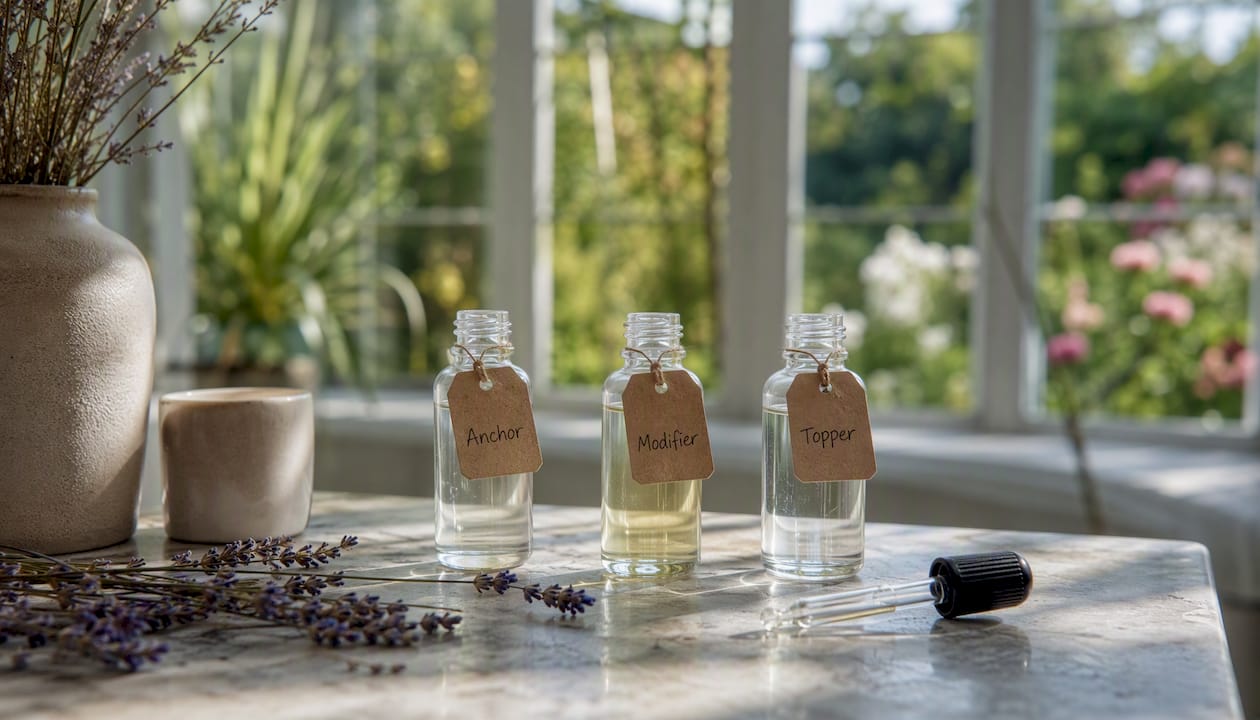
Prefer clear, single-note or lightly voiced bottles for early experiments. Two dense, multi-layered orientals fighting for space rarely resolve into something coherent. Complex compositions are harder to layer; clarity-led bottles give you more control.
Safe starter pairings by scent family
- Citrus or green topper + woody or musky base
- Vanilla or gourmand heart + light white floral
- Amber or ambergris anchor + fresh aquatic or citrus top note
- Soft rose or iris heart + clean musk base
A practical pairing rule: shared base notes increase cohesion; contrasting top notes deliver opening interest. A woody amber base under a citrus top note works because the anchor holds the volatile top in place, a principle backed by practitioner guidance on anchor notes and the 2:1:1 base:heart:top ratio.
Pro Tip: Season and context matter. In a UK spring or summer, citrus and green layers project cleanly in warm, humid air. Autumn and winter suit amber, woody, and gourmand anchors, which need cooler air to avoid becoming oppressive. Build your personal scent wardrobe around seasonal anchors first.
A step-by-step method for testing decant combinations on skin
Follow this sequence for reliable, comparable results every time.
- Prep skin. Apply a thin layer of unscented moisturiser to pulse points. Wait two minutes.
- Apply the base anchor first. Two sprays (or 4–6 drops from a pipette) of the heavier concentration on wrist or inner elbow.
- Apply the modifier or topper second. One spray (or 2–3 drops) of the lighter fragrance on the same or adjacent area. A 2:1 base-to-topper ratio is a reliable starting point; a 2:1:1 base:heart:top ratio works when using three bottles.
- Wait 10–15 minutes. Note the opening: does the blend smell coherent or discordant?
- Evaluate at 1 hour. The heart notes emerge. Record projection and any clashes.
- Evaluate at 4 hours. Timed evaluation at later checkpoints reveals the dry-down and true longevity. Immediate impressions can mislead.
What to record in your scent journal
- Ambient temperature and humidity
- Fragrance names, concentrations, and decant sizes used
- Number of sprays or drops, and application points
- Opening, heart, and dry-down impressions
- Overall verdict: proceed, adjust ratio, or abandon
For more rigour, try a blind fragrance trial: have someone else apply the blend without telling you the ratio, then record your impressions before checking the recipe.
How do skin, weather and concentration affect your results?
Concentration and format
Extraits and parfum oils anchor blends and project for longer. EDTs evaporate faster, making them better toppers than anchors. Layering an extrait base under an EDT top note is a reliable structure: the extrait holds the blend in place while the EDT shapes the opening impression. Detailed guidance on handling different concentrations is covered in the decanting methods guide.
Skin and weather adjustments
- Dry skin absorbs fragrance faster and reduces longevity; apply unscented balm first.
- Oily skin can amplify projection; reduce the number of sprays by one.
- Hot, humid UK summer days: reduce the base proportion to avoid overpowering projection; favour citrus and green toppers.
- Cold autumn or winter: increase the anchor proportion; amber, oud, and woody bases need cooler air to open properly rather than smother.
Pro Tip: Apply fragrance immediately after a shower when pores are open and skin is slightly warm. Longevity increases noticeably compared with applying to dry, cold skin.
Common mistakes when mixing perfumes and how to fix them
Mistakes to avoid
- Testing too many combinations in one session
- Pairing two opaque, multi-layered compositions without a clear anchor
- Overapplying both layers (more is not better)
- Ignoring application order and spraying both simultaneously
How to fix a clashing blend mid-session
- Apply unscented balm over the area to dilute and neutralise.
- Wait five minutes, then assess whether the clash has softened.
- If not, move to a fresh skin patch and reapply a single element only.
- Abandon the pairing if the clash persists after two attempts.
Recovering your nose
Céline Roux, vice-president of global fragrance development, highlights nose fatigue as a central problem when testing. Limit sessions to 3–6 combinations. Between tests, smell plain crackers, drink water, and take a short walk in fresh air. Theperfumesampler’s fragrance fatigue guide offers additional session-management strategies for sample shoppers.
When should you buy a full bottle?
A pairing or single fragrance is ready for a full-bottle purchase when it passes 3–5 independent wear tests across different contexts and you can describe consistent development at the 4-hour mark.
Decant sizes mapped to testing needs
- 2ml or 3ml: one-day trial, first impression only
- 5ml: three to four wears, suitable for paired testing and ratio adjustments
- 10ml: confirms seasonal use, layering recipes, and longevity across temperatures
Buying checklist before committing
- Confirm the fragrance develops consistently on your skin across at least three wears.
- Test projection and longevity in both warm and cool conditions.
- Wear it with the outfits and in the occasions you actually dress for.
- If layering, confirm the recipe is recorded and reproducible.
A 10ml decant costs a fraction of a full bottle. Testing with decants prevents spending £80–£200 on a fragrance that disappoints after the first wear. The advantages of decanting cover this cost-efficiency case in full.
Pro Tip: If a blend passes the 4-hour test in both summer and winter conditions, it is genuinely versatile. Most fragrances that disappoint at full-bottle stage fail this cross-season check.
How this guide was built
This guide draws on published expert commentary from two fragrance industry practitioners: Millie Lloyd (senior education manager at L’Occitane) on intentional role assignment, and Céline Roux (vice-president of global fragrance development) on nose fatigue and session limits. Both are paraphrased from their respective interviews in Harper’s Bazaar UK and Vogue UK. Practitioner ratio guidance (the 2:1:1 base:heart:top starting point) comes from PerfumerOnline’s scent-layering resource.
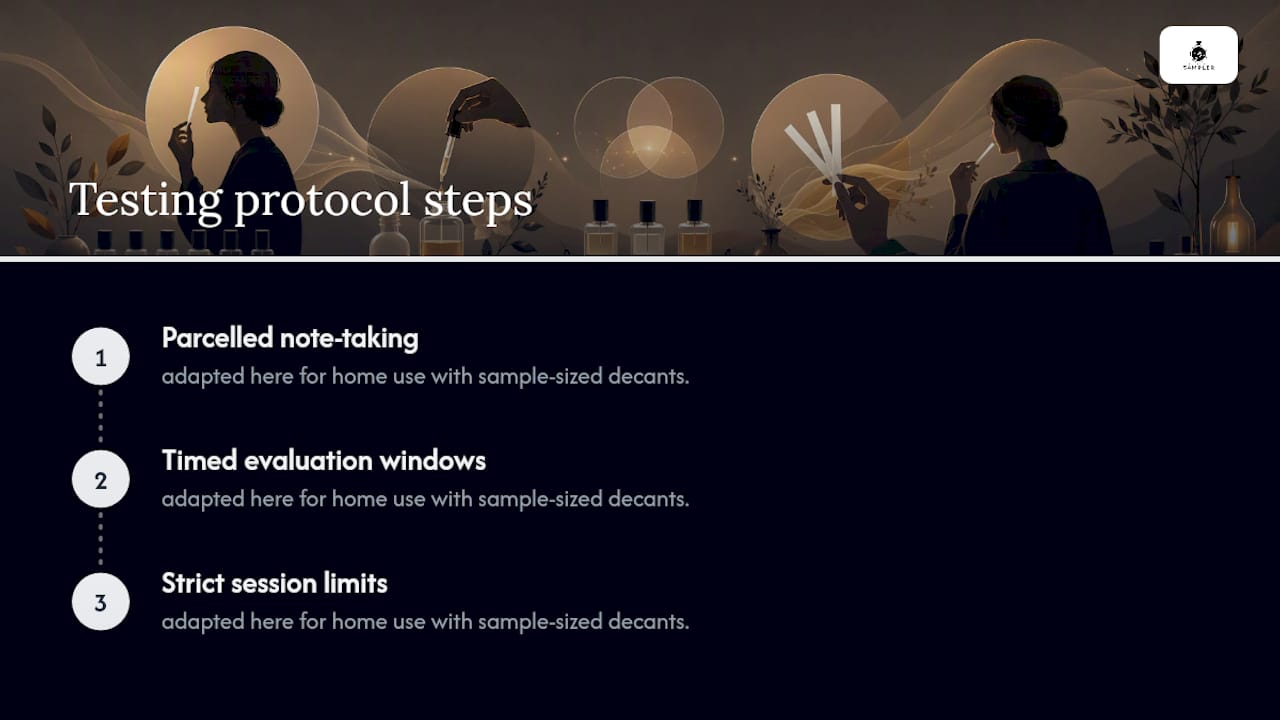
The testing protocol reflects professional counter-testing practices: parcelled note-taking, timed evaluation windows, and strict session limits. These are methods used by fragrance educators and counter staff, adapted here for home use with sample-sized decants.
Theperfumesampler supplies 2ml–10ml decants to UK shoppers, making low-risk, multi-wear testing practical without the cost of full bottles.
This guide was written by Rupesh, who writes about fragrance sampling and layering for the Theperfumesampler blog.
Why decants make layering worth doing properly
Decants remove the financial risk that stops most people experimenting. When a 5ml sample costs a few pounds, testing a pairing that fails costs almost nothing. That changes how you approach the process: you can afford to be methodical, to record what works, and to discard what does not without regret.
The ritual is simple. Assemble your kit, choose one pairing, apply it in order, walk for an hour, and write three sentences about what you noticed. Repeat that across a handful of sessions, and you will know more about your own scent preferences than most people who have been buying full bottles for years.
Try the method with Theperfumesampler decants
Theperfumesampler offers niche and designer fragrance decants in 2ml, 3ml, 5ml, and 10ml sizes, shipped across the UK.
For the testing method described in this guide, a 5ml decant covers three to four wears, enough to evaluate a pairing properly. A 10ml suits anyone confirming a layering recipe across seasons. New to layering? Start with two 5ml decants from different scent families and follow the step-by-step protocol above.
- Sizes available: 2ml, 3ml, 5ml, 10ml
- Full bottles: also available for confirmed favourites
- UK shipping: standard and tracked options
- Authenticity: 100% genuine, sourced from original bottles
Browse the full range and find your starting pair at Theperfumesampler.
Sources
- How to layer fragrances (Vogue UK)
- Perfume layering advice from experts (Harper’s Bazaar)
- How to layer perfume (Elite Traveler)
- Scent layering: build your signature fragrance (PerfumerOnline)
- The ultimate guide to layering fragrances (Perfume Cultures)