
Why fragrance maceration is important for your perfume
TL;DR:
- Fragrance maceration is a controlled resting phase where aromatic oils and alcohol are left undisturbed to ensure chemical stability and scent harmony. It is essential for achieving balanced notes, improved longevity, and consistent performance, typically lasting from four weeks to several months. Home ageing differs from professional maceration; the latter occurs under specific conditions during production to produce a cohesive and stable fragrance.
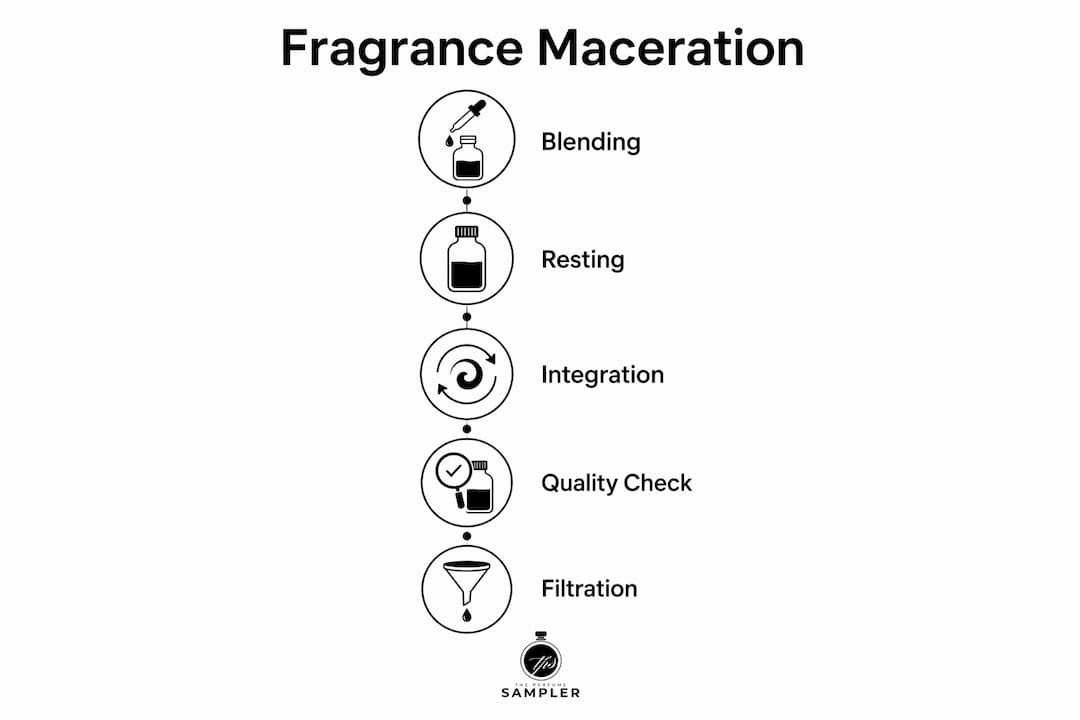
Fragrance maceration is defined as the controlled resting phase in which blended aromatic oils and alcohol are left undisturbed to achieve chemical stability and olfactory harmony. This process is the reason a finished perfume smells cohesive rather than disjointed. Without it, the top, middle, and base notes compete rather than complement. Professional perfumers regard maceration as the most critical manufacturing phase for achieving final harmony and stability in any formula. Standard resting periods run from 4 to 12 weeks, though complex formulas can require up to six months.
Why is fragrance maceration important?
Maceration is important because it allows aromatic molecules to fully dissolve and distribute evenly in alcohol, creating a stable equilibrium that produces a rounded, cohesive scent. Without this resting period, the fragrance remains chemically unsettled. The result is a perfume that smells sharp, unbalanced, or dominated by raw alcohol on first application.
The process works on all three scent layers simultaneously. Top notes, which are the most volatile, soften and lose their initial harshness. Middle notes, often the heart of the composition, begin to integrate with the base. Base notes, which are the heaviest and slowest to evaporate, anchor the entire structure once maceration is complete.
The importance of fragrance maceration extends beyond scent quality alone. It also determines how a perfume performs on skin, how long it lasts, and how consistently it behaves from one batch to the next. A perfume that skips or shortens this phase will often smell different on skin than it does in the bottle, and it may develop unpredictably over time.
Pro Tip: If a new fragrance smells harsh or overly alcoholic straight from the bottle, give it 10 to 15 minutes on skin before judging it. You are experiencing the tail end of what insufficient maceration can produce.
What happens during the fragrance maceration process?
The fragrance maceration process is a series of physical and chemical interactions that occur when blended ingredients are left to rest. Here is what takes place at each stage:
- Molecular diffusion begins. Aromatic molecules start migrating through the alcohol base, distributing themselves more uniformly than they were at the point of blending.
- Volatile components stabilise. The most reactive molecules, particularly those responsible for sharp or harsh top notes, begin to settle into a more stable chemical state.
- Scent layers integrate. Top, middle, and base notes stop behaving as separate elements and begin functioning as a single composition.
- Alcohol softens. The raw, biting quality of the alcohol carrier diminishes as the aromatic compounds bond with it more completely.
- The formula reaches equilibrium. The perfume is considered finished after maceration because no new ingredients are added. The composition simply becomes more cohesive.
The minimum effective resting period is generally 48 to 72 hours, but this produces only a basic level of integration. Most quality fragrances rest for several weeks. The longer the maceration, the more thoroughly the scent layers merge, and the more complex the final aroma becomes.
It is worth distinguishing maceration from simple blending. Blending is the act of combining ingredients. Maceration is the time those ingredients need to become a unified whole. Skipping maceration is the equivalent of baking a cake and serving the batter.
Pro Tip: When reading fragrance reviews, phrases like “the drydown is spectacular” often reflect the effects of thorough maceration. The base notes are performing exactly as the perfumer intended because the formula had time to settle.
How does maceration compare with ageing and maturation?
These three terms are frequently confused, even among fragrance enthusiasts. They describe distinct phases that occur at different points in a perfume’s life.
| Phase | Who controls it | When it occurs | What changes |
|---|---|---|---|
| Maturation | Perfumer | Before maceration, during blending | Raw materials are combined and allowed to interact before the full formula is assembled |
| Maceration | Manufacturer | Pre-bottling, in controlled conditions | Aromatic molecules distribute evenly in alcohol; scent stabilises |
| Ageing | Consumer or time | Post-purchase, in the bottle | Natural evolution of ingredients; colour and scent may shift gradually |
Maceration and maturation are manufacturing steps. Ageing is a consumer-side phenomenon. This distinction matters because many enthusiasts believe they can replicate professional maceration at home by leaving a bottle undisturbed for weeks. That practice describes ageing, not maceration. The chemical conditions required for true maceration, including temperature control, darkness, and the precise ratio of aromatic compounds to alcohol, are established during production, not after bottling.
Colour changes are another area of confusion. A perfume that darkens in the bottle is not macerating further. Colour changes result from natural ingredient reactions, particularly with heavier naturals like vanilla or oud, and do not indicate improved scent quality. They are a normal part of ageing, not evidence of ongoing maceration. Understanding how fragrance ageing works helps you interpret these changes accurately rather than assuming something has gone wrong.
Why maceration matters for fragrance performance
The benefits of scent maceration are most visible in how a perfume actually performs when worn. A properly macerated fragrance delivers a noticeably different experience from one that has been rushed.
- Smoother note transitions. Top notes fade gracefully into the heart rather than cutting off abruptly. The drydown feels natural rather than jarring.
- Improved longevity. Properly macerated perfumes have stronger base notes and longer-lasting characteristics on skin. The molecules are more thoroughly bonded to the alcohol carrier, which slows evaporation.
- Better sillage. Scent projection is more consistent when the formula is in equilibrium. An unmacerated perfume may project aggressively at first, then drop off sharply.
- Balanced complexity. The middle and base notes, which define a fragrance’s character, only come forward fully once maceration is complete. Before that, top notes dominate and mask the composition’s true depth.
- Batch consistency. Controlled maceration ensures homogeneous standards across production runs, meaning the bottle you buy today smells the same as the one purchased six months ago.
An insufficiently macerated perfume may smell harsh, unbalanced, or overly alcoholic, with dominant top notes that overwhelm the composition. This is not a flaw in the formula itself. It is a flaw in the production process. The same formula, given adequate resting time, would perform entirely differently.
Understanding what affects perfume performance goes beyond ingredients alone. Maceration is one of the most significant production variables, yet it is rarely discussed in consumer-facing fragrance content.
Pro Tip: When comparing two versions of the same fragrance, one from a fresh batch and one from an older bottle, any differences you notice are likely the result of ageing rather than maceration. Both bottles were macerated before leaving the factory.
Maceration duration and quality control in perfume production
Perfumers and manufacturers treat maceration as a controlled industrial step with defined timelines and measurable quality benchmarks. The following table outlines standard resting periods by formula complexity.
| Formula type | Typical maceration period | Notes |
|---|---|---|
| Simple, synthetic-heavy | 2 to 4 weeks | Fewer reactive components; reaches equilibrium faster |
| Balanced synthetic and natural | 4 to 8 weeks | Standard for most designer fragrances |
| Natural-heavy or complex | 8 to 12 weeks | More reactive molecules require longer integration |
| Highly complex or artisanal | Up to 6 months | Rare; used for bespoke or ultra-premium formulas |
After maceration, the fragrance does not go directly into bottles. Chilling and filtration remove microscopic impurities and prevent turbidity, ensuring the final product is visually clear and chemically stable. Skipping these post-maceration steps can result in a cloudy appearance even when the formula itself is well-constructed.
Quality checks at this stage assess three things: aroma profile against the reference standard, visual clarity, and chemical stability under temperature variation. If any of these fall outside acceptable parameters, the batch is held for further resting or reformulation.
For hobbyists interested in fragrance blending, the practical takeaway is straightforward. A minimum resting period of 48 to 72 hours is the absolute floor. Four weeks produces noticeably better results. Patience at this stage is not optional if the goal is a balanced, wearable composition. Maceration also improves batch-to-batch consistency, which is why professional producers treat it as a non-negotiable step rather than a variable one.
Key takeaways
Fragrance maceration is the single most important production step for achieving scent harmony, longevity, and batch consistency in any perfume formula.
| Point | Details |
|---|---|
| Maceration is a manufacturing step | It occurs pre-bottling under controlled conditions, not at home after purchase. |
| Standard duration is 4 to 12 weeks | Complex formulas may require up to six months for full molecular integration. |
| It improves longevity and balance | Properly macerated perfumes have stronger base notes and smoother note transitions. |
| Post-maceration steps matter | Chilling and filtration after resting are required for clarity and stability. |
| Ageing and maceration are different | Colour changes and scent shifts in your bottle reflect ageing, not ongoing maceration. |
Maceration, patience, and what it means for the perfume you wear
by Rupesh
The most common misunderstanding I encounter among fragrance enthusiasts is the belief that leaving a bottle on a shelf for a few weeks is the same as maceration. It is not, and conflating the two leads to unrealistic expectations about what home ageing can achieve.
What professional maceration actually delivers is something you cannot replicate after the bottle is sealed. The conditions, the ratios, the temperature control, all of it happens in a production environment before the fragrance ever reaches you. By the time you open a bottle from a reputable house, the maceration is done. What you experience from that point forward is ageing, which is a slower, less predictable process.
Where this matters practically is in how you evaluate fragrances. A perfume that smells slightly harsh or alcohol-forward on first spray is not necessarily a poor formula. It may simply be a very fresh bottle. Giving it time on skin, or revisiting it after a few months of natural ageing, often reveals a noticeably different character. I have seen this with heavier oriental and woody compositions in particular, where the base notes genuinely deepen over time.
The cultural value of patience in perfumery is real. The best fragrances are not rushed. Understanding that maceration is where that patience is built into the product gives you a more accurate framework for appreciating what you are wearing.
— Rupesh
Discover professionally macerated fragrances at Theperfumesampler
Every fragrance sold by Theperfumesampler comes from authentic, professionally produced batches where maceration has been completed to the manufacturer’s standard. You are not buying a rushed or immature formula.
Theperfumesampler offers fragrance decants in 2ml, 3ml, 5ml, and 10ml sizes, giving you the opportunity to experience the full performance of a properly macerated fragrance before committing to a full bottle. BOSS Boss Bottled Absolu Parfum Intense is one example of a rich, balanced formula that demonstrates exactly what thorough maceration delivers: smooth note transitions, strong sillage, and lasting depth. Sample it first. Buy with confidence.
FAQ
What is fragrance maceration?
Fragrance maceration is the controlled resting period after aromatic oils are blended with alcohol, allowing the molecules to distribute evenly and the scent to stabilise. It typically lasts between 4 and 12 weeks in professional production.
Can I macerate a perfume at home?
No. Professional maceration occurs pre-bottling under controlled industrial conditions. What happens at home after purchase is ageing, a natural but slower and less controlled process that is distinct from maceration.
Why does my perfume smell harsh when it is new?
A harsh or overly alcoholic smell on a fresh bottle can indicate that the fragrance is very recently produced. Allowing it to rest and wearing it on skin for 15 to 20 minutes will reveal the composition more accurately as the top notes settle.
Does perfume colour change mean it is macerating?
No. Colour changes in a bottle reflect natural ingredient reactions during ageing, particularly with ingredients like vanilla or oud. They do not indicate ongoing maceration or any improvement in scent quality.
How does maceration affect fragrance longevity?
Properly macerated perfumes have more thoroughly bonded aromatic molecules, which slows evaporation on skin and produces stronger, longer-lasting base notes compared with under-macerated formulas.