
What is an oud fragrance? The complete guide
TL;DR:
- Oud fragrance is derived from the resinous heartwood of infected Aquilaria trees, making it rare and highly valuable. It has a complex scent profile that evolves from animalic and smoky to warm and balsamic over time. Most first impressions are challenging, but patience reveals oud’s true rich and layered nature.
An oud fragrance is defined as the distinctive scent derived from the resinous heartwood of Aquilaria trees infected by a specific mould, producing one of the most prized and complex aromas in perfumery. Known formally as agarwood in the fragrance industry, oud has been central to Middle Eastern and Southeast Asian scenting traditions for over 3,400 years. Its profile is rich, woody, smoky, and deeply long-lasting. Genuine oud is extraordinarily rare and commands some of the highest prices of any natural fragrance ingredient in the world. Understanding what makes it special starts with how it forms.
What is an oud fragrance and how does it form?
Oud is a pathological product, not a standard output of the Aquilaria tree. The tree only produces the dark, resinous heartwood when it becomes infected by a specific mould-like fungus. As an immune response, the tree saturates its heartwood with a dense, aromatic resin. That resin is oud.
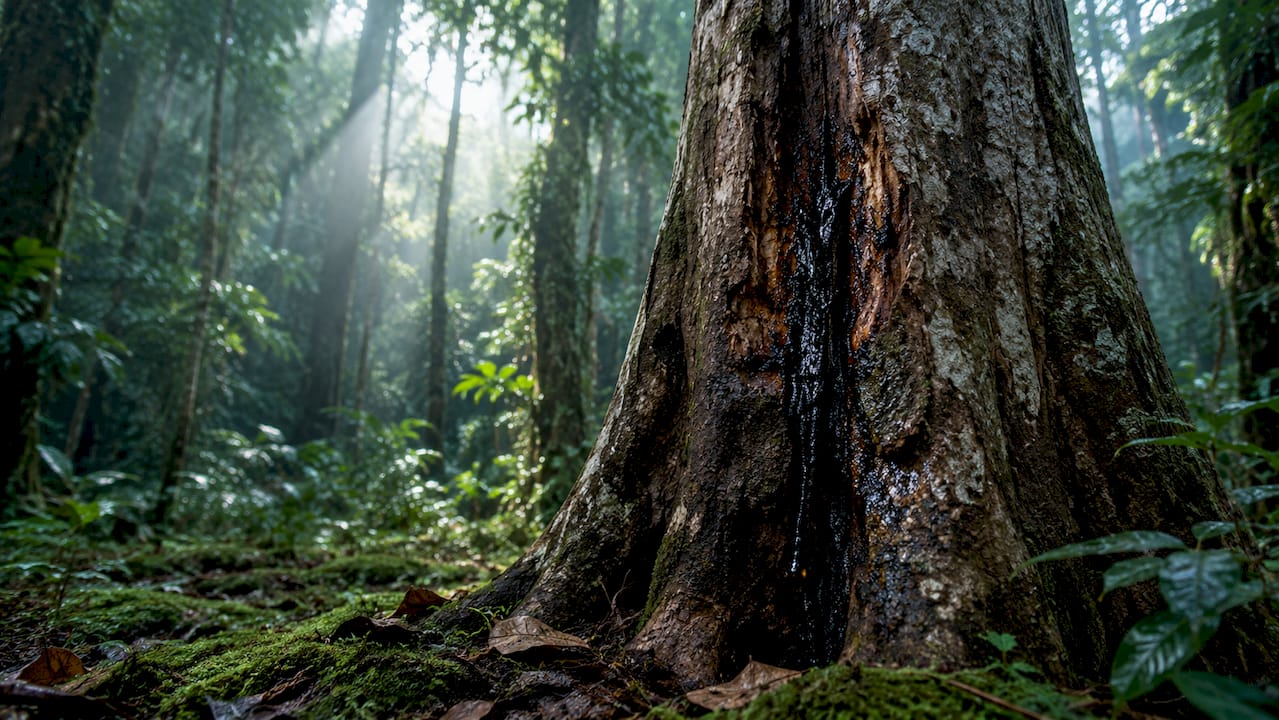
The infection and resin development process can take decades. This is not a crop you can harvest on a seasonal cycle. The slow, unpredictable nature of resin formation makes high-quality oud genuinely difficult to farm at scale. Even on managed plantations, results vary considerably from tree to tree.
Only around 2% of wild Aquilaria trees naturally produce valuable oud resin. That figure explains why authentic oud oil can cost more per gram than gold. The scarcity is not manufactured. It is built into the biology of the ingredient itself.
Pro Tip: When buying an oud fragrance, look for terms like “agarwood oil” or “oud oil” in the listed ingredients. These indicate the presence of genuine oud rather than a purely synthetic substitute.
Key facts about oud production:
- Aquilaria trees grow primarily across South and Southeast Asia, including India, Cambodia, Vietnam, and Indonesia.
- The infection that triggers resin production is caused by Phialophora parasitica and related fungal species.
- Wild oud is now classified as endangered under CITES regulations due to over-harvesting.
- Plantation-grown oud exists but produces resin of variable quality compared to wild sources.
- The harvested wood is then steam-distilled or solvent-extracted to produce oud oil for use in perfumery.
What does oud smell like?
Oud’s fragrance profile includes woody, resinous, smoky, animalic, and sometimes sweet balsamic notes. It is warm and deeply complex. New wearers often describe their first encounter as challenging, even barnyard-like or medicinal. That reaction is normal and expected.
The key to understanding oud’s scent is time. Oud requires warming on skin to fully release its complexity. What opens as something sharp or animalic gradually reveals a warm, balsamic depth over several hours. This evolution is precisely what makes oud so valued by experienced fragrance wearers.
Geographical origin shapes the scent significantly. Indian oud tends to be more intense, leathery, and animalic. Cambodian oud leans sweeter and fruitier. Vietnamese oud often carries a lighter, more honeyed quality. These are not minor variations. They represent genuinely different olfactory experiences from the same base ingredient.
Synthetic oud molecules are widely used in luxury perfumery to replicate the scent at lower cost. Synthetic versions lack the depth and complexity of natural oud. They tend to simplify the aroma, removing the animalic edge and reducing the evolution on skin. Many luxury perfumes blend real oud with synthetics for consistency, but authentic profiles are built around the natural material.
Oud scent characteristics at a glance
| Characteristic | Description |
|---|---|
| Primary notes | Woody, resinous, smoky, animalic |
| Secondary notes | Sweet, balsamic, leathery, honeyed |
| Longevity | Typically over 12 hours on skin |
| Dry-down | Evolves from sharp to warm and balsamic |
| Regional variation | Indian (intense), Cambodian (sweet), Vietnamese (light) |
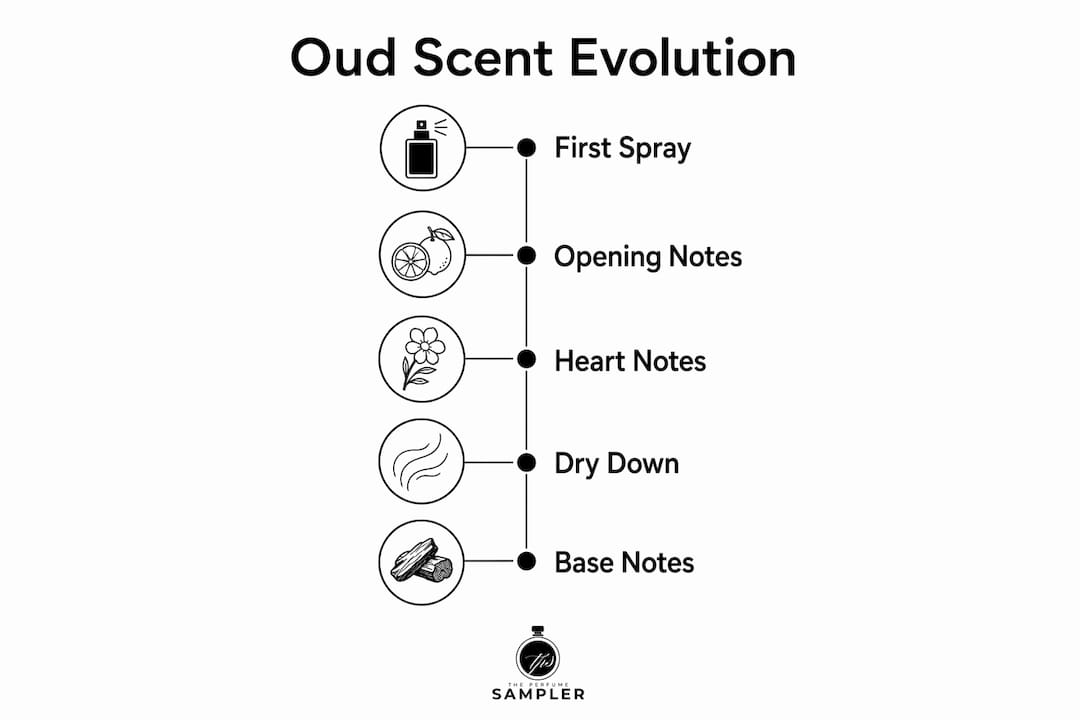
Understanding perfume note layers helps explain why oud performs so differently at first spray versus several hours later.
How is oud used in perfumery and cultural rituals?
Oud’s recorded use in scenting practices dates back to 1400 BC, appearing in ancient Sanskrit texts and embedded in Middle Eastern tradition. That historical depth is not incidental. It explains why oud carries such strong cultural weight today.
Oud holds deep cultural resonance in Middle Eastern societies, functioning as part of daily rituals, celebrations, and religious ceremonies. It is not treated as a luxury add-on. It is woven into identity and tradition. Burning oud wood as incense, known as bakhoor, remains a common practice in homes across the Gulf region.
Modern perfumery has adopted oud as a prestige base note. Its role in a composition is to anchor the fragrance, adding depth, warmth, and longevity. Common pairings include:
- Rose and oud. The classic Middle Eastern combination. Rose softens oud’s animalic edge and adds a floral sweetness. Maison Francis Kurkdjian’s Oud Satin Mood is a well-regarded example of this pairing.
- Amber and oud. Amber adds warmth and a resinous sweetness that complements oud’s base character without competing with it.
- Patchouli and oud. Patchouli brings an earthy, dark quality that deepens oud’s woody dimension.
- Spice and oud. Saffron, cardamom, and pepper are frequently used to add brightness and contrast against oud’s heaviness.
- Musk and oud. Musk extends oud’s longevity and softens its intensity, making the fragrance more wearable for those new to the ingredient.
Oud functions as a base note that anchors compositions and creates complex, elegant scents. This structural role means oud is rarely the first thing you smell in a fragrance. It is what remains and evolves over hours.
How to appreciate and choose authentic oud fragrances
Genuine oud fragrance evolves on skin and rewards patience. The opening minutes are rarely the best representation of what the fragrance becomes. Wearing oud for a full day before forming an opinion is the right approach.
Recognising authentic oud versus a synthetic substitute takes practice. A few practical markers help:
- Complexity over time. Genuine oud changes noticeably from first application to dry-down. Synthetic oud tends to stay flat.
- Animalic quality. Real oud has an edge that synthetic versions smooth away. If a fragrance labelled as oud smells entirely clean and unchallenging from the start, it is likely synthetic-dominant.
- Concentration and price. Genuine oud oil is expensive. Fragrances using real oud at meaningful concentrations reflect that in their price point.
- Composition focus. Look for fragrances built around oud rather than those using it as a background accent. Dior’s Oud Ispahan is a widely cited example of a Western luxury house constructing a full composition around the ingredient.
Pro Tip: Sample before you commit. Oud is an acquired taste, and your reaction to it on day one is rarely your reaction on day ten. Trying a small decant first saves you from spending on a full bottle before you know how the fragrance wears on your skin.
Understanding how fragrance ages also matters with oud. Oud-based fragrances often improve with time in the bottle, as the ingredients continue to integrate and mellow.
Oud is described as a statement ingredient with high longevity and evolving complexity. That description holds true for wearers willing to give it time. Those who dismiss it after a single spray miss the point of the ingredient entirely.
Key takeaways
Oud is defined by its biological rarity, its evolving complexity on skin, and its deep cultural roots across more than three millennia of use in perfumery and ritual.
| Point | Details |
|---|---|
| Biological origin | Oud forms only in Aquilaria trees infected by specific mould, making it genuinely rare. |
| Extreme scarcity | Only around 2% of wild trees produce valuable resin, driving high cost and limited supply. |
| Complex scent profile | Oud is woody, animalic, and resinous, evolving from sharp to warm and balsamic over hours. |
| Cultural significance | Oud use dates back over 3,400 years and remains central to Middle Eastern identity and ritual. |
| Sampling is essential | Oud is an acquired taste; trying a decant before buying a full bottle is the practical approach. |
Oud’s allure: what Western consumers often miss
Most people who try oud for the first time and dislike it are reacting to the opening minutes. That is understandable. The initial animalic quality can be genuinely confronting if you are used to clean, linear fragrances. But judging oud on its opening is like judging a wine before it has had time to breathe.
What I find most fascinating about oud is how it functions differently across cultures. In the Gulf region, oud is not a special occasion scent. It is worn daily, burned in homes, and layered with other materials as a matter of routine. Western consumers often approach it as an exotic novelty rather than a living tradition. That framing leads to misunderstanding.
The misconception I encounter most often is that stronger means better with oud. It does not. The most interesting oud fragrances are those where the ingredient is balanced and given room to evolve. A fragrance that hits you with raw oud from the first second and never changes is not sophisticated. It is just loud.
My honest recommendation: approach oud with the same patience you would give any complex sensory experience. Wear it for a full day. Notice how it changes. Give it a second and third try before deciding it is not for you. The wearers who develop a genuine appreciation for oud rarely go back to simpler fragrances.
— Rupesh
Try authentic oud fragrances with Theperfumesampler
Oud fragrances reward exploration, and the best way to explore is without financial risk.
Theperfumesampler offers a range of high-end oud and oud-blended fragrances in decant sizes of 2ml, 3ml, 5ml, and 10ml. You can try a luxury oud fragrance at a fraction of the full-bottle price, wear it properly over several days, and decide with confidence. All fragrances are 100% authentic. Find out why decants work for discovering complex scents like oud before committing to a full bottle. If you are building your fragrance knowledge, the guide to picking the right fragrance is a practical next step.
FAQ
What is the oud fragrance definition in simple terms?
Oud is the aromatic resin produced inside Aquilaria trees when they become infected by a specific mould. The resin is extracted and used as a fragrance ingredient known for its woody, smoky, and complex scent.
Is oud natural or synthetic?
Oud can be both natural and synthetic. Natural oud is extracted from infected Aquilaria heartwood. Synthetic oud molecules are laboratory-created and widely used in perfumery to reduce cost, but they lack the depth and evolution of the natural material.
What does oud smell like to a first-time wearer?
First-time wearers often describe oud as animalic, barnyard-like, or medicinal on initial application. With time on skin, it evolves into a warm, woody, balsamic scent that most wearers find far more appealing.
How long does an oud fragrance last?
Authentic oud fragrances typically last over 12 hours on skin due to the high concentration and density of the resin-based oil. Oud functions as a base note, which means it is one of the slowest-evaporating components in any fragrance.
How do you wear oud fragrance correctly?
Apply oud to warm pulse points such as the wrists, neck, and inner elbows. Allow it to warm on skin rather than rubbing it in. Give it at least two to three hours before assessing the full scent profile.