
The role of musk in fragrance: a complete guide
TL;DR:
- Musk is a foundational base note in perfumery that anchors fragrances, extends their longevity, and adds skin-like warmth.
- Because it interacts uniquely with individual skin chemistry, musk makes fragrances feel personal and intimate.
- Evolution from natural deer musk to synthetic and botanical alternatives has improved ethical standards and formulation consistency in modern perfumery.
Musk is defined in perfumery as a foundational base note ingredient that anchors a fragrance, slows the evaporation of other notes, and adds a warm, skin-like sensuality to the overall composition. Its role in fragrance is not decorative. It is structural. Without musk, most modern perfumes would fade within hours and lack the intimate depth that makes a scent feel personal. Perfumers from Ernest Beaux, who created Chanel No. 5, to the house behind Narciso Rodriguez For Her have relied on musk to give their compositions staying power and a signature warmth that reads differently on every wearer.
What is the role of musk in fragrance?
Musk functions as a fixative in perfumery. A fixative is any ingredient that slows the evaporation of more volatile top and heart notes, effectively extending the life of the entire fragrance on skin. Musk’s fixative properties also contribute a sensual, skin-like warmth that develops as the fragrance dries down. This is why musk is almost always positioned as a base note: it is the last thing you smell and the quality that lingers on clothing and skin long after the top notes have disappeared.
Beyond longevity, musk shapes how a fragrance interacts with your skin chemistry. Two people wearing the same perfume can smell noticeably different because musk amplifies the wearer’s natural scent. This skin-reactive quality is what perfumers describe when they say a fragrance “becomes your own.” It is also why musk-heavy compositions like Narciso Rodriguez For Her or Initio Musk Therapy feel so personal and intimate rather than generic.
Understanding how fragrances evolve on skin helps explain why musk matters so much in the base. The top notes you smell in the first five minutes are largely irrelevant to how a fragrance performs over eight hours. Musk determines that long-term performance.
How did musk evolve from animal origins to synthetic alternatives?
Natural musk was historically sourced from the musk deer, specifically from a gland found only in adult males of the species Moschus moschiferus. The extraction process required killing the animal, and the yield per deer was small, making natural musk extraordinarily expensive and ethically problematic. Until 1979, musk tinctures were used directly in perfumery before conservation pressure and legal restrictions changed the industry permanently.
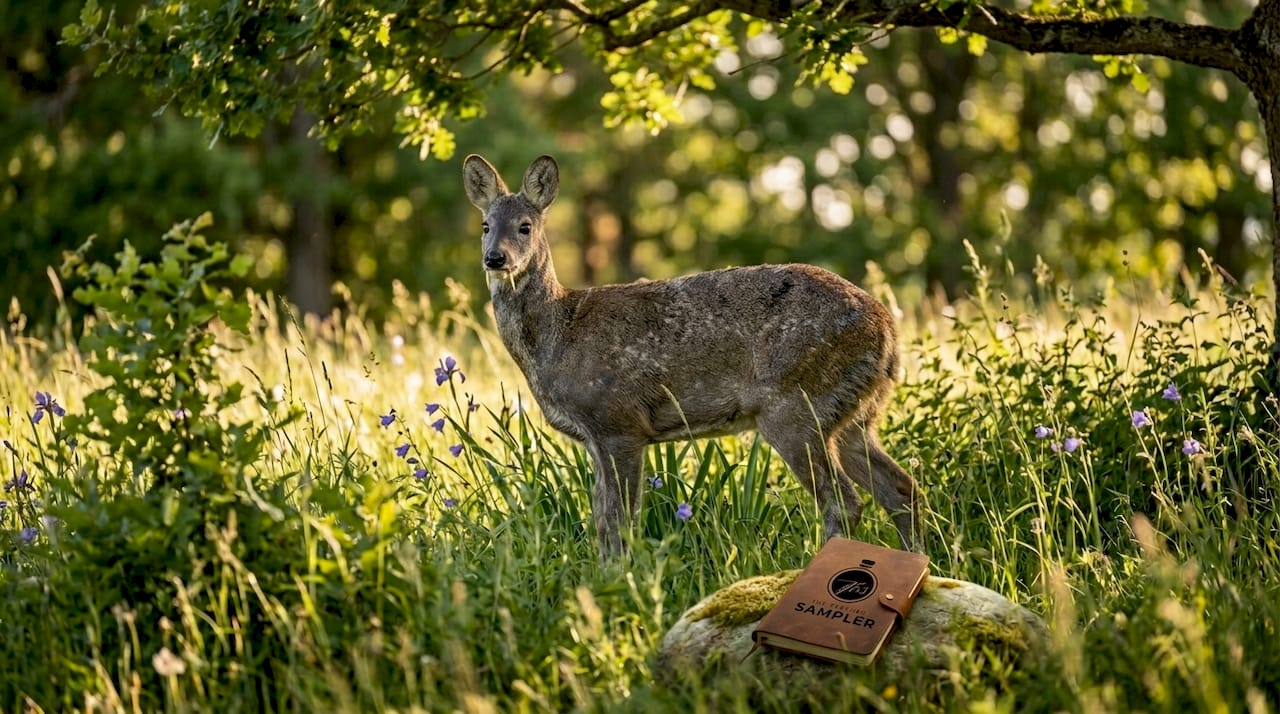
The musk deer’s decline prompted international protection under CITES (the Convention on International Trade in Endangered Species), which effectively ended the legal trade of natural deer musk in most markets. This was not simply an ethical gesture. It was a regulatory necessity driven by the near-collapse of wild musk deer populations across Central Asia and the Himalayas.
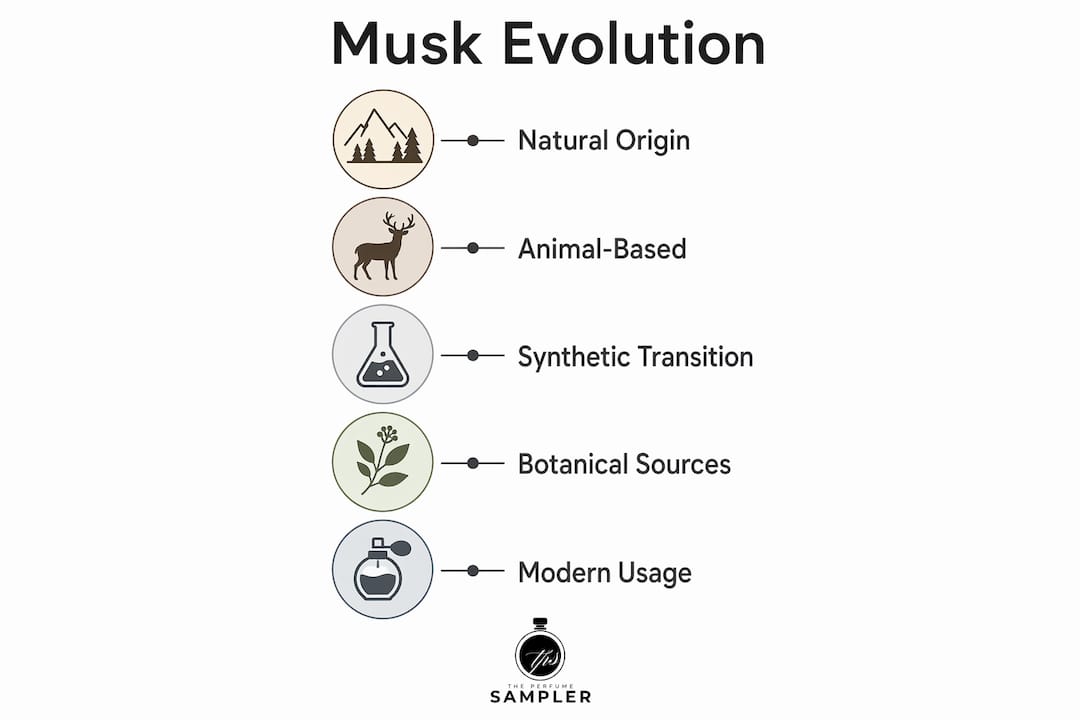
The perfume industry’s response was the development of synthetic musks. Albert Baur’s 1888 discovery of the first synthetic musk, a nitro musk compound, was accidental but transformative. It proved that the characteristic musk scent could be replicated in a laboratory without harming any animal. That discovery set the foundation for the modern fragrance industry.
Key drivers of the transition from natural to synthetic musk include:
- Conservation pressure: CITES restrictions made natural musk trade illegal in most countries
- Ethical concerns: Consumer awareness of animal welfare increased significantly from the 1970s onwards
- Cost and scalability: Synthetic musks are far cheaper to produce at commercial volumes
- Regulatory frameworks: IFRA (International Fragrance Association) guidelines now govern which musk compounds are permitted and at what concentrations
- Bioaccumulation risks: Some early synthetic musks, particularly nitro musks, were found to persist in the environment, accelerating research into safer alternatives
Pro Tip: When reading a fragrance’s ingredient list, terms like “musk” or “muscs” almost always refer to synthetic compounds today. True natural deer musk has not appeared in mainstream commercial perfumery for decades.
What does musk smell like? Scent profiles explained
Musk does not have a single fixed scent. Its character depends entirely on the type of musk compound used and the other notes it is paired with. Musk scent profiles range from warm and powdery to creamy, woody, and milky fresh, with some modern musks producing a clean, airy, linen-like sensation.
The four main classes of synthetic musk each produce distinct olfactory results:
| Musk class | Scent character | Notes |
|---|---|---|
| Nitro musks | Sweet, powdery, warm | Largely phased out due to environmental concerns |
| Polycyclic musks | Clean, fresh, slightly woody | Common in detergents and mainstream fragrances |
| Macrocyclic musks | Rich, animalic, complex | Closest to natural deer musk in character |
| Alicyclic musks | Soft, clean, skin-like | Widely used in fine fragrance for their subtlety |
Multiple synthetic musk classes exist precisely because perfumers need different effects. A fresh aquatic fragrance calls for a clean polycyclic musk. A rich oriental composition benefits from the depth of a macrocyclic musk. The choice of musk class is as deliberate as the choice of any other ingredient.
Common descriptors used by perfumers and fragrance writers to describe musk include:
- Warm and earthy: the animalic quality found in older oriental and chypre compositions
- Powdery: a soft, almost talcum-like effect common in classic feminines
- Creamy: a smooth, skin-close warmth found in many modern niche fragrances
- Clean and airy: the “fresh laundry” effect popularised by polycyclic musks in the 1990s
- Woody: a drier, more structured musk character often paired with sandalwood or cedarwood
Fragrances that showcase musk prominently include Narciso Rodriguez For Her, BOSS Bottled Absolu Parfum Intense, and Initio Musk Therapy. Each demonstrates a different facet of musk’s character, from clean and skin-close to rich and enveloping.
Why is musk so important in modern perfumery?
The importance of musk in perfumery is both technical and sensory. On the technical side, usage levels in fine fragrances typically range from 1 to 5%, a relatively small concentration that delivers a disproportionate impact on longevity and scent development. In personal care products like body lotions and shower gels, musk concentrations are often lower but still serve the same fixative purpose.
| Application | Typical musk concentration | Primary function |
|---|---|---|
| Fine fragrance (EDP/EDT) | 1–5% | Fixative, longevity, skin warmth |
| Body lotion or cream | 0.5–2% | Subtle scent, skin-close warmth |
| Shower gel or soap | 0.1–1% | Residual scent, freshness |
| Hair care | 0.1–0.5% | Lingering clean scent |
Musk also plays a central role in how a fragrance layers and evolves over time. As top notes (citrus, herbs, light florals) evaporate in the first 15 to 30 minutes, and heart notes (rose, jasmine, spices) develop through the middle phase, musk in the base quietly supports everything above it. It acts as a canvas. Without that base, the composition loses coherence as it dries down.
Synthetic musk market growth is driven by rising consumer demand for long-lasting fragrances and environmental concerns, leading to innovations in biotechnological manufacturing. The market is projected to grow from USD 157.11 million to USD 218.14 million, which reflects how central musk remains to the global fragrance industry.
Pro Tip: If you want to make your fragrance last longer, apply it to pulse points immediately after showering. Musk’s fixative properties work best on warm, slightly damp skin where it can bond with your natural scent.
IFRA standards guide usage limits for each musk class due to concerns about persistence and bioaccumulation. This means perfumers do not avoid musk. They select specific musk compounds carefully based on both performance and regulatory compliance.
Are botanical musks the future of ethical perfumery?
Botanical musks represent a third category beyond natural animal musk and fully synthetic compounds. These are plant-derived ingredients that produce a musky scent through their natural chemical composition, without any animal involvement and without the environmental concerns associated with some synthetic musk classes.
Ambrette seed is the most significant botanical musk in current use. Derived from the seeds of Abelmoschus moschatus, a plant in the hibiscus family, ambrette seed absolute produces macrocyclic lactones. These are the same chemical structures responsible for the scent of natural deer musk, which makes ambrette seed a genuinely nature-identical alternative rather than a synthetic approximation.
The scent of ambrette seed is powdery, woody, and slightly floral, with a warmth that sits close to the skin. It functions as a fixative in the same way as synthetic musks, though it is typically more expensive and less consistent in concentration than laboratory-produced alternatives.
Key benefits of botanical musks in modern perfumery:
- Ethical sourcing: no animal harm involved in production
- Environmental profile: biodegradable and free from bioaccumulation concerns linked to some polycyclic musks
- Natural perfumery compatibility: suitable for “all-natural” or “clean” fragrance formulations
- Regulatory acceptance: generally permitted under IFRA guidelines without the restrictions applied to some synthetic classes
- Unique scent character: ambrette seed in particular offers a complexity that many synthetic musks cannot fully replicate
Natural perfumery brands and niche houses are increasingly incorporating ambrette seed and other botanical musks into their compositions. This reflects both consumer demand for transparency in ingredients and a genuine interest in expanding the aromatic palette available to perfumers.
Key takeaways
Musk is the structural backbone of most fragrances, functioning as a fixative that extends longevity, shapes skin chemistry interaction, and provides the warm, sensual depth that defines a perfume’s lasting character.
| Point | Details |
|---|---|
| Musk as a fixative | Musk slows evaporation of other notes, extending fragrance wear from hours to a full day. |
| Synthetic musk dominance | Natural deer musk has been replaced by synthetic alternatives since CITES restrictions in 1979. |
| Scent profile variety | Musk ranges from clean and airy to animalic and rich depending on the chemical class used. |
| Usage concentration | Fine fragrances typically contain 1 to 5% musk, delivering significant impact at low concentrations. |
| Botanical alternatives | Ambrette seed provides an ethical, nature-identical musk option with genuine fixative properties. |
Musk’s enduring appeal: a personal view
I have spent years exploring fragrances across every category, from fresh aquatics to dense orientals, and musk is the one ingredient that consistently determines whether a fragrance feels finished or incomplete. A composition without musk often smells technically correct but emotionally flat. It does not settle into the skin. It just sits on top of it and fades.
What I find genuinely interesting is how musk operates below conscious awareness for most wearers. People rarely identify musk as the reason they love a fragrance. They say it smells “warm” or “like skin” or “like nothing else I have tried.” That is musk doing its job without announcing itself.
The ethical evolution of musk is also worth appreciating rather than glossing over. The shift from deer-derived musk to synthetic and botanical alternatives was not painless for the industry. It required significant investment in chemistry and reformulation. The result, however, is a perfume industry that produces better-performing, more consistent, and more ethically sound fragrances than at any point in its history.
My advice to anyone curious about musk is to seek out fragrances that place it front and centre rather than using it purely as a background fixative. Initio Musk Therapy is a good starting point. It treats musk as the star of the composition rather than the supporting cast. Smelling musk in that context teaches you more about the ingredient than any description can.
— Rupesh
Explore musk fragrances with Theperfumesampler
Theperfumesampler stocks a curated selection of musk-forward fragrances available as decants in 2ml, 3ml, 5ml, and 10ml sizes. This makes it straightforward to experience the full character of a musk-centric composition before committing to a full bottle. Initio Musk Therapy extrait de parfum and BOSS Bottled Absolu Parfum Intense are both available as decants, offering two very different expressions of musk in modern perfumery. If you are new to sampling, the why decants? page explains exactly how the process works and why it is the most practical way to build your fragrance knowledge without overspending.
FAQ
What is musk in perfumery?
Musk in perfumery refers to a class of aromatic ingredients used primarily as base notes and fixatives. Today, virtually all musk used in commercial fragrances is synthetic, derived from laboratory-produced compounds that replicate the scent of natural animal musk.
Why is musk used as a base note?
Musk is used as a base note because its molecular structure evaporates slowly, anchoring more volatile top and heart notes and extending the overall life of the fragrance on skin. Its skin-reactive quality also means it develops differently on each wearer.
What does musk smell like?
Musk scent profiles vary by compound class, ranging from clean and powdery to warm, animalic, creamy, or woody. Polycyclic musks produce the familiar “clean laundry” effect, while macrocyclic musks are richer and closer to natural deer musk in character.
Is natural musk still used in perfumery?
Natural deer musk has not been used in mainstream commercial perfumery since CITES regulations restricted its trade. Musk tinctures were used until 1979 before conservation protections effectively ended the practice.
What is ambrette seed and why does it matter?
Ambrette seed is a botanical musk derived from Abelmoschus moschatus that produces macrocyclic lactones, the same chemical structures found in natural deer musk. It offers perfumers an ethical, biodegradable alternative with genuine fixative properties and a powdery, woody scent character.
Recommended
- What makes a fragrance truly unique: your scent guide – ThePerfumeSampler
- How fragrances evolve: master scent profiles before you buy – ThePerfumeSampler
- How to find your signature scent: a complete guide – ThePerfumeSampler
- How fragrance ageing works: enhance your scent knowledge – ThePerfumeSampler