
How to transition scents for work: quick routines for pros
The easiest way to shift a scent through the working day is layering with intent: wear a low-projection base during office hours, carry a concentrated top-up in oil or rollerball form, then deepen the fragrance with one deliberate application before evening plans. This respects colleagues in shared spaces while still letting you change character after 6pm without going home to shower and start again.
It works because it separates two jobs that a single spray can’t do well. A light daytime base controls projection and settles by the time you’re at your desk. A concentrated evening top-up, applied once and applied precisely, adds depth without the cloud of a full respray in a lift or meeting room. The Fragrance File notes that fragrance applied before leaving home has time to soften before arrival, which is exactly why the timing matters as much as the product. Given that the global fragrance market runs to roughly $53 billion, there’s no shortage of formats built for exactly this kind of discreet control, and Theperfumesampler’s decant model exists specifically to help you test them before committing.
- Morning: a subtle, skin-close scent applied at home
- Midday: a rollerball or hair mist for a quiet refresh
- Evening: one dab of a concentrated oil or extrait to shift the mood
Key Takeaways
A workable day-to-night fragrance routine relies on a low-projection daytime base, a concentrated evening top-up, and deliberate layering rather than repeated spraying.
| Point | Details |
|---|---|
| Choose a light daytime base | Citrus, green notes, soft florals, or clean musks applied at home keep projection low through office hours. |
| Layer with a 3:1 ratio | Start lighter sprays over a heavier oil or extrait base, then adjust the balance for season and skin type. |
| Cap sprays at one or two | Apply to warm pulse points, avoid clothing where possible, and never respray in lifts or meeting rooms. |
| Deepen the scent for evening | A single dab of a concentrated oil or extrait on the wrist shifts the mood without a full reapplication. |
| Sample before buying a bottle | Theperfumesampler’s decants and rollerballs let you test a fragrance across a real workday before committing to a full size. |
Table of Contents
- Quick checklist to transition your scent during the workday
- How to choose a work-appropriate daytime scent
- How do you layer a scent from day to night?
- Where and how much fragrance should you apply at work?
- What’s the etiquette around scent sensitivity at work?
- Why sampling before buying matters for a work wardrobe
- Build a decant kit for your work fragrance wardrobe
- Frequently asked questions
- Sources
Quick checklist to transition your scent during the workday
Run through this before you leave the house, at lunch, and again before you head out for the evening.
- Morning: pick a low-projection daytime scent, apply one to two sprays to pulse points, and let it settle before you leave the house.
- Midday: refresh discreetly with a rollerball, a light mist to hair held at arm’s length, or a single swipe of scented balm.
- Evening: layer a concentrated oil or apply one decisive dab of a deeper note. Skip the full respray in shared spaces.
Pro Tip: Keep the evening top-up in a jacket pocket or desk drawer rather than your bag. You’re less likely to overdo it when the product is a small rollerball rather than a full bottle.
How to choose a work-appropriate daytime scent
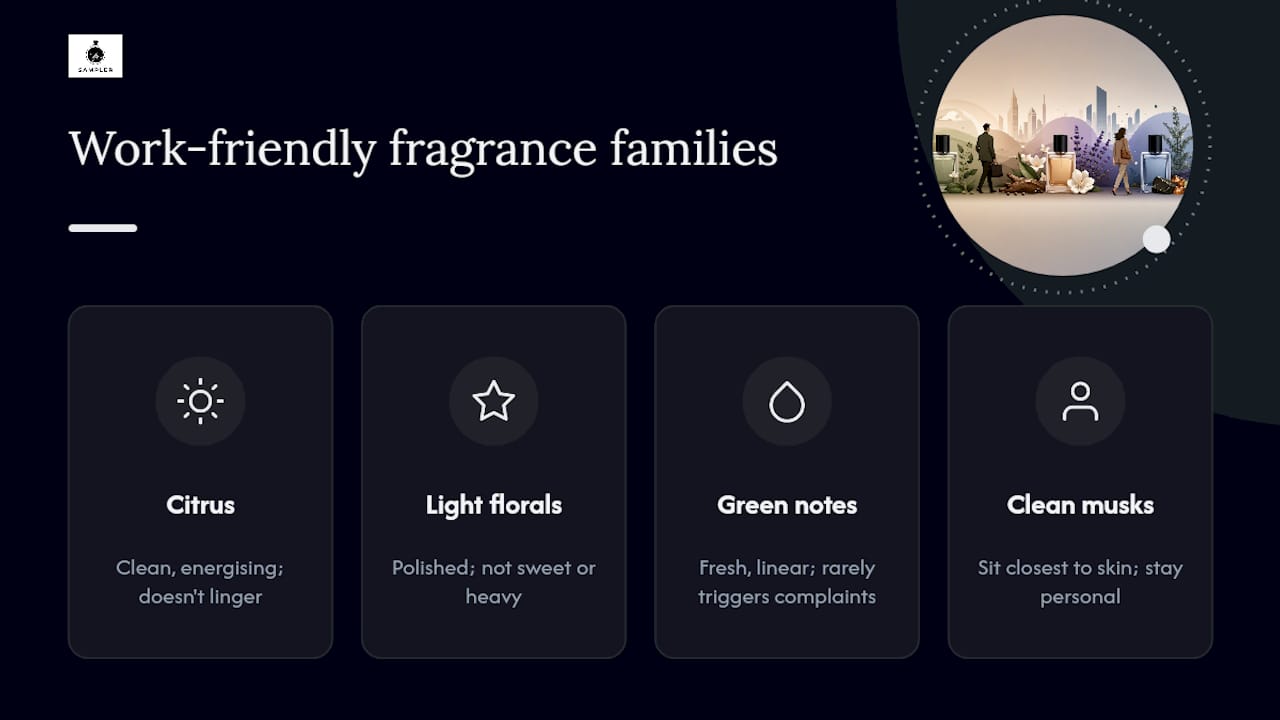
Office-friendly fragrance comes down to a handful of note families that behave well in shared air. Citrus notes (bergamot, mandarin, grapefruit) read as clean and energising without lingering. Light florals (muguet, peony, soft jasmine) feel polished without turning sweet or heavy. Green notes (fig leaf, galbanum, cut grass) bring a fresh, almost linear quality that rarely triggers complaints. Clean musks sit closest to skin and are, according to Allure’s editors, particularly successful in shared workplaces precisely because they stay personal rather than filling a room.
Ranges worth sampling across these families include Byredo and Diptyque for restrained, well-behaved florals and greens, Le Labo for skin-close musks that read as expensive rather than loud, Glossier for genuinely minimal skin scents, Maison Margiela’s REPLICA line for wearable, mood-specific options like fresh linen or beach walks, Phlur for modern, office-safe musks, and Kayali for citrus and fruity notes with enough restraint to work at a desk. None of these need to be an endorsement of one brand over another. The point is that all seven demonstrate the same principle: office-appropriate doesn’t mean forgettable, it means calibrated.
When you’re building this daytime base, favour lighter concentrations. Eau de toilette or fragrance mist formats project less than eau de parfum or extrait, which matters more in an open-plan office than in your living room. Before you buy a full bottle in any of these families, sample it as a decant or rollerball first. Fragrance reads differently on your own skin than it does on a card, and skin chemistry can turn a promising citrus into something sharper or softer than expected.
How do you layer a scent from day to night?
Layering is the technical heart of a good transition, and it works on a simple principle: heavier formats anchor the scent while lighter sprays shape how it first reads. PerfumerOnline’s guide to seasonal layering suggests a starting ratio of roughly 3:1, lighter to heavier, which you then adjust for weather and skin type.
- Morning base. Apply your daytime scent as usual, one to two sprays, and let it settle before you leave.
- Midday hold. If projection has faded by early afternoon, add a small amount of the same scent rather than switching, keeping the profile consistent through the working day.
- Evening depth. Apply a concentrated oil or extrait version of a heavier note, such as amber, oud, or sandalwood, directly to warm pulse points. This becomes your anchor for the evening.
- Adjust for climate. In warm weather, lean lighter on the anchor and heavier on the citrus top note, since heat amplifies projection. In cold weather, the reverse holds: skin runs cooler and fragrance clings closer, so a slightly heavier oil reads as more restrained than it would in summer.
Rollerballs and solid perfumes are the practical tools here. A rollerball delivers a controlled dose without the plume of a spray, which is exactly why it suits a desk drawer or a coat pocket better than a full bottle does.
Three scenarios illustrate the method well. Before a big meeting, a citrus top-up on the wrists lifts energy without adding weight. For a date straight after work, one dab of amber or a woody note on the inner wrist deepens the scent in seconds. For evening networking, a single dab of extrait on the inner wrist reads as intentional rather than heavy, which matters when you’re shaking a lot of hands.
Pro Tip: Test new pairings on blotter strips before committing them to skin, and keep a short note in your phone of which combinations worked. A five-minute habit like this saves you from discovering a clash in the office lift.
Where and how much fragrance should you apply at work?
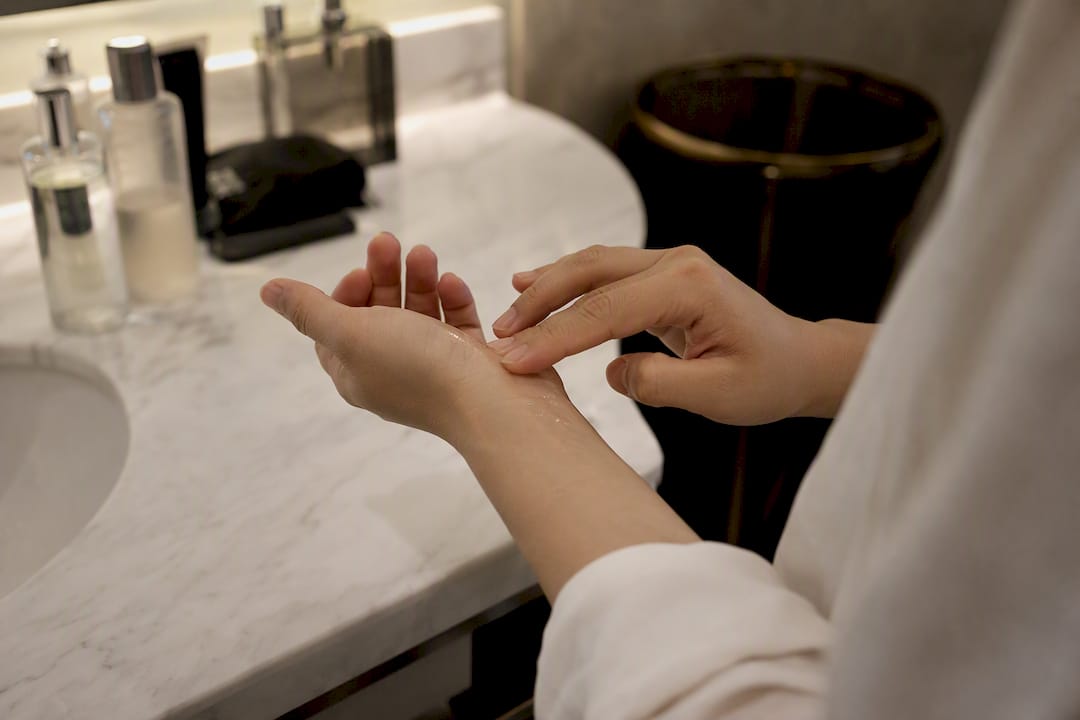
Pulse points work because warmth amplifies scent diffusion, and the classic spots (inner wrists, base of the throat, behind the ear) are joined by two under-used alternatives: the chest, just below the collarbone, and the nape of the neck under hair. Both project upward towards your own face rather than outward towards a colleague’s desk, which is precisely the control you want in an open-plan office.
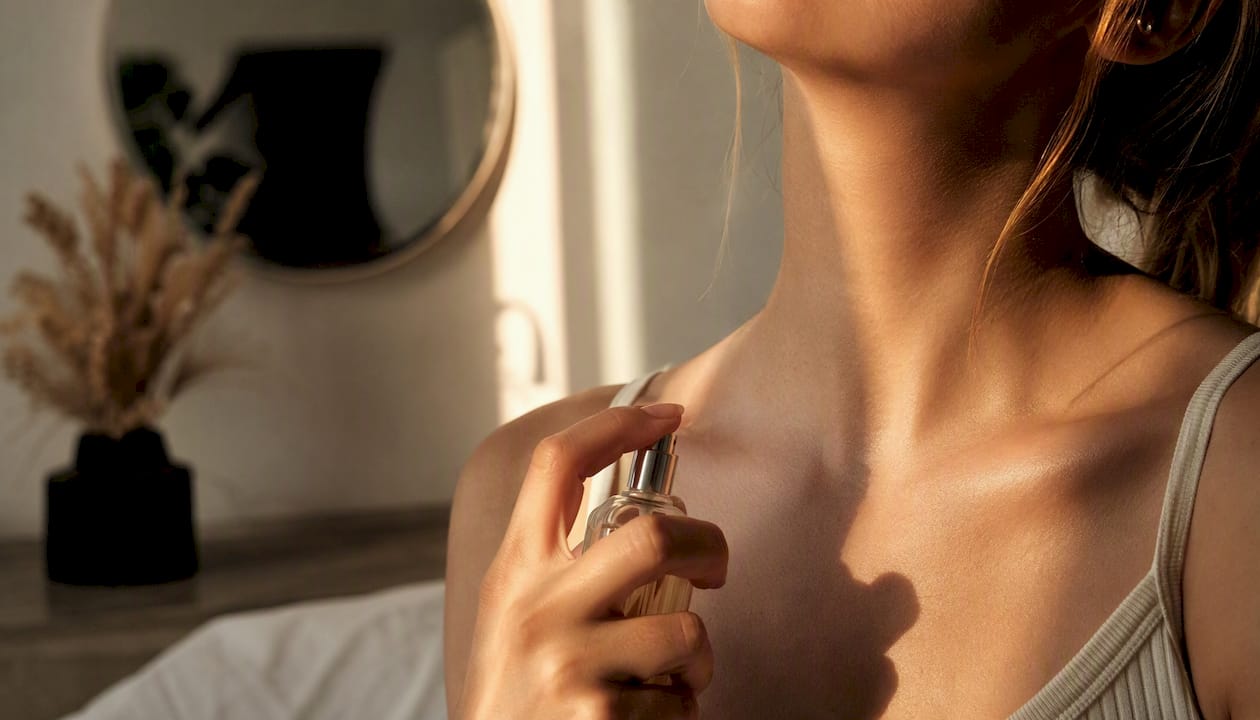
Skin and fabric behave differently. Fragrance on skin fades and mellows as your own chemistry interacts with it; fragrance on wool or cotton tends to sit closer to the surface and can project further, which is why a jacket sprayed at breakfast can still read strongly at 3pm. If you want longevity without loudness, apply to skin, not clothes.
On sprays and dabs: one to two sprays is the sensible ceiling for an open-plan office, rising to two or three in a private office where you control the air around you. For oils and solids, a single dab per pulse point is enough. Doubling up on oil formats rarely doubles the scent. It usually just muddies it.
Longevity comes from preparation more than product. Perkler’s grooming guide recommends applying fragrance to damp skin straight after a shower, since hydrated skin holds scent molecules longer than dry skin does. Matching a scented body lotion or shower gel to your fragrance extends this further, and using decanted oils rather than sprays for touch-ups reduces evaporation loss over the day. One habit to avoid: rubbing your wrists together after applying. It generates friction heat that breaks down the top notes faster, which shortens the very longevity you’re trying to build.
What’s the etiquette around scent sensitivity at work?
Good fragrance etiquette is mostly restraint. Keep it to one or two sprays, applied at home rather than at your desk, and never spray in a lift or a meeting room where others can’t step away. In particularly sensitivity-conscious teams, switch to unscented deodorant and let your fragrance do the only scented work.
Sensitivity is a real workplace issue, not an overreaction. Harper’s Bazaar notes that some workplaces now run formal no-fragrance policies, and moderation is the safest default in open-plan spaces. If a colleague raises a concern, the right response is a quiet thank you and a switch to a lighter application, or a genuinely fragrance-free day, not a defence of your choice of scent. If complaints repeat or a formal policy exists, that’s a conversation for HR, not a debate at your desk.
- Maximum one to two sprays, applied before you leave home
- Never spray in shared, enclosed spaces like lifts or meeting rooms
- Offer a fragrance-free day if a colleague raises a genuine sensitivity
- Escalate to HR only if a workplace policy is already in place
Do coworkers need to be warned before you wear a new scent? Not formally, but introducing something new gradually, at lower strength for the first week, gives you a natural read on reactions before you commit to it as a daily signature.
Why sampling before buying matters for a work wardrobe
Buying a full bottle on a whim is a gamble that a scent designed for a department store will actually behave in your office. Decants remove that gamble. Theperfumesampler’s approach to decants lets you test the same fragrance across a commute, a full workday, and an evening out before spending on a 100ml bottle you might use twice.
A practical kit is small: a 2 to 5ml decant of your daytime candidate, plus a 2ml roller oil of a heavier note for evening testing. That combination covers both halves of the transition routine without the cost or clutter of multiple full bottles.
- Test across real conditions: a full commute, a full workday, an evening plan
- Note projection and longevity, not just the first ten minutes on a blotter
- Build a small rotation of two or three daytime scents plus one evening anchor
Pro Tip: Wear a candidate scent for one entire workday before deciding. Office air, layers of clothing, and central heating all change how a fragrance performs compared with a five-minute test at the counter.
A quick note on building a fragrance wardrobe
Sampling office-appropriate scents across a working week taught me more about projection than any counter test ever did. Testing across a real commute and a full eight-hour day exposes the fragrances that fade politely by 11am versus the ones that quietly take over a shared desk by lunchtime. That’s the workflow behind Theperfumesampler: use samples to rule out the fragrances that won’t work in an office, before you spend on a full bottle that ends up sitting in a drawer.
Build a decant kit for your work fragrance wardrobe
Decants solve the exact problem this guide has walked through: you need a scent that behaves in an office and still has room to deepen for evening, and you won’t know which one until you’ve worn it through a real working day. A 2 to 5ml decant costs a fraction of a full bottle, produces far less waste when a scent doesn’t suit you, and fits easily into a desk drawer or coat pocket for midday touch-ups.
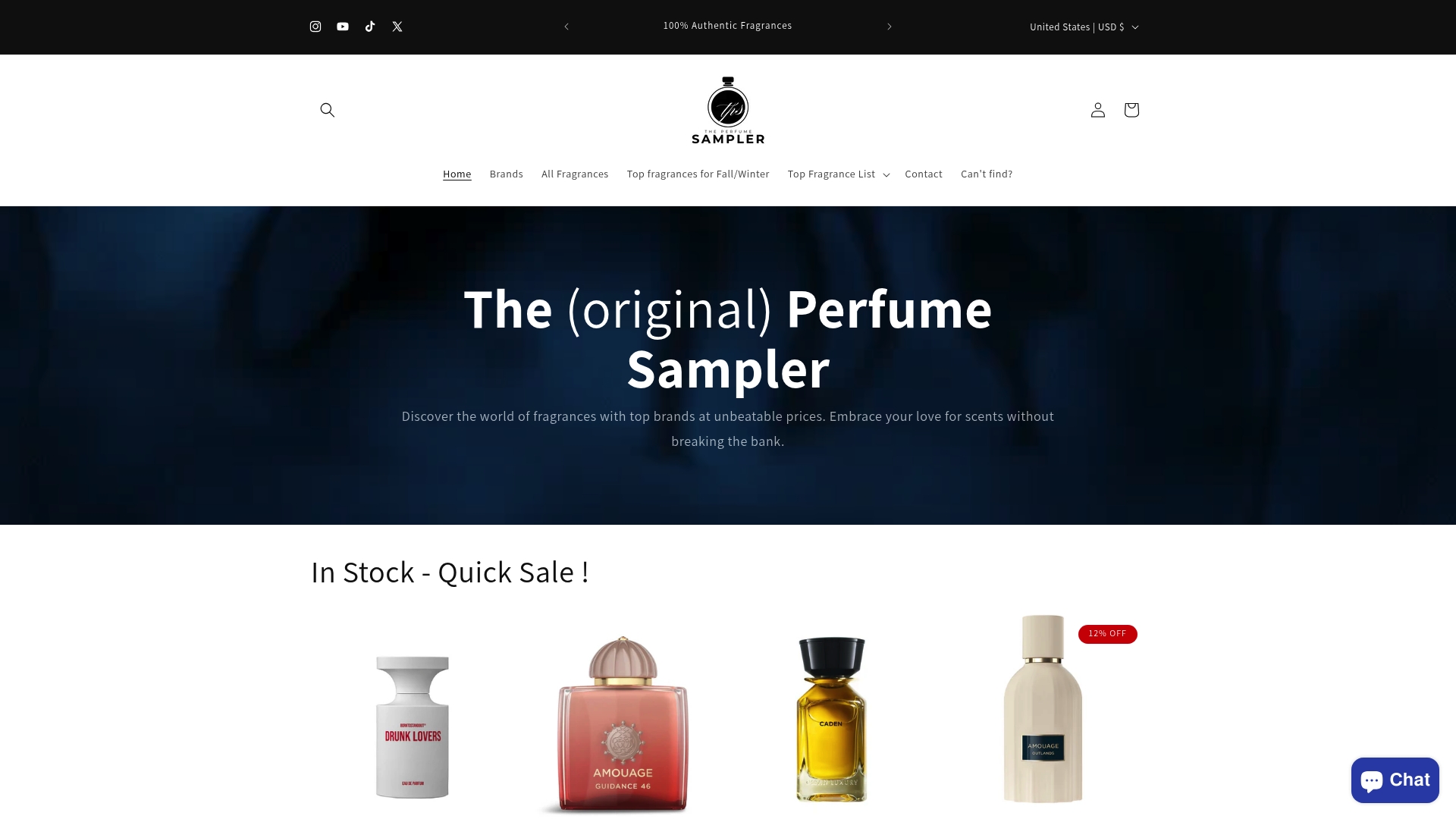
Theperfumesampler stocks decants and rollerballs across the note families covered here, from citrus and green scents suited to daytime wear through to the ambers and woods that work as an evening anchor. If you’re ready to test rather than guess, start with Theperfumesampler’s decant range and build a small rotation before you invest in a full bottle. Pairing a subtle office scent with a considered wardrobe is its own kind of professional polish, something the quiet luxury approach to office style captures well: understated, deliberate, and built to last through the working day.
Frequently asked questions
How many sprays of perfume are appropriate for the office? One to two sprays applied at home is the sensible standard for open-plan offices, rising to two or three only in a private office where you control the surrounding air.
Are strong scents appropriate for work? Generally no. Strong, high-projection fragrances travel further than intended in shared spaces and are more likely to trigger sensitivity complaints, so a lighter daytime base with a concentrated evening top-up serves you better.
What’s the quickest way to refresh a work scent midday? A rollerball, a light hair mist held at arm’s length, or a single swipe of scented balm all refresh a fading scent without the plume of a full respray.
Can I wear the same perfume for work and evening plans? Yes, if you layer it. Keep the same daytime base and add a concentrated oil or extrait version of a heavier note before you leave for the evening, rather than switching fragrances entirely.
Sources
- The art of wearing perfume to work
- Best office fragrances — Allure
- Perfumes at the office — Harper’s Bazaar
- How to choose fragrances for work, evening and weekends — Perkler
Recommended
- Guide to refreshing work fragrances for professionals – ThePerfumeSampler
- Workday fragrance selection guide for professionals – ThePerfumeSampler
- How to refresh fragrance on the go: practical tips – ThePerfumeSampler
- Why professionals wear perfume: confidence, branding, and scent – ThePerfumeSampler