
How to choose a daytime fragrance for daily wear
A good daytime fragrance sits close to the skin, opens bright, and settles into a dry-down you can wear through a full working day without it announcing itself across the room. That’s the whole rule. Daytime scents perform differently to night fragrances because they’re built for shared spaces, not for making an entrance.
The practical next step: narrow your options to two or three candidates and test them as decants or samples before you spend on a full bottle. Theperfumesampler exists precisely for this stage, offering sizes from 2ml to 10ml so you can trial real fragrances instead of guessing from a description. One useful benchmark worth knowing: some brands market fabric longevity figures, which matters more than you’d think once you understand how fabric holds scent differently to skin.
- Pick modest projection over big sillage for daytime wear
- Favour a clean top and heart with a wearable, non-heavy dry-down
- Test 2 to 3 shortlisted candidates on skin before buying a full bottle
Key Takeaways
The best daytime fragrance is a low-projection scent with a clean top, a tidy heart, and a comfortable dry-down, verified on skin across at least two different days before you buy.
| Point | Details |
|---|---|
| Match scent to occasion | Office and commute call for less projection than outdoor errands or cafés. |
| Favour daytime-friendly families | Citrus, green, aquatic, light florals and soft musks wear cleaner in shared spaces. |
| Choose EDT or restrained EDP | Moderate concentration avoids overwhelming enclosed daytime settings. |
| Test at 20 minutes, 2 hours, 6 hours | Multi-stage testing on skin reveals the real dry-down, not just the opening. |
| Start with decants, not bottles | Theperfumesampler’s 2ml to 10ml sizes let you shortlist two or three candidates cheaply before committing to a full bottle. |
Table of Contents
- How to choose a daytime fragrance based on where you’ll wear it
- Which scent families and notes suit daytime wear?
- EDT, EDP, or cologne: which concentration works best for day?
- How does the season affect which daytime scent to wear?
- How should you test a daytime fragrance before buying?
- How much fragrance should you apply, and can you layer it for evening?
- When to buy a full bottle versus sticking with samples
- How Theperfumesampler makes daytime testing affordable
- Frequently asked questions about choosing a daytime fragrance
- Sources
How to choose a daytime fragrance based on where you’ll wear it
“Daytime” isn’t one thing. An open-plan office, a packed commute, and a solo dog walk all call for different scent presence, and the biggest mistake buyers make is picking a fragrance that suits none of them particularly well.
Distance to other people is the deciding factor. In shared indoor spaces, like meeting rooms or a desk beside colleagues, restrained projection matters more than character. Outdoors, where air moves and you’re not sat six feet from anyone for hours, you can afford something with slightly more presence.
- Office or open-plan desk: light citrus, green tea or soft musk, applied sparingly
- Commuting on public transport: minimal spray, close-to-skin scents only
- Client meetings or interviews: clean, low-risk, familiar-smelling notes
- Outdoor errands or dog walks: slightly more latitude for aquatic or green notes
- Cafés and casual social daytime: light florals or citrus, moderate application
- Rule of thumb: if you can smell yourself strongly after 20 minutes indoors, you’ve overdone it
Which scent families and notes suit daytime wear?
Certain families were practically built for daylight hours. Citrus, green, tea, aquatic accords, light florals, transparent woods and soft musks all share one trait: they open cleanly and fade gracefully rather than sitting heavy in a room. This lines up with how experts distinguish day and night fragrance performance — day scents open brighter and wear closer to the skin, while night formulas lean into denser, longer-projecting bases.
Look out for these notes when scanning a fragrance description:
- Bergamot and mandarin: bright, familiar, fade within a couple of hours
- Neroli and petitgrain: floral-green, sharp but not sweet
- Lavender: clean and slightly herbal, good for office wear
- Green tea: quiet, almost neutral, works well under a blazer
- Light cedar: gives structure without heaviness
- White musk: soft, skin-close, ideal as a dry-down anchor
Pro Tip: If a fragrance description leads with “intense,” “opulent,” or “smoky,” it’s probably built for evening. Save it and check its dry-down again after 6 hours before ruling it out for daytime.
Avoid dense ambers, heavy oud, thick resins, and loud gourmand sweetness for daytime wear in shared spaces. These families were designed to project and to last, which is exactly what makes them uncomfortable at close range in an office or on a crowded train. It’s not that they’re poorly made; they’re simply doing their job too well for a 9am desk.
- A good day scent has a tidy heart and a base that stays present without becoming dense
- Curious how a fragrance moves through its stages? Learn how top, heart and base notes evolve before you commit to any bottle
EDT, EDP, or cologne: which concentration works best for day?
Concentration decides how loud and how long a fragrance runs, and getting this wrong is the most common reason a daytime pick feels wrong within a week.
| Concentration | Typical longevity | Typical projection | Best for |
|---|---|---|---|
| Eau de cologne | 2–3 hours | Light | Reapplication throughout the day |
| Eau de toilette | 4–6 hours | Moderate | Most office and daily wear |
| Eau de parfum (restrained) | 6 hours | Moderate to strong | All-day wear with fewer sprays |
Eau de toilette remains the safest default for daytime, though a well-blended EDP applied sparingly, one to three sprays depending on strength, can outlast an EDT without overwhelming a room. Citrus-forward formulas fade fastest regardless of concentration, so budget for a light reapplication after lunch if citrus is your base note. Musk-heavy blends behave differently: they can grow louder as the day warms your skin, so start lighter than you think you need.
- Choose EDT or a light EDP for enclosed daytime settings
- Reserve heavier EDPs for outdoor or low-contact daytime occasions
How does the season affect which daytime scent to wear?
Temperature changes how a fragrance reads on skin, which is why the same scent can feel perfect in April and cloying in August. Warmer months favour citrus, green and aquatic notes, while cooler months suit transparent woods and lighter spice, applied more sparingly than you’d use in summer.

| Season | Note preference | Application adjustment |
|---|---|---|
| Spring/summer | Citrus, green, aquatic | Fewer sprays, heat amplifies scent |
| Autumn/winter | Transparent woods, soft spice | Slightly more sprays, cold air mutes scent |
Watch your microclimate too. A heated office or an air-conditioned commute can each throw off the seasonal rule, so trust how a scent behaves in the room you’re actually sitting in, not just the weather outside.
- In heat, cut your usual spray count by roughly a third
- In heated indoor spaces during winter, a scent can read stronger than it would outdoors
How should you test a daytime fragrance before buying?
Testing properly is the single biggest lever you have over buyer’s regret, and it takes far less effort than people assume. Testing at multiple time marks reveals how a fragrance actually evolves, rather than how it smells in the first five minutes on a card.
- Spray on a pulse point (wrist or inner elbow), never on paper
- Wait 20 minutes before forming any opinion; the top notes are still burning off
- Check again at 2 hours to catch the heart notes
- Check again at 6 hours to judge the dry-down, which is what you’ll wear most of the day
- Repeat on a different day, ideally in a different temperature or setting
Testing in your actual environment matters just as much as timing. Heat, movement and the office you sit in all change how a scent performs, so a fragrance that impressed you at home might behave differently on a warm commute.
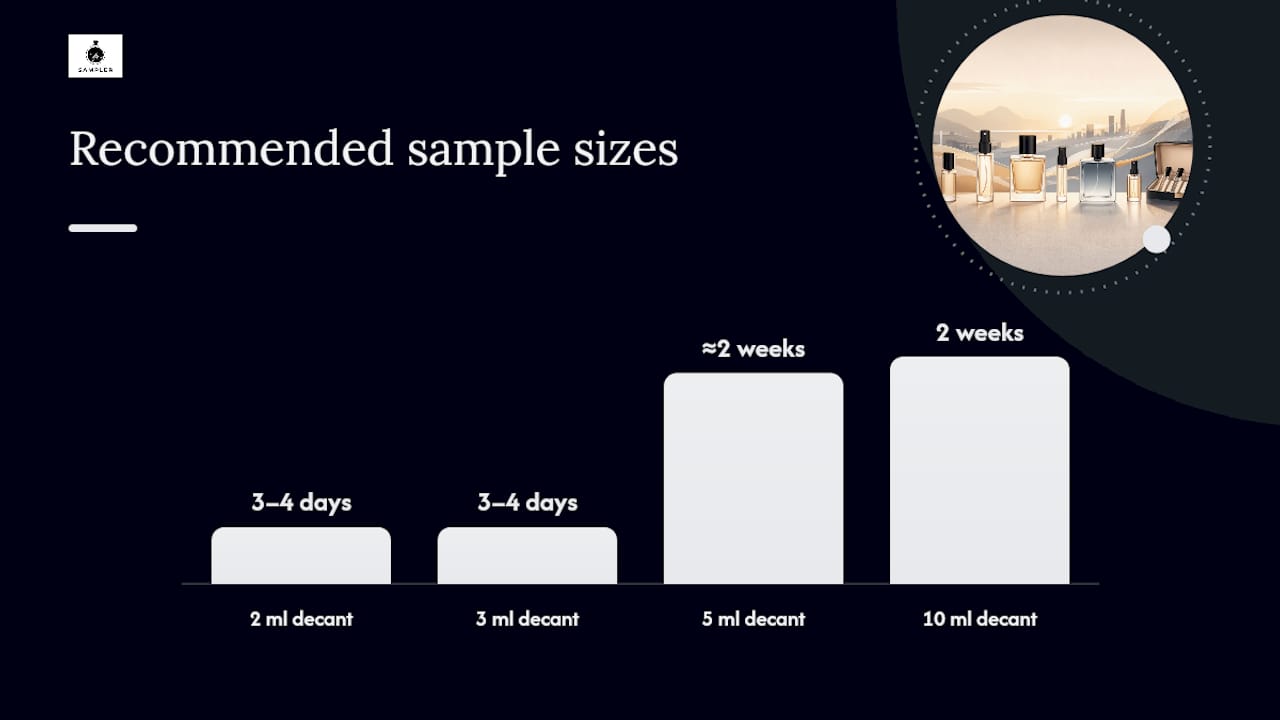
Sample sizes worth buying for this process: a 2ml or 3ml decant covers three or four full test days, a 5ml gives you closer to two weeks of genuine wear-testing, and a 10ml lets you carry a candidate through a full fortnight across different weather and settings.
Pro Tip: Test candidates on the same forearm on separate days rather than both arms at once. Comparing scents side by side on the same day confuses your nose after the first ten minutes; testing solo, one day at a time, gives a far more honest read.
Keep a short notes file. Three lines per candidate, noted at 20 minutes, 2 hours and 6 hours, will do more to narrow your shortlist than any amount of browsing new options. Theperfumesampler’s note-analysis workflow using decants walks through exactly this kind of structured comparison.
How much fragrance should you apply, and can you layer it for evening?
Apply to pulse points, wrists and inner elbow for everyday presence, and add the chest or back of the neck if you need the scent to carry longer into the evening. One to three sprays is usually enough for daytime; more than that in an enclosed space tips into projection territory fast.
Layering lets you add evening depth without starting over. A base with a clean, linear dry-down takes a darker top layer well, because the two don’t fight for attention.
- Wear your daytime scent as normal through the day
- Before heading out in the evening, add one single mist of a deeper, woodier fragrance
- Apply the second layer to chest or collar, not over the original pulse points
- Wait a few minutes before judging the combined result
- Fabric application, on a scarf or jacket lining, can extend how long a scent is noticeable, though it’s worth testing on delicate fabrics first
- Layering body lotion under fragrance can also shift how notes settle; how body products layer with scent is worth understanding if you use unscented or lightly scented lotion daily
- Never spray a second fragrance directly over damp perfume; wait until the first has dried
When to buy a full bottle versus sticking with samples
Commit to a full bottle only once a fragrance has proven itself across genuinely different conditions, not just one good day.
- Days 1 to 3: initial skin test across the protocol above
- Week 2: repeat wear in different weather, different rooms, different moods
- Decision point: buy the bottle only if the scent has evolved consistently and positively each time
- If you’re still buying single decants after four or five candidates, you’re saving money compared to guessing on full bottles
- A full bottle only earns its price-per-wear if you’ll reach for it several times a week, not once a month
- Building a small rotation, rather than one “signature” scent, often serves daytime wear better across a working year; Theperfumesampler’s guide to building a personal scent wardrobe covers how to pick complementary options
- Compare cost per wear before committing; a framework for judging value helps put decant spend against full-bottle spend properly
Storage, allergies and daytime fragrance etiquette
Store bottles upright, away from light and heat; bathroom shelves and windowsills degrade fragrance faster than most people realise. Watch for sudden headaches or skin irritation on first wear, and check your workplace’s fragrance policy before wearing anything with strong projection.
- Keep decants in a drawer, not a bathroom cabinet
- Stop wearing a scent immediately if it causes irritation or a headache
- In shared offices, err towards less rather than more, always
A practical note from Rupesh at Theperfumesampler
Most buyers regret a fragrance because they judged it on one spray, in one room, on one day. The fix isn’t more research, it’s more testing, on skin, across real conditions. Theperfumesampler’s decant sizes exist for exactly this reason. Pick two complementary daytime styles, a citrus and a soft musk, say, and let a fortnight of real wear tell you which one earns a full bottle.
How Theperfumesampler makes daytime testing affordable
Theperfumesampler is the low-risk way to build your daytime shortlist without buying three or four full bottles on a hunch. Rather than committing $100 or more per fragrance before you know how it wears past hour six, you can trial the same luxury names in 2ml, 3ml, 5ml or 10ml decants, at a fraction of the cost.
The catalogue spans designer and niche houses for both men and women, so you’re not limited to whatever sits on a department store counter. Every size in the range maps neatly onto the testing timeline above: a 2ml for a quick first impression, a 5ml or 10ml if a candidate makes it to the two-week wear-in. If a decant earns its place in your rotation, you can move straight to a full bottle, such as the BOSS Bottled Absolu Parfum Intense, without having wasted money getting there. Start by reading why decants make sense before testing, then pick two or three candidates to try this week.
Frequently asked questions about choosing a daytime fragrance
How do I choose a daytime fragrance if I wear it every day? Pick something with modest projection and a dry-down you can tolerate for eight hours straight, then confirm it with a fortnight of real wear before buying a full bottle.
What are the best scents for daytime in summer? Citrus, aquatic and green notes hold up best in heat, since warmth amplifies projection and heavier notes can turn overwhelming fast.
How do I select day-to-night fragrances without changing scents completely? Choose a daytime base with a clean, linear dry-down, then add a single mist of a deeper, woodier fragrance to the chest or collar before evening.
How many sprays should I use for daily fragrance? One to three sprays generally works, depending on concentration; citrus and lighter EDTs can take the higher end, while musk-heavy EDPs need less.
What makes a good daytime scent for the office? Something close to the skin rather than loud across the room, typically light citrus, green tea, or a soft musk applied sparingly.
Sources
The distinction between day and night fragrance performance is well documented, and a few sources are worth returning to if you want to go deeper on any single point raised here.
- Day Perfume vs Night: What Really Changes? | Perfume On Skin
- How to Choose a Perfume for Day to Night Wear – Shay & Blue UK
- Daytime perfume vs nighttime perfume: how to choose the right one | Perfumes LAROME
Theperfumesampler’s sample-first approach lines up directly with the testing method these sources recommend: verify on skin, across time, before you commit to a bottle.