

What is oakmoss in perfume: the complete guide
TL;DR:
- Oakmoss is a lichen from Evernia prunastri that provides an earthy, mossy scent and acts as a fixative in perfumes. Regulatory restrictions have limited its concentration, leading perfumers to blend natural extracts with synthetics like Evernyl to recreate its complexity. Modern oakmoss-based fragrances require patience to appreciate their depth and are best sampled before purchase.
Oakmoss is a lichen-derived fragrance ingredient that provides a distinctive earthy, mossy aroma and acts as a structural fixative in many classic and contemporary perfumes. Known formally as Evernia prunastri, it sits at the foundation of two of perfumery’s most celebrated fragrance families: chypre and fougère. The International Fragrance Association (IFRA) now restricts its concentration due to skin sensitisation concerns, yet oakmoss remains one of the most discussed and sought-after materials in the industry. Understanding what oakmoss is in perfume means understanding how raw nature becomes olfactive architecture.
Where does oakmoss come from?
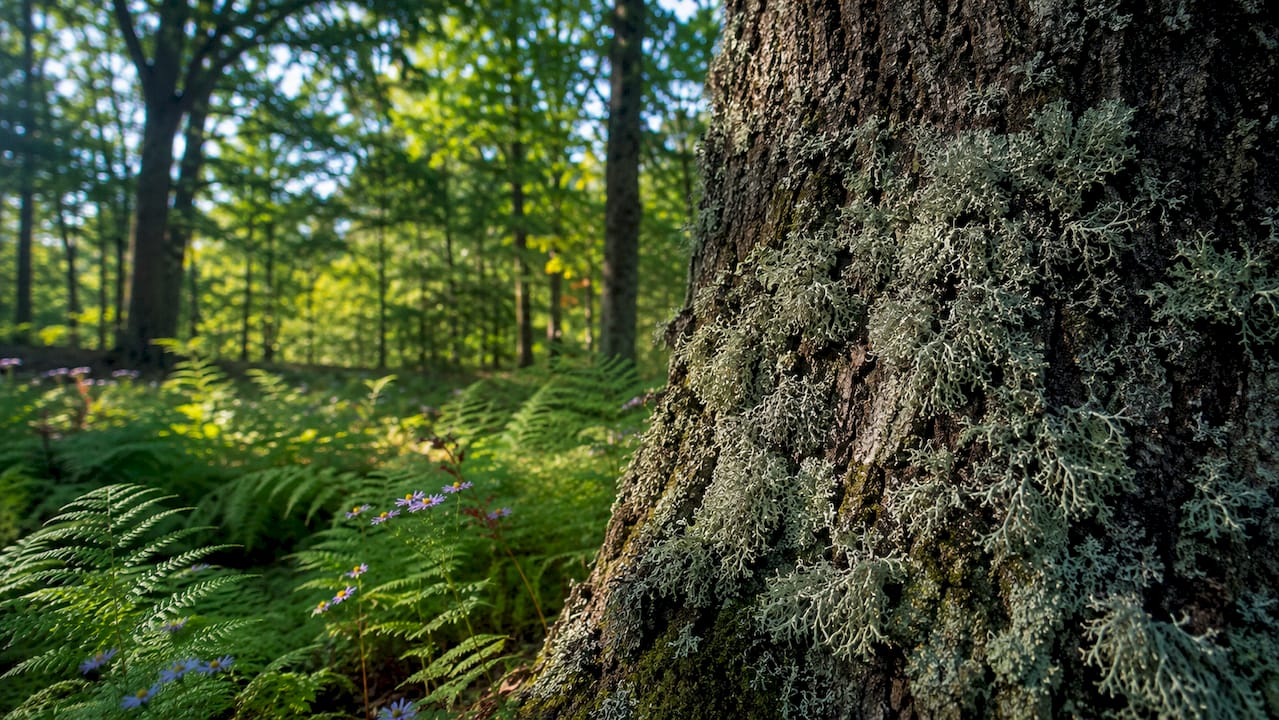
Oakmoss is a lichen, not a true moss. It grows on the bark of oak and other deciduous trees, and is commercially harvested in the temperate forests of South-Central Europe, particularly the Balkans, as well as Morocco. The lichen itself has a grey-green, branching appearance and clings to tree bark in damp woodland conditions.
Harvesting is largely manual. Workers collect the lichen by hand, then dry and transport it to extraction facilities. The raw material is largely odourless at this stage. The characteristic oakmoss scent only develops during solvent extraction, where hydrolytic cleavage of phenolic acids such as evernic acid occurs. This is a critical point that surprises many fragrance enthusiasts: the aroma is not present in nature. It is created by the extraction process itself.
The extraction steps are:
- Solvent washing: dried lichen is washed with a hydrocarbon solvent to dissolve aromatic compounds
- Concrete production: the solvent is removed under vacuum, leaving a waxy concrete
- Absolute production: the concrete is washed with alcohol, then the alcohol is evaporated to yield oakmoss absolute
- Quality grading: the resulting absolute is assessed for colour, viscosity, and odour profile
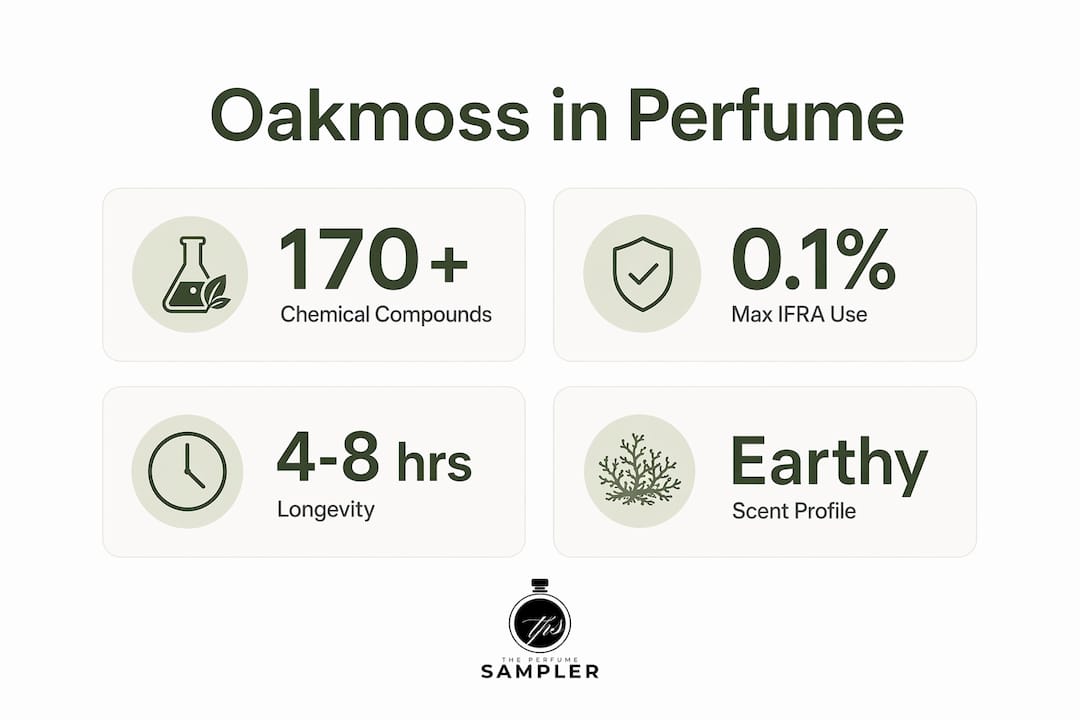
The finished absolute contains over 170 chemical compounds. That complexity is what gives natural oakmoss its depth and makes it so difficult to replicate synthetically.
What does oakmoss smell like in a fragrance?
The oakmoss scent profile is earthy, woody, leathery, and slightly marine, with a cool, damp quality that evokes a forest floor after rain. It is not a pretty or sweet note. It is raw, grounding, and unmistakably natural. That character is precisely why perfumers prize it.
Oakmoss functions as a critical fixative in perfumery, helping volatile top notes persist on skin for four to eight hours or longer. IFRA-compliant oakmoss extracts can retain their scent character on dry blotters for two to five days. That longevity is exceptional compared to most natural ingredients.
Industry experts describe oakmoss as the “architectural cornerstone” of perfumery. Others call it the “concert hall” of a fragrance, the space where all other notes resonate harmoniously. Both descriptions point to the same function: oakmoss does not compete with other ingredients. It supports them.
The key olfactive contributions of oakmoss are:
- Earthy and mossy: a cool, damp, forest-floor quality
- Leathery and woody: dry, slightly animalic undertones
- Marine and green: a faint aquatic freshness beneath the earthiness
- Resinous depth: a subtle balsamic warmth that anchors the composition
Oakmoss anchors both the chypre accord (bergamot, labdanum, oakmoss) and the fougère accord (lavender, coumarin, oakmoss). Classic fragrance families such as chypre and fougère rely on oakmoss as a structural base. Without it, these fragrance types lose their defining character. Understanding fragrance layers and lasting power helps clarify exactly where oakmoss sits in a composition.
Pro Tip: When testing a chypre or fougère fragrance, wait at least 30 minutes after application before assessing the base. Oakmoss notes deepen and clarify as top notes fade.
How do IFRA regulations affect oakmoss use?
IFRA regulations highly restrict oakmoss concentration in consumer products due to skin sensitisation properties identified in the 1990s. The limits apply differently depending on how a product is used.
| Product category | IFRA restriction level |
|---|---|
| Leave-on skin products (perfume, lotion) | As low as 0.1% in finished product |
| Rinse-off products (shower gel, shampoo) | Higher permitted concentration |
| Home fragrance (candles, diffusers) | Most latitude; higher concentrations allowed |
| Fine fragrance (eau de parfum, eau de toilette) | Strict limits; often below 0.1% |
These restrictions have forced the reformulation of many classic perfumes. Fragrances that built their identity on oakmoss-heavy bases had to be significantly altered. The result is that many modern versions of iconic chypre and fougère scents smell noticeably different from their original formulations. IFRA restrictions vary significantly by application category, giving perfumers some room to manoeuvre in rinse-off and home fragrance contexts.
The allergens responsible are primarily atranol and chloroatranol, two compounds found naturally in oakmoss absolute. These are among the most potent contact allergens identified in fragrance materials. Regulatory bodies across Europe have pushed for tighter controls, and IFRA has responded with successive amendments reducing permitted levels.
Pro Tip: If you are sensitive to fragrance allergens, check whether a perfume lists “tree moss extract” or “Evernia prunastri” in its ingredients. Both indicate oakmoss-derived materials are present.
How do modern perfumers work with oakmoss safely?
Modern perfumers do not simply replace oakmoss with a single synthetic substitute. The approach is architectural reconstruction, not direct substitution. Perfumers combine small amounts of IFRA-compliant natural oakmoss absolute with synthetics to rebuild the ingredient’s complexity within legal limits.
The standard modern approach involves several steps:
- Use trace natural oakmoss absolute: a small quantity of compliant natural absolute provides the genuine olfactive foundation that synthetics alone cannot deliver
- Add Evernyl as the primary synthetic: Evernyl provides a dry, phenolic, mossy-earthy character that approximates oakmoss’s core facets
- Layer complementary materials: vetiver, labdanum, and cedarwood fill the woody and resinous gaps that Evernyl cannot cover
- Address the marine and green facets: violet leaf absolute or galbanum can restore the cool, green dimension that natural oakmoss contributes
- Assess the accord on skin: blotter assessment alone is insufficient. Oakmoss’s fixative properties only fully reveal themselves on warm skin over time
Synthetic alternatives like Evernyl mimic some dry, powdery mossy notes but cannot fully replicate the complex “living forest” aroma of natural oakmoss’s 170-plus compounds. Evernyl provides dry, phenolic, mossy-earthy character but lacks green, marine, and animalic facets. That gap is why the architectural approach matters. A single synthetic cannot do the job that a complex natural material does. For guidance on selecting fragrances that use these techniques well, tips for choosing luxury fragrances offer a useful starting point.
The IFRA restrictions have fundamentally altered modern perfumery, requiring perfumers to architect multi-material accords to approximate original oakmoss character. The best contemporary chypre and fougère fragrances succeed not because they found a perfect substitute, but because their perfumers understood oakmoss deeply enough to reconstruct its effect from multiple angles.
How does oakmoss affect your experience of a fragrance?
Oakmoss shapes how a fragrance evolves on skin from the first hour through to the dry-down. Its fixative power stabilises volatile top notes, slowing their evaporation and creating a more gradual, satisfying transition through the fragrance’s stages. Oakmoss contributes to perfume longevity and underlies the evolution of a fragrance on skin, providing a lasting earthy and woody base that balances lighter notes.
Recognising oakmoss in a fragrance is a learnable skill. The signs to listen for include:
- A cool, damp earthiness that appears in the heart and base
- A sense of weight and grounding beneath brighter floral or citrus notes
- A leathery or slightly animalic quality in the dry-down
- Longevity that outlasts what the top notes suggest
Oakmoss-forward fragrances tend to suit cooler weather and evening wear. Their depth and seriousness make them less suited to casual daytime use, though personal preference always governs. Understanding how fragrances evolve on skin helps you appreciate exactly what oakmoss is doing at each stage of wear. Professionals who wear fragrance as part of their personal presentation often gravitate toward oakmoss-based compositions for their authority and staying power.
Key takeaways
Oakmoss is the structural foundation of chypre and fougère perfumery, functioning as a fixative, harmonic bridge, and base note that no single synthetic has yet fully replaced.
| Point | Details |
|---|---|
| Botanical origin | Oakmoss is the lichen Evernia prunastri, harvested mainly in the Balkans and Morocco. |
| Scent development | The characteristic aroma forms during solvent extraction, not in the raw lichen itself. |
| Fixative role | Oakmoss extends fragrance longevity significantly, anchoring volatile top notes on skin. |
| Regulatory limits | IFRA restricts oakmoss to as low as 0.1% in leave-on products due to skin sensitisation. |
| Modern formulation | Perfumers combine trace natural absolute with synthetics like Evernyl to rebuild oakmoss’s complexity. |
Oakmoss and the art of what we’ve lost
I have spent years working with fragrance, and oakmoss is the ingredient that makes me most aware of what regulation costs. Not in a resentful way. The allergen concerns are real, and the science behind IFRA’s decisions is sound. But the honest truth is that the chypre fragrances produced before the 1990s restrictions had a quality that modern versions, however skilfully made, do not quite match.
What oakmoss does that nothing else does is provide genuine ambiguity. It smells like something alive and something ancient at the same time. It is not comfortable. It does not flatter. It simply grounds a fragrance in a way that makes everything else around it more credible.
The perfumers I respect most do not mourn the restrictions. They treat them as a design constraint, the way a poet treats a fixed form. The best contemporary chypre fragrances are genuinely impressive precisely because they achieve their effect under such tight limits. That takes real craft.
My advice to anyone curious about oakmoss is to seek out older formulations where you can find them, and to compare them directly with modern versions of the same fragrance. The difference is instructive. It will teach you more about what oakmoss actually does than any description can. Then explore the modern interpretations with fresh appreciation for the skill involved.
— Rupesh
Oakmoss fragrances worth sampling before you commit
Oakmoss-based fragrances reward patience. Their depth only reveals itself over hours of wear, which makes sampling before purchasing a full bottle the sensible approach.

Theperfumesampler offers fragrance decants in 2ml, 3ml, 5ml, and 10ml sizes, covering niche and designer fragrances that feature oakmoss as a base note. Sampling lets you assess how a fragrance’s earthy, mossy foundation develops on your skin across a full day of wear. That is the only reliable way to know whether an oakmoss-forward fragrance suits you. Read more about why decants make sense before investing in a full bottle. All products sold by Theperfumesampler are 100% authentic.
FAQ
What is oakmoss in perfume?
Oakmoss is a lichen-derived fragrance ingredient from Evernia prunastri that provides an earthy, mossy, leathery scent and acts as a fixative in perfume compositions. It is foundational to chypre and fougère fragrance families.
Is oakmoss still used in perfumes today?
Oakmoss is still used in perfumery but at very low concentrations. IFRA regulations limit its use to as low as 0.1% in leave-on products due to skin sensitisation concerns identified in the 1990s.
What does oakmoss smell like?
Oakmoss smells earthy, damp, woody, and slightly leathery, with a cool, forest-floor quality. It is not sweet or floral. Its scent only develops during solvent extraction, not in the raw lichen.
What is the difference between oakmoss and synthetic substitutes?
Natural oakmoss absolute contains over 170 compounds that create a complex “living forest” aroma. Synthetics like Evernyl replicate the dry, mossy facets but lack the green, marine, and animalic dimensions of the natural material.
Which fragrance families rely on oakmoss?
Chypre and fougère are the two fragrance families most dependent on oakmoss. Chypre accords combine bergamot, labdanum, and oakmoss, while fougère accords use lavender, coumarin, and oakmoss as their structural base.