

What is a fragrance aesthetic: your scent identity guide
TL;DR:
- A fragrance aesthetic is a personal scent identity based on patterns in the fragrances a person prefers over time. It reflects personality, mood, and life stages, shaping how individuals express themselves through scent. To build one, observe your habits, test on skin, and keep a journal to discover scents that truly resonate with you.
A fragrance aesthetic is defined as the olfactory equivalent of a personal style signature, expressing identity through a curated collection of scents rather than a single perfume. The concept shifts the conversation away from “signature scent” and towards a scent wardrobe that reflects personality, mood, and life chapters. Fragrance literacy, the conscious ability to read and project scent identity, has become a genuine form of self-expression that operates alongside fashion and interior style. Understanding your fragrance aesthetic is the first step towards choosing scents that feel genuinely yours rather than simply well-marketed.
What is a fragrance aesthetic and why does it matter?
A fragrance aesthetic is your personal scent identity, built from the patterns in the fragrances you are drawn to across time. It is not one bottle on a shelf. It is the recognisable thread running through every scent you reach for, whether that is smoky woods, bright citrus, powdery musks, or green florals.

The shift from a single signature scent to a fragrance wardrobe reflects how consumers now use scent for self-expression rather than habit. Perfume choice encodes social and personal identifiers beyond conscious taste, linking fragrance to class, generation, geography, and psychology. That means the scents you wear are already telling a story about you, whether you have thought about it or not.
Fragrance creators in niche perfumery take this further. Conceptual perfumery treats scent as a message rather than a product, using deliberate artistic frameworks to translate emotions and narratives into olfactory experiences. Understanding this context helps you see your own scent choices as part of a broader creative language, not just a consumer habit.
Examples of popular fragrance aesthetics
Different scent identities cluster into recognisable styles. These are not rigid categories. They are useful reference points for identifying your own preferences.
- Dark romantic: Rich, resinous, and sensual. Think oud, amber, incense, and dark rose. This aesthetic favours depth and mystery over brightness.
- Clean minimalist: Fresh, airy, and understated. White musks, soft woods, and light aquatics define this style. The goal is presence without weight.
- Green botanical: Earthy, herbal, and natural. Vetiver, fig, moss, and cut grass characterise this aesthetic. It reads as grounded and uncontrived.
- Gourmand: Warm, edible, and comforting. Vanilla, tonka bean, praline, and coffee notes dominate. This aesthetic is unapologetically indulgent.
- Coastal and aquatic: Light, ozonic, and open. Sea salt, driftwood, and marine accords create a sense of space and movement.
Pro Tip: Write three adjectives that describe how you want to smell before you ever enter a shop or browse online. Those adjectives are the beginning of your fragrance aesthetic.
How can you identify your personal fragrance aesthetic?
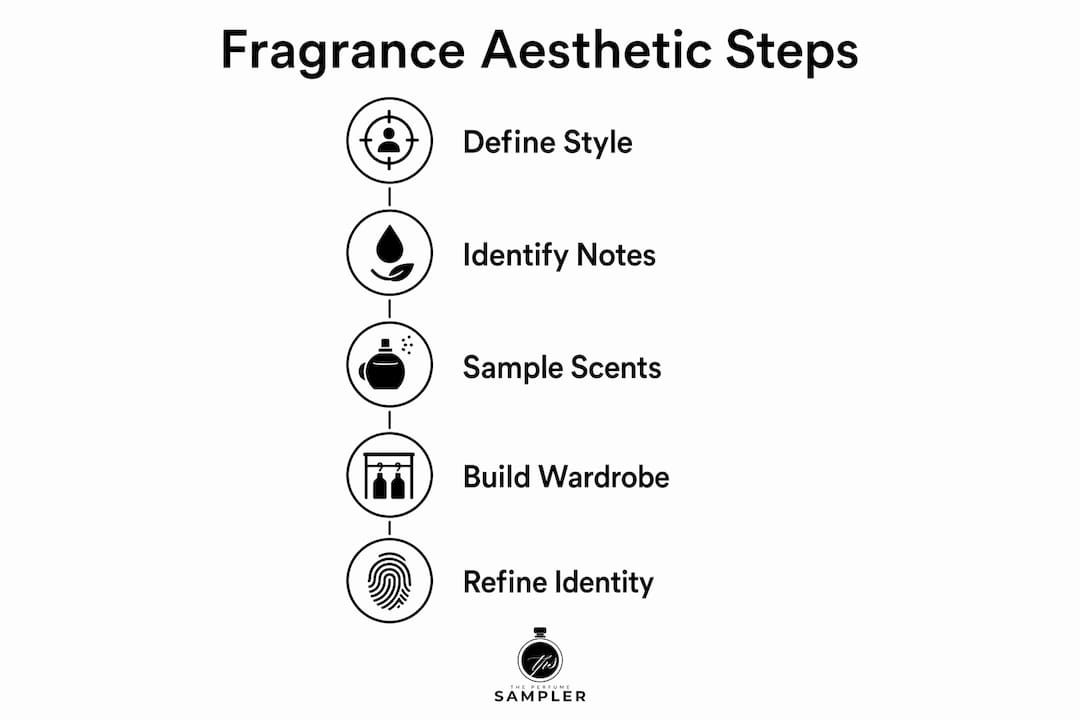
Identifying your scent identity requires honest observation of your existing habits and preferences. Most people already have a fragrance aesthetic. They simply have not named it yet.
Follow these steps to clarify yours:
- Audit your current collection. Line up every fragrance you own or have owned. Look for patterns in the notes, the occasions you wore them, and the ones you finished versus abandoned.
- Identify your scent memories. The fragrances that stopped you in a shop, the smell of a place you loved, or a scent worn by someone you admired all point towards your instinctive preferences.
- Write descriptive adjectives. Avoid note-based language at first. Instead, describe how you want to smell: warm, sharp, quiet, bold, nostalgic, clean. These adjectives become your filter when evaluating new fragrances.
- Test on skin, not paper. Skin chemistry significantly alters how a fragrance develops. Warm skin intensifies base notes. Cool skin can flatten them. Always wear a fragrance for several hours before deciding whether it belongs in your wardrobe.
- Keep a scent journal. A scent journal records your reactions to fragrances over time, separating genuine resonance from marketing-driven enthusiasm. Note the date, the scent, where you wore it, and how it made you feel.
Pro Tip: Sampling before buying is the single most reliable way to test skin chemistry. Theperfumesampler offers decants in 2ml, 3ml, 5ml, and 10ml sizes, which gives you enough time to wear a fragrance properly before committing to a full bottle.
The table below maps common scent descriptors to the fragrance families they typically correspond to, giving you a practical starting point.
| Descriptor you want | Fragrance family to explore |
|---|---|
| Warm and comforting | Oriental, gourmand, amber |
| Fresh and clean | Citrus, aquatic, white musk |
| Earthy and grounded | Chypre, woody, green |
| Mysterious and rich | Oud, leather, smoky resinous |
| Soft and romantic | Floral, powdery, iris |
Common misconceptions about fragrance aesthetics
The most widespread misconception is that a fragrance aesthetic is restrictive. It is not. A fragrance aesthetic acts as a compass, not a cage. It gives you direction without locking you into a single style.
Several other misunderstandings are worth addressing directly:
- You can only have one aesthetic. False. Holding multiple overlapping scent identities is entirely normal. Someone can wear a clean minimalist scent to work and a dark romantic fragrance on evenings out. Both belong to the same person.
- Your aesthetic is fixed. Scent identity evolves with life seasons. A fragrance that felt right at twenty may feel wrong at thirty-five. That is not inconsistency. That is growth.
- Liking a scent means it fits your aesthetic. Liking and belonging are different things. You can appreciate a fragrance without it feeling instinctively yours. Your aesthetic is defined by the scents that feel like recognition, not just approval.
- Wearing the same fragrance every day builds a stronger identity. Rotating fragrances prevents olfactory fatigue and keeps your relationship with each scent fresh. A well-curated wardrobe of four to six fragrances serves most people better than a single bottle worn daily.
Consumer perfume choices increasingly prioritise rich storytelling and emotional dimension. That cultural shift means the market now supports fragrance aesthetics far more than it did a decade ago, with niche and artisan houses producing scents designed for specific moods and identities rather than mass appeal.
How to integrate fragrance aesthetics into your everyday life
Building a working fragrance wardrobe requires a practical system, not just good taste. The goal is a small, cohesive collection that covers different moods, seasons, and occasions without overlap or redundancy.
Shopping without marketing bias
Marketing is the biggest obstacle to building an authentic scent identity. Advertising tells you how a fragrance should make you feel before you have smelled it. That pre-framing distorts your reaction.
- Avoid reading fragrance descriptions before testing. Smell first, read after.
- Ignore bottle design and brand prestige during the evaluation stage. Both are irrelevant to whether a scent fits your aesthetic.
- Use scent sampling to test fragrances in real conditions before spending on a full bottle.
- Free sampling programmes, such as those offered by Fragonard, provide low-risk access to new scent profiles.
Building your scent wardrobe by occasion
A practical wardrobe covers four core contexts: daytime casual, professional, evening, and seasonal. You do not need a separate fragrance for every situation. You need enough variety to match your mood and context without reaching for something that feels wrong.
Pro Tip: Start with two fragrances that sit at opposite ends of your aesthetic spectrum. One lighter, one richer. Those two anchor points reveal the full range of your scent identity faster than buying five similar bottles.
Understanding notes and layering
Fragrance literacy enables conscious identity projection through scent. Understanding the three-layer structure of top, heart, and base notes helps you predict how a fragrance will behave on your skin over time. Top notes are what you smell in the first five minutes. Base notes are what remain after two hours. Your aesthetic is most accurately reflected in the base.
Layering two complementary fragrances is a legitimate technique for creating a scent that feels entirely personal. A clean musk layered under a dark resinous fragrance, for example, softens the intensity while adding depth. The combination becomes something neither bottle achieves alone.
Key takeaways
A fragrance aesthetic is the recognisable pattern in your scent choices that communicates identity, and building one requires honest self-observation, skin testing, and a willingness to treat your fragrance wardrobe as an evolving creative project.
| Point | Details |
|---|---|
| Definition is clear | A fragrance aesthetic is your scent identity, built from consistent patterns across the fragrances you choose. |
| Aesthetics are flexible | You can hold multiple overlapping scent identities that shift with mood, season, and occasion. |
| Skin testing is non-negotiable | Skin chemistry changes how fragrances develop, so always wear a scent for several hours before deciding. |
| A scent journal builds clarity | Recording reactions over time separates genuine resonance from marketing-driven enthusiasm. |
| Marketing distorts judgement | Smell before reading descriptions to protect your instinctive response from pre-framing. |
Fragrance aesthetics and what they have taught me
Rupesh’s perspective:
The most useful thing I have learned about fragrance aesthetics is that most people already have one. They simply have not articulated it. When I started paying attention to the scents I kept returning to, the pattern was obvious within weeks. Dark, woody, slightly smoky. That was not a decision I made. It was something I noticed.
What surprised me more was how much the aesthetic shifted when my circumstances changed. A period of working outdoors pulled me towards green and earthy fragrances. A quieter, more interior phase brought me back to resins and ambers. The wardrobe followed the life, not the other way around.
The practical lesson is this: treat scent selection as a reflective process, not a shopping exercise. The fragrances that feel right are the ones that match where you are, not where you think you should be. Sampling widely and recording your reactions honestly is the fastest route to a collection that genuinely represents you.
— Rupesh
How Theperfumesampler supports your scent wardrobe
Building a fragrance aesthetic takes time and testing. Committing to a full bottle before you know how a scent performs on your skin is the most common and most expensive mistake in fragrance shopping.
Theperfumesampler offers 100% authentic fragrance decants in 2ml, 3ml, 5ml, and 10ml sizes, covering niche and designer fragrances from houses across the world. The why decants? page explains exactly how sampling works and why it is the most reliable method for building a cohesive scent wardrobe. For those ready to add a specific fragrance to their collection, Theperfumesampler also stocks full bottles, including options such as BOSS Bottled Absolu for those drawn to warm, rich aesthetics.
FAQ
What does fragrance aesthetic mean?
A fragrance aesthetic is the recognisable pattern in your scent choices that expresses your personal identity through smell. It functions like a style signature, built from the fragrances you consistently reach for across different moods and occasions.
How do I start creating my fragrance aesthetic?
Audit your existing fragrances, identify the descriptive adjectives that match how you want to smell, and test new scents on your skin over several hours before deciding whether they fit. Keeping a scent journal accelerates the process significantly.
Can I have more than one fragrance aesthetic?
Yes. Holding multiple overlapping scent identities is entirely normal. A clean daytime aesthetic and a dark evening aesthetic can coexist within the same wardrobe and belong to the same person.
Why does skin chemistry matter for fragrance aesthetics?
Skin chemistry alters how a fragrance develops, particularly in the base notes that define your long-term scent impression. Warm skin intensifies base notes, while cool skin can flatten them, which is why testing on skin rather than paper is the only reliable method.
What is the difference between a signature scent and a fragrance aesthetic?
A signature scent is a single fragrance worn consistently. A fragrance aesthetic is the broader identity expressed through a curated wardrobe of scents that share a recognisable character, even when they vary by occasion or season.