
Why fragrance becomes identity: the science behind scent
TL;DR:
- Repeated scent choices reinforce neural representations, transforming fragrance into a personal identity.
- Fragrance also signals social traits through chemosignals that influence trust and recognition subconsciously.
- Cultural norms shape scent preferences, making fragrance a complex expression of both identity and context.
Fragrance becomes identity when repeated scent choices build distinctive neural representations that connect memory, emotion, and social signalling, turning a smell into a signature of who you are. This process is not accidental. Neuroscience, social biology, and cultural learning all explain how a bottle of perfume shifts from something you wear to something you are. Research from eLife, PLOS Biology, and the NOMIS Foundation confirms that scent operates on the brain and on social perception in ways most people never consciously register. Understanding why fragrance becomes identity gives you a more deliberate relationship with the scents you choose.
Why fragrance becomes identity: the neuroscience
The brain does not treat scent the way it treats sight or sound. Smell bypasses the thalamus entirely and connects directly to the hippocampus and amygdala, the regions responsible for memory and emotion. This is why a single whiff of a fragrance can return you to a specific afternoon years ago with startling precision.
Repeated exposure deepens this effect. A 2026 eLife study found that experience reshapes neural odour representations along the cortico-hippocampal pathway, increasing selectivity and strengthening memory encoding with each exposure. The brain essentially tunes itself to recognise your scent as yours. That is the neurological foundation of a signature scent.
Subjective perception matters here too. A 2026 PLOS Biology study showed that olfactory bulb-cortex oscillations encode perceived odour intensity rather than physical concentration. This means two people wearing the same fragrance at the same strength can experience it entirely differently. Your identity scent is partly a product of your own neural architecture, not just the liquid in the bottle.
Sensory adaptation adds another layer. With consistent wear, your brain reduces its response to a familiar scent. This is not a flaw. According to Allure’s 2026 expert analysis, signature scents act as evolving anchors rather than fixed smells, shifting subtly as your perception adapts over time. Your scent identity is therefore dynamic, not static.
Pro Tip: Wear a new fragrance across at least five different contexts, including work, rest, and social occasions, before deciding whether it feels like “you.” Neural scent associations form over multiple exposures, not a single wearing.
Key mechanisms that build scent identity in the brain:
- The cortico-hippocampal pathway strengthens odour selectivity with repeated exposure
- Perceived intensity is encoded neurally, making scent experience deeply personal
- Sensory adaptation causes your brain to treat a familiar scent as background, reinforcing its role as an anchor
- Contextual memory links a fragrance to specific emotions, people, and places over time
How does scent signal identity to other people?
Your fragrance does not just define you to yourself. It communicates something to everyone around you, often without a single word being spoken. Humans produce distinctive odour profiles that function as social chemosignals, influencing trust, friendship, and cooperation at a subliminal level. The NOMIS Foundation’s 2026 research identifies these human volatilomes as genuine social communication cues, not background noise.

The role of fragrance in social settings is therefore more biological than most people assume. When you wear a consistent scent, you are adding a deliberate layer to your natural chemical signature. People around you begin to associate that scent with your presence, your reliability, and your character, all without conscious processing.
The role of fragrance in networking is particularly well documented. Professionals who wear a consistent scent are perceived as more put-together and trustworthy, partly because scent cues influence social bonds beyond what people consciously register. A fragrance worn consistently at professional events becomes part of your personal brand in the most literal neurological sense.
Social traits that scent cues influence in others:
- Trust: Familiar scents reduce social wariness and increase comfort
- Recognition: A consistent fragrance makes you more memorable in group settings
- Affiliation: Shared or complementary scent profiles correlate with stronger social bonds
- Perceived confidence: A well-chosen fragrance signals intentionality and self-awareness
- Emotional recall: Others remember interactions more vividly when a distinctive scent is present
The importance of scent in identity extends beyond personal feeling. It shapes how others construct their memory of you.
Does culture determine which scents feel like “you”?
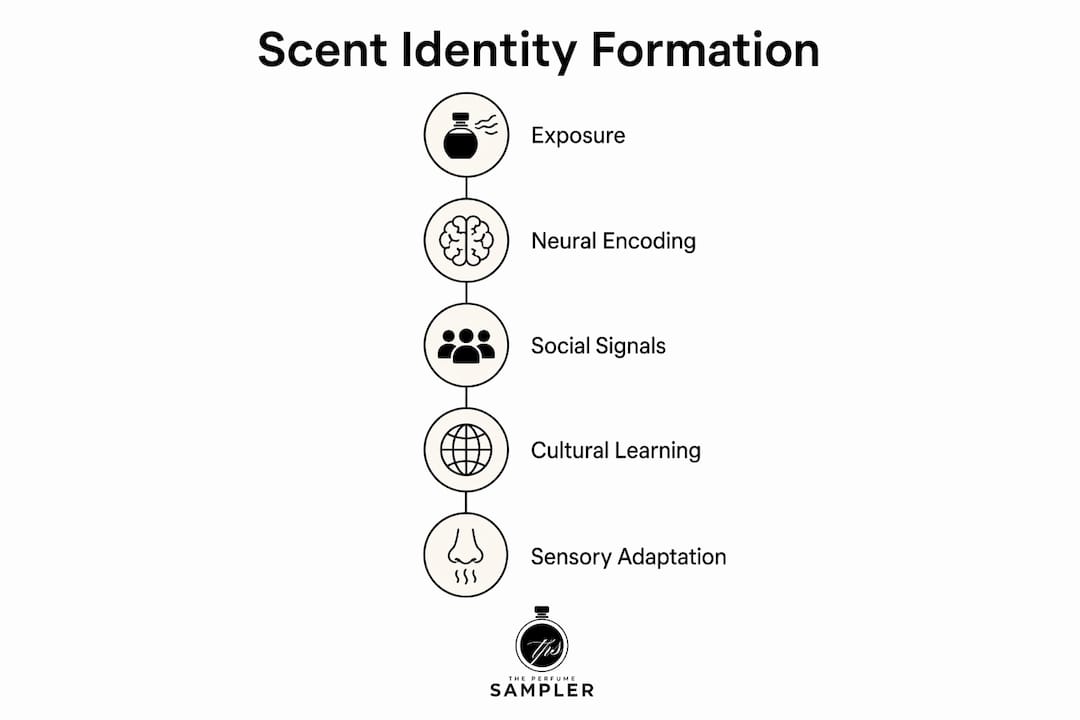
Scent preference is not purely personal. Cultural learning shapes which fragrances feel pleasant, appropriate, and identity-forming. The Conversation’s 2026 analysis confirms that smell preferences develop socially, meaning the same fragrance note can carry entirely different personal meaning depending on where and how you grew up.
In many Middle Eastern cultures, oud is a marker of prestige and social belonging. In Japan, subtle and clean fragrances signal respect and restraint. In Western Europe, heavier florals and musks have historically indicated femininity or formality. These are not arbitrary preferences. They are learned associations reinforced by family, community, and repeated social experience.
This cultural dimension explains why fragrance and personal identity are inseparable from context. A scent that feels deeply “you” in one country may read as unusual or even off-putting in another. Your fragrance identity is partly a product of the cultural vocabulary you absorbed growing up. Recognising this gives you more control over how you use scent as self-expression when you move between social contexts.
Cultural scent norms also evolve. Younger generations in the UK and US are increasingly drawn to gender-neutral and niche fragrances, reflecting a broader shift in how identity is expressed. Fragrance in youth culture now leans toward individuality over convention, with scent choices functioning as deliberate statements of difference rather than conformity.
The practical implication is clear. When you choose a fragrance, you are not just selecting a smell. You are selecting a cultural signal, and that signal will be read differently depending on your audience.
How to build a fragrance identity that actually reflects you
Building a personal scent profile is a deliberate process, not a single purchase decision. The neuroscience confirms that scent memory forms across multiple contexts over time, so consistency and variety both play a role.
A fragrance wardrobe is a more useful concept than a single signature scent. Rather than committing to one fragrance for all occasions, you build a small collection where each scent anchors a specific mood, setting, or version of yourself. One for work, one for evenings, one for weekends. Each becomes a neural anchor for that context.
Here is a practical approach to building your scent identity:
- Identify your scent families. Decide whether you gravitate toward woody, floral, oriental, or fresh categories. This narrows your search considerably.
- Sample before committing. Wear a fragrance for a full day before judging it. Top notes fade within an hour; the base notes are what stay on your skin and define the scent.
- Wear each candidate across multiple contexts. A fragrance that works at a desk may feel wrong at a dinner. Test it in the settings where you want it to define you.
- Notice how others respond. Compliments are data. If people consistently mention a particular scent, that is a signal it is working socially as well as personally.
- Allow your wardrobe to evolve. As the Allure 2026 analysis notes, signature scents evolve with adaptation, so revisit your choices annually rather than treating them as permanent.
Pro Tip: When building a fragrance wardrobe, start with one scent per life context rather than buying broadly. Depth of association matters more than variety. A fragrance worn consistently in one setting builds stronger neural and social identity than five fragrances worn interchangeably.
Understanding how fragrances evolve on skin is also worth studying before you invest in full bottles. Skin chemistry alters how a fragrance develops, which is why sampling is the most reliable method for building a scent identity that genuinely fits.
Key takeaways
Fragrance becomes identity through repeated neural encoding, social chemosignalling, and cultural learning, making scent one of the most personal and persistent forms of self-expression available.
| Point | Details |
|---|---|
| Neural encoding builds scent identity | Repeated exposure strengthens cortico-hippocampal odour representations, making a scent feel like “you.” |
| Scent signals identity to others | Human volatilomes act as social chemosignals influencing trust, recognition, and affiliation below conscious awareness. |
| Culture shapes scent preference | Learned social norms determine which fragrances feel appropriate and identity-forming in a given context. |
| A wardrobe outperforms one signature scent | Multiple contextual scents build stronger, more precise neural and social associations than a single fragrance. |
| Sampling is the most reliable method | Testing a fragrance across multiple days and settings is the only way to confirm it genuinely reflects your identity. |
Scent identity is more fluid than most people realise
By Rupesh
Most fragrance advice treats identity as something you find once and keep. My experience suggests the opposite. Scent identity is one of the most fluid aspects of personal expression, and the people who wear fragrance most confidently are the ones who treat it as something that evolves rather than something that is fixed.
I have noticed that the fragrances I was drawn to in my twenties no longer feel accurate. Not because they are bad fragrances, but because I am a different person in different contexts now. The neuroscience backs this up. Neural odour representations shift with repeated exposure and life context, so it makes sense that your scent identity would shift too.
What I find most compelling is the social dimension. The role of fragrance in self identity is partly about how you feel, but it is equally about the signal you send to others without speaking. A consistent, well-chosen scent communicates something about your character that words cannot replicate. That is not a small thing.
My honest view is that most people underinvest in this area because they treat fragrance as a finishing touch rather than a core element of self-presentation. Sampling widely, wearing deliberately, and allowing your choices to evolve are the habits that separate people who wear fragrance from people who use it as identity.
— Rupesh
Discover your scent identity with Theperfumesampler
Building a fragrance identity starts with exploration, and committing to a full bottle before you know a scent is the most common mistake. Theperfumesampler offers fragrance decants in 2ml, 3ml, 5ml, and 10ml sizes, giving you the opportunity to wear a fragrance properly before deciding. The BOSS Boss Bottled Absolu Parfum Intense is one example of a fragrance that rewards extended wear, revealing its full character across multiple days. All samples are 100% authentic. Find out why decants work as the most practical method for building a scent wardrobe that genuinely reflects who you are.
FAQ
Why does fragrance feel so personal compared to other accessories?
Scent connects directly to the hippocampus and amygdala, the brain regions governing memory and emotion, which is why fragrance triggers stronger personal associations than visual or auditory cues.
How long does it take to form a signature scent identity?
Neural odour representations strengthen with repeated exposure across multiple contexts, so a fragrance typically needs several weeks of consistent wear before it becomes a genuine identity anchor.
Does your fragrance identity change over time?
Sensory adaptation and life changes both alter scent perception, meaning your fragrance identity naturally evolves. Allure’s 2026 expert analysis confirms that signature scents function as evolving anchors rather than fixed choices.
Can fragrance influence how others perceive you professionally?
Human volatilomes act as social chemosignals that influence trust and recognition below conscious awareness, making a consistent, well-chosen fragrance a genuine factor in professional perception.
Is scent preference cultural or personal?
Both. Research from The Conversation confirms that scent preferences develop socially through cultural learning, while individual neural architecture shapes how each person experiences a given fragrance.
Recommended
- How perfume empowers self-expression and personal style – ThePerfumeSampler
- Fragrances in youth culture: identity and trends – ThePerfumeSampler
- Why scents smell different: A guide to fragrance variation – ThePerfumeSampler
- Why professionals wear perfume: confidence, branding, and scent – ThePerfumeSampler