

What is a dark fragrance: the complete guide
TL;DR:
- Dark fragrances are characterized by heavy base notes like oud and amber that create mysterious and layered scents. They evolve slowly on the skin, revealing a shadowy, emotional depth over time, especially in cooler seasons and evening settings. Sampling beforehand with decants helps ensure the scent’s complexity and long-lasting appeal suits individual chemistry.
A dark fragrance is a type of perfume defined by rich, heavy notes that unfold slowly to create a mysterious and enveloping scent experience. The term “dark fragrance” is not an official perfumery classification. The recognised industry term is “oriental” or “chypre” for many of these scent families, though “dark fragrance” has become widely used to describe any perfume with a deep, shadowy character. Understanding what makes a fragrance dark helps you choose scents with confidence, whether you are new to niche perfumery or refining an existing collection.
What are the main characteristics of dark fragrances?
Dark fragrances are defined by a chiaroscuro effect, creating dimensionality through complex layering that reveals itself slowly over time. The term “chiaroscuro” comes from visual art, describing the contrast between light and shadow. In perfumery, it describes how a scent shifts from a brighter, lighter opening to a dense and heavy base as the lighter molecules evaporate.
The sensory traits that distinguish dark scents from lighter ones are consistent across the category:
- Heavy base notes. Ingredients such as oud, amber, patchouli, and incense form the foundation. These notes are dense and slow to fade.
- Resinous and smoky accords. Smoky woods, labdanum, and benzoin add a dry, almost burnt quality that reads as dark and intense.
- Earthy and spicy elements. Vetiver, leather, and black pepper contribute a grounded, slightly austere character.
- Low brightness. Dark fragrances rarely open with sharp citrus or green notes. When they do, those notes disappear quickly, leaving the heavier structure behind.
- Emotional weight. Darkness in fragrance is a subjective label shaped by scent complexity, slow evaporation, and emotional association, not literal colour or ingredient.
The brain translates complex or unfamiliar smells into emotional labels such as “mysterious” or “intense.” This is why two people can smell the same perfume and one finds it oppressive while the other finds it compelling.
Pro Tip: If you are new to dark scents, start with an amber-based fragrance rather than a full oud or smoke-forward one. Amber is warm and approachable, making it the most accessible entry point into the dark fragrance category.
What types of notes and ingredients create dark fragrances?
Dark fragrance notes include oud, amber, patchouli, and incense, alongside smoky or resinous accords. These ingredients share one key property: they are built from heavier, slower-evaporating molecules that stay close to the skin and create a dense, lingering presence. That molecular weight is the technical reason these notes read as “dark” rather than fresh or airy.
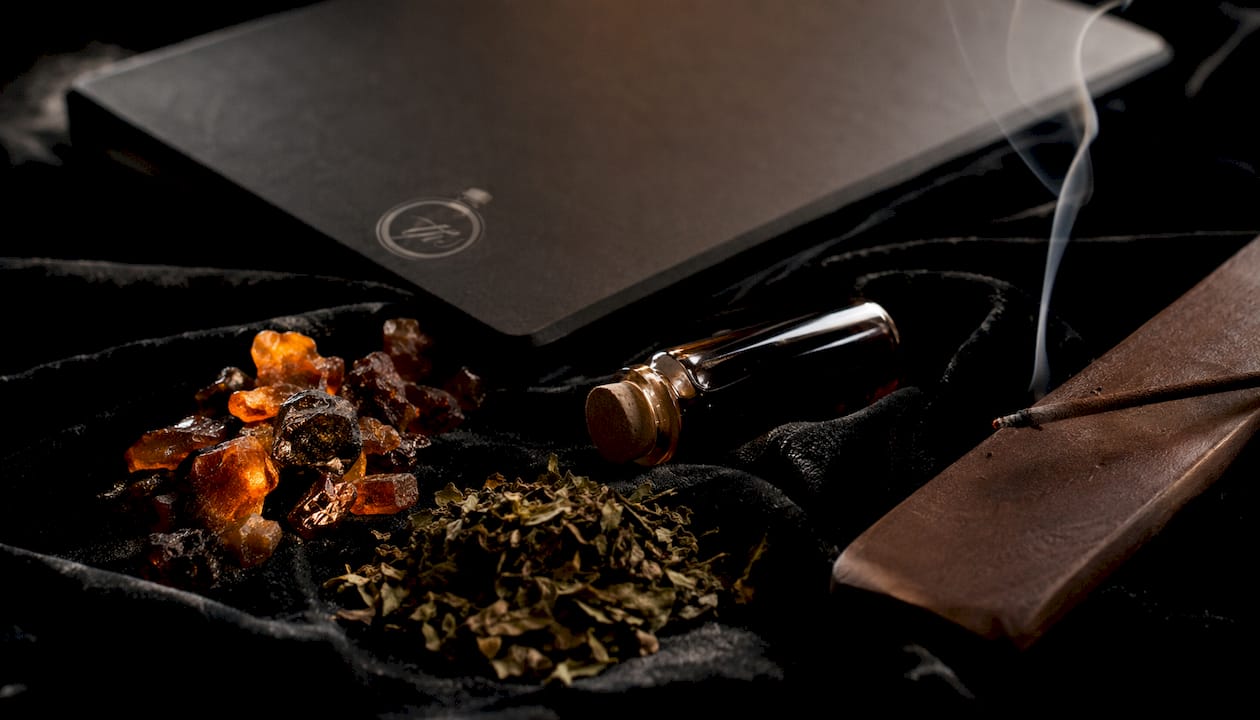
The note families most associated with dark fragrances fall into four broad groups.
| Note family | Typical scent traits | Role in dark fragrances |
|---|---|---|
| Woods (oud, sandalwood, vetiver) | Smoky, earthy, dry, or creamy | Anchor the base; provide depth and longevity |
| Resins (amber, benzoin, labdanum) | Warm, sweet, balsamic, slightly sticky | Add richness and a slow-burning sweetness |
| Spices (black pepper, cardamom, cinnamon) | Sharp, warm, dry | Create contrast and lift within a heavy structure |
| Musks (dark musk, animalic musks) | Skin-like, earthy, slightly animalic | Bind all other notes together; extend wear time |
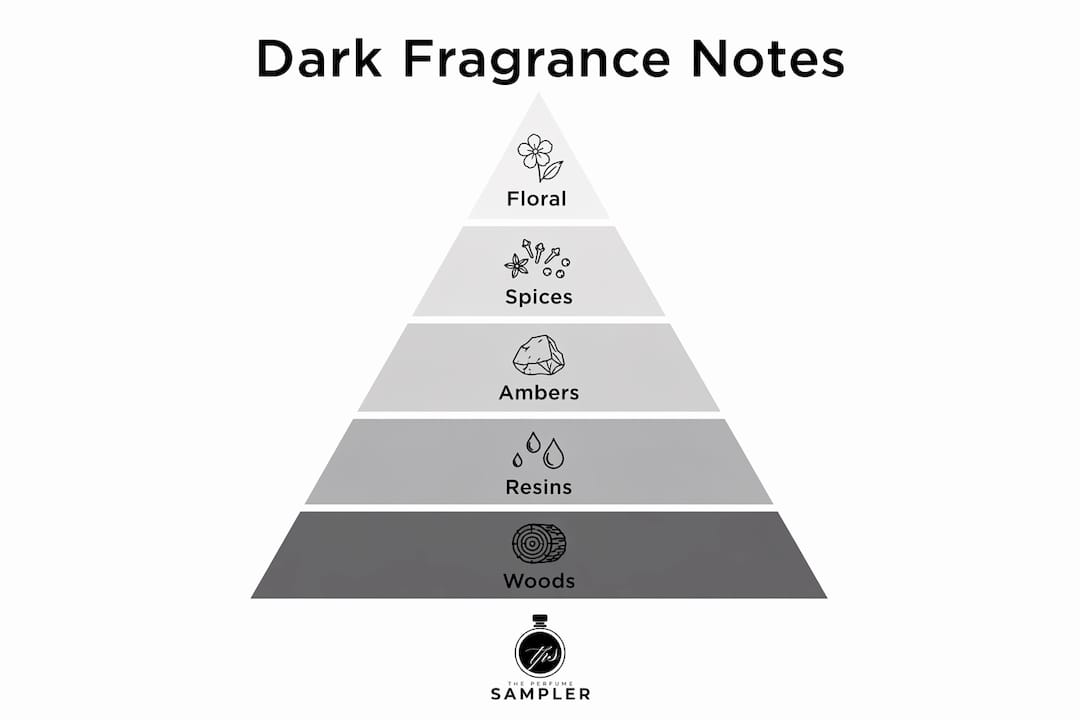
Floral amber fragrances combine flowers with warm, spicy elements such as amber and incense, embodying sensuality and depth. Amber scents often feature vanilla, cinnamon, musk, or cardamom for richness. This combination explains why many dark fragrances feel simultaneously warm and mysterious rather than cold or harsh.
The layering of top, heart, and base notes matters enormously. Darkness lives almost entirely in the base layer. Top notes in a dark fragrance may include bergamot or black pepper, giving a deceptively fresh or spicy opening. The heart might carry rose or saffron. But the base, where oud, amber, or patchouli dominate, is where the true character of the scent emerges. Understanding fragrance note layers helps you predict how a dark perfume will behave before you commit to a full bottle.
Pro Tip: Darker fragrances often come in darker packaging. Rich, dark scents frequently use darker glass and metallic accents to signal their character. If you are browsing in a shop, the bottle design is often a reliable first clue about the scent profile inside.
How do dark fragrances evolve on the skin over time?
Top notes are light and fresh, heart notes are balanced and expressive, and base notes are deep and long-lasting, with darkness usually hidden in the base layer. This structure means a dark fragrance does not reveal its full character immediately. It unfolds over hours, which is precisely what makes it feel mysterious.
The typical evolution of a dark fragrance follows this pattern:
- First 15–30 minutes (top notes). You smell the brightest, most volatile elements. A dark fragrance might open with bergamot, pink pepper, or a light floral. This phase can feel deceptively light.
- 30 minutes to 2 hours (heart notes). The middle notes emerge. Spices, florals, or woody accords become more prominent. The scent starts to feel warmer and more complex.
- 2 hours onwards (base notes). The heaviest molecules take over. Oud, amber, patchouli, and musks settle onto the skin. This is the phase that defines the fragrance as “dark.”
- Dry-down. The final stage, often 4–8 hours in, is where the scent becomes most intimate. It sits close to the skin and smells uniquely personal.
Skin chemistry plays a significant role in this process. Body heat accelerates evaporation of the lighter notes, which is why dark fragrances often smell more intense on warmer skin. Dry skin tends to absorb base notes faster, making the dark phase arrive sooner. Moisturised skin holds all layers longer, giving a more gradual and balanced evolution.
Understanding how fragrances evolve before you buy is the most practical skill you can develop as a fragrance enthusiast. A dark perfume that smells overwhelming in the first spray may become exactly what you want two hours later.
What emotional and practical effects do dark fragrances have?
Dark fragrances evoke emotions such as mystery, sensuality, and confidence, and they are often suited to evening wear and cooler seasons. These scents create a mood that many find deeply personal and intriguing. That emotional weight is not accidental. The heavy molecules in dark fragrances interact with the limbic system, the part of the brain that processes both smell and emotion, more intensely than lighter, fresher scents.
The practical question of when and where to wear dark fragrances is straightforward.
| Dark scent type | Mood evoked | Best setting |
|---|---|---|
| Oud-forward | Powerful, commanding | Formal evenings, special occasions |
| Amber and vanilla | Warm, sensual | Date nights, autumn and winter evenings |
| Smoky and resinous | Mysterious, brooding | Cooler evenings, intimate gatherings |
| Earthy and woody | Grounded, confident | Casual evenings, outdoor autumn settings |
Dark fragrances perform best in cooler temperatures. Heat amplifies projection, and a heavy dark scent in summer heat can become overwhelming. Autumn and winter are the natural seasons for this category. Evening wear is the classic context, though a restrained dark fragrance with good balance works well in a professional setting during cooler months.
Choosing a dark scent also depends on your personal chemistry. Because these fragrances interact so closely with the skin, the same perfume can smell dramatically different on two people. Sampling before buying is not optional with dark fragrances. It is the only reliable way to know how a scent will perform on your skin. You can also layer fragrances to build a personalised dark accord, combining a resinous base with a spiced heart for a result that is entirely your own.
Pro Tip: Apply dark fragrances to pulse points on covered skin, such as the inner wrist or the base of the neck, rather than exposed areas. The warmth builds gradually under clothing, releasing the scent slowly throughout the evening.
Key takeaways
Dark fragrances are defined by heavy, slow-evaporating base notes that create a layered, evolving scent profile with strong emotional associations, making them best suited to evenings and cooler months.
| Point | Details |
|---|---|
| Core definition | Dark fragrances rely on heavy base notes like oud, amber, and patchouli to create depth and mystery. |
| Chiaroscuro effect | Scent layers shift from a bright opening to a dense, shadowy base as lighter molecules evaporate. |
| Skin chemistry matters | Body heat and skin type affect how quickly the dark base notes emerge and how long they last. |
| Best occasions | Evening wear and cooler seasons suit dark fragrances; heat amplifies projection and can make them overpowering. |
| Sample before buying | Dark fragrances evolve significantly on skin, making sampling the only reliable way to judge the full scent. |
Why dark fragrances are worth taking seriously
I have spent years working with fragrance enthusiasts, and the most common misconception I encounter is that dark fragrances are simply “heavy” or “old-fashioned.” That framing misses the point entirely. A well-constructed dark fragrance is one of the most technically demanding things a perfumer can create. The chiaroscuro effect, that contrast between a deceptively light opening and a rich, shadowy base, requires precise calibration. Get it wrong and the scent feels muddy. Get it right and it feels like a second skin.
The other misconception is that dark fragrances are only for confident or experienced wearers. That is not true either. Amber-based dark fragrances, in particular, are genuinely approachable. They are warm and slightly sweet without being cloying. Many people who claim they “do not like dark scents” have simply never tried the right one.
My honest advice is to resist the urge to judge a dark fragrance in the first ten minutes. The opening is rarely the point. The base is. Give it two hours on your skin before you decide. Most people who do that end up surprised by how much they enjoy the dry-down. The best dark fragrances reward patience in a way that lighter, fresher scents simply cannot.
— Rupesh
Try dark fragrance decants at Theperfumesampler
Dark fragrances are complex, and committing to a full bottle without wearing one for a full day is a significant risk. Theperfumesampler offers fragrance decants in 2ml, 3ml, 5ml, and 10ml sizes, giving you the opportunity to experience the full evolution of a dark scent before spending on a full bottle.

The benefits of decants are particularly clear with dark fragrances. A 5ml decant gives you enough to wear a scent three or four times across different occasions and seasons, which is exactly what you need to judge a complex, evolving perfume fairly. For those ready to commit, Theperfumesampler also stocks full bottles of intense fragrances such as BOSS Bottled Absolu Parfum Intense, a rich, dark-leaning perfume that exemplifies the category. All products are 100% authentic, with discounted shipping available internationally.
FAQ
What is a dark fragrance in simple terms?
A dark fragrance is a perfume built around heavy, slow-evaporating notes such as oud, amber, patchouli, and incense that create a rich, mysterious, and long-lasting scent. The “darkness” refers to the scent’s depth and emotional weight, not its colour or any single ingredient.
Are dark fragrances suitable for daytime wear?
Dark fragrances are best suited to evenings and cooler months, as heat amplifies their projection and can make them feel overpowering. A restrained dark fragrance with good balance can work in a professional setting during autumn or winter.
How long do dark fragrances last on the skin?
Dark fragrances typically last longer than lighter scents because their base notes are built from heavier, slower-evaporating molecules that stay close to the skin. Longevity varies by formulation, but many dark fragrances remain detectable for 8–12 hours.
What is the difference between dark and light fragrances?
Light fragrances rely on fast-evaporating top notes such as citrus, green, or aquatic accords that fade within hours. Dark fragrances are anchored in the base layer, where heavy resins, woods, and musks create a dense, lingering presence that evolves significantly over time.
How do I choose a dark fragrance for the first time?
Start with an amber or floral amber fragrance, as these are the most approachable dark scent types. Sample before buying, and wear the scent for at least two hours to experience the full base note evolution before making a decision. Theperfumesampler’s decant range is a practical way to do this without the cost of a full bottle.