
The importance of seasonal scents for mood and memory
TL;DR:
- Seasonal scents influence mood by directly activating brain regions responsible for emotion through scent signals.
- Understanding climate, culture, and personal habits helps optimize fragrance choices for each season’s environment and emotional needs.
- Intentional pairing and regular use of specific scents strengthen their emotional impact, transforming fragrance into a mood management tool.
Seasonal scents are defined as fragrance profiles chosen to align with the emotional, climatic, and cultural character of a particular time of year. The importance of seasonal scents goes far beyond aesthetic preference. Olfaction affects emotion more directly than any other sense, and researchers at the Monell Chemical Senses Center, including scientist Pamela Dalton, have confirmed that scents do not merely trigger memories. They re-activate the original emotion attached to those memories. That distinction matters enormously for anyone who wants to use fragrance deliberately, whether to lift their mood on a grey January morning or to mark a celebration with something memorable.
Why the importance of seasonal scents is rooted in brain science
The reason scent affects mood so powerfully comes down to anatomy. When you inhale a fragrance, signals travel through the olfactory bulb directly to the piriform cortex, amygdala, and orbitofrontal cortex. These are the brain regions responsible for emotional processing, threat detection, and reward. No other sense has this direct a route. Vision and sound are routed through the thalamus first, adding a processing step that scent simply bypasses.
A 2026 fMRI study published in Nature Communications analysed brain responses to 160 distinct odours and found that pleasantness is encoded separately across the piriform cortex and amygdala, with appetitive and aversive odours processed through distinct but integrated pathways. This means the brain does not just register whether a smell is pleasant or unpleasant. It calibrates the emotional salience of that smell relative to your current environment and past experience. A warm cinnamon note smells comforting in October precisely because your brain has encoded it that way through repeated seasonal exposure.
“Scents bring back the emotional impact of memories, not just the memory itself.” — Pamela Dalton, Monell Chemical Senses Center
The ventromedial prefrontal cortex also plays a role, connecting scent-triggered emotions to decision-making and self-referential thought. This is why a particular fragrance can shift your entire mental state within seconds. A 2026 review published by SciOpen confirmed that functional fragrances influence emotional states and mental well-being through olfactory pathways that directly affect the nervous and neuroendocrine systems. The practical implication is clear: choosing your scent with intention is a form of mood management.
Pro Tip: Keep a brief scent journal for one season. Note which fragrances you reach for on low-energy days versus high-energy ones. Patterns emerge quickly, and they tell you more about your emotional triggers than any fragrance quiz.
How climate and season shape scent performance and preference
Temperature and humidity do not just affect how a fragrance smells on paper. They change how it performs on your skin and in your home. Heat increases evaporation, which accelerates the release of top notes and shortens overall longevity. In summer, a heavy oriental or dense amber can become overwhelming within minutes of application. In winter, the same fragrance settles beautifully because cooler air slows evaporation and allows base notes to develop gradually.

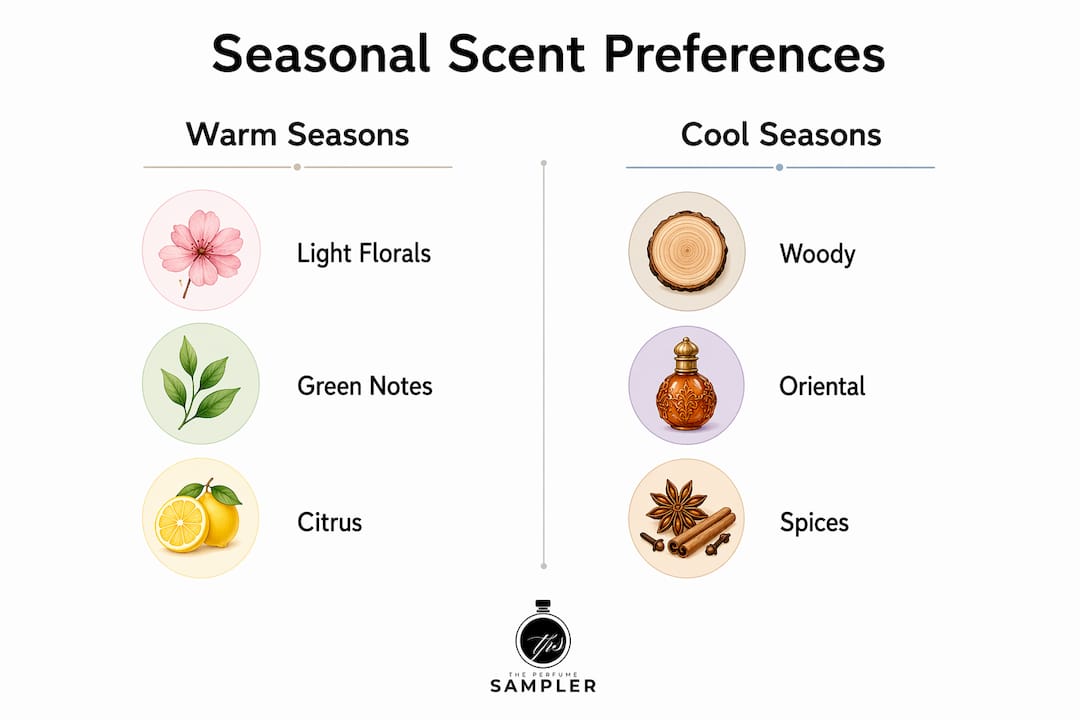
Experts Jeniece Trizzino and Mara Dumski have both noted that lighter, fresher scents perform best in warm, humid conditions, while richer woody and amber profiles create a sense of warmth and cosiness in cooler months. This is not simply a matter of taste. It is a matter of chemistry. Understanding how perfume performance changes with the weather helps you make smarter choices rather than wondering why your favourite winter scent smells flat in July.
| Season | Recommended fragrance families | Why they work |
|---|---|---|
| Spring | Florals, green notes, light musks | Fresh and uplifting; complement mild temperatures |
| Summer | Citrus, aquatics, light woods | Fast-evaporating top notes suit heat; feel clean and energising |
| Autumn | Spices, warm woods, leather | Depth and warmth match cooling air and shorter days |
| Winter | Ambers, resins, vanilla, incense | Slow evaporation allows rich base notes to develop fully |
The same principle applies to home fragrance. A reed diffuser set to full capacity in a warm room in August will project far more aggressively than the same diffuser in a cool hallway in December. Adjusting the number of reeds or the strength of your candle accordingly is a practical step most people overlook. Understanding fragrance note structure also helps here. Citrus top notes vanish fastest in heat, while base notes of sandalwood or musk anchor a scent through cold weather.
Pro Tip: In summer, apply fragrance to pulse points immediately after a cool shower when skin temperature is lower. This slows initial evaporation and extends the life of lighter scents considerably.
How culture and personal history shape seasonal scent responses
The emotional impact of a seasonal scent is never purely chemical. It is shaped by what you have experienced while smelling it. ENT specialist Olaf Conrad explains that the proximity of olfactory processing to the amygdala and hippocampus makes smell the strongest sensory trigger for autobiographical memory. Fresh pine at Christmas is the most cited example, but the same mechanism applies to sunscreen in summer, damp earth in autumn, and hyacinths in spring.
Cultural context reinforces these associations at a collective level. Across Northern Europe, frankincense and clove are deeply embedded in winter celebrations. In South Asia, jasmine and sandalwood carry associations with festivals and religious occasions that span generations. These are not arbitrary preferences. They are the result of emotional conditioning built through consistent pairing of a scent with a specific seasonal event over many years.
Personal sensitivity also varies. Highly Sensitive Persons (HSPs), a group estimated to make up roughly 15 to 20 per cent of the population, process sensory input more deeply and may find strong seasonal scents either profoundly mood-enhancing or genuinely overwhelming. For this group, subtler concentrations such as eau de cologne or lightly scented home products often deliver the emotional benefit without sensory overload.
- Pine, cinnamon, and clove are culturally encoded as winter comfort scents across much of the Western world.
- Jasmine and neroli carry strong spring and celebration associations in Mediterranean and Middle Eastern cultures.
- Petrichor (the scent of rain on dry earth) triggers nostalgia and calm across diverse cultural backgrounds.
- Vanilla is one of the most universally positive scents, associated with warmth and safety regardless of cultural origin.
“Scent memory is not passive recall. It is emotional re-experience.” — Olaf Conrad, ENT specialist
How to integrate seasonal scents into daily life for mood and occasion
Building a seasonal scent wardrobe does not require a large collection. It requires a deliberate approach. A mood map is a practical starting point: identify which emotional states you want to support in each season, then match fragrance families to those states. Citrus and green notes energise. Lavender and sandalwood calm. Spice and resin warm and ground. Matching scent to desired state, rather than simply to season, produces more consistent mood benefits.
Here is a structured approach to building your seasonal scent rotation:
- Audit your current collection. Identify which fragrances you reach for in warm versus cool weather. Most people already have informal seasonal preferences without realising it.
- Assign scents to occasions, not just seasons. A morning work scent, an evening wind-down scent, and a celebration scent each serve different emotional functions. Rotating these by season strengthens the associations over time.
- Sample before committing. Seasonal scent trends shift, and a fragrance that reads beautifully in a bottle may not suit your skin chemistry in a particular climate. Testing in small quantities first is the most practical approach.
- Layer thoughtfully. Combining a scented body lotion with a complementary eau de parfum extends longevity and adds depth. Techniques for layering fragrances effectively are worth learning before investing in full bottles.
- Adjust concentration by season. Parfum and eau de parfum concentrations suit winter. Eau de toilette and eau de cologne work better in summer heat. The same fragrance family in a lighter concentration can serve you year-round.
Scented environments also influence behaviour beyond personal mood. Research on sensory cues in retail settings shows that fragrance directly affects dwell time and emotional response in shared spaces. Applying this at home means a well-chosen seasonal scent in your living room or workspace can make the environment feel more welcoming and conducive to the activities you associate with that time of year.
Pro Tip: Use a mood map approach when selecting seasonal scents. Write down three emotional states you want to cultivate each season, then test fragrances against those states rather than simply following trend recommendations.
Key takeaways
Seasonal scents work because the olfactory system connects directly to the brain’s emotional centres, making fragrance the most reliable sensory tool for mood regulation and memory marking.
| Point | Details |
|---|---|
| Direct neurological pathway | Scent bypasses the thalamus and reaches the amygdala directly, producing faster emotional responses than any other sense. |
| Climate affects performance | Heat accelerates evaporation; choose lighter concentrations in summer and richer base-heavy scents in winter. |
| Cultural and personal conditioning | Consistent pairing of a scent with seasonal events strengthens emotional associations over time. |
| Mood mapping improves results | Matching fragrance families to desired emotional states produces more reliable mood benefits than following trends alone. |
| Sample before committing | Testing fragrances in small quantities across seasons prevents costly mismatches between scent, skin, and climate. |
Why I think most people underestimate seasonal scent as a daily tool
I have spent years paying attention to how fragrance shifts the feel of a day, and the most consistent observation I have made is this: people treat scent as an afterthought rather than a deliberate choice. They spray whatever is on the bathroom shelf and move on. The result is that they miss most of the emotional benefit that seasonal fragrance can deliver.
The science is clear enough. The brain encodes scent with emotional context, and that encoding strengthens every time you repeat the pairing. But the practical insight that most articles skip is this: the benefit compounds. A scent you wear every autumn morning for three years does not just smell pleasant. It becomes a reliable emotional anchor. On a difficult day in October, that scent genuinely shifts your state because your brain has been trained to associate it with a particular feeling.
What I would caution against is rigidity. Some people read about seasonal scent rules and then feel they cannot wear a warm amber in July or a fresh citrus in December. That is the wrong takeaway. The goal is intentionality, not compliance. Wear what serves your mood and your occasion. Use the seasonal framework as a starting point, not a constraint. The fragrances that matter most to you will tell you when they belong in your life, regardless of the calendar.
— Rupesh
Explore seasonal scents with Theperfumesampler
Building a seasonal scent wardrobe is far easier when you can test before you invest. Theperfumesampler offers fragrance decants in 2ml, 3ml, 5ml, and 10ml sizes, covering both niche and designer fragrances at a fraction of full-bottle prices. For cooler months, a rich option such as BOSS Bottled Absolu Parfum Intense is worth sampling before committing to a full bottle. If you are new to decants, the why decants page explains exactly how sampling works and why it is the most practical way to build a seasonal fragrance collection. All products are 100% authentic, and Theperfumesampler ships internationally with discounted rates.
FAQ
What is the importance of seasonal scents for mood?
Seasonal scents influence mood by triggering the amygdala and other limbic brain regions directly through the olfactory system. Research confirms that scent re-activates the original emotion associated with a memory, not just the memory itself.
Which scents work best in summer versus winter?
Citrus, aquatic, and light floral notes perform best in summer because heat accelerates their evaporation and keeps them from becoming overpowering. Ambers, resins, spices, and vanilla suit winter because cooler air slows evaporation and allows rich base notes to develop fully.
How do I build a seasonal scent routine?
Start by identifying two or three emotional states you want to support each season, then match fragrance families to those states using a mood map approach. Sampling in small quantities before buying full bottles is the most practical way to test seasonal fit.
Can the same fragrance be worn year-round?
Yes, but concentration and application method should be adjusted by season. A parfum concentration that works beautifully in winter may be too intense in summer heat. Switching to an eau de toilette version of the same fragrance family often solves this.
Why do some seasonal scents feel more emotionally powerful than others?
The emotional strength of a seasonal scent depends on how consistently it has been paired with a specific occasion or routine over time. Deliberate, repeated pairing builds stronger neural associations, which is why a fragrance worn every Christmas for a decade feels more emotionally resonant than one worn occasionally.
Recommended
- Why professionals wear perfume: confidence, branding, and scent – ThePerfumeSampler
- How perfume empowers self-expression and personal style – ThePerfumeSampler
- Why scents smell different: A guide to fragrance variation – ThePerfumeSampler
- Fragrance tips for college: your campus scent guide – ThePerfumeSampler