

How to practise scent recall: practical drills for enthusiasts
Start today with three decants or essential oils, a blotter strip, and a pen. Smell the first sample, write three descriptive words, wait two minutes, then smell the next. After all three, cover the labels and try to match each scent to your notes. That single routine, repeated three times a week, is how to practise scent recall effectively from day one.
Bare-minimum kit to begin:
- Blotter strips or a clean decant (2ml or 3ml works well)
- A pen and a small notebook or journal
- A few single-note references such as bergamot, sandalwood, and vetiver are reliable starting points
Pro Tip: Smell the back of your hand between samples rather than coffee beans. Coffee introduces its own aromatic compounds and can confuse rather than reset your nose.
Key takeaways
Consistent, scored practice with a small reference set is the fastest route to reliable scent recall.
| Point | Details |
|---|---|
| Start with a small number of materials | Use a few single-note references per session; add new materials progressively as you improve. |
| Score every blind test | Use a 2/1/0 system and track a four-week moving average to measure real improvement. |
| Write descriptors every session | Three to five words per sample, dated and filed by family, builds a retrievable mental library faster than smelling alone. |
| Limit sessions to a small number of scents | Stop at a manageable number of materials per set to avoid olfactory fatigue and keep results accurate. |
| Use Theperfumesampler decants | 2ml and 3ml decants provide consistent, affordable samples ideal for repeated blind tests and intensity drills. |
Table of Contents
- Why scent memory is trainable
- How to practise scent recall: the core drills
- How to build an olfactory library and keep a scent journal
- What tools and materials do you need for reliable practice?
- What does a weekly training schedule look like?
- How do you test progress and avoid common pitfalls?
- Ready-to-use exercise templates you can run now
- A note on practice philosophy, from Rupesh
- Decants are the most practical way to build your practice library
- Sources
Why scent memory is trainable
Scent recognition depends on memory networks as much as on olfactory receptors. When you smell something, the signal travels directly to the limbic system, the brain region governing memory and emotion, before it reaches conscious thought. That pathway is why a single whiff can retrieve a vivid memory from decades ago.
Professional perfumers confirm that smell identification is fundamentally a memory skill. The nose collects data; the brain matches and retrieves. Linking a scent to a personal experience, a specific place, a meal, a moment, creates a stable recall anchor that is far more durable than a label alone. Journalling and intentional smelling accelerate recognition of notes and accords by forcing the brain to encode each scent with language and context simultaneously.
The practical implication: every session you run is depositing a memory, not just a sensory impression. Consistent, structured practice compounds over weeks.
How to practise scent recall: the core drills
Four drills build the discrete skills that reliable note recognition requires. Run them in short sets of three to five scents per session to stay below the threshold where olfactory fatigue distorts results.
Single-note identification
Choose one raw material or essential oil, apply it to a blotter, and smell it for thirty seconds. Write three to five descriptive words without looking at the label. Then smell it on skin, where heat and chemistry alter the dry-down, and note any differences. The Jean Carles method, used in formal perfumery training, isolates each ingredient this way before any blending occurs. Blotter strips for isolation and skin testing for development are both necessary because the same material can read differently on each surface.

Odour intensity test
Apply a small amount of bergamot to one blotter and your test material to another. Rate each for intensity using a qualitative scale. Aftelier’s training exercises use bergamot as a light reference precisely because its brightness makes heavier materials, such as benzoin or opoponax, easier to perceive in contrast. Understanding relative intensity teaches you why certain notes disappear inside a blend: a stronger material at even a low concentration can mask a lighter one entirely.
Pairwise comparison
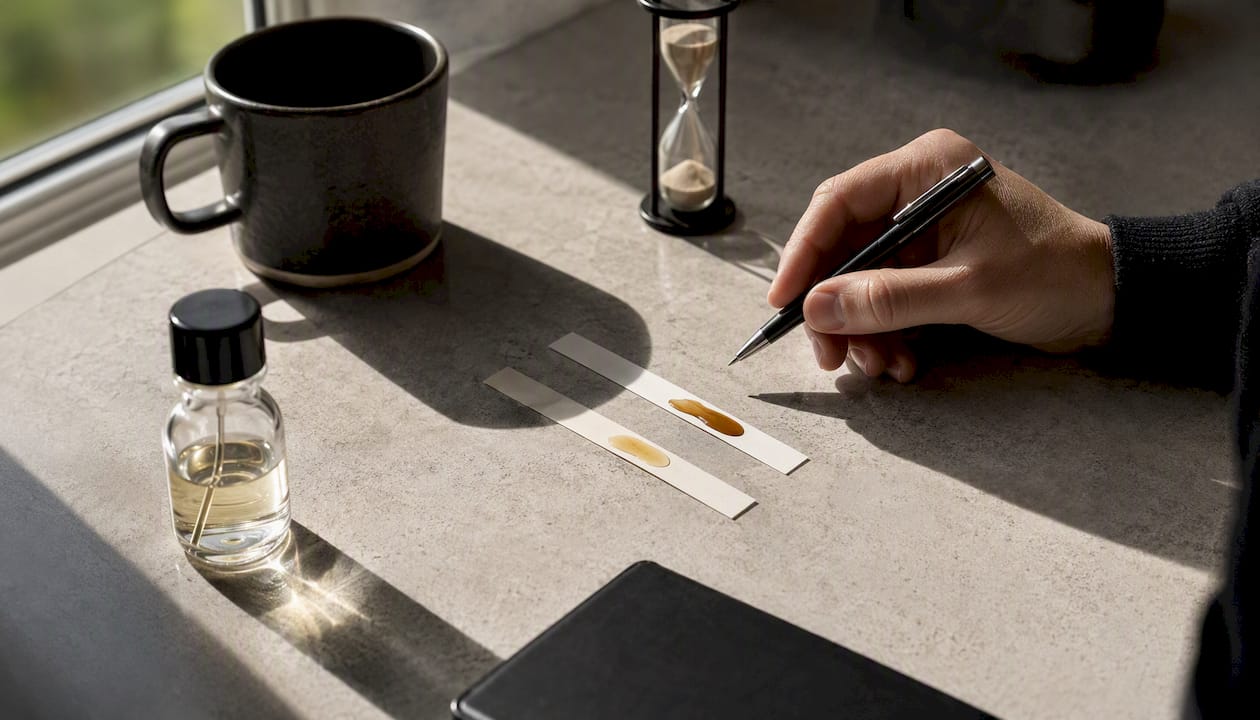
Place two blotters side by side, labelled A and B. Smell A, pause thirty seconds, smell B, then write one sentence on how they differ. Swap the labels and repeat the test blind. Scoring: one point for each correctly identified difference, zero for a miss. This drill sharpens discrimination between similar notes, such as two different musks or two citrus materials.
Blind sniffing
Prepare five labelled vials in advance, then shuffle them and remove the labels. Smell each one and record your guess. Score correct identifications after all five. Keep a running weekly total to track improvement over time.
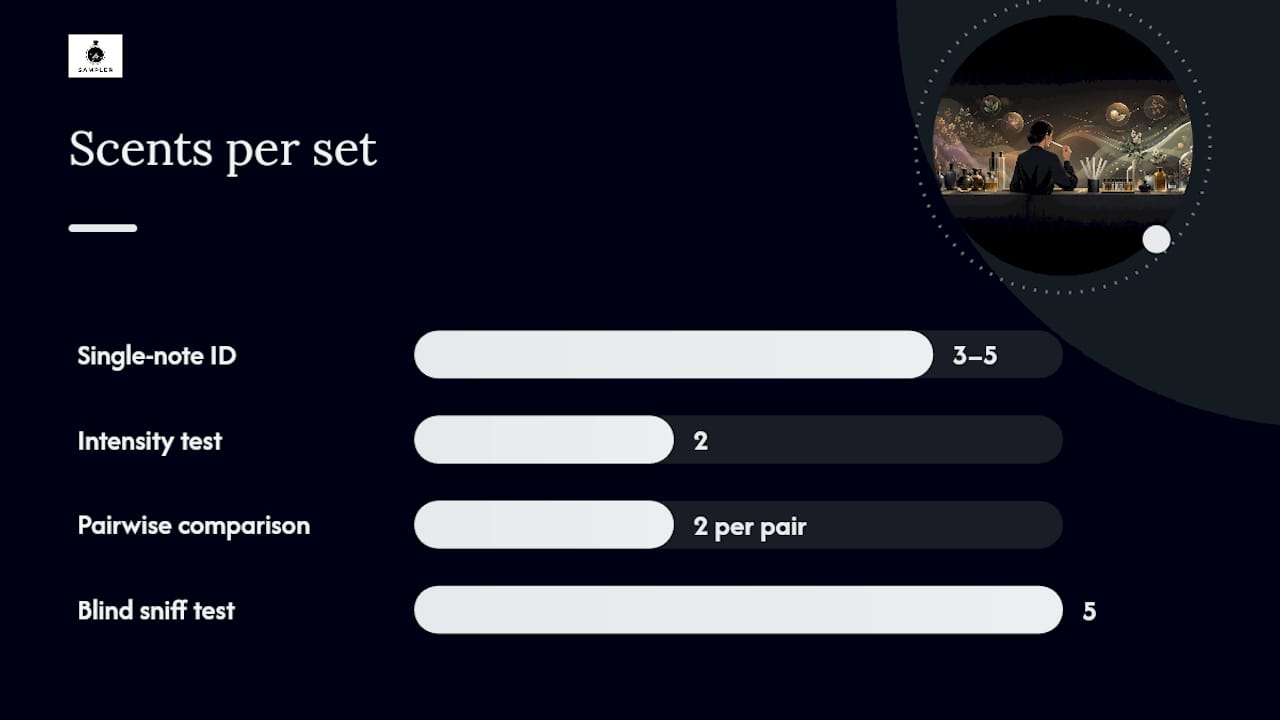
| Drill | Session length | Scents per set | Scoring |
|---|---|---|---|
| Single-note ID | 10 minutes | 3–5 | Pass/fail per note |
| Intensity test | 10 minutes | 2 (reference + test) | 1–10 scale |
| Pairwise comparison | 10 to 15 minutes | 2 per pair | 1 point per correct difference |
| Blind sniff test | 10 to 15 minutes | 5 | 2 correct, 1 partial, 0 wrong |
Pro Tip: Set a two-minute timer between each blotter. Stepping away from the sample, rather than sniffing repeatedly, gives your receptors time to reset and produces more accurate impressions.
How to build an olfactory library and keep a scent journal
Keep a small, labelled reference set you revisit habitually: ten to fifteen essential oils or decants covering the main fragrance families (citrus, floral, woody, oriental, green, aquatic). Familiarity with a fixed set builds the mental benchmarks you compare everything else against.
Practising descriptive language alongside smelling accelerates recall. A journal entry for each sample should include:
- Title and family: e.g. “Bergamot / Citrus”
- Three to five descriptors: bright, tart, slightly floral, clean, fleeting
- Intensity rating: 1–10 on blotter and on skin
- Development notes: how the scent changes from first spray to dry-down
- Cross-references: similar notes or fragrances it reminds you of
Organise entries by family first, then add usage tags (daytime, evening, formal) so you can pull relevant references quickly before a practice session. A “favourite recall” shortlist of your five most distinct references speeds up warm-up drills considerably. For a structured approach to building a fragrance sample library, a dedicated guide covers the collection-building process in full.
Pro Tip: Date every journal entry. Comparing your descriptors for the same material six weeks apart shows you exactly how your vocabulary and perception have developed.
What tools and materials do you need for reliable practice?
The essential kit is low-cost and easy to assemble:
- Blotter strips (buy in bulk; 100 strips costs a few dollars)
- Small labelled glass vials or 2ml decants for each reference material
- Pipettes for transferring concentrated oils without contamination
- Masking tape and a permanent marker for blind-test labelling
- A neutral notebook dedicated to scent notes
- Ten to fifteen single-note essential oils covering major families
Decants are particularly valuable for training. A 2ml or 3ml decant of a niche fragrance gives you enough material for repeated sessions without the cost of a full bottle. Using decants to analyse perfume notes provides a practical workflow for getting the most from each sample.
Never apply undiluted synthetics directly to skin, and always label vials clearly to avoid accidental double-dosing during blind tests.
Fragrance accessories and related products are also available through retail partners such as Jeffi Inc if you want to expand your kit.
What does a weekly training schedule look like?
Several short sessions per week plus regular blind tests is a sustainable starting point. A 21-day progression moving from basic families to complex notes to blind testing is a widely recommended scaffold for new learners.
Spaced repetition applies here: revisit a material after two days, then after five days, then after two weeks. Each re-exposure at increasing intervals consolidates the memory more effectively than daily repetition of the same set.
- Begin with the broadest family categories (citrus, woody, floral) before moving to sub-families.
- Add one new material per session once you can reliably identify the previous set.
- Increase blind-test set size by two items every fortnight.
- Review your journal scores monthly and retire materials you identify correctly every time.
Pro Tip: Practise for ten to fifteen minutes at the same time each day, such as just before your morning coffee, to build a consistent habit without requiring extra motivation.
How do you test progress and avoid common pitfalls?
Use a simple scoring system for every blind test: 2 points for a correct identification, 1 for a partial match (right family, wrong note), 0 for incorrect. Track your weekly total and calculate a four-week moving average. A rising average is objective evidence of improvement.
Common pitfalls and how to avoid them:
- Olfactory fatigue: limit each set to five scents, take a two-minute break between samples, and end the session if notes start smelling similar or flat.
- Cross-contamination: use a fresh blotter for every material; never reuse one. Store vials capped and away from heat.
- The coffee-bean myth: coffee beans do not reliably reset olfactory perception; fresh air or smelling the crook of your elbow works better.
- Overfitting to familiar notes: rotate your reference set every four weeks to avoid recognising your own handwriting on the label rather than the scent itself.
- Rubbing test areas: rubbing skin after application crushes the top notes and produces a false impression of the material’s character.
- Score every session immediately after, not from memory the next day.
- Log scores in your journal alongside the date and materials used.
- Review your four-week average at the end of each month.
- Adjust difficulty (add materials, shorten rest intervals) when your average exceeds 80%.
Ready-to-use exercise templates you can run now
Template 1: Intensity test (bergamot reference)
Objective: Perceive relative intensity and masking between two materials. Materials: Bergamot essential oil, one test material, two blotters, journal. Steps:
- Apply bergamot to blotter A, test material to blotter B.
- Rate bergamot intensity: __/10. Rate test material: __/10.
- Hold both blotters 5cm apart and smell simultaneously. Which dominates?
- Note which material you lose first as you move the blotters further apart.
- Record: “At distance, [material] masked [material] because ___.”
Template 2: Five-item blind identification
Objective: Test recall accuracy across five single-note references. Materials: Five labelled vials (shuffle and remove labels), blotters, journal. Steps:
- Smell each unlabelled blotter for thirty seconds.
- Write your identification and confidence level (high/medium/low).
- Reveal labels. Score: 2 correct, 1 partial, 0 wrong.
- Total: __/10. Record in journal.
Template 3: Pairwise discrimination
Objective: Identify the difference between two similar materials. Materials: Two similar-family materials (e.g. two musks), two blotters. Steps:
- Smell A, then B. Write one sentence on the difference.
- Swap labels. Repeat blind.
- Score: 1 point per correctly identified difference.
Pro Tip: Use the five-step decode method for any template: smell, smell consciously, take notes, give it time, then envision the scent from memory before re-smelling.
A note on practice philosophy, from Rupesh
The single most valuable habit for long-term scent recall is not smelling more, it is writing more. Every session where you commit descriptors to paper builds a retrievable mental file. Sessions where you simply sniff and move on leave almost nothing behind.
Treating scent practice as a tracked skill changes the relationship with it. When you see a rising score in your journal, you have evidence of progress, and evidence is what sustains the habit past the first enthusiastic week. Decants are the practical enabler here: a small, consistent sample of the same fragrance across multiple sessions is far more useful than a different full bottle each time.
Decants are the most practical way to build your practice library
Decants are the most cost-effective, consistent way to build an olfactory library for training. A single 2ml decant of a niche fragrance provides enough material for eight to ten blotter tests, at a fraction of the cost of a full bottle. Consistent dosing across sessions means your intensity ratings and journal notes are actually comparable week to week.
The 2ml and 3ml sizes are ideal for single-note practice and blind tests; the 5ml and 10ml sizes suit longer training programmes where you need repeated access to the same scent. Read more about why decants work for training and browse the full range to start building your practice set today.
Sources
The following sources informed the exercises and methods in this guide:
- Odor training exercises — Aftelier workshop materials (OTWB_Exercise.pdf)
- Train your nose to recognise perfume notes – CLEAN Beauty Collective
- Train your nose: guide to recognising perfume notes – WhatScent Magazine
Recommended
- Guide to personal scent style: build your scent wardrobe – ThePerfumeSampler
- How to detect scent differences: a practical science guide – ThePerfumeSampler
- How to appreciate rare fragrances: a practical guide – ThePerfumeSampler
- How to optimise scent usage for home and personal wear – ThePerfumeSampler