
EDT vs EDP: 3–6 Hours vs 6–10 Hours and a Two Hour Skin Test
Eau de parfum usually outlasts eau de toilette on skin, often by several hours, but the label alone doesn’t guarantee it. Composition, skin chemistry and climate can all flip that result, so testing on skin remains the only reliable way to judge performance for you specifically.
TL;DR:
- The longevity of eau de parfum can vary greatly depending on skin chemistry and climate, making personal testing essential for accurate judgment.
- Fragrance composition, especially the presence of base notes like resins and musks, often determines how long a scent lasts regardless of concentration label.
- Testing fragrances side-by-side on skin at different intervals provides a more reliable assessment than initial impressions or shop samples.
- Costs per wear between EDT and EDP depend heavily on individual usage habits, not just bottle size or price, and can be close in value with reapplication needs.
- Concentration ranges are industry norms, not regulated standards, so labels should be considered guidelines rather than strict performance guarantees.
Table of Contents
- EDT vs EDP performance: a quick comparison
- What concentration actually means
- Why composition can override concentration entirely
- How skin type and climate change the result
- A reproducible way to test EDT vs EDP on your own skin
- Choosing EDT or EDP by occasion
- Is the extra cost of EDP actually worth it?
- An honest look at what side-by-side testing actually changes
- Testing before you buy: how decants make the comparison easier
- Sources
EDT vs EDP performance: a quick comparison
Concentration is the starting point, not the whole story. The table below sets out typical ranges reported across the fragrance industry for eau de toilette, eau de parfum and parfum.
| Concentration | Typical aromatic compounds | Typical longevity | Typical projection | Best for |
|---|---|---|---|---|
| Eau de Toilette (EDT) | 5–15% | 3–6 hours | Often stronger in the first hour, fades faster | Daytime, office, warm weather |
| Eau de Parfum (EDP) | 15–20% | 6–10 hours | Moderate, builds close to skin over time | Evening, cooler weather, longer wear |
| Parfum / Extrait | 20–40% | 8–14+ hours | Intimate, skin-close, low but persistent | Special occasions, minimal reapplication |
A few things sit behind those numbers:
- These are averages pulled from formulas across the market, not fixed outcomes for any one bottle.
- Two EDPs from different houses can perform nothing alike, because the materials inside matter more than the percentage on the box.
- Skin type, application method and storage conditions all shift the real-world result.
Statistic callout: The concentration bands above are industry shorthand, not enforceable standards. There is no regulator checking that every “eau de parfum” sits at 18% rather than 14%. Treat the label as a strong hint about performance, not a guarantee.
What concentration actually means
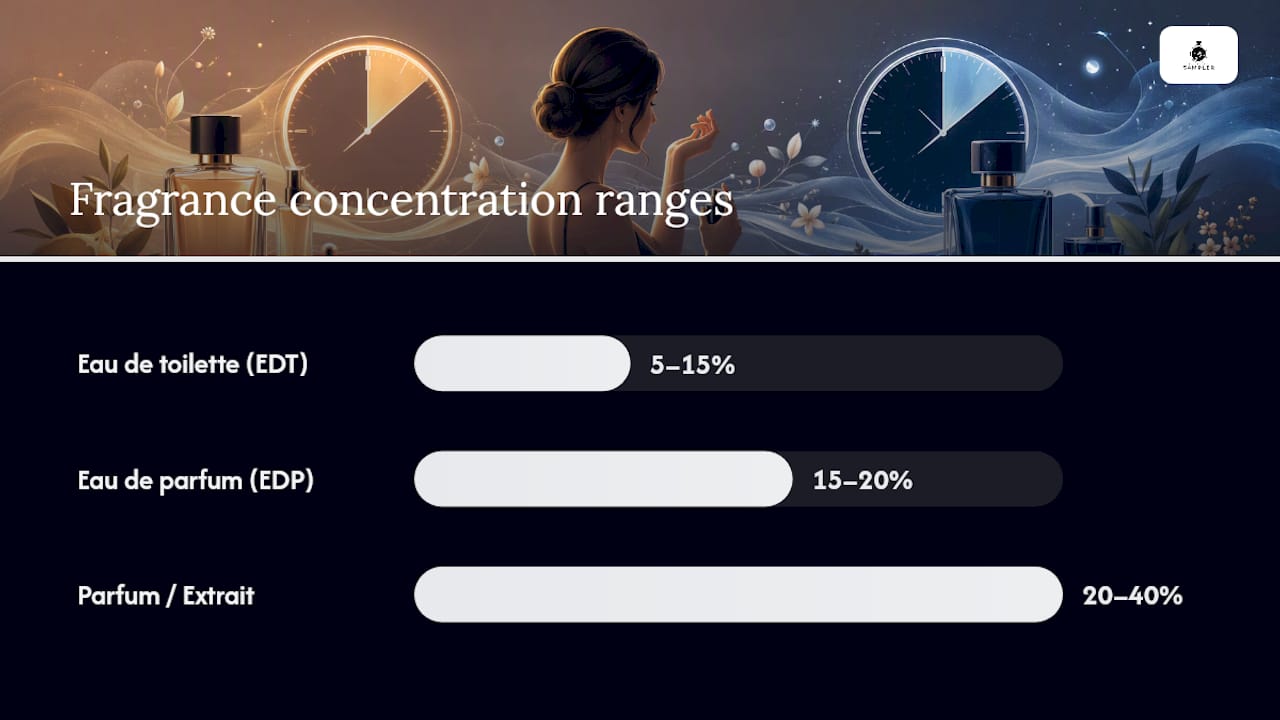
Concentration refers to the percentage of aromatic compounds dissolved in the alcohol and water base. Eau de toilette typically sits at 5–15%, eau de parfum at roughly 15–20%, and parfum or extrait often runs from 20% up to 40%. The rest of the bottle is largely alcohol, with a small amount of water and sometimes fixatives.
A higher aromatic load generally slows evaporation. Alcohol evaporates quickly once sprayed, and it’s the alcohol carrying most of the scent molecules into the air in the opening minutes. Once that alcohol has gone, what remains on the skin is the aromatic material itself, and more of it tends to mean a longer, slower dry down. This is why an EDP so often still reads clearly on skin at the six-hour mark when an EDT from the same line has faded into little more than a memory.
These percentage bands are customary industry guidance rather than legal definitions enforced by any single body. IFRA, the body that sets safety guidelines for fragrance materials, doesn’t mandate exact concentration cut-offs for what a brand can call “eau de toilette” versus “eau de parfum”. A few practical consequences follow from that:
- A brand can release an EDT at the upper end of its range and an EDP at the lower end, narrowing the expected gap between them.
- “Eau de parfum” on a label tells you roughly how much aromatic material is present, but not which materials, and that second detail matters more for longevity.
- Some houses use “parfum” as a marketing term rather than a precise concentration claim, so cross-checking against a fragrance concentration guide is worth doing before assuming a strict hierarchy.
Why composition can override concentration entirely
Concentration sets the volume of aromatic material, but the ingredients inside that material decide how long it survives on skin. Volatile top notes, citrus oils, aldehydes, light florals, evaporate fast almost regardless of concentration, because their molecules are small and light. Heavier base materials, sandalwood, ambroxan, resins, vanilla, and musks, cling to skin for hours because their molecules are larger and slower to break down.
This is why perfumers rarely just dilute one formula to create both an EDT and an EDP version. They typically reformulate, shifting the balance of notes rather than simply adding water and alcohol. An EDT is often built to emphasise bright top notes for a fresher, lighter opening, while the EDP of the same name leans harder into heart and base notes for depth and staying power.
That’s the mechanism behind a result that surprises a lot of fragrance buyers: a citrus-forward EDT can genuinely feel fresher for longer stretches of the day than a poorly constructed EDP, because the EDP’s added aromatic material might still be mostly top notes that evaporate just as quickly, only in slightly larger quantity.
- Citrus, aldehyde and light aquatic families tend to fade fast in both concentrations, though the EDP version usually edges ahead slightly.
- Woody, amber, oud and gourmand families show the widest gap, with EDP or parfum versions often lasting noticeably longer than their EDT counterparts.
- Fresh green and aromatic fougère families sit in between, performing reasonably in either concentration.
Pro Tip: Don’t judge a fragrance by its first ten minutes. A concentration-driven insight worth remembering is that a bright EDT opening can outshine an EDP at first spray, then disappear within two hours, while the EDP quietly settles in for the rest of the day. Check back at the two-hour mark before forming an opinion, because that reading tends to predict the day’s performance far better than the first impression does.
How skin type and climate change the result
Your skin and the weather around you can matter as much as the bottle itself. Oily skin tends to hold fragrance molecules longer than dry skin, because oil slows evaporation and gives aromatic compounds something to bind to. Dry skin, by contrast, often burns through a scent faster, which is why the same EDP can last eight hours on one wearer and four on another.
Climate adds another layer. Heat and humidity speed up molecule movement, which often increases projection but shortens overall longevity, since the fragrance is quite literally evaporating off you faster. Cold, dry air does the opposite, calming projection but sometimes helping a scent hold on longer against skin. Indoor heating and air conditioning both dry the air further, which can mimic a cold-climate effect even in summer.
A short checklist for everyday application:
- Apply straight after showering, while skin is still slightly damp, since hydrated skin holds fragrance better than dry skin.
- Moisturise unscented pulse points first if your skin runs dry, using barrier products before spraying to slow evaporation.
- Spray on skin rather than only on clothing for accurate longevity testing, since fabric holds scent differently to skin.
- Layer a small amount on clothing as a supplement, not a replacement, for pulse-point application in cold weather.
- Avoid rubbing wrists together after spraying, since friction breaks down the top note structure and can shorten the opening phase.
A reproducible way to test EDT vs EDP on your own skin
Averages only tell you what happened on someone else’s skin. To find out what actually happens on yours, run a controlled side-by-side test rather than relying on memory or a paper strip in a shop.
- Choose the same fragrance in EDT and EDP if available, or two comparable scents from the same family, and apply an identical number of sprays, typically two, to each.
- Apply one to your left wrist or inner elbow and the other to the right, keeping a few centimetres of bare skin between them, and avoid wearing any other scented product that day.
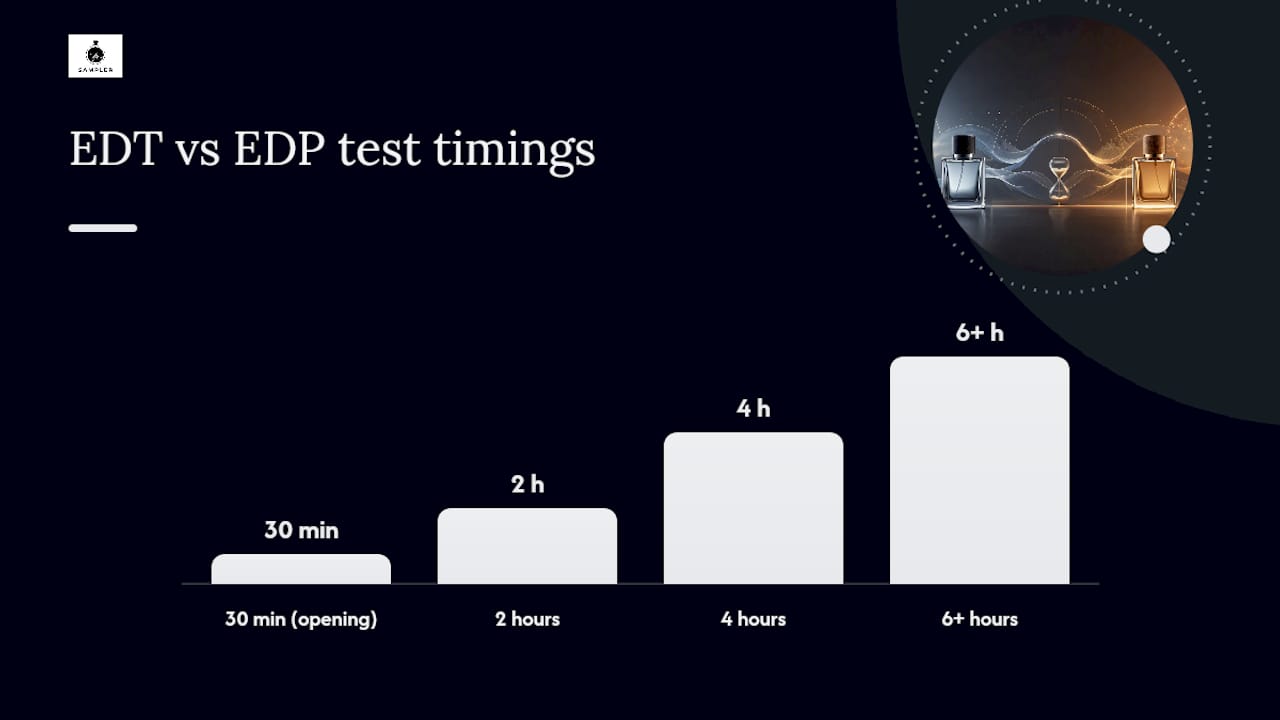
- Smell each at 30 minutes to capture the opening character, then again at two hours, four hours, and six hours or beyond.
- At each check, note three things: how far the scent projects from skin, whether it has become a “skin scent” you can only smell up close, and how the dry-down character has shifted from the opening.
- Record which concentration you preferred at each stage, since longevity and preference don’t always point the same direction.
Testing directly on skin rather than only on a fabric or paper strip gives a far more honest read, because skin chemistry interacts with the formula in ways paper simply can’t replicate.
Pro Tip: Run this test using small decants rather than committing to full bottles of both concentrations. A 2ml or 5ml sample of each gives you enough product for several timed checks without the outlay of buying two full-size bottles just to compare.
Choosing EDT or EDP by occasion
Once you know how a fragrance performs on your own skin, the occasion usually decides the concentration. Office and daytime settings generally favour EDT or a restrained EDP, since strong projection in an enclosed space can be intrusive to colleagues, and lighter formulas suit warmer daytime temperatures. Evening and formal settings lean towards EDP or parfum, where a closer, richer scent that lasts through dinner and beyond works in your favour.
Season matters just as much as the event. Summer heat amplifies projection, so an EDT often performs plenty strong enough on its own, while an EDP in the same weather can feel heavier than intended. Winter’s cold, dry air calms projection generally, which is exactly when an EDP’s extra staying power earns its place.
A few practical rules worth keeping in mind:
- Two to three sprays on pulse points, wrists, and neck, is usually enough for an EDP; EDT often needs three to four to reach a comparable projection.
- Carrying a small decant in a bag makes far more sense than buying a second full bottle purely for reapplication at midday.
- If you’re torn between concentrations for the same scent, the EDT explainer covers how to judge which version actually suits your routine, rather than which one sounds more premium.
Is the extra cost of EDP actually worth it?
The maths is simple: cost per wear equals the bottle price divided by the number of wears you genuinely get from it, and wears depend on sprays per use and your personal longevity, not the average on a review site. A 50ml EDP costing $150 that reliably gives you 80 wears at two sprays works out to roughly $1.88 per wear. A 50ml EDT at $100 giving 60 wears, because it needs more frequent reapplication, comes to about $1.67 per wear, a smaller gap than the sticker price suggests.
- Your actual spray count and skin longevity change this equation more than the label percentage does.
- Reapplying midway through the day adds real cost that a single EDP application often avoids.
- If you genuinely don’t know your own longevity for a scent, a decant of each concentration is a cheaper way to find out than guessing with full bottles.
An honest look at what side-by-side testing actually changes
Comparing an EDT and EDP of the same scent directly on skin at timed intervals is more revealing than the marketing copy on either box. A fragrance that reads as sharper and brighter at 30 minutes in EDT form can lose that edge by the two-hour mark, while the EDP quietly outperforms it from that point onward.
That gap is exactly why testing on your own skin, not a shop strip and not someone else’s review, settles the question for a signature scent. Decants make that comparison cheap and low-risk rather than an expensive gamble on two full bottles. The internal guide on skin chemistry is a useful companion to the testing protocol above, since it explains why the same bottle can perform so differently from one wearer to the next.
— Rupesh
Testing before you buy: how decants make the comparison easier
Buying a full bottle to settle an EDT versus EDP question is expensive, and it’s rarely necessary. Decants, poured samples typically sized at 2ml, 3ml, 5ml or 10ml, give you enough product to run the full timed testing protocol on both concentrations without the commitment of a full-size purchase.
Decants are available across a wide range of niche and designer houses, in sizes built specifically for this kind of side-by-side comparison. The why decants page sets out how sampling works and why it suits fragrance buyers who want to test before committing. If you want a concrete example of what’s available, the Boss Bottled Absolu Parfum Intense decant shows the format: a genuine luxury fragrance, sized for testing rather than a full bottle’s outlay. Pick a scent you’re deciding between, order the size that suits your test plan, and run the timed checks on your own skin before you spend on a full bottle.