

Green Perfumes That Need a Skin Trial: Try 2–10ml Decants First
The best green perfumes right now include Diptyque Philosykos, Parfums de Marly Greenley, and D.S. & Durga Coriander, alongside a handful of fresher, edible-green newcomers built on notes like matcha and pistachio. Each brings a distinct shade of green, from sharp galbanum to soft fig leaf. The smartest way to find your match is to sample before you commit, since green notes shift more on skin than almost any other fragrance family. Full profiles follow below.
TL;DR:
- Green fragrances vary greatly on skin and should be sampled over several hours to accurately assess their true character.
- Key green notes like galbanum, fig leaf, violet leaf, and vetiver influence scent profile and seasonality, with each suited to different preferences and climates.
- Testing multiple contrasting samples, including figgy, herbal, and sharp styles, helps identify the most suitable green scent before buying a full bottle.
- Green perfumes carry specific allergy risks, especially with oakmoss and galbanum, making patch testing essential for sensitive skin.
- Layering green scents with other fragrances, such as woods or musks, can enhance their depth without overwhelming the green character.
Table of Contents
- The best green perfumes to sample this year
- What ‘green’ actually means in perfumery
- How to choose a green perfume: a practical checklist
- How to try green perfumes without buying full bottles
- Allergy and sensitivity considerations for green perfumes
- How green perfumes differ by fragrance family
- How to layer green perfumes with other scents
- Curator’s perspective: how collectors actually wear green
- Build a sample set with Theperfumesampler
- Sources
The best green perfumes to sample this year
Green fragrances rarely behave the same way twice. What reads as crisp and grassy on one wrist can turn sharp or metallic on another, which is exactly why this list leans on scents with a track record across skin types, not just a striking bottle. Each pick below names its dominant green character, so you can match it to what you actually like wearing.
1. Diptyque Philosykos
Built almost entirely around fig, from the milky sap of the leaf to the woody bitterness of the bark, Philosykos is the reference point for figgy green. It suits warm afternoons and quiet dinners equally well. Sample it in 3ml first; fig accords need a few hours to show their full range from green to creamy.
2. Parfums de Marly Greenley
Greenley opens on green apple and citrus before settling into oakmoss and soft woods, a formula built for mass appeal rather than niche obscurity. Editorial reviewers consistently flag it as a crisp, crowd-pleasing green that works from office to evening. Try a 5ml decant if you want enough volume to test it across several outfits and occasions.
3. D.S. & Durga Coriander
This one leans herbal and slightly peppery, closer to a garden bed than a perfume counter. It rewards people who find most green fragrances too sweet or too soapy. A 2ml sample is enough to judge the opening, but you will want a second wear to catch the drydown properly.
4. A galbanum-forward niche green
Look for anything built around galbanum if you want the sharpest, most bracing green available. It smells like snapped stems and bitter sap in the first ten minutes, softening only gradually. Not for the faint-hearted, but unmatched for cutting through humid weather.
5. A violet leaf composition
Violet leaf sits between green and floral, cooler and more powdery than fig, less aggressive than galbanum. It works well for readers who like the idea of green but find galbanum too austere. Sample it alongside a fig-based scent to feel the difference immediately.
6. A vetiver-based green
Vetiver brings smoke, earth, and root-like depth to the green family, making it the natural bridge into autumn and winter wear. It projects less than citrus-green scents but lasts considerably longer on skin.
7. A matcha or pistachio gourmand-green
Recent editorial coverage has tracked a shift toward edible green accords like matcha, pistachio, and pear, softer and more approachable than classic leafy or mossy greens. These suit readers who want green’s freshness without its usual sharpness. Sample two or three of these back to back; they vary more from house to house than the classics do.
8. A prebiotic or lightweight green body spray
Not every green scent needs to be an eau de parfum. Some lighter green formulations are designed as quick refreshes, particularly after exercise, and simply will not last as long as a proper EDP. Keep one in rotation for daytime top-ups rather than expecting all-day projection.
9. A herbal basil or green tea composition
Basil and green tea notes give a lighter, almost culinary freshness, ideal for warmer months when heavier woods feel like too much. These tend to sit close to the skin, so they suit readers who prefer subtlety over sillage.
Order two or three contrasting samples in one go, one figgy, one galbanum-sharp, one gourmand-green, rather than buying a single full bottle on a hunch. The differences only become obvious side by side.
What ‘green’ actually means in perfumery
Green is less a single note than an entire family, spanning sharp grassy accords, fig and leafy compositions, and mossy or woody bases that lean cooler and earthier. Perfumers borrow heavily from the chypre and floral families when building green scents, which explains why some feel closer to a garden and others closer to a forest floor.
A handful of ingredients recur constantly across the category:
- Galbanum: bitter, sappy, almost peppery; the sharpest green material in common use
- Fig leaf: milky, slightly coconut-like, softer than galbanum but still distinctly green
- Violet leaf: cool and powdery, a bridge between green and floral
- Vetiver: smoky and rooty, the note that pulls green fragrances toward autumn
- Basil: bright and herbal, closer to the kitchen than the garden
- Green apple: crisp and fruity, common in modern crowd-pleasing greens like Greenley
- Oakmoss: damp and earthy, the backbone of classic chypre-green scents (worth reading up on if you want the full history of oakmoss in perfume)
Green notes are built from both natural extracts and synthetic materials, and the balance between the two matters more than most buyers realise. Synthetic galbanum can smell brighter and more consistent, while natural extracts sometimes bring a metallic or bitter edge that only shows up once the fragrance warms on skin.
Pro Tip: If a green perfume smells sharp or almost cold in the first ten minutes, give it another hour before judging it. Most green top notes soften considerably as the composition moves into its heart and base.
How to choose a green perfume: a practical checklist
Picking the right green scent comes down to matching intensity, season, and how the fragrance actually behaves over several hours, not just how it smells straight from the bottle.
- Decide your intensity threshold first. Eau de toilette concentrations wear lighter and closer to skin; eau de parfum versions of the same scent often smell noticeably heavier and last longer.
- Identify the dominant green note you’re drawn to. Fig leaf suits softer, warmer preferences; galbanum suits anyone who wants something bracing and unmistakable.
- Match the season to the base. Citrus-green and fig scents lean toward spring and summer, while vetiver and mossy greens carry better into autumn and winter.
- Check longevity and projection separately. A scent can last eight hours while barely projecting past your wrist, which matters if you work in close quarters.
- Test in stages. Smell it at the first hour, again at the midpoint, and once more during drydown; green fragrances change shape more than most families.
- Watch for oakmoss or patchouli overload. If a green scent turns muddy or heavy after two hours, it’s usually the mossy base overpowering the lighter green top notes; a lighter concentration or shorter wear time helps you judge whether that’s a dealbreaker.
How to try green perfumes without buying full bottles
Buying a full bottle on the strength of one sniff is the single most common mistake in this category, and green fragrances punish it more than most. Reviewers consistently recommend testing on skin across several hours rather than relying on a blotter card, since green notes are among the most likely to shift character between opening and drydown.
A simple protocol works well:
- Start with a blotter test to rule out anything you dislike immediately.
- Move to a one-skin test for anything promising, applying two to three sprays.
- Revisit the scent at the two to three hour mark, which is when fig, galbanum, and mossy bases usually reveal their true character.
- Repeat over two to three days if you’re torn between two similar picks.
Pro Tip: Build a short list of four or five samples before ordering, and include at least one contrasting scent, a gourmand-green next to a sharp galbanum, for example, so you have a clear reference point rather than judging each one in isolation.
Theperfumesampler’s types of fragrance samples give you the range to do exactly this, from 2ml decants for a quick first impression to 10ml sizes if a scent earns a longer trial.
Allergy and sensitivity considerations for green perfumes
Green fragrances carry a few specific sensitivity risks worth knowing before you spray liberally. Oakmoss, one of the most common green base notes, contains atranol and chloroatranol, compounds regulated in the EU and widely flagged by dermatologists as common contact allergens. Reformulated oakmoss extracts have reduced this risk considerably, but sensitive skin can still react, particularly with older or vintage formulations.
Galbanum and other green top notes can also cause irritation in concentrated form, less commonly than oakmoss, but worth noting if you have a history of reacting to strong herbal or citrus oils. Basil and green tea notes are generally gentler, though anyone with a known sensitivity to essential oils should patch test first.
The practical fix is simple: apply a small amount to your inner forearm rather than straight to your neck or wrists, and wait 24 hours before wearing a new green scent more broadly. This is another reason sampling before committing to a full bottle makes sense, a 2ml decant lets you patch test without wasting a £150 bottle on a scent your skin rejects. If you already know oakmoss triggers a reaction, steer toward fig, violet leaf, or basil-forward greens instead, since they rely far less on mossy bases.

How green perfumes differ by fragrance family
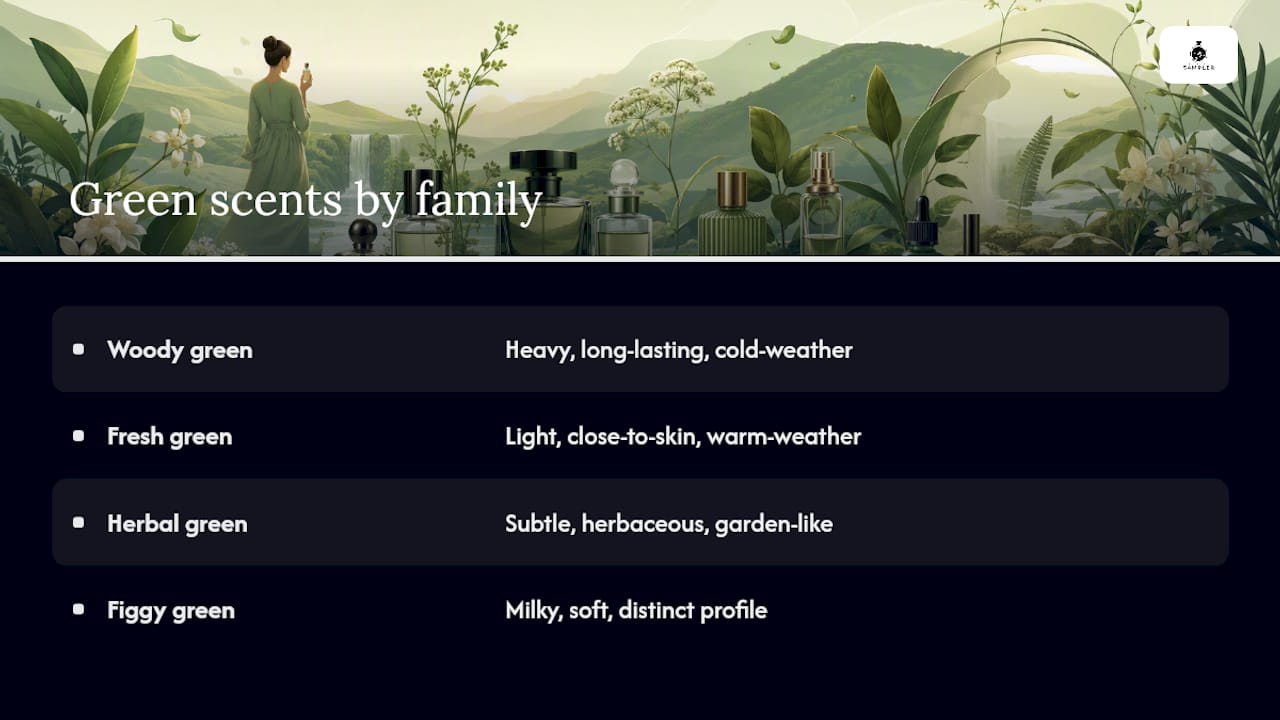
Not all green scents behave the same way, and the differences come down to what sits underneath the green top notes. Woody green fragrances pair galbanum or vetiver with cedar, sandalwood, or oakmoss bases, giving them more weight and better cold-weather performance. These tend to last longest and project the most, making them the natural choice for autumn and winter wear.
Fresh green scents lean on citrus, green apple, or crisp aquatic facets alongside their green notes, staying lighter and closer to skin throughout the wear. Parfums de Marly Greenley sits firmly in this camp, built for warm weather and daytime wear rather than evening depth.
Herbal green compositions favour basil, thyme, or green tea, reading closer to a kitchen garden than a forest. They’re generally the most subtle of the three families and suit readers who find both woody and fresh greens too assertive.
Figgy green scents like Philosykos don’t fit neatly into any of the three, since fig leaf carries a milky softness that woody, fresh, and herbal greens all lack. Knowing which family a scent belongs to before you sample it saves time. If woody greens already feel too heavy on your skin, there’s little point testing another vetiver-based fragrance expecting a different result.
How to layer green perfumes with other scents
Green fragrances layer more easily than most people assume, largely because their top notes are sharp enough to cut through other accords without disappearing, much like the calming effect of an Amber Jar Wood Wick Candle enhances a relaxing atmosphere. A fig-based green like Philosykos layers well with a light woody or musky base scent, since the fig softens and the wood adds depth that fig alone doesn’t provide.
Galbanum-heavy greens work best layered with something warmer underneath, an amber or soft vanilla base can round off the sharpness without smothering it. Avoid layering two galbanum-forward scents together; the result tends to fight rather than blend.
Herbal greens like basil or green tea pair naturally with citrus, since both sit in the same fresh register and reinforce rather than compete. If you want a green scent to feel more personal or less generic, try applying it to one pulse point and a complementary scent, a vanilla, musk, or soft woody fragrance, to another. That gives your skin two accords to blend naturally over the course of the day, rather than one flat, single-note result. Start with small amounts of each; layering is easy to overdo, and green notes in particular can turn muddy if you apply too much of either scent.
Curator’s perspective: how collectors actually wear green
Green has quietly become one of the more adaptable families in a collector’s rotation, not because it’s trendy, but because it flexes across seasons better than florals or heavy orientals. The shift toward matcha, pistachio, and pear accords hasn’t replaced galbanum and fig; it’s simply widened what “green” can mean.
My honest read is that most collectors under-use green in cooler months, assuming it’s strictly a spring scent. A vetiver-based green earns its place in October just as easily as June. Rotate a fresh green for daytime and a mossy or woody green for evening, and the family starts to feel far less one-dimensional than the shelf displays suggest.
— Rupesh
Build a sample set with Theperfumesampler
You don’t need to gamble £150 on a full bottle to find out whether galbanum suits you or fig leaf feels more like home. Theperfumesampler exists precisely for readers who want to test green fragrances properly, in real sizes, on real skin, before spending on a bottle they might regret. Sample sizes run from 2ml decants for a quick first impression up to 10ml for an extended trial across several weeks.

Building a green fragrance shortlist is straightforward:
- Pick three or four contrasting greens from the list above, mixing figgy, sharp, and gourmand-green styles.
- Order them as decants rather than committing to full bottles.
- Read why decants make sense if you want the full reasoning behind sampling before buying.
- Test each one across the two to three hour mark before deciding which, if any, deserves a full bottle.
Once you’ve narrowed your shortlist down, Theperfumesampler also stocks full bottles of designer fragrances for when you’re ready to commit. Start with the samples, and let your skin make the final call.
Sources
- The Best “Green” Fragrances Are a Walk in the Park | GQ
- These 8 green perfumes make for the ultimate fresh, crunchy and uplifting scents | Marie Claire UK
- From matcha to pistachio and pear: the 15 best green scents | Who What Wear